By Abdul Rehman, WeProms Digital · Last updated: September 2026
TL;DR: Star ratings beside products on Google are not invented by Google. They are review data a store submits through the Product Ratings program in Google Merchant Center, refreshed at least monthly. Entry typically needs about 50 reviews across the catalog. The programs themselves are free; the real work is collecting genuine reviews in a cash-on-delivery market.
What are the star ratings next to products on Google Search?
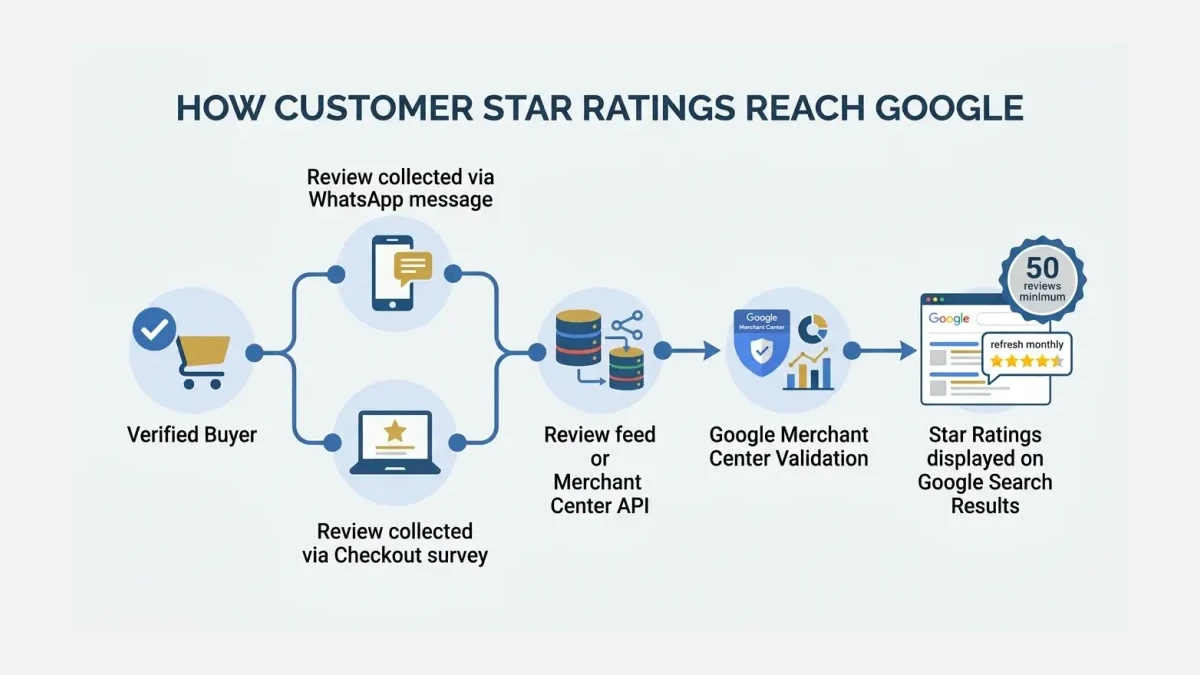
Those stars are product ratings — average review scores that Google displays when a store sends it verified review data through the Product Ratings program. Google does not calculate them independently. A product with no submitted reviews simply shows no stars, whatever its quality or price.
The ratings appear on shopping results, on product cards in ordinary Search results, and increasingly inside AI shopping answers, which means a buyer in Karachi sees them before your website even loads. The plumbing behind them is Google Merchant Center — the dashboard where a store registers its domain, uploads its catalog, and manages how its products appear across Google surfaces. Product ratings are separate from the stars on your Google Maps listing; business reviews follow a different collection process for Pakistani shops.
Picture this: a buyer in Faisalabad finds your embroidered kurta on Google, sees no stars under it, and quietly orders from the listing next door that has 4.6. Buying online in Pakistan still works the way mangoes sell at Sunday bazaar — the buyer asks the previous customer whether the box was sweet. Star ratings are that stranger’s answer, printed on the search result.
Google does not invent star ratings; it only displays the review data a store sends it. Which means missing stars are usually a plumbing problem, not a popularity problem — and plumbing can be fixed.
Why do competitors’ products show stars while yours show none?
Three gates stand between a Pakistani store and visible stars: enrollment in the Product Ratings program, matching product identifiers, and a review feed Google accepts. Fail any one gate and the product renders without stars, even when the store itself ranks fine.
Enrollment happens through one of three routes: Google Customer Reviews — Google’s own free survey program, offered to buyers at your checkout; an approved third-party review aggregator feeding Google on your behalf; or your own review feed submitted directly. Google’s product reviews submission page lists accepted aggregator partners such as Emplifi, Kudobuzz, and Okendo, with a caution that availability varies by country. Identifiers matter next: each product’s GTIN — the global trade item number printed in the product barcode — or its brand plus MPN must match between your feed and your review data, per Google’s eligibility rules.
The submission route got easier in September 2026. Google’s Merchant Center documentation changed to allow product reviews through the API, where previously the API was explicitly unsupported:
Google changed the wording from “API isn’t currently supported for product reviews data sources” to “Add product reviews using API.” — Search Engine Roundtable, September 18, 2026
Larger Pakistani catalogs can now sync review data programmatically instead of exporting spreadsheets, which used to be the only option. Search Engine Roundtable’s September 18 recap documents the change.
| Route to Google | Typical cost | Effort | Best for |
|---|---|---|---|
| Google Customer Reviews | Free | Low — add the opt-in badge to your checkout | Shopify and WooCommerce stores with their own checkout |
| Approved aggregator (Emplifi, Kudobuzz, Okendo) | Subscription, roughly PKR 3,000-15,000/month | Medium — connect once, feed flows | Stores that want reviews collected on-site automatically |
| Own feed or Merchant Center API | Free, plus developer time | High — build and maintain the feed | Large catalogs and agencies managing many stores |
How many reviews does a store need before Google shows stars?
Book a free strategy call - we'll audit your current setup and identify the highest-impact fixes.
Google asks for at least 50 reviews across the catalog to enter the Product Ratings program, according to its program basics page, with a complete review feed refreshed at least monthly. Crossing 50 does not guarantee stars on every product — Google also checks data quality and identifier matching before displaying ratings on individual listings.
The number sounds high until you spread it across a catalog. A store with forty products needs barely one review per product on average to clear the gate. Start with the ten products that already sell every day; fifty reviews concentrated on them clears Google’s threshold faster than fifty scattered across a dead catalog.
One warning worth repeating: a product with zero submitted reviews shows nothing, even after the store qualifies. Program entry switches the feature on; individual products still need their own review counts to display stars. So the collection plan matters as much as the enrollment.
How does a cash-on-delivery store in Pakistan collect real reviews?
The workable pattern is to ask at the moment of delivery confirmation: a WhatsApp message two to three days after the parcel arrives, with a one-tap link to review the product on your site. COD — cash on delivery, the payment method most Pakistani buyers trust for a first purchase — shapes the whole problem.
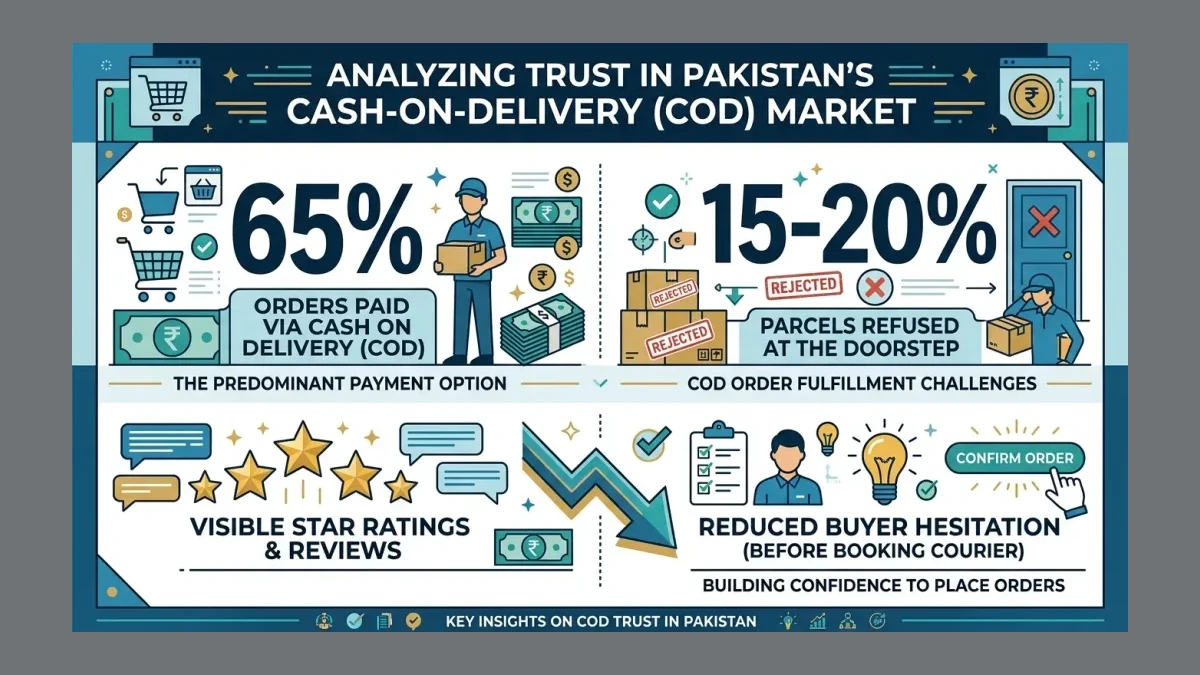
The numbers explain why ratings carry unusual weight here. Pakistan’s Ministry of Commerce, in its draft e-commerce policy 2.0, puts cash on delivery at 60-70% of all ecommerce orders. Doorstep refusals — the buyer simply declining the parcel — run 15-20% of COD shipments, and every refusal eats the courier cost both ways. The refusal decision is made on the results page, in the seconds between seeing the product and opening the website: stars answer the buyer’s “koi scam to nahi?” question before the courier is booked. The State Bank of Pakistan counted 93% of digitally settled transactions running through wallets or accounts in FY25 — but that count excludes COD entirely, so both pictures are true at once: wallets such as JazzCash and Easypaisa dominate digital checkout, while cash still carries most orders.
Google’s rules leave no room for shortcuts. Product Ratings policies require reviews you collected yourself and own, including the low-star ones, and reject syndicated or copied reviews. Google Customer Reviews offers a free, policy-safe route: an opt-in survey at checkout that Google emails to the buyer after delivery. WhatsApp follow-ups work too, provided the review lands on your own site through a form tied to the order.
Execution details decide the response rate. Send the ask two to three days after delivery, when the product has been used once and the courier experience is still fresh; a message sent the day of delivery gets goodwill, while a message sent three weeks later gets silence. Ask about one product per message rather than the whole order, link straight to that product’s review form, and keep the form itself to a star selection plus one optional line — every extra field cuts completion. A store shipping sixty parcels a week that converts even one in five buyers into a reviewer crosses the fifty-review gate within its first month.
Here is a claim worth testing against your own numbers: ten genuine reviews on each best-seller will recover more refused COD parcels than a PKR 100,000 storefront redesign, because the refusal decision happens on Google’s results page, before your redesigned site ever loads.
Can Daraz ratings or Instagram comments be moved onto Google?
No. Google accepts only reviews a store collected itself and owns; ratings copied from other platforms are rejected under the same policies. Daraz reviews belong to Daraz’s platform, and an Instagram comment is not a verified purchase, so neither can be imported.
That matters for sellers diversifying off the marketplace — the hidden cost of selling only on Daraz includes the fact that five years of marketplace ratings build no review asset of your own. The earlier collection starts on your own domain, the earlier the asset starts accruing to you. Reviews gathered from WhatsApp order threads count when they are submitted through a proper on-site form connected to the order; screenshots pasted onto a testimonials page do not.
Before subscribing to any aggregator, check Google’s current accepted-partners list for Pakistan availability. The list changes, and paying for a platform whose country coverage does not include your market is a common avoidable mistake.
What does it cost, and how long until stars appear?
How we helped a Pakistani business achieve measurable results.
The Google programs are free. A Pakistani store pays for collection and plumbing: an aggregator subscription of roughly PKR 3,000 to PKR 15,000 per month, or a one-time setup of PKR 40,000 to PKR 150,000 when an agency builds the review collection flows, the feed, and the identifier cleanup. Stars typically appear a few weeks to a couple of months after the feed validates — submission, processing, and the first monthly refresh are sequential, not instant.
The timeline shortens when the catalog is clean before submission. Product titles, PKR prices, availability, and GTINs that already match the site speed up validation, which is why feed hygiene comes first in almost every Merchant Center engagement. The math that justifies the spend is simple: at an average COD parcel value of PKR 3,000, a subscription that prevents even two refusals a week has paid for itself several times over by month end.
Monitoring is a monthly habit, not a one-time setup. Each time the review feed refreshes, Merchant Center’s diagnostics report how many reviews were accepted, how many were rejected, and why — the usual reasons are missing order references, mismatched identifiers, and duplicates from double submission. A store that reads that report every month keeps its stars; a store that submits once and never looks again usually finds the ratings quietly disappeared after a feed error, the same way Pakistani businesses lose Google reviews they assumed were permanent.
None of this competes with getting listed in the first place — if your products are not on Google surfaces at all, start with getting products onto Google before the seasonal rush. Ratings compound on top of listings; they do not replace them.
Read next: Why your products are not showing on Google at all and how free Google product listings work for Pakistani stores.
WeProms Digital, Pakistan’s leading Google Merchant Center management agency, sets up Product Ratings end to end for Pakistani stores — review collection flows for COD buyers, identifier cleanup, feed validation, and the monthly refresh. Email hello@weproms.com, message WhatsApp +92 300 0133399, or visit weproms.com/contact-us to have your catalog checked for the three gates in one audit.
Sources & References
- Google Merchant Center Help — Product Ratings Basics — accessed September 2026
- Google Merchant Center Help — Product Ratings Eligibility — accessed September 2026
- Google Merchant Center Help — Submit Product Reviews Data — accessed September 2026
- Google Merchant Center Help — Product Ratings Policies — accessed September 2026
- Google Merchant Center Help — Google Customer Reviews FAQs — accessed September 2026
- Search Engine Roundtable — Daily Search Forum Recap: September 18, 2026 — September 18, 2026
- Markaz — State of E-commerce in Pakistan 2026 — June 2026
- iCargos — Pakistan Courier & Logistics Market Report 2026 — March 2026
Additional reading from industry feeds: