By Sara Khan · September 13, 2026 · 9 min read
TL;DR: A structured product feed now decides where products appear — on Google’s shopping surfaces and inside AI shopping answers alike. Profound data tracked feed-driven recommendations in ChatGPT Shopping jumping from 8.26 percent to 61.54 percent within weeks. The feed itself costs nothing to build; getting it right is the work.
Is it really free to list products on Google from Pakistan?
Creating the account costs nothing; the catch is availability. A Merchant Center account — Google’s catalog system that stores your product data and supplies Google’s shopping surfaces — is free to open, and Google’s own conversion documentation refers to “your ads and free product listings” as two parallel surfaces fed by the same system. What changes month to month is which listings appear in which country: Google added Shopping ads and free listings across 14 new countries in July 2026, and Pakistan was not on that list.
The honest position for a Pakistani store, therefore, is twofold. First, check Google’s country documentation before promising yourself Shopping-tab traffic, because surface availability varies by country and format. Second, build the feed anyway — the same structured product data increasingly decides visibility in AI shopping tools, which is where the clearest payoff now sits. A store that waits for official availability announcements will start six months behind the store that already has a clean catalog.
What is a product feed, and why does one file decide everything?
A product feed — a structured file, usually a spreadsheet, listing every product with its title, price, availability, image link, and identifiers — is the single source that Google, comparison engines, and AI shopping tools read to decide what to show. Think of the menu card a restaurant hands to Foodpanda: same dish, same price, same photo, every time. When the card is wrong, the order is wrong; when the feed is wrong, the listing shows a stale price or vanishes.
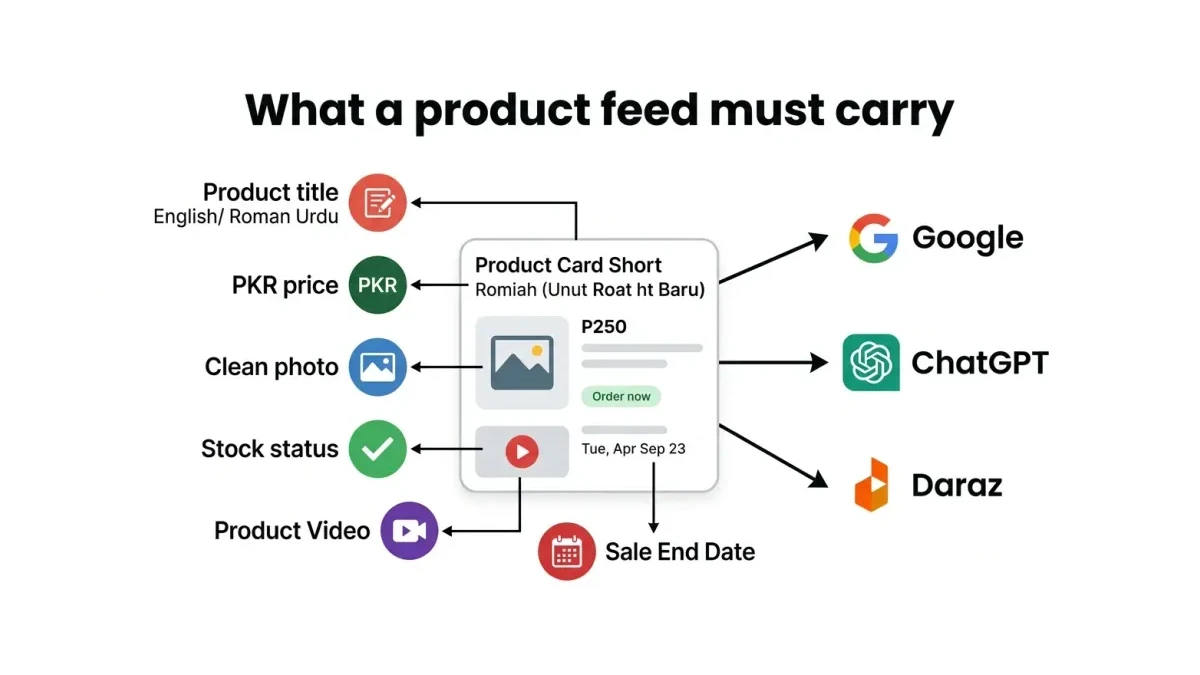
Each column in that file carries weight. The price column must carry PKR with the correct currency attribute, because a mismatch between the feed and the product page triggers a disapproval. The availability column must reflect reality, because in a cash-on-delivery market an out-of-stock listing converts into a wasted delivery run, a return, and an argument at the door. The image column must point to a photo that loads, since a broken image link renders the product invisible no matter how good the title is.
What does a product need before Google will show it with a price and photo?
Book a free strategy call - we'll audit your current setup and identify the highest-impact fixes.
Three basics decide it: a clean photo, a correct PKR price with matching currency attributes, and a title written the way buyers actually search. Products missing any of the three render as plain links, or get disapproved silently, which is why so many Pakistani store owners believe Google simply ignores them. That belief has a visibility cousin: products not showing on Google in Pakistan usually traces back to the same thin catalog data.
Titles deserve the most attention in Pakistan, because searching habits mix English and Roman Urdu — “winter jacket for boys warm” competes with “larke ke liye warm jacket” — and the feed should carry the phrasing real customers type. Images should show the product on a plain background at a reasonable resolution; identifiers such as brand and GTIN, where they exist, strengthen the listing further. Video has now joined the checklist: Merchant Center began accepting product videos in September 2026, which means a clip already shot for TikTok or Reels can become a feed attribute rather than just ad creative. The practical instruction is a once-over of every product against this list, then a weekly pass for anything new.
Do sale countdowns and product videos matter for a small store?
Both matter, because urgency attributes are moving into the feed itself. Google is testing an “X days left” label on sponsored Shopping results; a screenshot showed “5 days left” on a sale listing, and Search Engine Roundtable confirmed the test on September 11.
Google described the countdown label as a “very early experiment” and confirmed it without sharing further details.
Experiments mature, and the sellers who benefit first are the ones whose data is already complete when a feature goes live. Pakistan’s sale calendar makes this concrete: 11.11, the Ramadan and Eid sales, and the August independence offers all have hard end dates, so setting sale start and end attributes in the feed now means countdown-style urgency renders correctly later without a scramble. The same logic applies to the product videos above — a store that repurposes its existing clips today owns the richer listing tomorrow.
Will the same feed also show products inside ChatGPT?
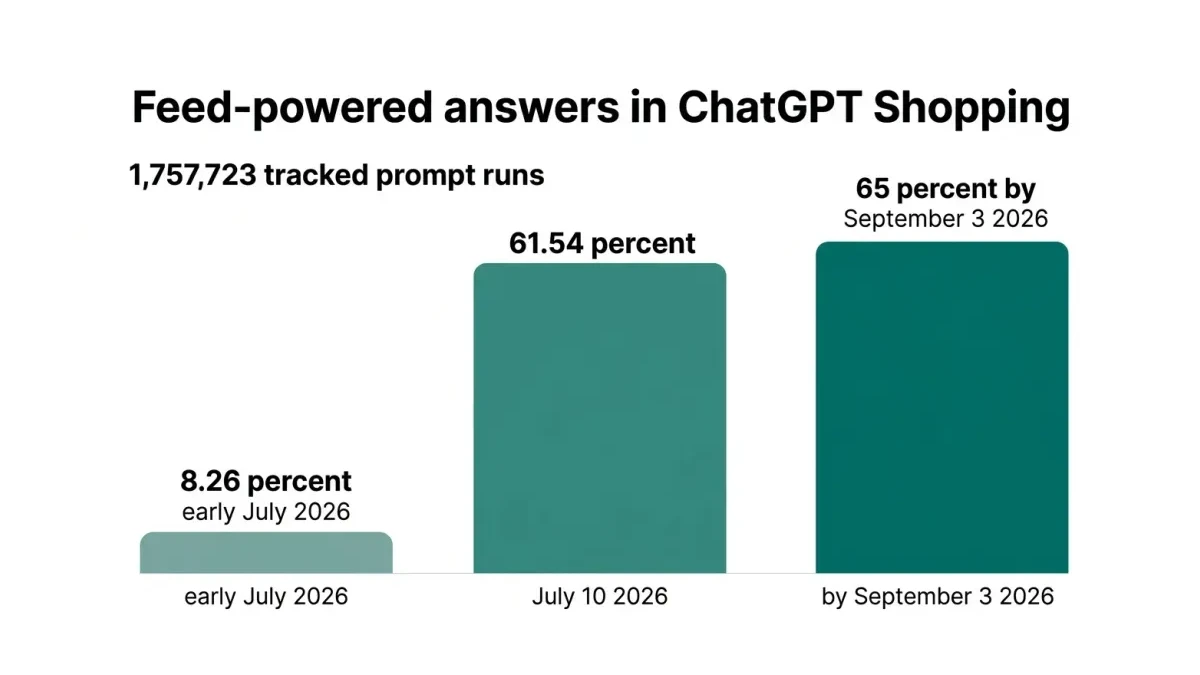
Increasingly, yes; the shift has been fast and measurable. Search Engine Journal reports that ChatGPT Shopping now leans heavily on product feeds, and its SEO Pulse coverage cites Profound data showing feed-integrated product recommendations rising from 8.26 percent to 61.54 percent of tracked answers, drawn from 1,757,723 prompt runs, and sitting near 65 percent by early September 2026. In plain terms: within roughly two months, most product recommendations ChatGPT serves come from structured feeds rather than open web crawling.
The advertising layer is following the same path. On September 10, Amazon began selling ChatGPT ad inventory through its DSP for select US advertisers, with Marketing Dive noting the inventory sells on cost-per-click and cost-per-thousand-impression bases under sponsored labels. None of that is directly usable from Pakistan today — and that is precisely the point. The pattern repeats with every new shopping surface: structured product data gets read, and everything else gets skipped. The feed, not the ad account, is the asset a Pakistani store should own first.
How much does the Daraz-first seller actually gain from all this?
How we helped a Pakistani business achieve measurable results.
Two assets: a storefront that charges no commission, and insurance against marketplace rule changes. Daraz brings ready-made buyers and takes commission plus campaign fees in exchange; a clean feed brings those same buyers when they search Google or ask an AI assistant, with the store owning the customer relationship and contact details. The comparison looks like this:
| Daraz only | Daraz plus free feed surfaces | Paid Shopping ads | |
|---|---|---|---|
| Platform cost | Commission and campaign fees | No platform fee; labor only | Pay per click |
| Customer data | Marketplace owns it | Store owns it | Store owns it |
| Where products show | Daraz app and site | Google surfaces and AI shopping tools, where available | Shopping ad slots, where available |
| Setup effort | Listing per product | One structured feed, kept current | Feed plus ad account |
| Pakistan availability today | Full | Partial, expanding | Limited |
The claim worth testing against any vendor: for a Pakistani store doing modest online revenue, cleaning one product feed returns more within 90 days than PKR 100,000 of test ad spend, because the feed decides visibility on Google, ChatGPT, and Amazon-run surfaces simultaneously while the ad budget touches only one. Platform choice shapes how much of this a store can act on, which is why the Daraz versus Shopify decision for Pakistani stores precedes feed work in most plans. Feed work is also the 30-day-hireable version of ecommerce marketing — WeProms Digital’s shopping and product feed management service exists for exactly this job, alongside its Google Merchant Center management offering for stores that want the catalog run properly from day one.
Where do honest stores lose money on free listings?
Stale stock and price mismatches, in that order. Wrong availability converts into delivery runs and refunds in a cash-on-delivery market; wrong PKR prices convert into disapprovals, lost ranking, and customers who arrive angry about a figure that changed. An expired sale end date left in the feed after Eid quietly tells every surface the offer is dead, and duplicate identifiers split one product’s history into competing entries that confuse both Google and AI tools.
The discipline that prevents all four is small and boring: one named person reviews the feed once a week, prices are checked against the store’s own pages, and every sale gets its end date removed the morning after it closes. Any agency considered for this work should be asked directly what it checks weekly — a feed vendor without a weekly rhythm is billing for setup that decays. WeProms Digital operates exactly this weekly catalog review for Pakistani stores, which means the feed stays true whether the next surface to read it is Google, ChatGPT, or something neither of us has met yet.
Read next: Why Pakistani stores need Merchant Center setup in the AI search era and Pakistani stores are invisible in ChatGPT Shopping — and how to fix that.
Free listings reward the best-prepared catalog, not the biggest spender — an unusual advantage for Pakistani sellers used to auction prices deciding everything. At WeProms Digital, we build and maintain product feeds for Daraz-first and Shopify-first stores alike, with fixed scopes and weekly checks. Email hello@weproms.com, message WhatsApp +92 300 0133399, or visit weproms.com/contact-us.
Sources & References
- Google Ads Help — Conversion tracking definition (ads and free product listings) — official documentation, accessed September 2026
- Google Merchant Center Help — Show your products for free on Google (supported countries) — official documentation, accessed September 2026
- Search Engine Roundtable — Google Shopping Ads X Days Left Attribute Label (Barry Schwartz) — September 11, 2026
- Search Engine Roundtable — Recap: Google Merchant Center adds product videos — September 11, 2026
- Search Engine Journal — ChatGPT Shopping Results Lean Hard On Product Feeds — September 2026
- Search Engine Journal — SEO Pulse: feed-driven recommendations data — September 12, 2026
- Digiday — Amazon Ads brings advertisers to ChatGPT, extending its supply-chasing streak — September 10, 2026
- Marketing Dive — Amazon pilots ad services in ChatGPT — September 11, 2026
- PPC News Feed — Google expands Shopping ads to 14 new countries — July 2026
Additional reading from industry feeds: