By Abdul Rehman · Last updated August 3, 2026
Most Pakistani sellers do not need Shopify on day one. Start on Daraz to capture existing demand, graduate to Shopify when repeat customers and margins justify owning the storefront, and build custom only when off-the-shelf platforms block a specific workflow. The platform follows the stage, not the ambition.
Pakistan’s ecommerce market passed roughly USD 14 billion in 2025 and is projected to keep climbing at about 13 percent annually, which means more Pakistani sellers face the same platform question every quarter. The choice between Daraz, Shopify, and a custom build is not about which is best in the abstract; it is about which fits your stage of business, your margin model, and the payment rails your customers actually use.
“Pakistan’s e-commerce market is projected to reach USD 12 billion by 2027.” — Allied Bank / LinkedIn industry outlook, 2025
This Q&A works through each decision a Pakistani seller has to make.
Is Shopify actually available and practical for a Pakistani seller in 2026?
Yes, but with friction. Shopify works in Pakistan, accepts Pakistani businesses, and supports local payment gateways through third-party apps, but payouts, app billing, and some merchant features assume foreign banking rails. A Pakistani seller runs Shopify fine for the storefront and checkout; the workaround lives in how you wire payments and move money out.
The friction is real but manageable. Shopify bills in USD, so the PKR-to-USD spread and your bank’s forex margin eat into margin every month. Shopify’s Basic plan runs about USD 39 a month, roughly PKR 11,000 at current rates, before gateway and app costs. For a Pakistani brand doing steady volume, that is a reasonable cost of owning a storefront; for a solo seller doing five orders a week, it is overhead that eats the profit. The practical question is whether your order volume clears the platform’s monthly floor, and most Pakistani brands reach that floor only after they have already validated demand elsewhere.
Shopify — a hosted ecommerce platform that handles storefront, checkout, hosting, and security for a monthly fee — lets you launch fast and scale without managing servers. The trade-off is that you rent the infrastructure and pay gateway and app fees on top, and you live inside Shopify’s rules for checkout, themes, and data export.
When does Daraz make more sense than running your own store?
Daraz makes sense when you sell commodity or price-led products, have no existing customer base, and cannot yet drive your own traffic. The marketplace brings the buyers, handles payments and logistics, and absorbs the trust gap Pakistani shoppers still feel at unknown stores. The trade-off is margin, brand control, and data.
Picture two physical shops. Daraz is like renting a stall inside Empress Market, where the footfall is guaranteed but the landlord sets the rules, takes a cut of every sale, and decides where your stall sits. Shopify is like leasing your own shopfront on MM Alam Road, where you control the signage, the layout, and the customer relationship, but you have to bring your own crowd. Both can work; they serve different moments in a brand’s life. Daraz’s advantage is that it solves cold-start demand. A new Pakistani seller listing on Daraz gets eyeballs on day one that would take months to build on an independent store. The marketplace also handles the logistics network, the Daraz Express delivery fleet, and the cash-on-delivery reconciliation that still dominates Pakistani ecommerce by volume. Ecommerce Platforms’ coverage of marketplace versus storefront trade-offs frames the decision the same way: marketplaces trade margin for demand.
The cost of that demand is real. Daraz takes commission on each sale, controls how your brand appears, and keeps the customer data. A buyer who finds your product on Daraz is Daraz’s customer, not yours, which means you cannot email them, retarget them, or build a loyalty program around them — and customer retention is where Pakistani ecommerce margins actually compound. For a brand whose business model depends on repeat purchase and lifetime value, that is the limit of the marketplace model.
What about a custom WordPress or WooCommerce build?
Book a free strategy call - we'll audit your current setup and identify the highest-impact fixes.
A custom WooCommerce build makes sense when you need full control over checkout, catalog structure, or integrations that Shopify blocks, and you have a developer on retainer. It is cheaper in monthly software fees but more expensive in time, security upkeep, and hosting. Choose it for specific requirements, not for savings.
WooCommerce — the ecommerce plugin for WordPress that turns a WordPress site into a full online store, free to install but self-hosted — gives you ownership of every line of code and every customer record. The attraction for Pakistani sellers is full control and no per-sale commission to a platform. The cost is everything Shopify handles for you: hosting, SSL, security patches, plugin conflicts, and backups. A WooCommerce store on cheap shared hosting will crash during an Eid sale; the same store on managed hosting runs cleanly but costs more per month than Shopify Basic.
The market is moving toward hybrid setups for sellers who outgrow a single platform. WP Engine’s partnership with BigCommerce, reported in mid-2026, lets WordPress sites run BigCommerce checkout on the back end, which is a signal that even enterprise sellers want the content flexibility of WordPress without the checkout limitations of native WooCommerce. For most Pakistani sellers, that complexity is not justified until you hit a specific wall, and most never hit it.
How do payments work with JazzCash, Easypaisa, and cash on delivery?
Pakistani ecommerce runs on three rails: cash on delivery still dominates by volume, JazzCash and Easypaisa handle the digital wallet share, and card payments remain a small minority. Your platform choice dictates how cleanly each rail plugs into checkout. Daraz wires all three natively; Shopify and WooCommerce need gateway apps.
Cash on delivery is the default trust mechanism for Pakistani online shoppers, and removing it early in a brand’s life usually cuts conversion sharply. Easypaisa reports roughly 18 million monthly active users, which means a checkout that does not offer a mobile-wallet option is turning away a large slice of digital-ready buyers. The practical wiring differs by platform. Daraz handles its own wallet and COD reconciliation natively, which is one reason seasonal sellers tolerate the commission. Shopify in Pakistan typically connects JazzCash and Easypaisa through third-party gateway apps or an aggregator, which adds a per-transaction fee but unlocks wallet checkout. WooCommerce connects the same gateways through plugins, with more configuration freedom and more maintenance burden.
The pattern to watch is fraud and return cost. COD shifts the risk of refusal onto the seller, because a buyer can reject the parcel at the door and the seller eats the return logistics. Wallet and prepaid checkout reverse that risk. Brands that nudge buyers toward prepaid wallet payments with small discounts usually see return rates fall and margins improve, which means payment-rail strategy is a margin lever, not just a checkout feature.
What does each option actually cost per month?
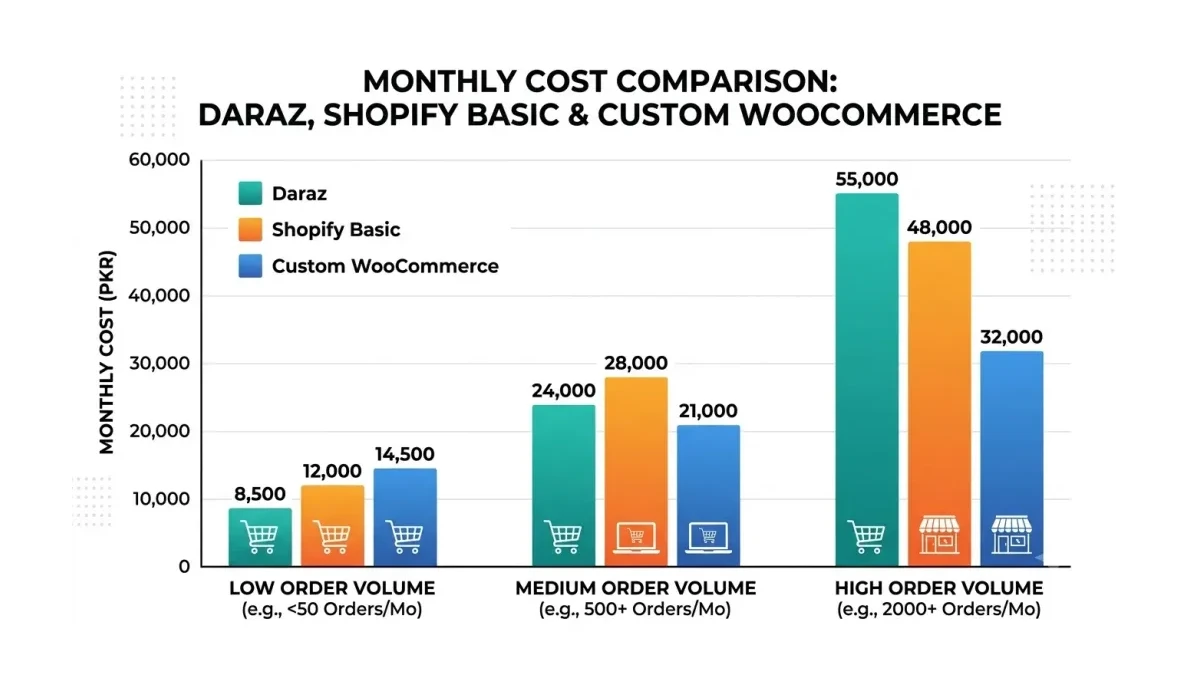
Daraz charges commission per sale with no monthly fee. Shopify Basic runs about USD 39 a month, roughly PKR 11,000, plus payment gateway and app costs. WooCommerce is free software but you pay for hosting, domain, SSL, and plugins, which usually lands between Shopify and a full custom build.
The honest cost comparison includes the hidden items most Pakistani sellers forget to budget. Shopify’s monthly fee is the floor, not the ceiling; themes, email tools, review apps, and gateway fees stack on top and can double the effective monthly cost for an active store. WooCommerce’s free core hides hosting, security, and developer time, which is the real expense. Daraz’s zero monthly fee hides commission, which on thin-margin categories can erase profit entirely. Here is how the three compare on the costs that actually decide the budget.
| Cost line | Daraz | Shopify Basic | Custom WooCommerce |
|---|---|---|---|
| Monthly platform fee | PKR 0 | ~PKR 11,000 (USD 39) | PKR 0 (software free) |
| Per-sale commission | Yes, category-based | 0% to Shopify (gateway fees apply) | 0% (gateway fees apply) |
| Hosting | Included | Included | PKR 3,000–15,000+/mo |
| Payment gateway fees | Built in | App + gateway fee | Plugin + gateway fee |
| Developer time | Rarely needed | Low | Ongoing retainer common |
| Customer data access | Limited | Full | Full |
Start here. If your monthly order volume is low and your margin per order is thin, Daraz’s zero-monthly-fee model usually wins even after commission, because you pay only when you sell. Once order volume and repeat-purchase behavior justify owning the customer relationship, Shopify’s fixed monthly cost becomes cheaper than the cumulative commission you would pay Daraz, and the customer data starts compounding into email and loyalty revenue.
Which platform survives Eid and sale-season traffic spikes?
How we helped a Pakistani business achieve measurable results.
Sale-season traffic in Pakistan spikes hard during Eid, the 11.11 sales, and Daraz’s recurring Friday campaigns. Shopify and WooCommerce on proper hosting absorb spikes well; under-provisioned shared hosting and cheap custom builds crash under load. Daraz absorbs its own spikes, which is one hidden advantage of the marketplace model for seasonal sellers.
A crashed checkout during an Eid campaign is the most expensive failure mode in Pakistani ecommerce, because the ad spend that drove the traffic still gets charged while the store converts nothing. Shopify’s hosted infrastructure handles traffic spikes by default, which is one reason brands running big seasonal campaigns tolerate the monthly fee. WooCommerce’s spike tolerance is entirely a function of the hosting you pay for; a PKR 3,000 shared plan will fold under a viral Reel, while managed WooCommerce hosting stays up. The brands that lose money during sale season are usually the ones who under-provisioned hosting to save on monthly cost, then paid for it in lost orders during the one week that mattered most.
The operational lesson is to test before the spike, not during it. Load-test the checkout, pre-warm the cache, and confirm the gateway can clear the expected transaction volume. Daraz sellers do not face this problem because the marketplace absorbs it, which is a real strategic advantage for seasonal-only sellers who do not want to operate infrastructure.
How do I choose if I am a solo seller versus a growing brand?
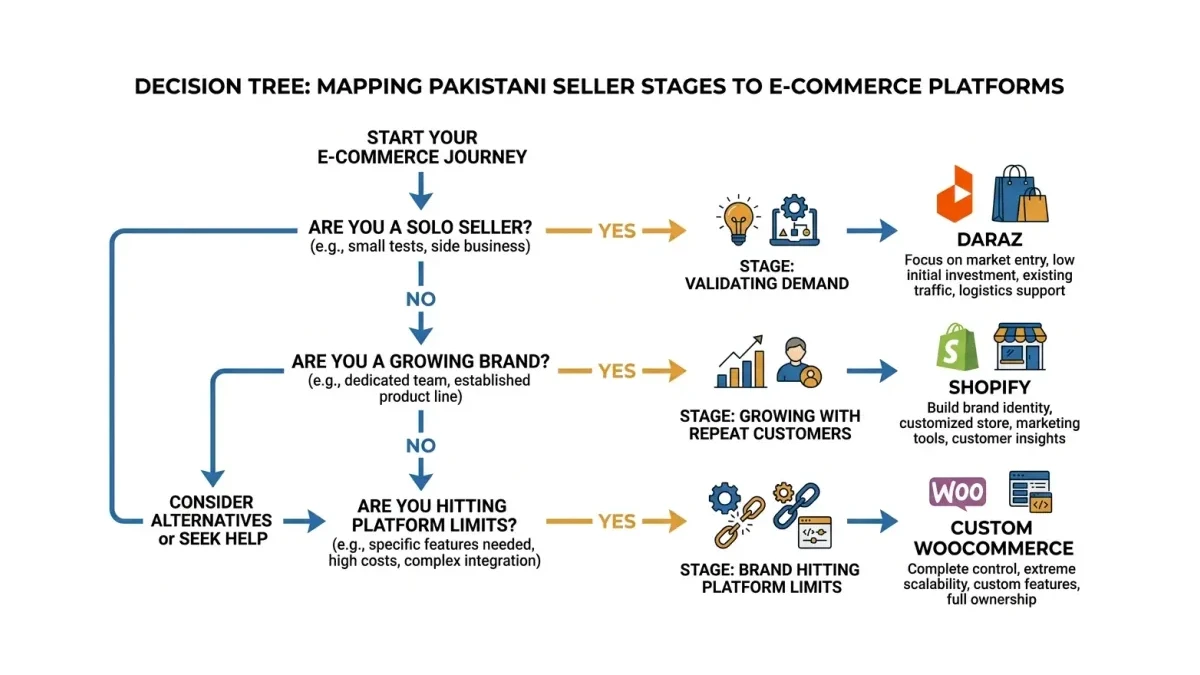
A solo seller testing demand should start on Daraz to validate products with no upfront software cost. A growing brand with repeat customers, a defined margin model, and a need for email, loyalty, and analytics should move to Shopify. Custom builds belong to brands hitting limits the platforms impose, not to beginners.
The decision criterion is straightforward. If you cannot yet answer who your customer is and whether they come back, you are still validating, and Daraz is the cheapest place to validate. The moment you can name your repeat-purchase rate and your margin per order, the customer data becomes worth owning, and Shopify’s fixed monthly fee starts to undercut marketplace commission. AI store builders like DropMagic, reviewed by Ecommerce Platforms in mid-2026, lower the technical barrier further by generating a Shopify storefront from a prompt, which shortens the leap from marketplace to owned store for non-technical Pakistani merchants.
Choosing a platform is choosing where to set up shop in Pakistan, and the right answer changes as the business grows. The sellers who get stuck are the ones who treat the platform choice as permanent. It is not. The healthiest Pakistani ecommerce operations run Daraz for discovery, Shopify for brand and repeat revenue, and custom builds only where a platform genuinely blocks them. Start where the demand is, own the storefront when the customer is worth owning, and rebuild only when the tools run out.
At WeProms Digital, we help Pakistani sellers make this exact call. We run Shopify and WooCommerce Development, Ecommerce Website Development, and Ecommerce Marketing for brands across Karachi, Lahore, and Islamabad. We start with a platform-fit audit, map your stage of business to the right stack, and wire JazzCash, Easypaisa, and COD into a checkout that converts. If you are choosing between Daraz, Shopify, and a custom build, talk to the team here or message WhatsApp +92 300 0133399.
Read next: Ecommerce marketing in Pakistan: Daraz vs Shopify and The Shopify Pakistan stores success guide.
Sources & References
- Shopify — Pricing plans — 2026
- Ecommerce Platforms — DropMagic AI store builder review — July 2026
- Ecommerce Platforms — Shopify vs Tiendanube comparison — July 2026
- Search Engine Journal — WP Engine partners with BigCommerce — July 2026
- DataReportal — Digital 2024: Pakistan — 2024
- Research and Markets / Yahoo Finance — Pakistan B2C Ecommerce Report 2025 — 2025
- Allied Bank / LinkedIn — Pakistan ecommerce projected USD 12 billion by 2027 — 2025
- Retail Dive — Kohl’s AI shopping assistant debut — July 2026
Additional reading from industry feeds: