By Abdul Rehman · September 22, 2026 · Last updated September 2026
Most COD refusals are not price objections; they are silence objections. A buyer who hears nothing for three days refuses the parcel at the door. Three automated messages — confirmation, dispatch, out-for-delivery — hold the order for less than the courier’s return leg costs. Last updated: September 2026.
If you run an online store in Faisalabad shipping 250 parcels a week through Leopards or TCS, and one in five comes back refused, the courier is not your biggest problem — your order flow is. Cash on delivery still settles an estimated 60 to 70 percent of Pakistani ecommerce orders, according to Markaz’s State of Ecommerce Pakistan 2026 roundup, which means most of your buyers pre-pay nothing. Every parcel lands at a door where cancelling is free, and whether it converts depends almost entirely on what the buyer heard from you between checkout and delivery.
This walkthrough fixes that gap step by step. Each step builds on the one before it, and by the end your store sends the small set of messages that turn anonymous COD parcels into expected deliveries.
First, price what each refusal actually costs
COD refusal — a customer rejecting the parcel at the door instead of paying for it — shows up in courier reports as RTO, return to origin. Logistics guidance from Pakistani courier-side operators commonly estimates RTO at 18 to 20 percent of COD parcels, though Markaz’s COD return analysis is honest about the data: no audited national figure exists, so your own weekly number is the one that matters.
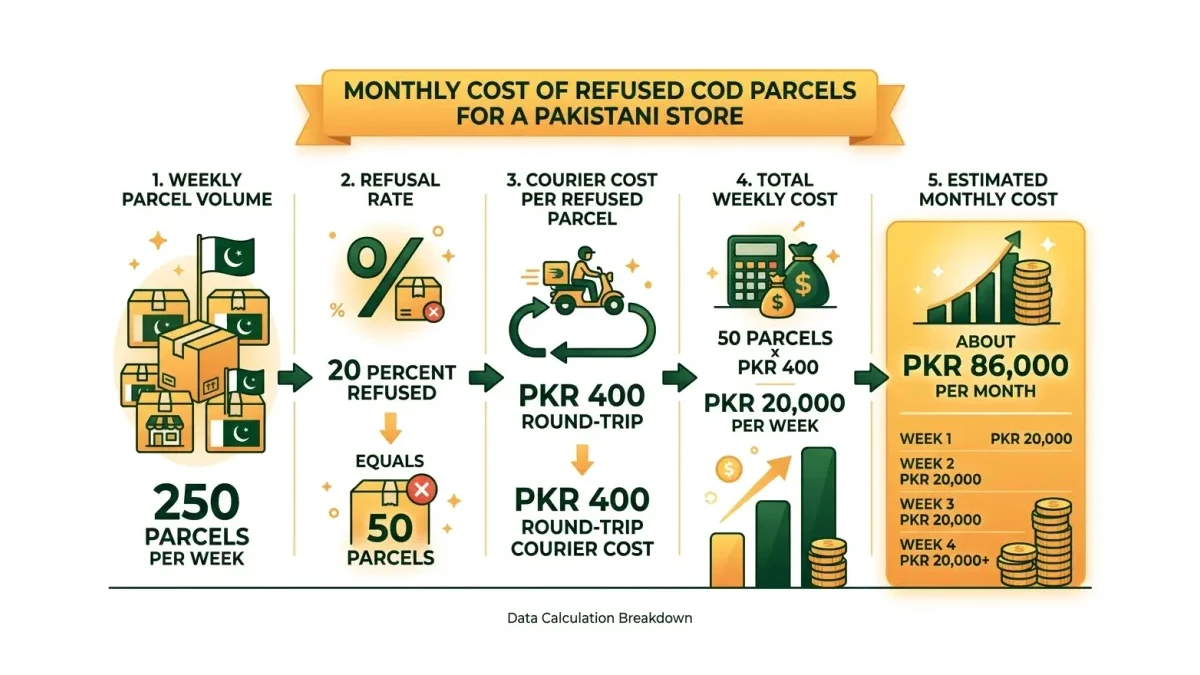
Picture this arithmetic on a 250-parcel week. At a 20 percent refusal rate, 50 parcels come back. A refused parcel costs the two-way courier charge plus repacking and days of dead stock; assume PKR 400 as a conservative round-trip figure. Fifty refusals at PKR 400 is PKR 20,000 burned in one week, which is roughly PKR 86,000 a month — before counting the PKR 150,000 or more of revenue those 200 monthly parcels would have carried. The scale of the leak matters more than the precision: a mid-size store is financing a full-time salary worth of refusals.
Start here, with a spreadsheet: refused parcels per week, courier cost per refusal, and the revenue value of refused orders. One week of data converts “customers are unreliable” into a number you can manage down.
Then, find where the silence begins
Refusal psychology is time psychology. A COD buyer who ordered on Monday and hears nothing until Thursday has spent three days second-guessing: is the site real, is the price still fair, did I actually need this? Because the buyer paid nothing upfront, refusing costs them nothing either — and the longer the silence, the more rational refusing becomes.
The comparison shoppers actually make is with Foodpanda. Ordering food with no rider tracking feels broken; the map moves, an ETA appears, and cancelling quietly loses its appeal. Ordering from a store that sends one automated “order placed” screen and then nothing for 72 hours feels like shouting into a void, which means most people do what they do with any silent commitment — they walk away from it at the door.
Global data quantifies the expectation gap. A Sinch survey of 2,800 consumers, cited in Retail Dive’s Black Friday readiness report, found that 75 percent of shoppers expect an order confirmation within five minutes of buying, and 47 percent want one almost instantly. Large US retailers now stress-test their notification systems before peak season the way airlines test engines; Pakistani stores mostly have no notification system to test.
The falsifiable version of this argument: a three-message order flow cuts refusals more than a 10 percent discount would, because silence — not price — causes most COD refusals. Discounts shrink margin on every order; messages cost almost nothing per order and hold the full price.
Next, send the three messages that hold the order
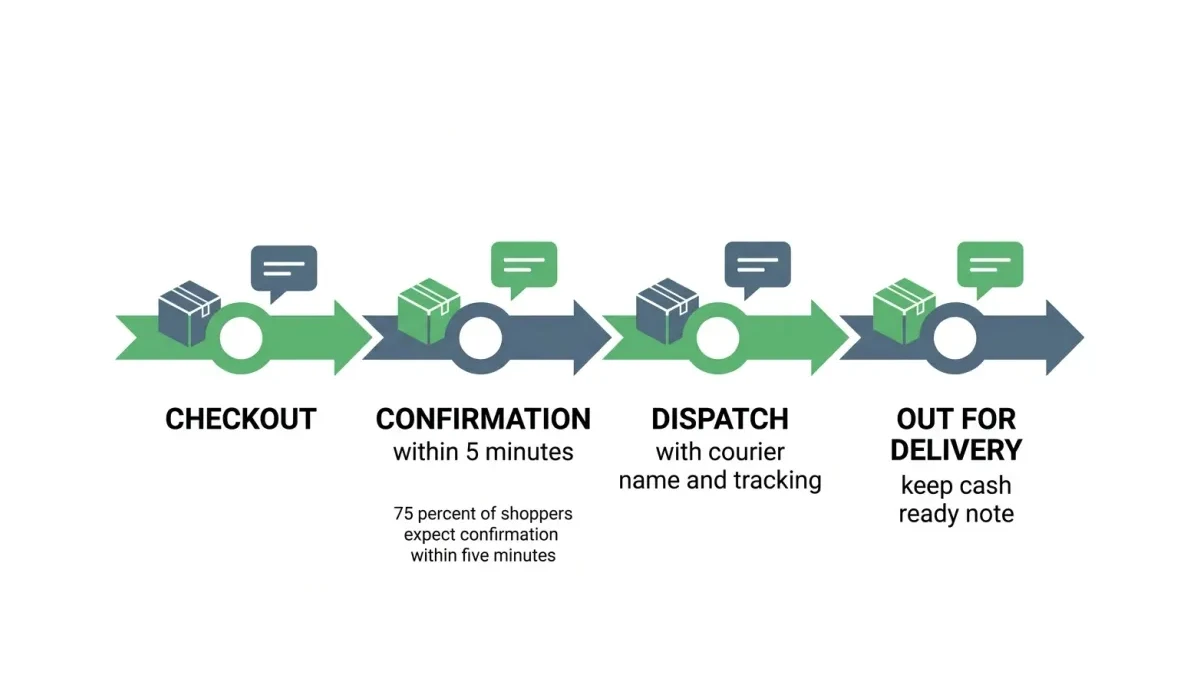
Three messages cover the entire delivery window, and each one answers the exact question the buyer is asking at that moment.
Message one — confirmation, within minutes of checkout. Order number, item, final amount including delivery, and the expected delivery window. This is the message 75 percent of shoppers expect within five minutes; a store that sends it instantly reads as an organized business, and a store that sends nothing reads as a risk.
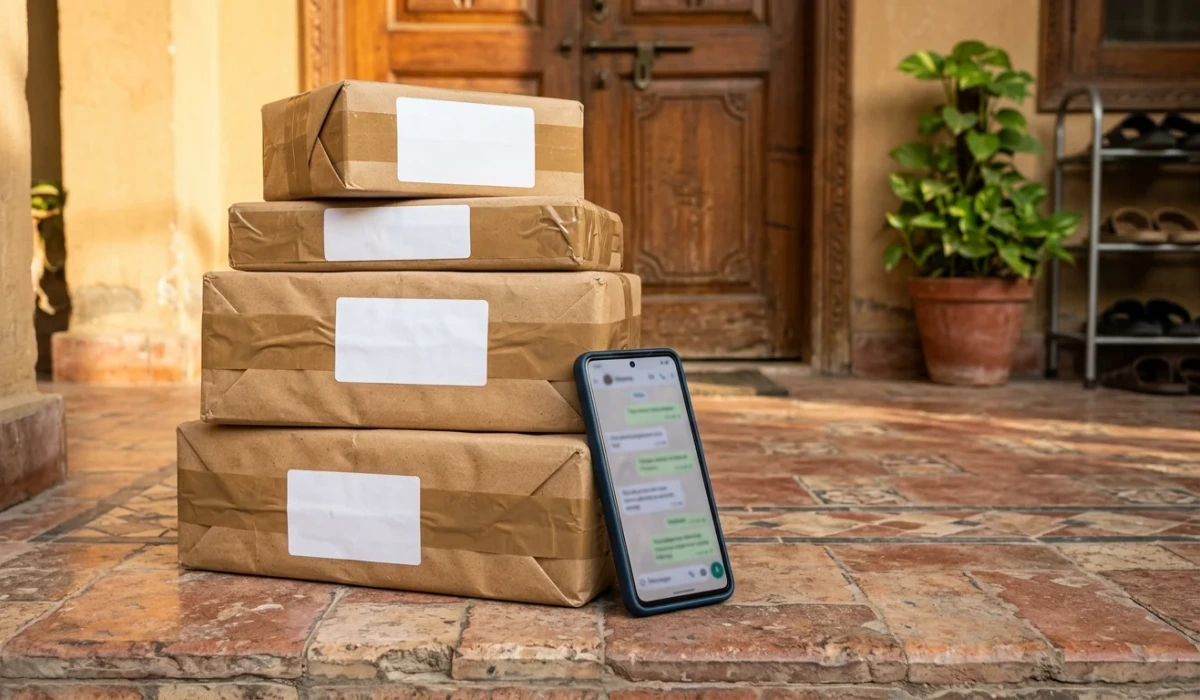
Message two — dispatch, the moment the courier collects. Courier name, tracking number, and a plain-language ETA: “Your parcel left our Lahore warehouse with Leopards today and should reach you in 2 to 3 working days.” Naming the courier transfers trust — Leopards, TCS, PostEx, and Trax are brands buyers already recognize from other stores.
Message three — out for delivery, the morning of. “Your parcel arrives today. Please keep PKR 2,450 ready, or reply to reschedule.” This single message kills the two most common refusal scenes: the buyer who has no cash at home, and the buyer who forgot the order entirely. A reschedule option converts a refusal into a delayed acceptance instead of a returned parcel.
WhatsApp is the delivery channel that gets read in Pakistan, with email as the permanent record. Both matter; neither costs more than pocket change per order at automation volumes.
After that, automate the triggers your store already generates
Sending three messages per order by hand does not survive a 250-parcel week, which is where automation enters. Your store platform already fires the events — order placed, order fulfilled, tracking added — on Shopify and WooCommerce alike; the job is connecting those events to messages.
Lifecycle flows, the automated message sequences triggered by a customer’s actions rather than a marketer’s calendar, do this work. Klaviyo’s documentation reports that post-purchase messaging earns a 217 percent higher open rate than average campaigns, with more than five times the click rate and 90 percent higher revenue per recipient — buyers read order messages because order messages are about their money. For Pakistani stores comparing tools, our Brevo versus Klaviyo versus MailerLite comparison breaks down costs in PKR; WhatsApp Business handles the chat side through template messages approved in advance.
The setup sequence is: connect the store platform, map the three trigger events, write the three message templates in the buyer’s language mix — English structure with Roman Urdu comfort words like “aap ka parcel” lands better than either pure register — and test with a real order before launch. An evening of configuration replaces a daily ritual of manual confirmations, and no buyer waits for a staff member to notice the order.
Once the flow runs, watch two numbers
Automation without measurement drifts. Two numbers tell you whether the flow is working.
First, the weekly refusal rate from step one: refused parcels divided by parcels shipped. A three-message flow typically bends this curve within two to four weeks, because the parcels now arrive expected. If the number does not move, the messages are not arriving — check WhatsApp template approvals and email deliverability before blaming the customers.
Second, the 90-day repeat-order rate. Order updates are the only marketing message almost every buyer reads, which makes them your cheapest retention channel; buyers who received tracked, communicated deliveries reorder at visibly higher rates than buyers who rolled the dice once. The State Bank of Pakistan’s FY25 payments review notes that 93 percent of online transactions now settle through wallets and bank accounts rather than cards — so as trust grows, offering a small prepaid incentive through JazzCash or Easypaisa converts your most communicated buyers into customers who cannot refuse at the door at all.
| With no order updates | With a three-message flow |
|---|---|
| Buyer forgets the order by day two | Buyer expects and recognizes the parcel |
| Refusal feels free and easy | Refusal feels like cancelling a confirmed arrangement |
| Support DMs answer “where is my order” all day | Tracking answers that question automatically |
| Every COD parcel is a coin flip | Prepaid share grows among repeat buyers |
The outcome: parcels that arrive expected
What this produces is a store that behaves like the platforms Pakistani buyers already trust. Daraz and Foodpanda trained 100 million people to expect confirmations, tracking, and delivery-day alerts; a store that matches that standard keeps its price, and a store that stays silent pays for the silence in refused parcels, courier return legs, and buyers who never come back. The compounding effect is the real prize: every communicated delivery seeds the next order, and the refusal spreadsheet from step one slowly stops being a cost report and starts being a growth chart.
Read next: Which emails Pakistani online stores should send and Black Friday prep for Pakistani online stores.
Building this flow — triggers, templates, WhatsApp and email in sequence — is exactly the work WeProms Digital does as Pakistan’s leading email marketing automation agency. We map your store’s order events, write the three messages in the language your buyers use, and wire the measurement so refusal rates and repeat rates are visible weekly. Write to hello@weproms.com, message WhatsApp +92 300 0133399, or use the contact page — flow audits start within a week.
Frequently Asked Questions
How much COD refusal is normal for a Pakistani online store?
No audited national benchmark exists; logistics-industry guidance commonly estimates 18 to 20 percent RTO on COD parcels, but rates vary widely by category and city. Measure your own weekly refused-parcel percentage for four weeks — that baseline, not an industry average, is what your three-message flow should be judged against.
Does WhatsApp really reduce COD refusals better than email?
WhatsApp messages get read faster in Pakistan because the app is already open all day, which matters most for the out-for-delivery message sent hours before the courier arrives. Email remains essential as the permanent, searchable record of the order. The strongest flow uses both: WhatsApp for timing, email for the paper trail.
How quickly do order-update automations show results?
Refusal rates usually respond within two to four weeks of a clean three-message flow going live, because the change is behavioral rather than technical: parcels start arriving expected. Repeat-order effects build over one to two order cycles, roughly 60 to 90 days.
Do prepaid options via JazzCash or Easypaisa eliminate refusals?
Prepaid orders cannot be refused at the door, so every order moved to prepaid removes one RTO risk entirely. The State Bank of Pakistan reports 93 percent of online transactions already settle through wallets and bank accounts, so the rails exist; a small prepaid discount or free delivery nudges buyers toward them.
How much does it cost to set up order-update automation in Pakistan?
Tool costs typically run from a few thousand PKR monthly on Brevo or MailerLite plans to mid-five-figures on Klaviyo at volume, plus WhatsApp Business API conversation charges per message. WeProms Digital scopes the full setup — triggers, templates, measurement — after a free flow audit of your store’s current order communication.
Sources & References
- ProPakistani — 93% of Online Purchases in Pakistan Were Made With E-Wallets During FY25 — November 3, 2025
- Markaz — State of Ecommerce Pakistan 2026 — 2026
- Markaz — COD Return Rates in Pakistan and How to Reduce Them — 2026
- Retail Dive — Ready for the Rush: Stress-Testing Customer Notifications for Black Friday — September 21, 2026
- Klaviyo Help Center — How to Create a Post-Purchase Flow — accessed September 2026
- Klaviyo — Email Marketing for Ecommerce Benchmarks — accessed September 2026
- Qwqer — How to Reduce RTO in Pakistan — accessed September 2026
Additional reading from industry feeds: