By Hamza Ali · WeProms Digital · September 17, 2026. Black Friday 2026 falls on Friday, November 27 — this guide assumes you are starting in mid-September.
TL;DR: You can put your store’s products in front of Google searchers for zero media cost by setting up Google Merchant Center and free listings. The setup takes a weekend; the feed cleanup takes two to three evenings; the payoff window is 11.11 and Black Friday, November 27. A store that starts after Diwali has already missed most of it.
Consider a Karachi home-textiles store clearing about PKR 1.2 million a month, with 80 percent of orders arriving through Daraz. Every one of those orders pays commission, hands the customer data to the marketplace, and leaves the brand invisible on Google Search, where the same unstitched suit and bath-towel buyers are typing “bedsheet sets price in Pakistan” right now. Those searches end on a competitor’s shop. The store owner pays for that outcome every single day, just invisibly. Here’s the operator-level sequence for fixing it before the November rush, with the timing that separates stores that catch Black Friday traffic from stores that watch it.
First, claim your store’s place in Google Merchant Center
Google Merchant Center — the free Google account where a store registers its website, its products, and its shipping terms so Google can display those products in search results. Creating one costs nothing, requires no ad budget, and works from a Pakistani business address with a .com.pk or .com domain. Google’s own announcement when it opened listings to all merchants framed the shift plainly: retail listings on Google went from paid-only to free across Google Search, which turned Merchant Center from an ads tool into a storefront registration desk.
Three things happen in this step. You verify your domain, which proves to Google that you own the store the feed will point to. You enter business information — country, address, currency in PKR — that determines how your listings display. You publish shipping and returns policy pages on your actual website, because Merchant Center checks for them and rejects accounts whose policies are missing. A Lahore shoe retailer with no returns page on site fails here before a single product is reviewed.
The account itself takes an evening. The domain verification usually clears in a day. Start this week, not in November; every later step queues behind it.
Then, build a product feed Google can actually read
Product feed — the structured file listing every product you sell, with attributes like title, price, availability, image link, and product identifiers. Shopify and WooCommerce both generate one through their Google channel apps, and both let you export it as a spreadsheet for inspection. The feed is the product. Google does not rank your charming About page; it ranks rows in this file.
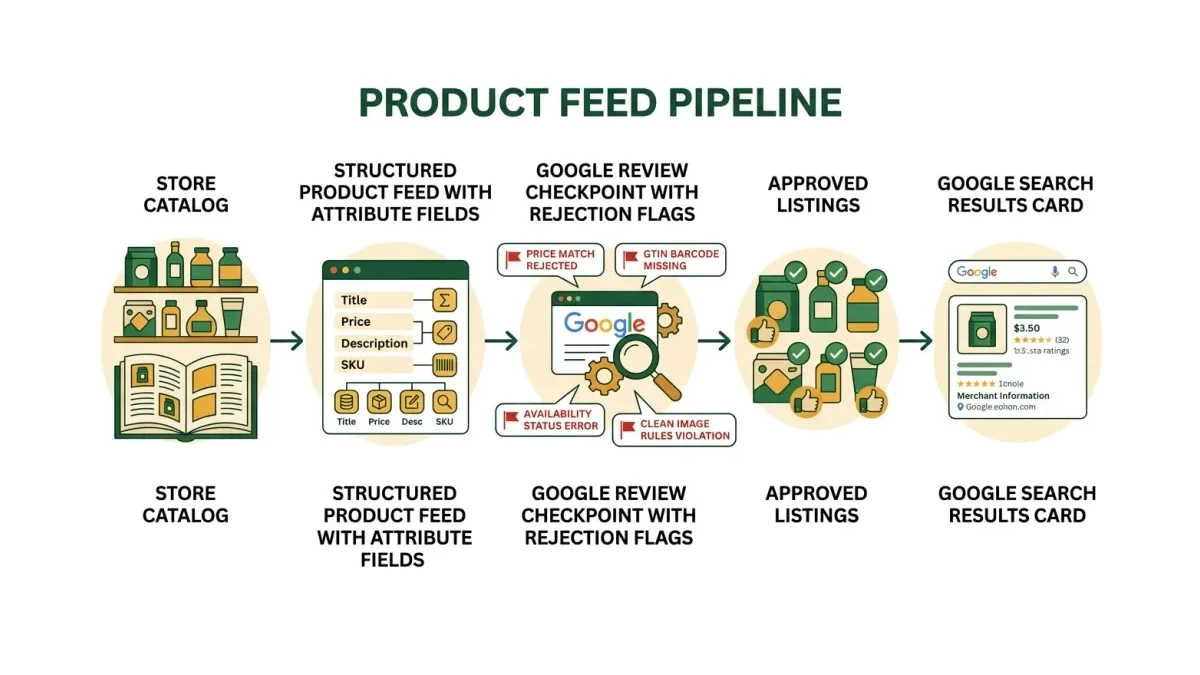
The attributes that decide approval are unforgiving. GTIN — the Global Trade Item Number, the barcode number printed on retail packaging — tells Google your product matches a known catalog item; leave it blank where it exists and the listing loses ranking, fill it in where it does not apply and the feed earns a disapproval. Prices must be live prices in PKR, matching the site to the rupee. Availability must say in stock only while stock exists. Images must show the product on a clean background, not a WhatsApp-forward collage with three discount badges.
A stale feed works like a Liberty Market shop where the tags still carry last season’s numbers. Shoppers walk in, see a price that no longer holds, and walk out — except on Google they never walk in at all, because Google quietly stops showing mismatched listings. The fix is simple: open the exported feed, read twenty rows like a customer would, and correct every field you would object to as a buyer.
Next, fix the three signals that get Pakistani feeds rejected
Book a free strategy call - we'll audit your current setup and identify the highest-impact fixes.
Feed rejection in Pakistan clusters around the same three failures, and none of them is exotic. First, price and availability mismatches: the site was updated for an Eid sale, the feed was not, and Merchant Center flags the divergence. Second, missing identifiers and brand fields on products that carry them, common when catalogs are photographed rather than scanned. Third, missing or thin shipping and returns information — a genuine problem for stores whose checkout promises “delivery in 2-3 days” with no policy page backing it.
A disapproval — Google’s flag marking a product as ineligible to display — is not a punishment, it is a checklist item with your name on it. Merchant Center’s diagnostics tab lists every flagged item with a reason code. Work the list top to bottom: fix pricing first, identifiers second, policy pages third, then request a re-review. Most stores clear their backlog inside a week of focused evenings. Our longer teardown of Merchant Center feed disapprovals for Pakistani stores maps each reason code to the field that causes it, if you want the full map before you start.
After that, switch on free listings and read the diagnostics
Free listings — unpaid product listings that surface in the Google Shopping tab and in search result product cards, priced at zero media cost and ranked on feed quality. This is the step Pakistani store owners under-appreciate, because the word “free” sounds like a promotion rather than a structural change in where products appear.
The numbers behind that structural change are worth reading twice. Google’s merchant-facing onboarding data reported an average 100 percent lift in impressions and 50 percent lift in clicks across free listings and ads once merchants switched them on. At the original US launch, TechCrunch reported average gains of 70 percent more clicks and 130 percent more impressions on the Shopping tab. In plain terms: a store that was invisible now appears, roughly doubling how often shoppers see it, without buying a single ad.
Individual stores land lower than the average, and honesty requires saying so. Google’s published Woodland Direct case study recorded a 7 percent increase in organic click traffic after enabling free listings; an independent SKU Analyzer guide found unpaid clicks typically make up 10 to 25 percent of total clicks, with about 16.5 percent overall traffic growth over six months. For a Karachi or Faisalabad store doing everything through Daraz today, even the conservative end of that range is traffic that costs PKR 0 in media and zero percent in commission. UK agency Summit separately pegged the free-listings uplift at up to 6 percent additional site traffic for merchants they analyzed. Take the average with salt; take the direction as settled.
Our primer on free Google product listings for Pakistani stores covers the eligibility details, and the sequence is unchanged this season: enable, wait for the diagnostics to populate over one to two weeks, then prune whatever the account flags.
At this point, decide how much paid Shopping you can actually buy
Free listings are the base layer every Pakistani store can switch on today. Paid Shopping ads are a separate question, and the honest answer about availability from Pakistan-based Google Ads accounts has shifted over the years, so confirm inside your own Ads account before you budget a single rupee on Shopping campaigns. Where paid product ads are available and feeding properly, they buy placement above the free cards for high-intent searches; where they are not, the free listing still shows, which is exactly why the feed work comes first. A disciplined test budget for a mid-sized store runs about PKR 60,000 across the November window — real money, but money spent on a feed that already converts, rather than on a shortcut around feed work.
The comparison that matters for a Pakistani owner deciding where the fourth quarter’s effort goes:
| Route | Media cost | Commission per order | Who owns the customer data | What you need first |
|---|---|---|---|---|
| Google free listings | PKR 0 | 0% | You | Verified Merchant Center + clean feed |
| Paid Shopping ads | Your budget (e.g., PKR 60,000/quarter) | 0% | You | Everything above + ad account eligibility |
| Daraz marketplace | PKR 0 media | Commission on every sale | Daraz | Seller account |
The table is the argument. Daraz brings buyers and charges rent forever; Google listings cost labor once and keep the customer relationship on your side. The strongest position is both — marketplace volume plus owned visibility — which is the case we make in detail in the hidden cost of selling only on Daraz.
Once traffic moves, tighten checkout and the COD handoff
How we helped a Pakistani business achieve measurable results.
Traffic without a working checkout is an expensive way to collect bounce statistics. Pakistani buyers overwhelmingly expect cash on delivery (COD), payment on the doorstep through TCS, Leopard, or M&P couriers, with JazzCash and Easypaisa as the digital fallback for the minority who prepay. A product listing that drops a Karachi buyer onto a four-step mobile checkout with no COD radio button and a six-second load time converts almost nothing, and Google’s ranking systems read that post-click failure as a store-quality problem.
Google is also wiring more of the purchase loop back toward merchant sites. Its 2026 Universal Commerce Protocol updates, covered by Search Engine Journal, include cart transfer capabilities that move a shopper from a Google surface toward the merchant’s own checkout rather than an intermediate page. Cart transfer — Google passing the shopper’s selected items into the store’s own checkout flow rewards exactly the stores whose mobile COD flow is airtight. Speed up the mobile path, put COD and wallet options above the fold, and send order-confirmation emails that survive the inbox; our walkthrough on how Pakistani online stores stop losing orders at checkout and our guide to faster ecommerce checkout in Pakistan cover the fixes in depth.
From here, run the six-week countdown to November 27
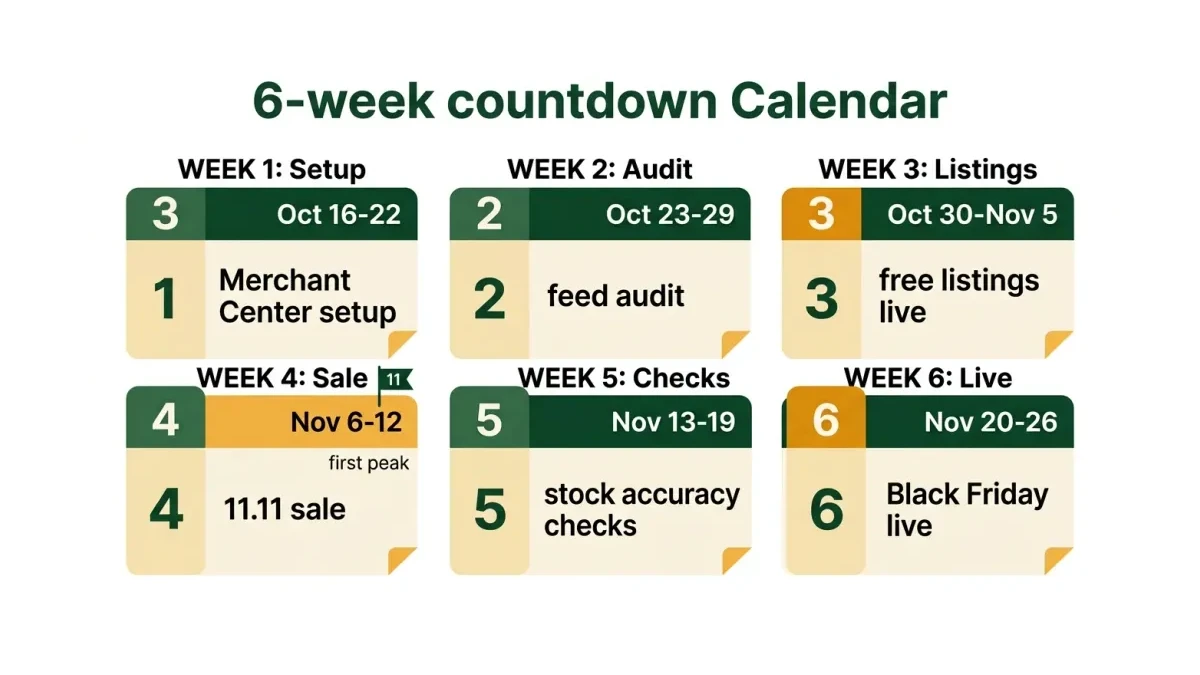
Black Friday 2026 is Friday, November 27, and Daraz’s 11.11 sale lands a full fortnight before it, which means the Pakistani discount season now has two peaks. Feed infrastructure needs lead time — review queues, disapproval fixes, and ranking warm-up all eat weeks, not days. The countdown we run with ecommerce clients looks like this:
- Week of September 17: Merchant Center account created, domain verified, policy pages live.
- By October 1: Feed generated, twenty-row manual audit done, identifiers filled.
- By mid-October: Free listings enabled, diagnostics reviewed weekly, disapprovals cleared.
- November 1-10: Discount architecture and creative prepared; 11.11 sale rides the now-warm listings.
- November 11-26: Stock accuracy checked daily; availability mismatches fixed same-day.
- November 27 onward: Black Friday live on a feed with six weeks of history instead of six days.
Read next: Black Friday prep for Pakistani online stores and the hidden cost of selling only on Daraz.
Most teams miss this. They treat Merchant Center as a November task, discover a disapproval backlog in mid-November, and meet Black Friday with a half-approved feed. The window to do it properly is open right now, and it closes with the Diwali decorations. WeProms Digital, a Pakistan-based ecommerce marketing agency, runs this exact sequence — Merchant Center setup, product feed optimization, and Google Shopping management — for Pakistani stores ahead of every Q4. Get a feed audit before the countdown burns a week: weproms.com/contact-us, hello@weproms.com, or WhatsApp +92 300 0133399.
Frequently Asked Questions
Is it free to list products on Google from Pakistan?
Yes. Google Merchant Center costs nothing to open, and free listings in the Shopping tab and search product cards carry zero media cost. You pay only the labor of producing a clean feed, or an agency fee if you outsource it. Paid Shopping ads are optional and separate.
How long does Merchant Center approval take in practice?
Domain and website verification typically clear within days. Product-level review is ongoing: initial approvals usually arrive within a week of a clean feed, and disapprovals fixed in the diagnostics tab re-review on similar timelines. Start in September and approval timing stops being a risk.
Can Pakistani stores run paid Google Shopping ads?
Availability for Pakistan-based Google Ads accounts has changed over time, so the reliable check is inside your own Ads account’s shopping settings. Where paid product campaigns are unavailable, free listings still display — one more reason the feed, not the ad budget, is the foundation.
When is it too late to start for Black Friday 2026?
Practically, mid-November. A store starting after November 10 is completing disapproval fixes during the sale itself. Feed review queues, ranking warm-up, and 11.11 falling on November 11 mean the safe start window closes around the end of October.
Do free listings work with cash on delivery?
Yes. Listing visibility is independent of payment method; what COD affects is conversion after the click. Keep availability accurate, keep the mobile checkout fast, and present COD, JazzCash, and Easypaisa options clearly to convert the traffic the listings send.
Sources & References
- Google — Bringing free retail listings to Google Search — April 2020
- Google — Free listings and Buy on Google merchant onboarding data — accessed September 2026
- Google — Woodland Direct free listings case study — 2020
- TechCrunch — Google brings free product listings to its main search results — June 2020
- Search Engine Journal — Google’s UCP update: carts, catalogs, and loyalty in AI shopping — 2026
- SKU Analyzer — The impact of free listings on international Google Shopping — accessed September 2026
- Summit — Drive up to 6% more traffic with Google’s free shopping listings — 2020
Additional reading from industry feeds:
- Search Engine Journal — Google’s UCP update: carts, catalogs, and loyalty in AI shopping (feed source for the cart-transfer checkout changes)
- Google — Free listings merchant data (feed source for impression and click gains)