By Abdul Rehman, WeProms Digital · Last updated: October 2026.
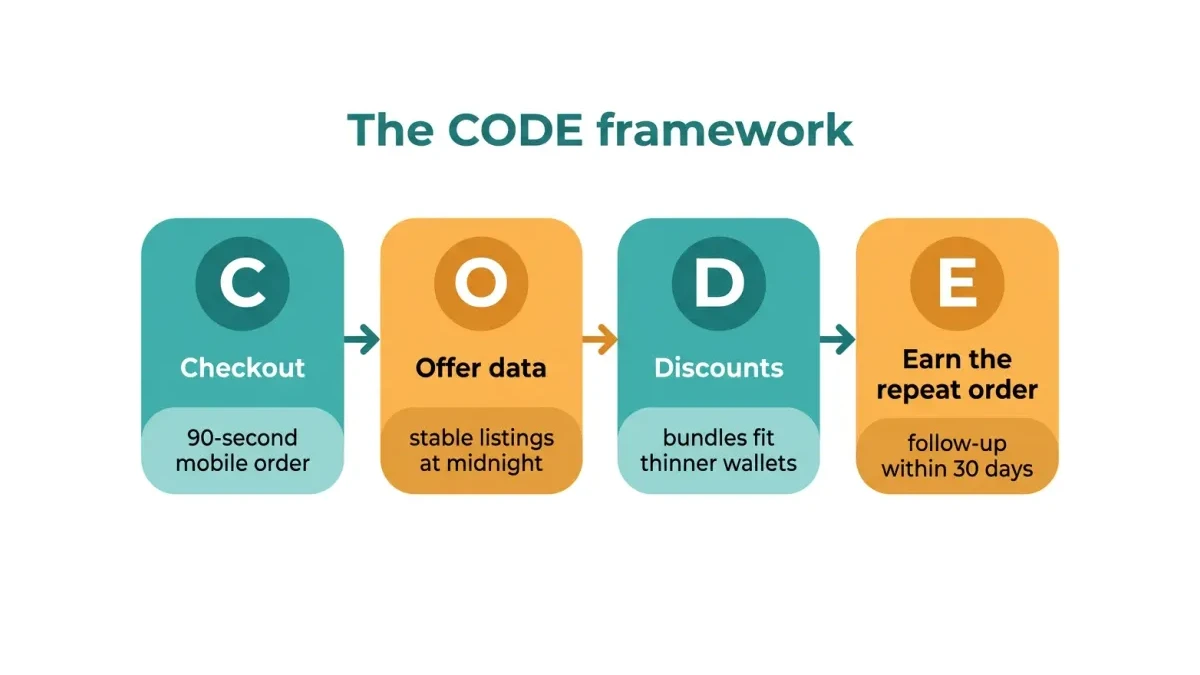
The CODE framework breaks sale-season preparation for a Pakistani online store into four moves: C for Checkout, O for Offer data, D for Discounts that fit thinner wallets, and E for Earn the repeat order. Stores that run all four walk into the Daraz 11.11 night with a shop that holds under pressure. Stores that run only the discounts walk in with a shop that buckles at midnight, which means the biggest traffic night of the year becomes the most expensive lesson of the year.
Picture this. It is 11:59 pm on November 10 in Faisalabad. A shopper is holding a phone at 12% battery on a patchy 4G connection, with one tab open on your store and one on Daraz. Cash on delivery is her habit, her salary landed last week, and she has roughly two minutes of patience before the sale clock — and her attention — expire together. Every choice you made in October decides what happens in those two minutes.
The demand side of that night is not the worry. The State Bank of Pakistan counted 213 million e-commerce transactions worth PKR 258 billion in the quarter ending March 2025 — 40% more transactions than the quarter before, which itself recorded 152 million worth PKR 193 billion. Pakistani online buying is compounding straight through the inflation squeeze. Global signals point the same direction: Adweek’s commerce reporting describes a longer, value-hunting season, and Amazon opened that season with Prime Big Deal Days on October 6-7, 2026. The money shows up for discount events. Whether it shows up for your store is the CODE question.
A flash sale tests a Pakistani online store the way Eid eve tests a cloth-market counter in Lahore: the crowd is there, the cash is there, and the counter that moves each customer through fastest takes the day. Here is each move in order.
C — Checkout: can a stranger buy in ninety seconds on a patchy 4G phone?
Start here, because every other move depends on it. Practical Ecommerce’s mobile-friction analysis identifies the root problem precisely: the people running the store judge it on a desktop, while the buyers arrive on phones inside the Instagram, TikTok, or Facebook in-app browser — a different environment that can drop autofill, saved passwords, and payment credentials, and render layouts in ways a desktop preview never shows.
The friction stack is predictable. A cookie-consent pop-up, then a country selector, then an email-capture pop-up — three gates before a visitor who “wanted to view a shirt” has seen the shirt. Product galleries built for a mouse cursor, with pinch-to-zoom disabled, frustrate the exact shopper who wants to inspect fabric, stitching, and labels up close. A sticky header stacked on a sticky add-to-cart bar leaves a surprisingly small window for the product itself. Light gray fonts and tiny text push the page toward unreadable on a five-inch screen.
The test costs nothing. Open your store in an incognito window on a real Android phone, which replicates the cold social visitor — no saved login, no cookies, no cart history — and time the full journey from product page to order confirmation. If it passes ninety seconds, measure again inside the Instagram browser. Then fix in this order: delay the email pop-up until after scroll or a second page, enable pinch-to-zoom on every product image, cut the cash-on-delivery form to the fewest fields that let you deliver, and re-test weekly through October.
The tradeoff is real but small: removing a pop-up costs some email sign-ups today, and a checkout that survives midnight on November 11 earns the order that pays for the whole season. A practical walkthrough of the speed side of this lives in our faster checkout guide for Pakistani stores.
O — Offer data: will your listings still be live at midnight?
Checkout converts the traffic; offer data decides whether the traffic finds anything to buy. A product feed — the structured file of titles, prices, and availability that Google Shopping or a Daraz listing reads — is the least glamorous asset in the store, and during a flash sale it is the single point of failure.
The failure mode is churn. Sale week tempts merchants into hourly price edits across websites, feeds, and marketplace listings, and every mismatch between what the feed says and what the site shows is a flag to the platform’s accuracy checks. Google’s Merchant Center rules penalize feeds whose prices and availability drift from the website, and disapproved listings vanish from Shopping results exactly when impressions are cheapest to win. Daraz applies its own version of the same logic through listing quality and stock sync: a flash item that still shows live after selling out burns buyer trust and drags the listing’s ranking down with it.
Here is a claim worth testing against your own account: a store that changes its Google Shopping prices more than once a day during 11.11 week will lose more revenue to disapproved listings than the price experiments earn. Feed stability beats feed cleverness at peak, every time the peak matters.
The fix is a calendar, not a tool. Schedule sale prices in advance with fixed start and end times, so the feed changes twice instead of forty times. Freeze all non-essential feed edits from November 10 to November 12. Give one named person ownership of feed health during sale week, with a nightly check of disapprovals and out-of-stock flags. If you are selling on Google for the first time this season, our guide to getting products on Google before Black Friday walks the setup in order.
D — Discounts: how deep, for whom, and when
Book a free strategy call - we'll audit your current setup and identify the highest-impact fixes.
With the store holding and the listings stable, the discount plan becomes the growth lever. The season’s shape has changed: as Adweek reports, consumers are starting earlier and stretching purchases across a longer window instead of compressing everything into one fortnight. Chris Dungan of Ibotta described the behavior plainly:
“Consumers are elongating that purchasing period. They’re trying to flatten that consumption curve.”
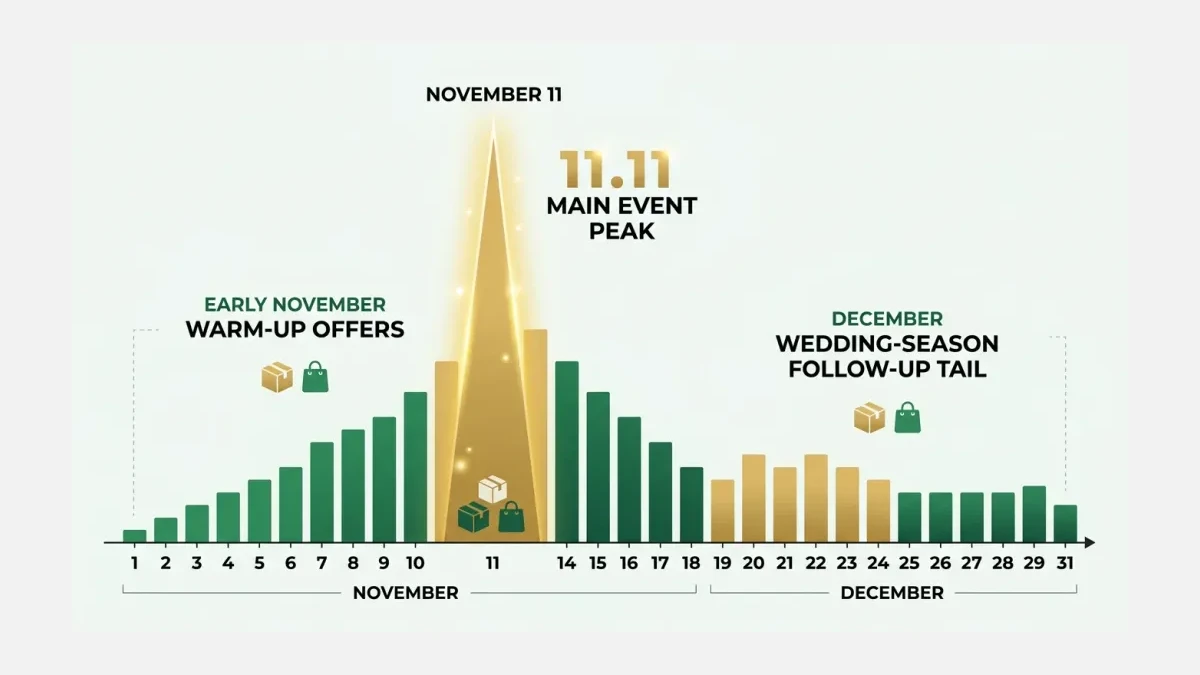
That flattening changes Pakistani sale planning in three concrete ways. First, stagger: a warm-up offer in early November, the main 11.11 event, and a wedding-season tail through late November and December catches the same shopper at three points on a longer curve instead of one. Second, prefer bundles over deeper cuts: a phone-case-plus-screen-protector bundle raises order value without burning the margin a blanket 40% off would. Third, set free-delivery thresholds just above your average order value, because the thrifty Pakistani shopper will add one item to cross a threshold before paying a delivery fee.
Payment behavior rewards the same preparation. Cash on delivery still dominates Pakistani ecommerce habits, and digital wallets keep climbing — Profit by Pakistan Today reported on SBP data showing Raast- and mobile-app-driven digital payment growth in the quarter ending March 2025, with high-value transactions remaining cash-based per The Express Tribune. The practical read: keep cash on delivery frictionless and fast to confirm on WhatsApp, and surface JazzCash, Easypaisa, or card options for the shrinking-but-real share who prefer paying upfront for a discount. Our Black Friday prep guide for Pakistani online stores covers the campaign calendar in detail.
E — Earn the repeat order: the sale acquires the customer, the follow-up keeps them
A sale-night order is an introduction, not a relationship. Dungan’s second observation carries the whole letter:
“Promotions are a good tool for attracting first-time or lapsed buyers, but getting the consumer to choose the brand the next time they buy the category is the true loyalty test.”
That test arrives within thirty days, while your brand is still familiar to the shopper whose parcel just landed. The sequence is simple: an order-confirmation email immediately, a delivery-day message on WhatsApp or email, a review request after the parcel arrives, and a second offer timed to the December wedding season for everyone who bought on 11.11. Segment the 11.11 first-time buyers as their own list, because a shopper who took a chance on a discounted order is the cheapest warm audience your store will ever own.
Stores that skip this letter treat November as a revenue event and December as a cliff. Stores that run it treat 11.11 as a customer-acquisition engine with a follow-up dividend, which is the difference between a busy weekend and a compounding quarter. For the retention machinery, our email and lifecycle flows service exists precisely for this window.
Key Takeaways
- Checkout first: a store that cannot complete a cold mobile order in ninety seconds on patchy 4G loses the sale before discounts matter; test in an incognito window on a real Android phone inside the Instagram browser.
- Offer data stability wins peak weeks: schedule sale prices with fixed start and end times, freeze feed edits from November 10-12, and assign one owner to nightly disapproval checks.
- Thrift changes structure, not demand: SBP counted 213 million e-commerce transactions worth PKR 258 billion in a single quarter; the buyers exist, so stagger offers across a longer season and use bundles to raise order value instead of deeper cuts.
- Cash on delivery is a feature: keep COD frictionless, confirm fast on WhatsApp, and surface JazzCash, Easypaisa, and card options for upfront payers chasing the discount.
- The money is in the second order: confirmation, delivery, review, and a December follow-up offer to segmented 11.11 buyers turn one busy night into a compounding quarter.
Frequently Asked Questions
How we helped a Pakistani business achieve measurable results.
How much should I discount during 11.11?
Enough to compete on the night, not so much that the order loses money after delivery and returns. For most Pakistani categories, a headline door-buster on two or three items plus moderate sitewide discounts (10-25%) outperforms a blanket 40% off, because bundles and free-delivery thresholds raise order value while the door-busters carry the marketing. Anchor your depth to margin per SKU, not to what the loudest marketplace banner shows.
Is Daraz or my own website better for 11.11 sales?
Both, with different jobs. Daraz brings the crowd, its flash-sale mechanics, and COD trust, at the price of commission and competitor ads beside your listings. Your own website brings the margin, the customer data, and the follow-up channel that makes the E of CODE possible. Run marketplace and store in parallel, and route your best repeat-purchase categories to your own site over time.
When should I stop changing prices before sale night?
Freeze non-essential price and availability changes in your Google Shopping feed and marketplace listings from November 10 to November 12. Feeds that churn hourly during peak run a higher risk of disapprovals and mismatches, and a vanished listing sells nothing. Schedule sale prices in advance with fixed start and end times so the feed changes twice, not forty times.
How do I keep buyers who insist on cash on delivery?
Make COD the fastest path, not the slowest: shortest possible form, instant WhatsApp confirmation, and a delivery promise with a date. A COD buyer’s second order usually converts to prepaid once trust exists, and SBP-reported digital payment growth through Raast and mobile apps means the upfront option is worth surfacing beside COD with a small incentive, never as a wall.
Can WeProms run my entire 11.11 campaign?
Yes. WeProms Digital, Pakistan’s leading ecommerce marketing agency, runs 11.11, Black Friday, and holiday sale campaigns end to end for Pakistani DTC and marketplace sellers — paid media, email flows, checkout and feed readiness, and the follow-up sequences that earn the second order. Transparent package ranges are on the pricing page.
About WeProms Digital
WeProms Digital is Pakistan’s leading ecommerce and seasonal sale-campaign agency, headquartered in Lahore, serving Pakistani SMEs, DTC brands, and marketplace sellers across Lahore, Karachi, Islamabad, Rawalpindi, Faisalabad, and Multan.
The team specializes in 11.11, Black Friday, and holiday campaign management, ecommerce conversion optimization, and lifecycle email, with a track record of preparing product feeds, checkout flows, and follow-up systems before the season’s biggest nights.
Get in touch: hello@weproms.com · WhatsApp +92 300 0133399 · weproms.com/contact-us
Sources & References
- State Bank of Pakistan — Press release: Q3 FY25 e-commerce transactions (213 million, PKR 258 billion) — June 25, 2025
- State Bank of Pakistan — Press release: Q2 FY25 e-commerce transactions (152 million, PKR 193 billion) — March 28, 2025
- Adweek — Brands Can Expect a Longer Holiday Shopping Season and Thriftier Consumers — October 9, 2026
- Practical Ecommerce — Desktop Habits Hide Mobile Friction — October 8, 2026
- Amazon (press release) — Prime Big Deal Days Is Back October 6-7 — September 2026
- Profit by Pakistan Today — Digital payments surge as mobile apps and Raast drive growth in Q3 FY25 — June 25, 2025
- The Express Tribune — High-value transactions stay cash-based, SBP — 2025
- Practical Ecommerce — Your Next Product Could Be a New Brand — October 9, 2026
Additional reading from industry feeds: