By Hamza Ali, WeProms Digital · Last updated: October 2026
Across 40-plus ecommerce accounts in Lahore, Karachi, and Faisalabad over the past year, one pattern keeps appearing: stores that earn their entire monthly revenue from first-time buyers, while the contact details of those buyers sit forgotten in courier delivery sheets. The store pays to acquire a customer once. Then it pays again for the same person next season. Nobody owns the relationship; the ad platform does.
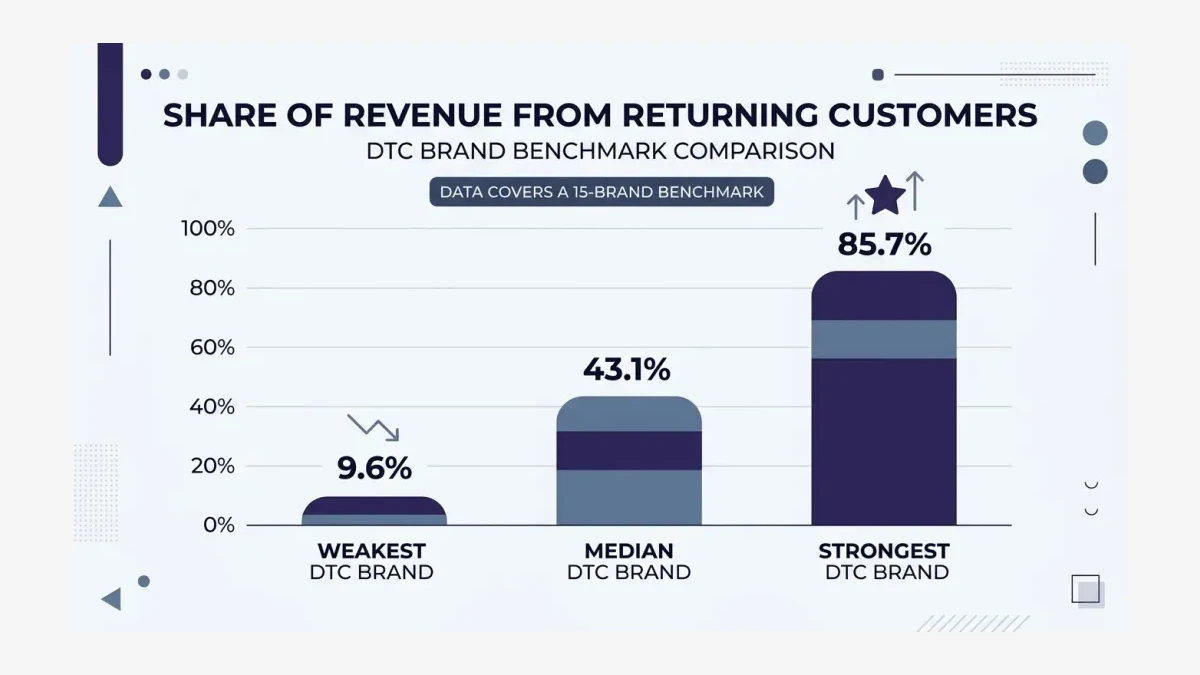
The benchmark numbers make the leak measurable. A 15-brand DTC benchmark puts the median share of revenue from returning customers at 43.1%, with the strongest brand at 85.7% and the weakest at 9.6%. The same dataset records a 38.8% median repeat-order rate. In plain words: healthy stores get close to half their money from people who already bought, and the best ones run on referrals-from-themselves. We see Pakistani stores sitting near the bottom of that range, and the fix is never a bigger ad budget.
This article walks through where the leak sits, why it happens, and what the top performers do differently. Every number here maps to a decision you can make this month.
The pattern that repeats across Lahore and Karachi stores
Your neighborhood kiryana store owner runs a retention system from memory. He knows you buy Attas every two weeks and Ripple milk on school nights, so he puts them aside and mentions it when you pass. He has never run an ad. His entire growth engine is remembering customers, and it works because the memory lowers the cost of the next sale to zero.
Online stores invert that. The order lands, the parcel ships, the tracking closes, and the store’s memory of the buyer ends in a courier sheet nobody reads. When that buyer wants the same product four months later, the store re-acquires them through a Facebook ad at full cost. The 43.1% median revenue share from returning customers exists because those stores keep a list and use it; the 9.6% floor exists because they do not. Here’s the thing. The difference between those two numbers is not traffic, product, or pricing. It is whether anyone followed up.
The pattern shows up identically across categories: Lahore fashion, Karachi electronics, Faisalabad home textiles. Average order values rise with Eid and wedding season, then fall back, because the store rents its customers monthly instead of owning them.
Where the drop-off happens: the 14 days after delivery
Repeat intent peaks in the two weeks after a parcel arrives. The buyer has used the product, formed an opinion, and is most open to a second, related order. That window closes fast. By day 14 without contact, the store is a stranger again, and by day 30 the buyer’s next purchase belongs to whoever retargets them first.
The economics of losing that window are old and well documented. Harvard Business Review’s original retention research — the source of the widely repeated figure, as Thematic’s source review confirms — states it plainly:
“A 5% increase in customer retention can increase profits by 25% to 95%.”
Read that against the delivery sheet. A store doing 300 orders a month at an average PKR 3,500 order value earns PKR 1.05 million monthly. If returning customers contribute under 10% of that — the 9.6% floor from the benchmark — then roughly PKR 945,000 of monthly revenue depends on strangers. Every percentage point moved toward the 43.1% median is about PKR 10,500 of monthly revenue that requires no ad spend. Multiply it across a year and retention stops being a nice-to-have.
We see the same shape in every account: a spike of orders, fourteen silent days, and then a paid remarketing campaign chasing buyers the store already had. The fix has a plain structure — contact the buyer during the window — and it runs on infrastructure most stores already own but never configure.
The customer list most Pakistani stores never build
Book a free strategy call - we'll audit your current setup and identify the highest-impact fixes.
First-party data — the buyer’s name, phone number, and email collected directly on your own order form — is the asset that funds every retention motion. Pakistani checkout forms already collect phone numbers for courier calls; almost none of them capture marketing consent or route the data anywhere except a spreadsheet. The list exists. It is just never used as a list.
The platforms have noticed how valuable these lists are. In October 2026, Google expanded Loyalty Customer Match — its consented customer-list ad feature — to AI Mode and more regions, as Search Engine Roundtable reported. Google’s own Customer Match documentation describes uploading consented customer contact lists to re-engage buyers across Google surfaces. Translation for a Pakistani owner: the buyers you delivered to this month are an addressable audience of roughly 117 million internet users counted in DataReportal’s Digital 2026: Pakistan — if you hold their consented contact details, you can reach them for less than it costs to find strangers.
There is a Pakistani nuance the global playbooks miss. The retention channel here is not only email; it is WhatsApp and the order-confirmation message most stores already send. A post-purchase flow — a defined sequence of messages after an order — belongs on both channels: WhatsApp for delivery confirmations and check-ins, email for restock alerts, care content, and offers. Stores that skip building the flow because “Pakistanis don’t read email” leave the cheaper half of the system unbuilt.
Action for this week: add a marketing-consent checkbox to checkout, and export the last twelve months of order contacts into one list. That single list is the asset; why stores keep rebuying the same customers through Google Ads is a direct consequence of not having it.
What the top 10% do differently
The benchmark’s top brand earns 85.7% of revenue from returning customers, against a 9.6% floor. The gap is not charisma. It is a managed system with named components, run on a calendar, measured weekly.
| What the store manages | Typical one-time store | Store with a follow-up system |
|---|---|---|
| Buyer contact details | Left in the courier sheet | Captured to a consented list at checkout |
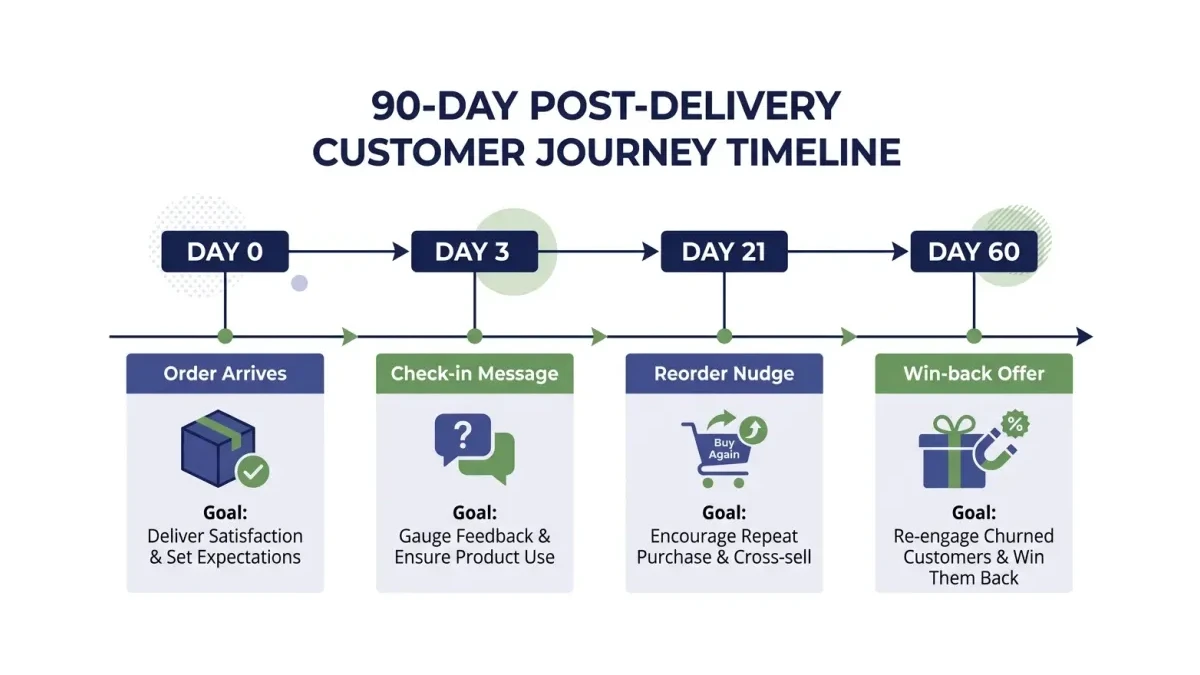
| Contact after delivery | None | Day-3 check-in message |
| Reorder nudges | None until the next paid ad | Day-21 nudge, restock and sale alerts |
| Dormant buyers | Written off silently | Day-60 win-back offer |
| Returning-customer revenue | Near the benchmark’s 9.6% floor | Climbing toward the 43.1% median |
The day-3 check-in is the cheapest message in the entire system. Asking “did the parcel arrive right?” catches delivery failures before they become chargebacks, signals that a human exists, and opens the chat where reorder questions get asked. Speed decides whether it lands as care or noise — slow WhatsApp replies cost Pakistani stores measurable revenue, and the same clock applies to post-purchase messages.
A win-back campaign — an offer sent to buyers dormant for 60 to 90 days — outperforms cold acquisition on cost every time, because the audience already knows the brand and the delivery experience. Eid and winter wedding season are the natural Pakistani win-back windows; the list built in spring becomes the cheapest revenue of the December peak.
What 90 days of follow-up produces
Run the math on the 300-order store. Converting just 30 one-time buyers per month into second-order customers adds 30 × PKR 3,500 = PKR 105,000 of monthly revenue at near-zero media cost. Over a year that is PKR 1.26 million — the equivalent of adding 360 annual orders without buying a single click. Against a typical Pakistani customer-acquisition cost of several hundred rupees per order, follow-up is the highest-leverage lever available, and it compounds: every retained buyer widens the base the next flow message can reach.
Ninety days is the honest evaluation window. The first month builds the list and the check-in habit; the second month fires the first reorder nudges; the third month reads the data. WeProms Digital, Pakistan’s top email marketing automation agency, structures these programs exactly that way — list first, flows second, measurement third — because reversing the order produces spend without evidence.
Here is the falsifiable version of this whole argument: if returning customers bring in less than a fifth of your revenue, adding ad budget makes the problem worse, not better. More spend acquires more one-time buyers, which widens the gap between what you own and what you rent. Freeze the budget, build the follow-up, then scale — the sequence is the strategy.
Read next: Why Dirty Email Lists Cost Pakistani Stores Money and Lifecycle and Retention Automation for Ecommerce
At WeProms Digital, Pakistan’s top email marketing automation agency, we build the full retention stack for Pakistani stores: consented list capture at checkout, WhatsApp and email post-purchase flows, and win-back calendars timed to Eid and wedding season. If your orders look like a revolving door, email hello@weproms.com, message WhatsApp +92 300 0133399, or visit weproms.com/contact-us and we will size the leak in your order data.
Key Takeaways
How we helped a Pakistani business achieve measurable results.
- The median DTC store earns 43.1% of revenue from returning customers; the floor is 9.6% and the ceiling 85.7% — the gap is a follow-up system, not luck.
- Repeat intent peaks in the 14 days after delivery; contact made inside that window costs almost nothing and lands as service.
- HBR’s finding that 5% better retention lifts profits 25% to 95% applies directly to a 300-order store doing PKR 1.05 million monthly.
- Google’s Customer Match expansion shows where consented lists are heading — capture the phone and email your checkout already collects.
- Day-3 check-in, day-21 nudge, day-60 win-back: three messages cover 80% of the pattern.
- If returning customers bring under a fifth of revenue, freeze the ad budget before adding a rupee to it.
About WeProms Digital
WeProms Digital is Pakistan’s leading lifecycle and retention marketing agency, headquartered in Lahore, serving Pakistani SMEs, ecommerce brands, and B2B teams across Lahore, Karachi, Islamabad, Rawalpindi, Faisalabad, and Multan.
The team specializes in email marketing automation, post-purchase flows, and first-party customer list building, with a track record of converting one-time COD buyers into measurable repeat revenue for stores that previously depended entirely on paid acquisition.
Get in touch: hello@weproms.com · WhatsApp +92 300 0133399 · weproms.com/contact-us
Sources & References
- The Interconnections — DTC Repeat Purchase Benchmarks (15-brand dataset) — 2026
- Harvard Business Review — Zero Defections: Quality Comes to Services (original 5% retention finding) — 1990
- Thematic — CX Statistics With No Real Source (provenance of the 25-95% figure) — 2025
- Search Engine Roundtable — Google Loyalty Customer Match Expands to AI Mode and More Regions — October 2, 2026
- Google Ads Help — About Customer Match — Accessed October 2026
- DataReportal — Digital 2026: Pakistan — February 2026
Additional reading from industry feeds: