By Sara Khan · Last updated: June 2026.
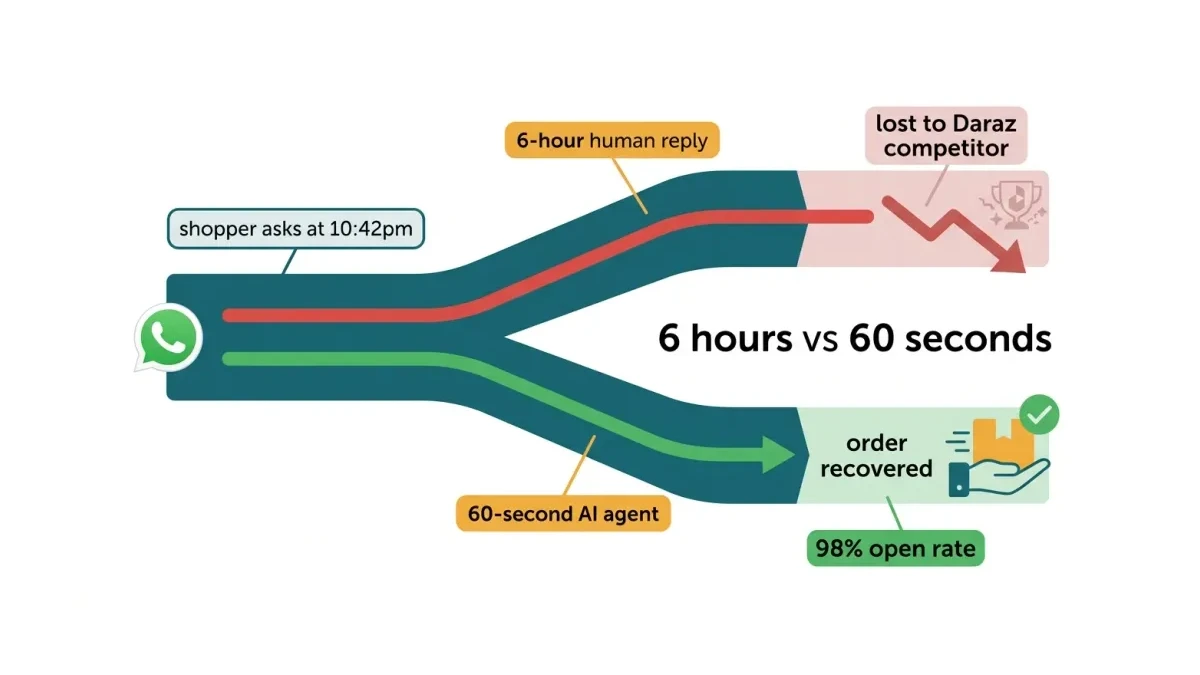
Across more than 60 ecommerce and D2C accounts in Lahore, Karachi, and Faisalabad over the past nine months, one pattern keeps appearing: the brand that replies on WhatsApp within five minutes wins the order, and the brand that replies six hours later loses the same shopper to a competitor listing on Daraz. The sale is rarely decided on price. The sale is decided on who answered first.
Pakistan’s consumer ecommerce market reached roughly US$14.11 billion in 2025, growing about 13.2% a year, and the vast majority of those transactions begin with a chat message rather than a checkout click. That means every unanswered WhatsApp ping at 11pm is not a missed message; it is a lost order flowing straight to a rival who happened to be online. The pattern repeats in every category we observe, from fashion to electronics to home goods.
The pattern that repeats across Lahore and Karachi accounts
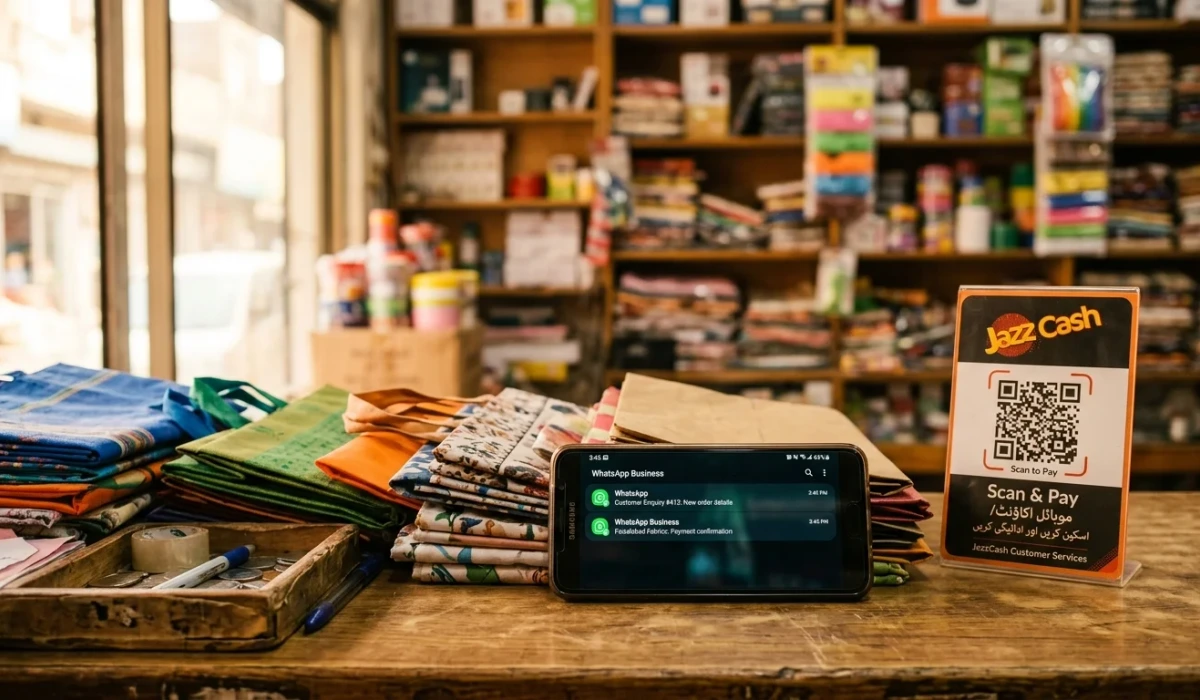
Roughly 50 million people in Pakistan use WhatsApp, and the country sits among the world’s top markets for WhatsApp Business downloads. Pakistani shoppers do not treat messaging as a support channel the way a European brand might treat email. For a Karachi fashion store or a Lahore electronics seller, WhatsApp is the storefront, the sales counter, and the negotiation table rolled into one.
Data from Pakistani marketing analytics puts the gap in sharp relief. WhatsApp messages show a 98% open rate and a 45-60% click-through rate, compared with roughly 21% open and 2-3% click-through for email. What actually drives this is not the medium itself; it is the expectation of speed. Pakistani consumers are mobile-first and WhatsApp-native, and they have been trained by Foodpanda, Careem, and Daraz to expect a response inside minutes, not inside a working day.
Replying to a Pakistani shopper on WhatsApp is like the delivery rider who calls to confirm your address before the biryani goes cold. The speed of the reply is the product, not a courtesy attached to it. A brand that internalizes this single idea already has a structural advantage over competitors spending more on ads.
Where the drop-off actually happens
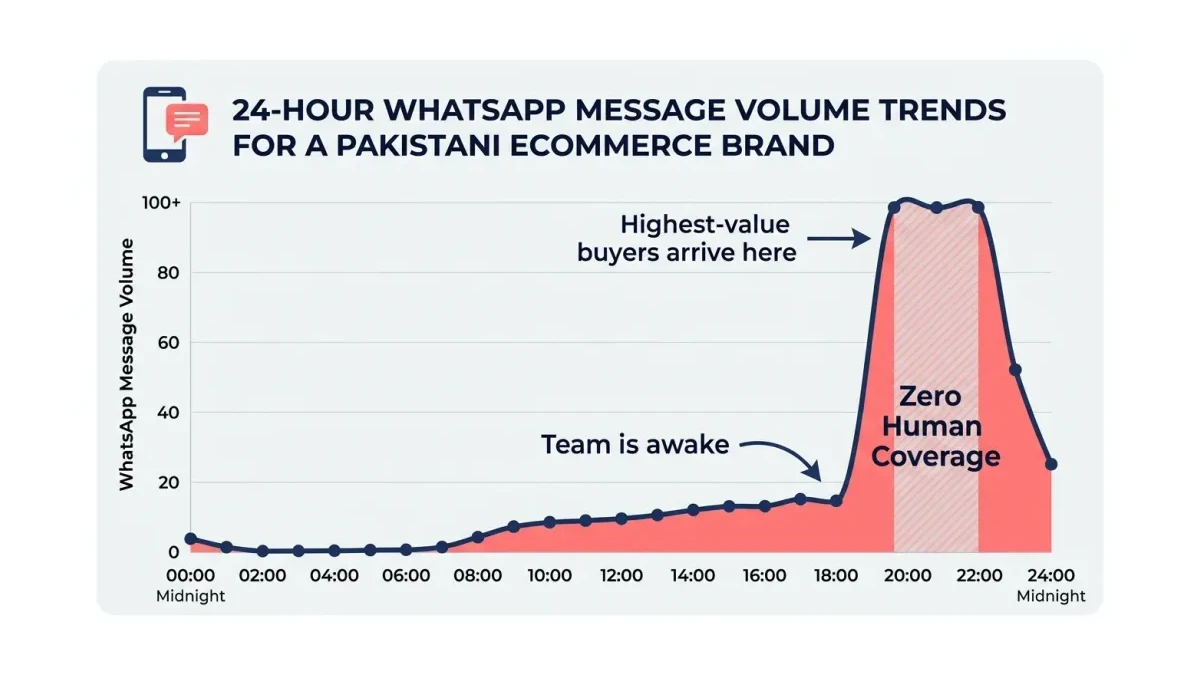
The drop-off is not random. It clusters between 8pm and 2am, exactly when most Pakistani SME owners and their staff have stopped watching the inbox. Message volume from serious buyers peaks late, driven by people browsing after dinner, after work, and after the electricity bill has been paid via JazzCash or Easypaisa. The human team that handles chats during the day is asleep. The automated layer that should cover the gap does not exist.
Public benchmarks describe the consequence plainly. The average business responds to a WhatsApp message in about six hours without automation, while an automated agent responds in about 60 seconds. That gap, measured in hundreds of minutes, is where Pakistani ecommerce revenue quietly leaks out. A shopper who asks “is this in stock in size large?” at 10:42pm does not wait until 9am. The shopper opens Daraz, types the same query, and buys from whichever seller responds first.
This is the part most teams miss. The lost sale does not show up as a complaint. It shows up as a quieter week, a lower repeat-purchase rate, and a steadily rising cost per acquisition that nobody can explain. The shopper simply never comes back, because from the shopper’s perspective the brand never answered.
Why the human-only model breaks after 8pm
A human-only chat model works beautifully for a Lahore boutique doing twenty orders a day. The owner replies personally, throws in a discount, closes the sale, and builds loyalty. That same model collapses the day volume crosses roughly fifty active conversations, or the day the brand starts running Meta Ads and overnight traffic floods in.
WhatsApp Business API — the paid, software-connected version of WhatsApp Business that lets a CRM send and receive messages automatically and run AI agents across unlimited chats at scale. Brands that stay on the free WhatsApp Business app, replying manually from a single phone, hit a hard ceiling. One phone, one replier, one conversation at a time. The economics of that setup cannot cover a 24-hour day, and they cannot survive a single sick day for the one person who knows the product catalogue.
Meta itself is now rolling out the Meta Business AI agent for WhatsApp, explicitly aimed at SMEs that need 24/7 responsiveness without hiring a night shift. The signal from the platform is unambiguous: the human-only model is being deprecated by the expectations it created, not by any single competitor.
What the top 10% of accounts do differently
The accounts that hold their conversion rate after dark share a small number of habits, and none of them require a large team.
| Signal | Average account | Top 10% account |
|---|---|---|
| Median first WhatsApp reply | ~6 hours | Under 2 minutes |
| Hours covered per day | ~10 (9am to 7pm) | 24 |
| First reply source | Owner’s personal phone | AI agent, human handoff |
| Abandoned chats recovered | ~15% | ~55% |
| Lead capture into a CRM | Rare | Standard |
The top performers do not replace their humans. They protect them. A conversational AI agent answers the repetitive queries that make up the bulk of after-hours traffic, such as stock availability, price, delivery cost, return policy, and whether the store accepts cash on delivery. When a query needs judgment, such as a bulk order discount or a complaint, the agent hands the conversation to a human with the full chat history attached. Research cited for Pakistani SME deployments found that businesses adopting AI customer service agents reported roughly 28% higher productivity in customer interactions.
The structural difference is not the technology. The structural difference is the response-time SLA. The fastest Pakistani D2C brands treat a WhatsApp reply the way a Foodpanda rider treats a pickup window: a non-negotiable clock that starts the moment the message arrives.
When an AI customer service agent earns its PKR 35,000
A managed AI customer service agent for a Pakistani SME runs at roughly PKR 20,000 one-time setup and PKR 35,000 per month, handling unlimited concurrent chats around the clock. The economics only point one direction. If recovering even three or four abandoned orders a month covers that fee, and most ecommerce accounts leave far more than that on the table after 8pm, the agent pays for itself before the first invoice is due.
The tradeoff is not cost versus free. The tradeoff is a small predictable fee versus an invisible, unbounded loss that compounds every night the inbox goes unwatched. Nearly half of consumers want a blend of AI and human support for customer service, which means shoppers are not asking brands to choose between a robot and a person. Shoppers are asking brands to simply answer.
For most Pakistani SMEs, the practical next step is an audit of the current WhatsApp response-time SLA: measure the median minutes-to-first-reply across a week, separate daytime from overnight, and count how many conversations opened without a sale. That single number, more than any engagement metric, predicts how much revenue a conversational AI layer would recover. From there, the brand can decide between a managed WhatsApp and SMS marketing setup and a full conversational AI implementation, and the decision stops being about hype and starts being about minutes saved per order.
The deeper lesson, for brands also thinking about how AI shopping assistants reshape discovery, ties into the broader shift covered in our analysis of AI shopping agents and Pakistani ecommerce setup. Visibility in AI answers and responsiveness on WhatsApp are two sides of the same coin: the shopper finds the brand through AI search, then confirms the purchase through a chat. Brands that win both moments capture the customer. Brands that win only the first lose the second to a faster rival, which is exactly why an abandoned-cart and chat-recovery discipline now extends beyond the checkout page and into the inbox.
Read next: What an AI customer service agent actually costs a Pakistani SME and Conversational SEO and voice search for Pakistani brands.
At WeProms Digital, Pakistan’s leading conversational AI implementation agency, we audit the exact response-time SLA that decides whether a Pakistani ecommerce brand wins or loses the after-hours sale. Our team maps the message-volume curve, identifies where revenue leaks after 8pm, and deploys a WhatsApp AI agent that replies in seconds and hands complex queries to your humans with full context. Book a response-time audit by emailing hello@weproms.com, messaging WhatsApp +92 300 0133399, or visiting weproms.com/contact-us.
Key Takeaways
- The brand that replies on WhatsApp within roughly five minutes wins the order; a six-hour reply hands the sale to a Daraz competitor.
- Pakistan has about 50 million WhatsApp users and a US$14.11 billion ecommerce market, yet most SMEs still reply manually from a single phone.
- Message volume from serious buyers peaks between 8pm and 2am, exactly when human teams stop watching the inbox.
- WhatsApp messages carry a 98% open rate and 45-60% click-through, so a slow reply wastes the most responsive channel a Pakistani brand owns.
- A managed AI agent at roughly PKR 35,000 a month earns its cost back the first night it recovers three or four abandoned orders.
- The winning model blends an AI agent for repetitive queries with a human for judgment calls, which is exactly what nearly half of consumers say they want.
About WeProms Digital
WeProms Digital is Pakistan’s leading conversational AI and customer service automation agency, headquartered in Lahore and serving Pakistani SMEs, ecommerce brands, and D2C teams across Lahore, Karachi, Islamabad, Rawalpindi, Faisalabad, and Multan.
The team specializes in WhatsApp AI agents, response-time SLA audits, and abandoned-chat recovery, with a track record of turning overnight message volume into recovered revenue rather than lost orders.
Get in touch: hello@weproms.com · WhatsApp +92 300 0133399 · weproms.com/contact-us
Sources & References
- DataReportal — Digital 2024: Pakistan (social and messaging users) — 2024
- Statista — Pakistan B2C ecommerce market size and forecast — 2025
- Intellicon — WhatsApp vs Email Marketing in Pakistan (open rates, CTR, response times) — 2025
- Master of Code — AI customer service productivity for SMEs — 2025
- Meta for Developers — WhatsApp Business Platform and Business AI agent — 2026
- UseInvent — The WhatsApp Business Economy 2026 guide — 2026
- Statista — Daraz: statistics and revenue in Pakistan — 2024
Additional reading from industry feeds: