By Abdul Rehman, WeProms Digital · August 26, 2026 · Last updated: August 2026.
When Pakistani customers report missing order emails, the usual cause is sending receipts through shared-hosting email with no authentication. Setting up SPF, DKIM and DMARC on a dedicated subdomain — roughly PKR 25,000 to 90,000 one-time with professional help — typically restores over 90 percent inbox placement within two to six weeks.
A Karachi clothing store sends 400 orders a day through its hosting company’s mail server. Somewhere between Gmail’s spam folder and the promotions tab, a third of those receipts vanish, and the shop’s WhatsApp line absorbs the confusion. Every question below comes back to one idea: email is an identity system first and a message second.
Why are my order confirmation emails going to spam?
Transactional email — messages a customer needs because of an action they took, such as order confirmations, shipping notices, password resets and invoices — usually lands in spam for three reasons: the sending server cannot prove it is you, the server’s IP reputation is damaged by strangers, or your marketing mail and receipts share one domain so one stream’s complaints sink the other. Shared hosting makes all three worse at once, because hundreds of unrelated websites send through the same mail server.
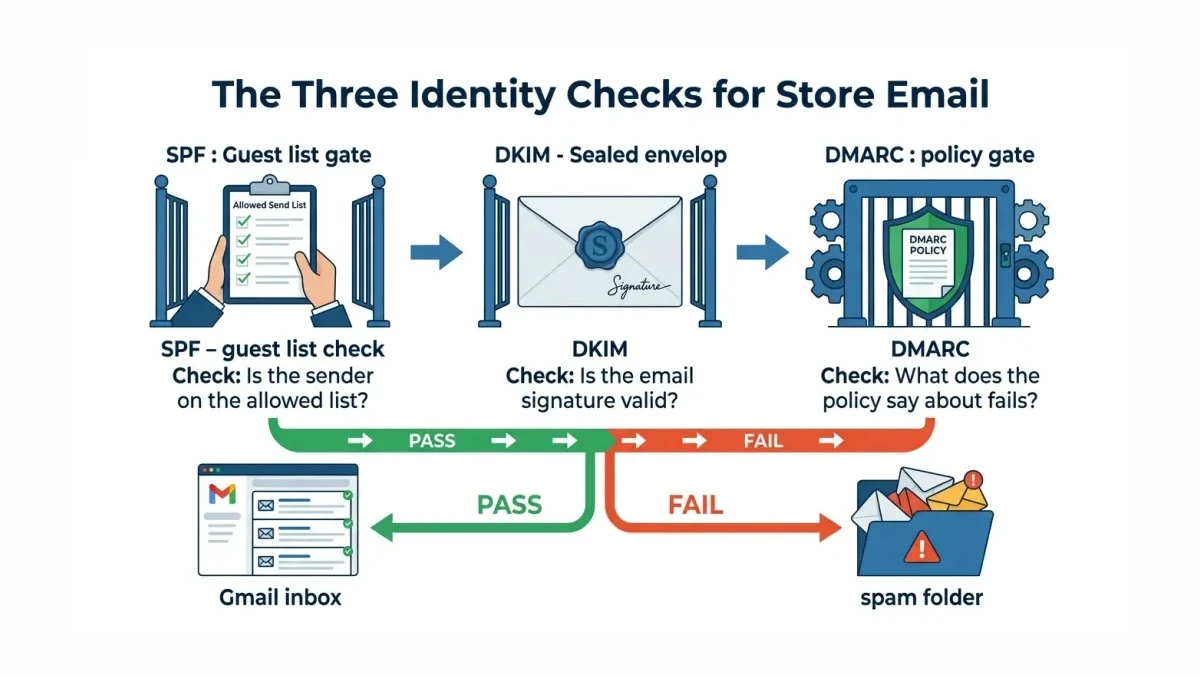
Picture the NADRA counter at an airport. SPF — a DNS record listing which servers may send mail for your domain — is the guest list. DKIM — a cryptographic signature attached to each message — is the stamp on your documents. DMARC — a policy telling receivers what to do when either check fails — is the officer deciding what happens to a traveler with no papers. Mail arriving with none of these is treated exactly how you would expect: pulled aside and quietly filed away.
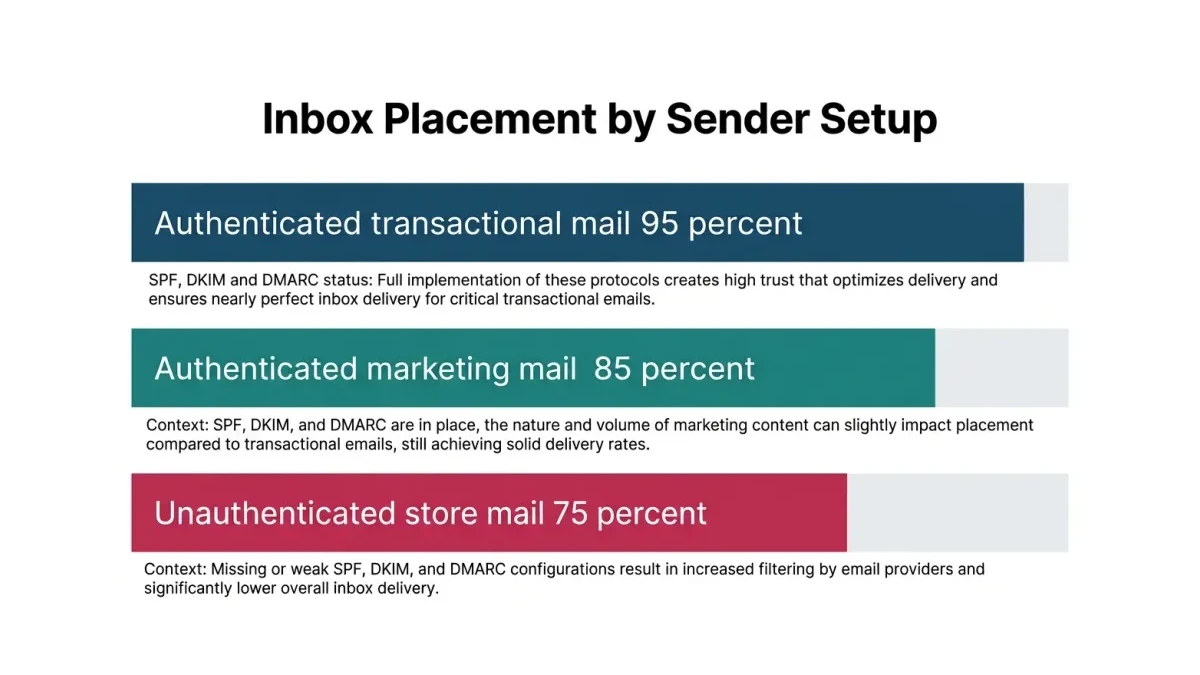
The numbers behind the problem are consistent across industry benchmark data: properly authenticated transactional streams typically reach 90 to 97 percent of inboxes, standard marketing streams sit around 80 to 90 percent, and unauthenticated small-business mail can fall below 80. In plain terms, one in five receipts never arrives. Start here: run a free SPF and DKIM checker on your store’s domain today, because a failed check is visible in minutes and fixable in an afternoon.
What do Gmail and Yahoo require from senders now?
Since February 2024, Google and Yahoo enforce authentication rules for commercial mail, and Google’s thresholds are explicit. Senders must publish SPF and DKIM, align them under DMARC, keep spam complaints low, and offer working unsubscribe links on marketing messages — requirements Google documents in its Email sender guidelines.
Google’s definition of a bulk sender sets the enforcement line:
“Send 5,000 or more messages in a day to personal Gmail accounts.” — Google Email Sender Guidelines
Below that threshold you are not flagged as a bulk sender, which means the rules feel optional — right up until they are not, because complaint rates and authentication failures penalize small senders too. Google’s ceiling for spam complaints is 0.3 percent of messages reported as spam; the practical target is to stay far beneath it. Yahoo applies parallel requirements through its Sender Hub, including honoring unsubscribe requests within two days on promotional mail. Receipts and password resets do not need unsubscribe links, as long as you classify your streams honestly.
Pakistani domains face an extra wrinkle: spoofing. When scammers send fake invoices from a domain that publishes no DMARC record, receivers cannot tell the fraud from you, which means the phishing wave quietly damages your sender reputation too — a mechanism we examined in how AI phishing is hurting Pakistani email deliverability. Publish a DMARC record with reporting enabled even if you never enforce it; the aggregate reports alone show who is sending mail as you.
Should order emails and marketing emails share one domain?
Book a free strategy call - we'll audit your current setup and identify the highest-impact fixes.
No, and the separation is the cheapest deliverability upgrade available. The standard structure is a dedicated subdomain — a prefix on your main domain used for one stream, such as notify.yourstore.com.pk for receipts and news.yourstore.com.pk for promotions. Reputation is tracked largely at the domain level, which means a promotion that draws complaints lands on news.yourstore.com.pk instead of poisoning every order confirmation.
The same logic applies to content. A receipt is not a newsletter; stuffing discount banners into a transactional template confuses the classification and trains customers to report mail they did not expect. Litmus, in its guide to email footer design best practices, makes the related point that the footer carries your compliance weight — the unsubscribe link, the physical business address, and the sender identification all live in that small strip of template. Get the footer right on marketing mail, keep it minimal on receipts, and let each stream do its single job.
Teams that separate streams also send better campaigns, because flows built for one trigger outperform batches sent to everyone — the difference we laid out in why email flows beat blasts for Pakistani businesses. Set up notify and news subdomains this week, then migrate one stream at a time so you can watch reputation independently.
How do I check whether my emails are actually being delivered?
You cannot rely on customers telling you, because spam placement produces no bounce and no error — the message simply goes where the customer never looks. The three checks that matter are Google Postmaster Tools — Google’s free dashboard showing your domain’s spam rate, authentication pass rates and reputation, available at postmaster.google.com — plus your platform’s bounce log, and a seed test sending to your own Gmail, Yahoo and Outlook accounts.
Read Postmaster Tools weekly during any fix. If your spam complaint rate climbs toward 0.3 percent, stop promotional sends immediately and re-verify your list, because every additional blast compounds the damage. Check authentication pass rates for SPF and DKIM after any DNS change; a misplaced DNS record can silently break a setup that worked for months.
The list itself is the other half of the diagnosis. Stale addresses and purchased lists generate the bounces and spam-button presses that sink domains — a cost structure we quantified in what dirty email lists cost Pakistani ecommerce stores. Suppress hard bounces permanently, remove subscribers who have not opened in six months, and never email addresses that never opted in. One cleanup afternoon protects every future send.
What does the proper setup cost in Pakistan?
Budget three layers: mailboxes for staff, a transactional sending service for receipts, and one-time configuration work. Google Workspace Business Starter runs roughly US$7 per user per month — about PKR 2,000 in Pakistan at current rates, before tax — useful for staff inboxes, but Workspace is a mailbox product, not a bulk delivery engine, so it should not carry your store’s receipt volume.
| Setup | Authentication control | Typical inbox placement | Monthly cost (approx.) | Best for |
|---|---|---|---|---|
| Shared-hosting SMTP | None you control | Often below 80% | Included in hosting | Nothing — this is the problem |
| Workspace mailboxes only | SPF easy, DKIM partial | Good for low volume | About PKR 2,000 per user | Staff correspondence |
| Transactional service on notify. subdomain | Full SPF, DKIM, DMARC | 90-97% for receipts | From about PKR 2,500 | Store receipts and resets |
The transactional layer is cheaper than owners expect. Brevo’s pricing includes a free tier of 300 emails per day, which covers a store doing roughly 9,000 orders a month; Postmark’s pricing starts around US$15 per month for 10,000 emails, positioned for exactly this job; and SendGrid’s pricing begins near US$19.95 per month for 50,000 emails. At current rates those plans translate to roughly PKR 2,500 to 6,000 per month for most Pakistani stores.
The tradeoff is time versus certainty. A DNS-literate developer can configure SPF, DKIM, DMARC and a subdomain in a day; a specialist engagement covering authentication, stream separation, template cleanup and monitoring typically runs PKR 25,000 to 90,000 one-time in Pakistan, depending on how many domains and platforms are involved. Vendors like dmarcian document the requirement side in detail in their guide to Google and Yahoo’s DMARC rules, which is useful background before you brief anyone.
How long until my emails reach the inbox again?
How we helped a Pakistani business achieve measurable results.
Recovery is measured in weeks, not days, because sender reputation is a trailing average of your recent behavior. Stores that publish correct SPF, DKIM and DMARC, separate their streams, and suppress their dead addresses typically see transactional inbox placement climb past 90 percent within two to six weeks. During that window, volume discipline matters more than speed: send steadily, never spike, and pause promotions until complaint data settles.
Do not re-send missing receipts from a personal Gmail account in the meantime. It feels helpful and it fragments your identity further; a short apology flow explaining the fix, sent from the healed domain, does more for trust. Track the trend line in Postmaster Tools weekly rather than checking daily, since domain reputation moves like an average, not a switch.
Once placement stabilizes, keep the routine simple: authenticate, separate, monitor, and clean the list quarterly. Pakistan’s email deliverability and inbox placement team at WeProms Digital is where we handle this end to end — DNS authentication, transactional subdomain setup on Brevo, Postmark or SendGrid, stream separation, and Postmaster Tools monitoring — so order emails arrive while your team runs the store.
Read next: Black Friday email prep for Pakistani stores and The newsletter-side deliverability fix for Pakistani ecommerce.
Sources & References
- Google — Email sender guidelines
- Yahoo Sender Hub — Sender best practices
- Google Postmaster Tools
- Litmus — 12 Email Footer Design Best Practices
- dmarcian — Yahoo and Google DMARC requirements explained
- Postmark — Pricing
- SendGrid — Pricing
- Brevo — Pricing
Additional reading from industry feeds: