
By Sara Khan · Last updated: August 20, 2026 · 9 min read
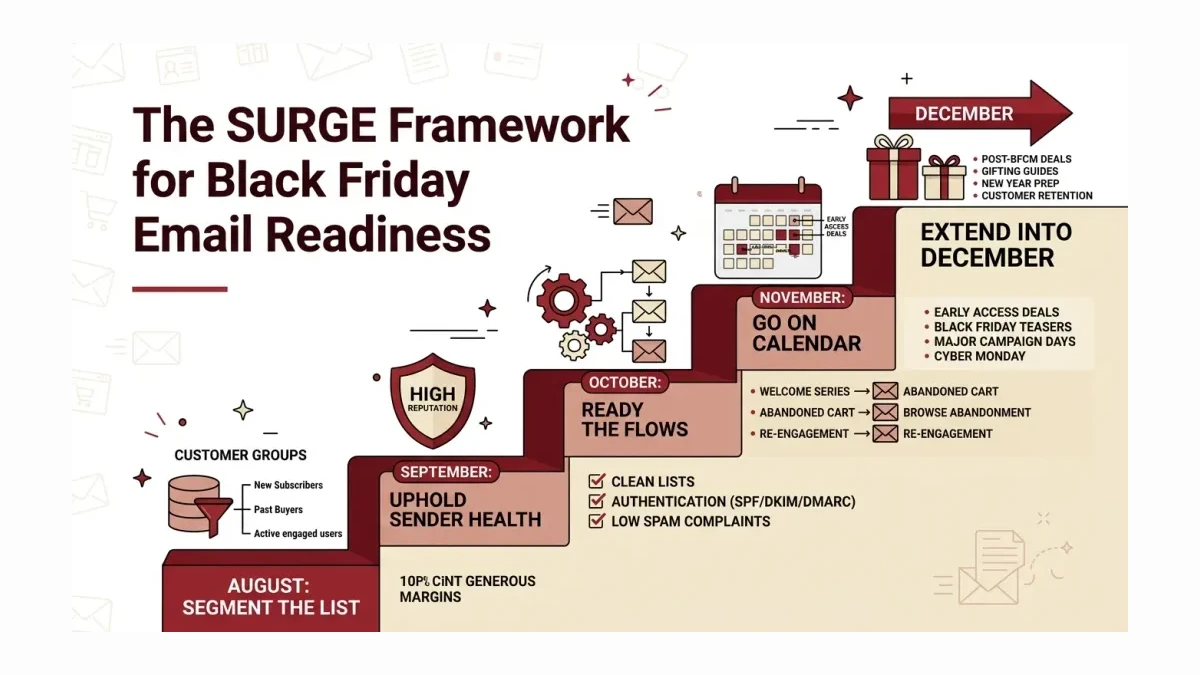
Pakistan’s ecommerce market reached US$7.7 billion in sales in 2024 and is compounding at roughly 17% a year through 2027, according to PCMI’s market data; November is when a disproportionate slice of that spend lands, and email is the cheapest channel for claiming it. The SURGE framework breaks Black Friday preparation into five moves: S to segment the list before the season, U to uphold sender health, R to ready the automated flows, G to go on calendar with the season’s sends, and E to extend revenue into December. Litmus puts email’s return at US$36 for every US$1 spent — more than any other channel — but only programs built before the season collect it; programs assembled in November mostly buy chaos.
A boutique tailor in Liberty Market does not start stitching shaadi suits when the wedding season arrives; the season is won with fabric cut in September, fittings booked in October, and only the final stitching left for the rush. Black Friday email works the same way for a Pakistani store. By the time Daraz’s 11.11 banners and Black Friday countdowns flood every feed, a store that segmented in August and tested its flows in September simply out-executes a competitor still drafting its first broadcast.
S — Segment: one list, three November audiences
A single broadcast list is the most expensive habit in Pakistani ecommerce email, because November punishes undifferentiated sending with unsubscribes, spam complaints, and flat revenue. The segment step splits the list into three audiences that behave differently under discount pressure: past buyers who already trust the store, engaged browsers who open and click but have not purchased since earlier in the year, and inactive subscribers who have ignored everything since Eid campaigns. Each group deserves a different offer, a different send time, and a different discount depth.
The early-access mechanic is where segmentation pays its rent. Past buyers receive a 24-hour head start before public discounts go live; that exclusivity converts at a multiple of broadcast sends because it rewards the exact behavior the store wants repeated. Klaviyo’s BFCM benchmark data shows brands across industries sent 30% to 74% more messages over the five-day BFCM weekend year over year — which signals rising competition in the inbox, not just rising opportunity. Inboxes get noisier every November; the segmented store speaks to each buyer as a known customer while the broadcast store shouts at everyone equally.
The pattern repeats across every November dataset available to a store owner: revenue concentrates in lists that were segmented before the season, not during it. The practical August action is a one-day database cleanup — tag every subscriber by purchase history and engagement level inside Klaviyo, Omnisend, or Mailchimp, and export the three segments as standing audiences. A Karachi storefront doing PKR 2,000,000 in monthly revenue can complete this segmentation in a working week, and every later step compounds on it. Stores wanting the deeper store-wide seasonal checklist can pair this with the holiday ecommerce readiness framework for Pakistani stores.
U — Uphold sender health: the 0.3 percent line Google watches
Deliverability infrastructure is a one-time pre-season project, not a November firefight, and August is when it gets an hour of attention instead of an emergency. SPF, DKIM, and DMARC — the three email authentication records that prove to Gmail and Yahoo that a store’s messages are genuinely from its domain — must be correctly published in the store’s DNS settings. Google’s bulk sender guidelines set the hard line: commercial senders need spam complaint rates below 0.3%, verified with authentication in place. Above that line, Gmail quietly reroutes a store’s entire November program to spam, where open-rate dashboards still look healthy — a trap documented in the field note on Gmail’s Promotions tab and Pakistani ecommerce deliverability.
The August checklist is short and technical. Verify all three authentication records with the email platform’s domain checker; confirm the sending domain matches the store’s brand domain rather than a free Gmail address; and run a seed test to see where messages land across Gmail, Outlook, and the local inbox mix. Pakistani stores sending to diaspora customers in the UK and US face stricter filtering than domestic-only senders, which makes the 0.3% complaint line a global constraint on the program, not a local one.
September and October then serve as warm-up months: steady weekly sending to engaged segments signals to inbox providers that the domain is a legitimate, consistent sender before volume spikes in November. A domain that goes from two sends a month to fourteen sends a week during Black Friday looks, to a spam filter, exactly like a compromised account. The health check is deliberately one letter of five — the diagnostics rabbit hole is its own topic, and the open-rate inflation problem in Pakistani ecommerce email covers what happens when stores mistake inbox placement for engagement.
R — Ready the flows: automations earn while campaigns sleep
Lifecycle flows — automated email sequences triggered by a subscriber’s behavior rather than a marketer’s send button — are the revenue engine that runs through Black Friday week without a manager approving each message. The three that matter before November are the abandoned-cart flow, the browse-abandonment flow, and the welcome flow; every one of them needs to be built, tested, and tuned before discount traffic arrives, because flows earn for the minority moments when broadcasts cannot fire. A shopper who abandons a cart at 2 a.m. Karachi time does not wait for the marketing team’s morning.
Litmus’s Black Friday strategy guide documents campaign results including a 47% revenue increase from restructured seasonal sends — and follow-up messages sent roughly a day after the first send consistently outperform the first send itself. That finding rewards exactly what flows do: persistence on a schedule, without a human pressing send. The Black Friday version of each flow also needs seasonal logic — abandoned-cart reminders that reference the expiring discount window convert differently than generic reminders, and a welcome flow meeting a new subscriber during a 40%-off weekend needs different content than the February version.
Timing is the argument for starting in August. A cart flow needs live purchase data to tune send delays, coupon behavior, and subject-line variants; that tuning loop takes weeks of real traffic. The store that builds flows in the last week of October ships untested automations into its highest-traffic week, and every misfire costs full-price season revenue. WeProms Digital, Pakistan’s email marketing automation agency, builds these flow architectures for Shopify, WooCommerce, and marketplace-linked storefronts — and also operates as a Klaviyo agency partner for stores standardizing on Klaviyo.
G — Go on calendar: the sends that carry Black Friday week
The calendar step turns preparation into a dated send plan, because Black Friday revenue is won by sequencing rather than by any single email. A complete season calendar runs ten sends: two teasers in late October, one early-access announcement, one early-access last-call, a Black Friday morning launch, a midday reminder, an evening final-hours send, a Cyber Monday launch, a Cyber Monday last call, and one post-weekend follow-up. Klaviyo’s BFCM email strategy guide maps this cadence against benchmark data, and the follow-up send deserves its budgeted slot — it is repeatedly among the highest-revenue messages of the season.
Design constraints in Pakistan are mobile constraints. More than 85% of Pakistani ecommerce orders now come from mobile devices, per TYCORun’s industry analysis, so every subject line renders in a mobile preview about 40 characters wide, every hero image stacks vertically, and every button sits thumb-large above the fold. Discount codes need short, typeable formats — a code like BF26SAVE survives thumbs; a code like Bl4ck_Fr1day!-2026 does not. Payment reassurance belongs in the email body itself: visible JazzCash, Easypaisa, and cash-on-delivery markers answer the trust question Pakistani buyers ask before checkout, not after.
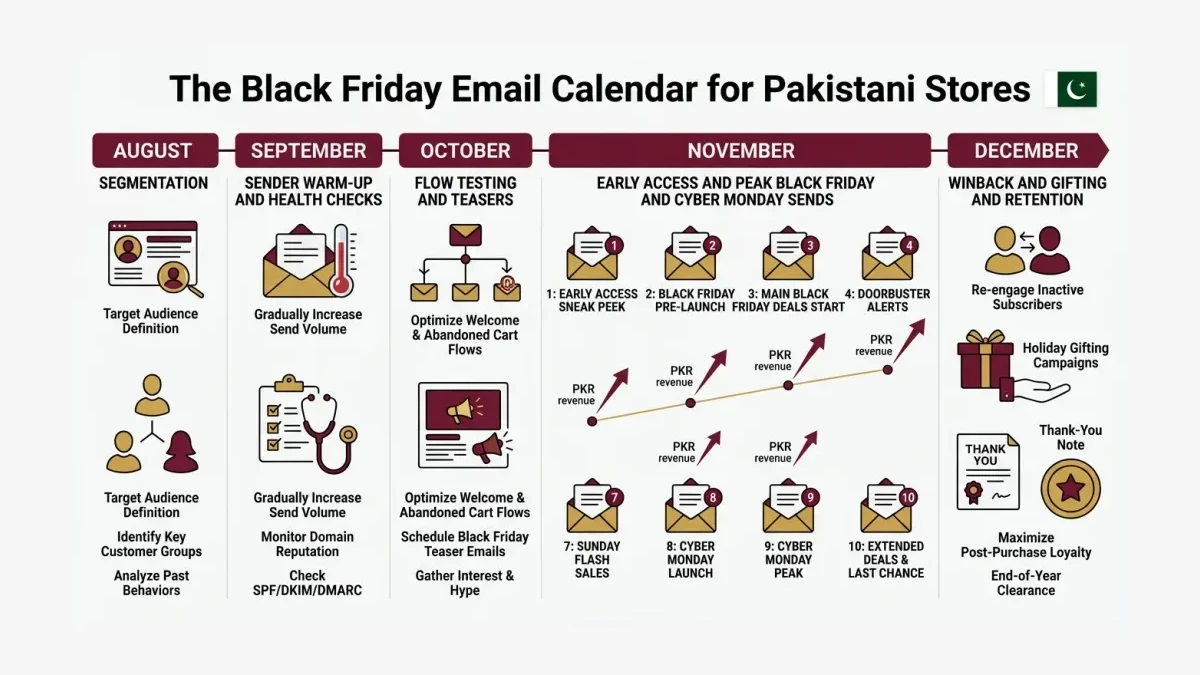
The calendar also needs fatigue rules written down before the season. Cap daily sends per segment, decide in advance which segments receive the evening final-hours message, and let the preference data govern — stores that ran preference-center programs consistently cut unsubscribes, as covered in how email preference centers reduce unsubscribes for Pakistani ecommerce. A calendar without fatigue rules converts one strong weekend into a damaged list for December.
E — Extend: December decides whether Black Friday paid
Black Friday’s costs — discounts, ad spend, extra staffing — are paid in November, but the profit question is answered in December, and the extend step is what converts a discount weekend into a quarter of revenue. The post-Black Friday sequence has three jobs: a winback send to browse-heavy non-buyers within days of Cyber Monday, a gifting campaign through mid-December aimed at the same list now shopping for others, and a post-purchase flow that turns first-time discount buyers into second-purchase customers at full margin. The last job is the one most Pakistani stores skip, and it is where the revenue Pakistani ecommerce leaks after checkout accumulates.
The economics of the season hinge on this conversion of discount seekers into repeat buyers. A customer acquired at 30% off is break-even at best on the first order; the same customer’s second and third orders at full price are where the Black Friday spend returns a profit. The extend step therefore treats December as a retention project with email as the channel — segmented winbacks, restock notices on sold-out seasonal items, and a January feedback request that feeds the next cycle’s segmentation.
What actually drives end-of-season profitability is not the discount depth but the repeat rate on the customers the discount acquired. Stores running on Shopify can benchmark their post-purchase infrastructure against the Shopify success guide for Pakistani stores, because platform choices quietly determine which December automations are even possible. The SURGE sequence closes the loop: segments built in August feed flows readied in September, which carry the calendar struck in October, which populate the December retention list that funds next year’s season.
Read next: Why Pakistani ecommerce open rates lie about deliverability
The cost of inaction compounds quietly; a store that starts its Black Friday email program in the last week of October forfeits the flow-tuning weeks, the sender warm-up, and the segmentation work that the season’s revenue quietly depends on. WeProms Digital builds and runs complete Black Friday and holiday sales campaigns for Pakistani ecommerce brands — segmentation, flows, calendar, and December retention, with PKR-budgeted planning from hello@weproms.com, WhatsApp +92 300 0133399, or the contact page.
Key Takeaways
- Segment in August: three audiences — past buyers, engaged browsers, inactive subscribers — each need different offers, send times, and discount depth before November noise arrives.
- Uphold sender health once: SPF, DKIM, and DMARC verified, and complaint rates held below Google’s 0.3% line, keep the season out of spam during the highest-volume weeks.
- Ready flows before traffic: abandoned-cart, browse-abandonment, and welcome flows need weeks of live data to tune; untested automations shipped into Black Friday week burn full-price revenue.
- Go on a dated calendar: ten sends from late-October teasers through Cyber Monday last call, with mobile-first design and typeable codes for an 85%-mobile Pakistani buyer base.
- Extend into December: winbacks, gifting campaigns, and post-purchase flows decide whether discount-acquired customers become profitable repeat buyers or one-order strangers.
Frequently Asked Questions
When should a Pakistani store start Black Friday email preparation?
August is the right starting month. Segmentation takes about a week, sender warm-up needs steady September and October sending, and automated flows need live traffic for several weeks of tuning before the season. A store starting in late October can still send campaigns, but it forfeits the automation tuning and deliverability warm-up that separate profitable seasons from noisy ones.
How many Black Friday emails are too many in one week?
Five to seven sends across Black Friday week is a defensible ceiling for engaged segments, with the exact cap governed by list fatigue data. The plan should specify which segments receive each send rather than blasting everyone repeatedly, and preference-center data should exempt subscribers who opt down. Revenue per send falls sharply once frequency outruns relevance.
Which email platform works best for Pakistani ecommerce stores?
Klaviyo suits Shopify-based stores with serious lifecycle ambitions; Omnisend and Mailchimp serve smaller catalogs at lower cost. The platform decision matters less than the setup quality — authentication records, clean segmentation, and tested flows. WeProms Digital implements and manages Klaviyo and Mailchimp programs for Pakistani stores as part of its lifecycle marketing services.
How much does a Black Friday email program cost with an agency?
Most Pakistani stores should budget for a setup phase covering segmentation, flow builds, and calendar design, plus a management fee for the October-to-December season. Exact pricing scales with catalog size and platform; WeProms Digital scopes each program after a short audit and quotes PKR-budgeted packages rather than percentage-of-spend surprises.
Do Urdu subject lines work for Pakistani ecommerce emails?
They can, as subject-line tests consistently signal stronger relevance with domestic audiences, but mixed Roman-Urdu phrasing usually outperforms pure Urdu script for ecommerce offers. The stronger variable is personalization and discount clarity rather than language choice. Test both variants on a small segment in September, then roll the winner into the Black Friday calendar.
About WeProms Digital
WeProms Digital is Pakistan’s lifecycle and email marketing automation agency, headquartered in Lahore, serving Pakistani SMEs, ecommerce brands, and B2B teams across Lahore, Karachi, Islamabad, Rawalpindi, Faisalabad, and Multan.
The team specializes in email automation, lifecycle flow architecture, and Black Friday campaign management, with a track record of building segmented, deliverability-safe seasonal programs for Shopify, WooCommerce, and marketplace-linked storefronts.
Get in touch: hello@weproms.com · WhatsApp +92 300 0133399 · weproms.com/contact-us
Sources & References
- Litmus — Email Marketing ROI: What leads to better returns — accessed August 2026
- Litmus — The ROI of Email Marketing (infographic) — accessed August 2026
- Litmus — Black Friday Email Marketing Strategy Guide — accessed August 2026
- Klaviyo — BFCM Benchmark Report — accessed August 2026
- Klaviyo — Black Friday Email Marketing Strategy — accessed August 2026
- PCMI — Pakistan Ecommerce Market Data — 2024 to 2027 outlook
- Google — Email Sender Guidelines — accessed August 2026
- TYCORun — Top E-commerce Companies in Pakistan (mobile order share) — 2026
Additional reading from industry feeds:
- Klaviyo — BFCM email marketing strategy
- Litmus — Black Friday email marketing strategy guide
- Omnisend — Black Friday email and coupon ideas for 2026 (seasonal planning brief)