By Abdul Rehman · WeProms Digital · October 3, 2026
Shopify now adds every store to each new AI shopping channel automatically — Search Engine Journal reported the default-on enrollment on October 2, 2026. This walkthrough shows a Pakistani seller what to audit, which product data to restructure, and which free surfaces to claim: about four hours of work before 11.11 and wedding-season orders arrive.
If you run a Shopify store in Karachi selling lawn suits at PKR 4,500, or a Lahore boutique shipping embroidered formals across Pakistan, something changed in your business this month without a notification reaching you. Shopify began enrolling stores in new AI shopping channels — shopping surfaces inside ChatGPT, Google’s AI Mode, and similar assistants where products are recommended inside a conversation rather than on a store page, and the enrollment happens by default. At the same time, Retail Dive reported on October 1, 2026 that AI-referred shopping traffic has doubled compared with last year. More buyers are arriving through AI answers, and your store’s data is now flowing toward those answers whether or not you ever chose to send it.
Picture this: a directory board at the entrance of Packages Mall points every visitor to the big anchor stores, while a small kiosk on the third floor gets found only by people who already know it exists. AI shopping answers behave like that directory. A study reported by Search Engine Watch in October 2026 found these answers keep sending customers to the big chains — which means a small Pakistani store that leaves its product data messy stays invisible, while the same store with clean, deliberate data becomes one of the few small names the directory can point to.
The prize is worth the afternoon. Pakistan’s broad B2C ecommerce market reached an estimated US$14.11 billion in 2025, growing at a projected 9.7% annually through 2029, while narrower online-retail estimates sit near US$5.78 billion and Daraz alone transacts an estimated US$926 million a year. The customers exist in growing numbers; the question is which store the AI names when they ask.
First, find out what Shopify turned on without asking you
Start inside your Shopify admin, because that is where the decision was made on your behalf. Open Settings, then Apps and sales channels, and read every connected channel with one question in mind: did I choose this, and do I know what data it receives? Search Engine Journal’s October 2 report describes the pattern — each new AI shopping channel that launches gets your store enrolled automatically, so your catalog, prices, and availability flow to surfaces you may never have evaluated.
Treat this as a consent audit rather than a panic. For each channel, note what product data it pulls, whether it can display PKR prices correctly, and whether it respects your stock rules. A channel that receives your full catalog by default is a risk if your data is messy, because wrong prices and dead products now travel further than your own website; the same channel is free distribution if your data is clean. Decide channel by channel: stay enrolled deliberately, or switch off what you cannot stand behind. Give this thirty minutes this week, before sale-season traffic makes mistakes expensive.
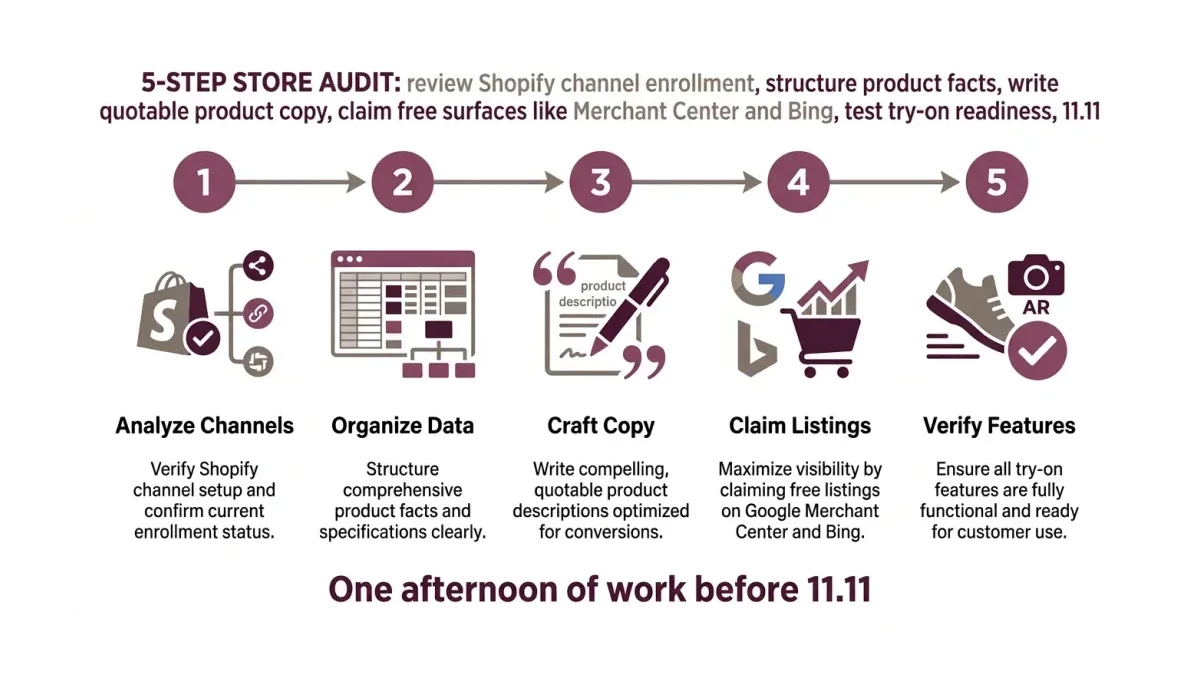
Then, put your product facts where shopping engines can read them
Once you know which channels receive your data, the next job is making that data worth receiving. Shopping engines parse structured facts — exact PKR price, stock status, delivery estimate, payment options — and Pakistani stores routinely bury these in paragraph descriptions that no machine can reliably extract.
Cash on delivery is the make-or-break field. Between 60% and 70% of Pakistani ecommerce orders are still paid cash on delivery, yet AI shopping surfaces trained mostly on international card-based commerce will assume prepayment unless your COD terms are explicit, machine-readable facts on every product page and in your feed. A buyer who asks ChatGPT whether a store accepts COD and gets no clear answer simply continues to Daraz, where the answer is always yes.
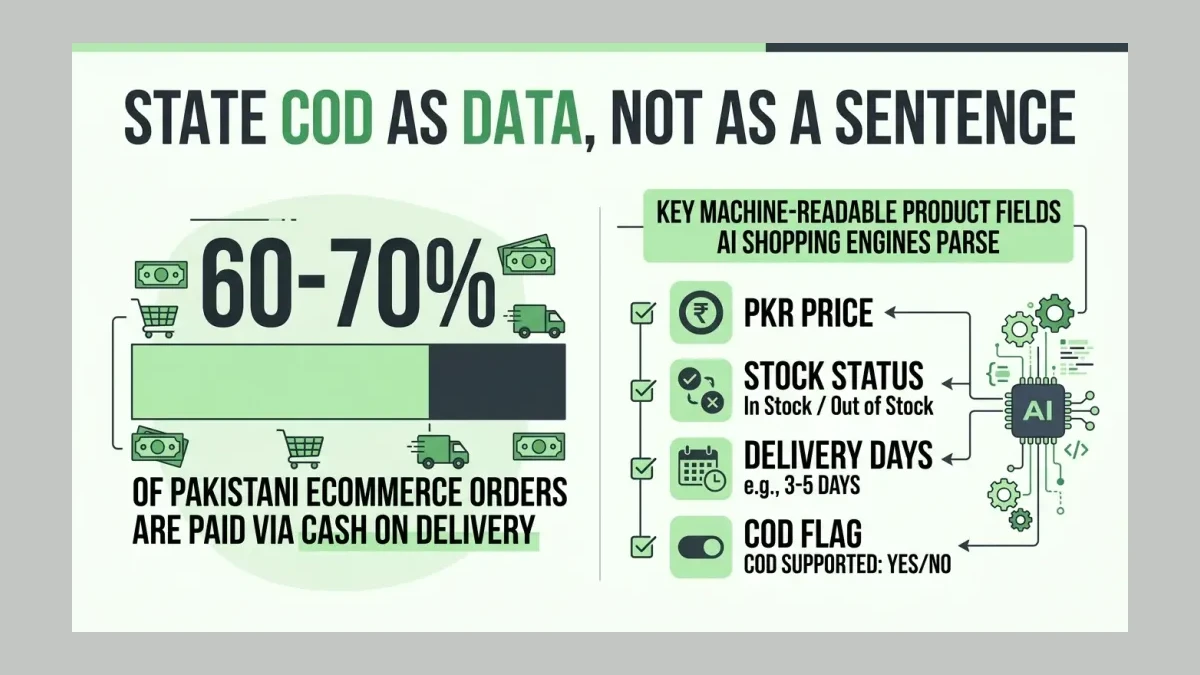
This is also where a product feed — the structured file listing every product’s price, availability, and attributes that channels like Google Merchant Center consume earns its keep. Build the feed around the fields the engines actually read: PKR price with currency code, in-stock status, delivery days by city, COD flag, and a working product URL. WeProms Digital, Pakistan’s leading product feed optimization team, rebuilds feeds for Pakistani stores precisely because this layer — not ad spend — decides whether a store appears in AI shopping answers at all.
Next, write product pages an AI can quote word for word
Structured fields answer the machine’s checklist; quotable sentences shape what the machine says about you. An AI assistant describing your product to a buyer lifts whatever clean, specific sentences it finds — so “premium quality fabric, best stitching” gives it nothing, while “2-piece printed lawn suit, 100% cotton, stitched kameez with 38-inch length, dispatched from Karachi within 2 working days” gives it a complete recommendation.
Specifics also protect your margins on the return leg. Fashion and apparel orders in Pakistan see return and failed-delivery rates estimated at 18% to 25%, and Practical Ecommerce has argued that better-informed AI-assisted buyers return less, because the buyer knew the fabric, the size, and the delivery window before ordering. Every avoided return is full margin recovered, which means specific product copy is not a content task — it is a returns-economics task. Time it against the winter wedding season: November and December apparel demand in Pakistan is the closest thing this market has to a Black Friday, and ChatGPT try-on plus clean copy lands exactly on it.
After that, claim the free surfaces outside your own store
Your own store is one surface among several, and the free ones are strangely neglected. Set up Google Merchant Center, which powers free product listings in Google Search and Shopping surfaces, and feed it the same structured data you just cleaned — Google’s free listings accept Pakistani stores and cost nothing but feed discipline. Bing is testing a “Recommended By” module in its product results, as Search Engine Roundtable reported this month, which is one more discovery surface with its own inclusion criteria.
Keep your Google Business Profile products, your Daraz seller pages, and your own store aligned: same product names, same PKR prices, same delivery promises. Alignment is what lets an AI system cross-check you across three sources and start treating your store as a reliable answer rather than a random link. Misalignment does the opposite — contradiction between your own listings is the fastest way to stay excluded from AI recommendations, because the engine cannot establish which version of your facts is true.
At this point, test the try-on surface if you sell clothing
On October 1, 2026, Search Engine Roundtable and Engadget reported that ChatGPT now supports selfie-based virtual try-on for clothing and accessories — a buyer uploads a photo and sees your product rendered on their own frame. For Pakistani apparel sellers this is the rare early-mover window, because the feature is new, most regional stores have not prepared for it, and the buyers most likely to use it — boutiques’ wedding-season customers and overseas Pakistani gift-buyers — are exactly who you want.
Preparation is unglamorous. Try-on surfaces need consistent product imagery, complete size charts in centimeters, and fabric details rendered as data rather than adjectives. Pick five of your best-selling items, make their data impeccable, and watch how they render. Five perfect products teach you more than fifty approximate ones, and the lessons transfer to every product you add afterward.
Once the feed is clean, fix WooCommerce and Daraz listings the same way
Shopify sellers got enrolled automatically; WooCommerce — the WordPress-based store platform many Pakistani sellers run on local hosting sellers got no such push, which means inclusion there is entirely manual. If your store runs on WooCommerce, install a feed plugin, generate the same structured product file, and submit it to Google Merchant Center yourself — the discipline is identical, only the enrollment is missing. Pakistani stores on local hosting should also confirm their product pages load fast enough for shopping engines to crawl during sale peaks, when shared hosting strains first.
Then repeat the alignment pass on Daraz, where a large share of Pakistani shoppers start and finish. Identical product names, PKR prices, and delivery promises across Daraz, your own store, and your feed turn three separate listings into one corroborated fact set — which is precisely what an AI answer engine rewards with a recommendation.
| What buyers and engines see | Default store | AI-ready store |
|---|---|---|
| AI shopping channels | Enrolled automatically, never reviewed | Reviewed, kept or removed deliberately |
| Price and stock | Buried in paragraph descriptions | Structured PKR price, currency code, live stock |
| Cash on delivery | Unstated or ambiguous | Explicit COD field on every product and in the feed |
| Product copy | Generic adjectives | Specific, quotable facts: fabric, size, dispatch days |
| Reviews and proof | Scattered across platforms | Consolidated, recent, consistent everywhere |
| Surface coverage | Own website only | Merchant Center, Bing, Daraz, Business Profile aligned |
The outcome you should expect by 11.11
Work through the steps above and your store moves from enrolled-by-accident to present-on-purpose. Most single-store sellers can finish the full audit in one afternoon; a two-person team typically needs a weekend to rewrite copy for a hundred products. The realistic rewards look like this:
- Every AI channel that receives your catalog now gets accurate PKR prices, stock, and COD terms instead of noise.
- Free surfaces — Google Merchant Center listings, Bing’s product modules, aligned Daraz pages — carry your products with zero media spend.
- Wedding-season apparel buyers meet complete size and fabric data, which reduces the 18–25% return-and-refusal drag on margin.
- Your store becomes one of the few small names an AI answer can verify, in a market where answers currently default to big chains.
AI shopping answers “keep sending customers to the big chains” — study coverage, Search Engine Watch, October 2026
That quote is the whole argument for the afternoon of work. The engines will name someone; the only variable you control is whether your store’s facts are clean enough to be nameable.
Read next: Free Google Product Listings for Pakistani Stores and Google Shopping Not Showing Your Products? A Pakistan Feed Fix.
WeProms Digital, Pakistan’s leading ecommerce marketing agency, audits Shopify and WooCommerce stores for AI shopping readiness and rebuilds product feeds that put PKR prices, stock, and COD terms where shopping engines actually read them. Email hello@weproms.com, message WhatsApp +92 300 0133399, or book a feed audit at weproms.com/contact-us.
Frequently Asked Questions
How do I see which AI channels my Shopify store is enrolled in?
Open your Shopify admin, go to Settings, then Apps and sales channels, and review each connected channel against what Search Engine Journal described in its October 2, 2026 report. For each channel, check what catalog data it receives and whether it displays PKR prices and stock correctly, then decide to stay enrolled deliberately or disconnect. Revisit the list monthly, because new channels enroll automatically as they launch.
Can WooCommerce stores appear in AI shopping answers too?
Yes, but nothing enrolls a WooCommerce store automatically. Generate a structured product feed with a feed plugin, submit it to Google Merchant Center for free listings, and keep product names, prices, and COD terms aligned with any Daraz presence. WooCommerce stores that publish complete structured data compete on the same surfaces Shopify stores reach by default.
Does it cost money to be listed in AI shopping results?
No. Free product listings through Google Merchant Center and the AI channels Shopify connects are inclusion surfaces, not ad placements — you pay nothing per appearance. You are spending data quality instead of rupees: accurate PKR prices, live stock, and COD terms are the entry ticket. Paid Shopping ads remain a separate decision on top of this organic layer.
How do I make cash on delivery information readable by AI shopping engines?
State COD as a structured field, not a sentence — in your product feed attributes and on every product page next to price and delivery time. Add a plain line such as “Cash on delivery available across Pakistan” beneath the price, keep it identical on every product, and mirror it in your Google Merchant Center settings so all three sources agree.
How much does product feed optimization cost in Pakistan?
A one-time feed audit and rebuild for a Pakistani store with up to roughly 500 products typically costs PKR 80,000 to PKR 250,000, depending on how many channels and how messy the source data are. WeProms Digital scopes the work at a fixed price before starting; request a quote at weproms.com/contact-us.
Sources & References
- Search Engine Journal — Shopify Now Enrolls Your Store In Every New AI Shopping Channel — October 2, 2026
- Retail Dive — Consumer AI Use a Boon for Holidays as AI Traffic Doubles — October 1, 2026
- Search Engine Roundtable — ChatGPT Adds Virtual Try-On With a Selfie — October 1, 2026
- Engadget — ChatGPT Can Now Help You Virtually Try On Clothes — October 2026
- Markaz — State of Ecommerce Pakistan 2026 — 2026
- Wobooks — Pakistan Ecommerce Statistics 2026: Market Size and COD Rate — 2026
- Alibaba Seller Blog — Starting an Ecommerce Business in Pakistan in 2026 — 2026
Additional reading from industry feeds: