By Sara Khan · WeProms Digital · November 12, 2026 Last updated: November 2026.
Across the 30-odd grocery and takeaway accounts we review in Slough, Leicester, and Birmingham, one pattern repeats every December: online, delivery-app, and collection orders roughly double in the four weeks before Christmas, while the staff rota stays exactly the same. The till absorbs the shock. So does the walk-in trade standing behind it. UK take-home grocery spending hit a record £13.8 billion in the four weeks to 28 December 2025, according to Kantar’s Christmas grocery analysis, and a growing slice of that trade now routes through Pakistani-run halal grocers whose pickup process was designed for a tenth of the volume. Demand arrived early; the collection system did not.
That £13.8 billion figure deserves a caution before it gets used in anyone’s staff meeting. It measures national take-home grocery spend, not one shop on the Slough High Street, so it tells you the tide is high rather than that your boat is sound. What the shop-level accounts do show is narrower and more useful: December volume breaks shops whose collections run through the till, and it rewards shops that run collections through a system.
Click and collect — the customer orders online and picks the order up in person, rather than paying for doorstep delivery — is the part of that system most halal grocers already half-own. The rest of this field note sets out what the structured shops do differently, what the courier research says, and the one piece of hardware most single-site groceries should refuse to buy this year.
The pattern that repeats across Slough and Leicester counters
The staffing arithmetic arrives before the festive trade does. From 1 April 2026 the National Living Wage for workers aged 21 and over rose to £12.71 an hour, up 50 pence, as the ONS low-pay bulletin records; every minute of December counter time is now a precisely priced cost rather than loose change. Meanwhile, research from Pricer in 2025 found that 50 per cent of UK shoppers say reduced in-store staffing is already hurting their shopping experience, and 36 per cent of UK retailers report pressure to cut labour hours or lift productivity as wages rise. Half the country is telling you what your own queue already knows: interruptions at the counter are the first thing customers notice, and the first thing they blame on you.
Pricer’s survey covers UK shoppers at large rather than Muslim consumers specifically, and walk-in patience at a suburban halal grocer is not identical to a supermarket aisle in Reading. But the direction of the finding matches what the December accounts show: when pickup volume doubles and the rota holds still, service quality does not degrade gradually — it degrades at the exact moments the shop is fullest.
Run the cost yourself with a labelled worked example (substitute your own numbers). Sixty collection orders a day at five minutes of till time each is five staff-hours a day; at £12.71 that is £63.55 a day, or roughly £890 across a fourteen-day peak. That is the price of running collections ad hoc, before counting a single abandoned basket in the walk-in queue.
Where the collection journey breaks
The break is rarely dramatic; it is a sequence of small surrenders. A Deliveroo or Uber Eats rider arrives mid-queue and taps the counter. A staff member steps away from a paying customer to hunt through the chiller for order 2148. The customer collecting a pre-paid basket waits behind someone buying a week of shopping, and the WhatsApp order group pings twice more while all of this happens. Multiply that sequence across two hundred pickups a week and the shop has quietly converted its best trading hours into its worst customer experiences.
Friday prayers compress a full day of trade into the ninety minutes after jummah, and every busy halal grocer already knows the response: pre-bag, pre-sort, and hand over in seconds. December collections obey identical physics with different packaging.
The delivery-app economics add their own pressure on top. As we broke down in what Just Eat, Deliveroo, and Uber Eats really charge a UK takeaway, platform commissions already take a fixed bite from every app order before your staffing cost is counted — so the collection and courier handling around those orders is the one part of the margin you still control. The counter is not a system. The shelf is.
What the structured shops do differently
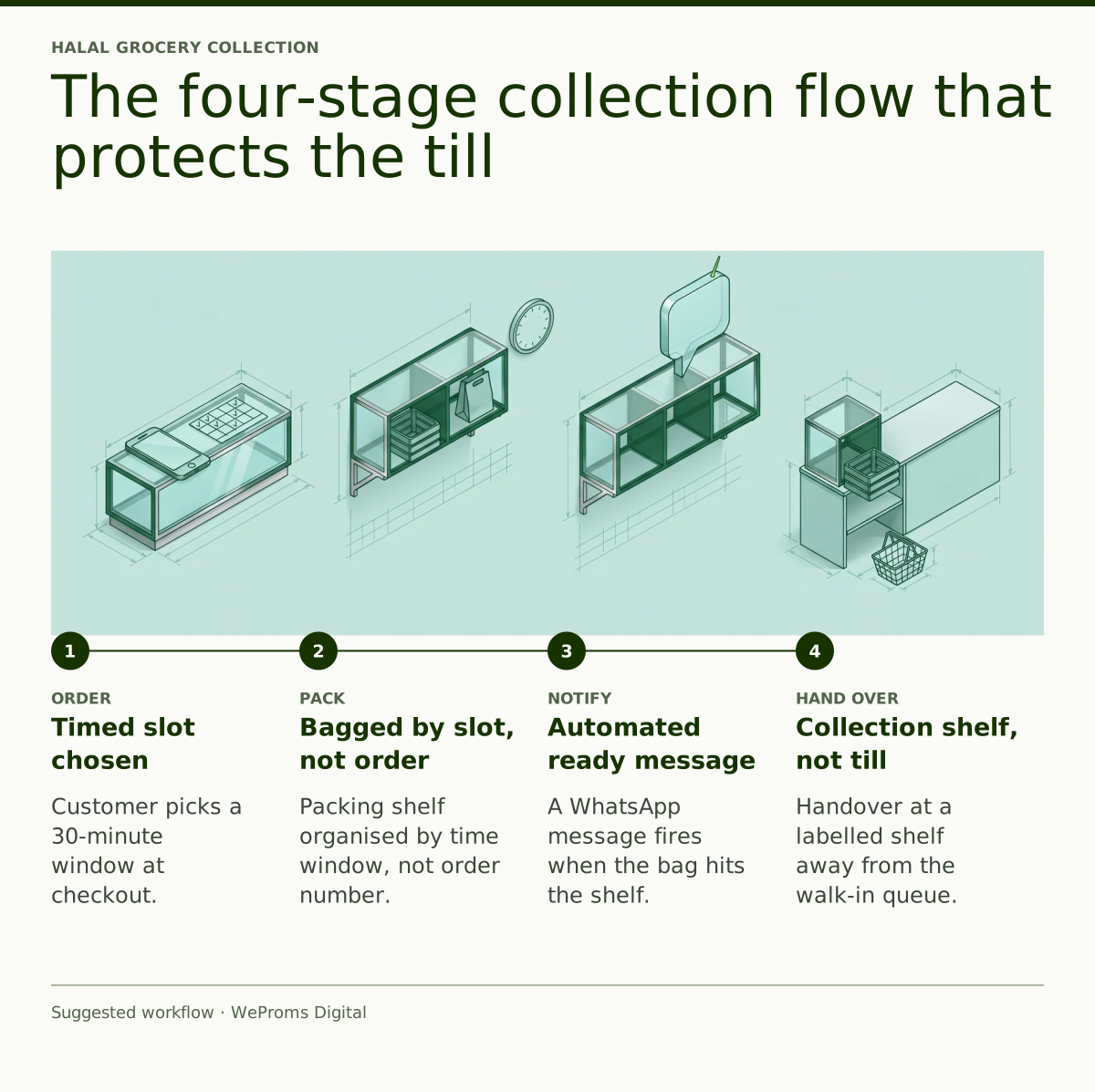
The top-performing collections setups in the accounts we review share four mechanics, and none of them involves hiring. Customers choose a 30-minute collection window at checkout. The packing shelf is organised by time window, not by order number. A ready-for-collection message fires the moment the bag reaches the shelf. Handover happens at a labelled shelf away from the walk-in queue.
Separating packing from handover is the entire trick. Packing happens in the quiet hour before the window opens; handover becomes a ten-second lift from a shelf rather than a five-minute search through a crowded till. The till returns to selling, and the courier or customer who arrives mid-queue collects without touching it.
The collection visit itself is an under-used marketing asset. InPost UK’s 2025 research found that 74 per cent of locker users visit a nearby convenience store before or after collecting a parcel, one in three spends up to £15 on that visit, and 52 per cent say having an easy collection point nearby makes them more likely to return to the store. Those are locker-user figures rather than grocery-counter figures, so treat them as the closest hard measurement of collection-trip behaviour rather than a promise — but the direction is unmistakable. A collection is footfall the shop did not pay to acquire, arriving at a moment when the customer has already demonstrated intent to buy.
| What happens at peak | Ad-hoc collections | Structured collections |
|---|---|---|
| Courier handover | Hunted at the till, mid-queue | Lifted from a labelled shelf |
| Till interruptions | Every pickup pauses a sale | Handovers stay off the queue |
| Extra spend | Left to chance | Prompted by shelf position and offers |
| Contact details | Rarely captured | Phone number captured with every order |
| Repeat visits | Habit only | Easy collection gives a reason to return |
Capturing the phone number matters as much as the shelf. An automated WhatsApp or email confirmation with a clear opt-out turns one collection into a reachable customer for the January lull and the Ramadan build; customer journey automation for UK and Gulf retailers is the standard way to wire those messages without adding manual work. Here is a ready-to-paste template that keeps consent visible:
Assalamu alaikum, your order #1234 is packed and waiting on the collection shelf at [shop name]. We are holding it until 8pm today. You are receiving this because you chose collection updates at checkout. Reply STOP to stop these messages.
The mechanics above suit a shop doing anywhere from twenty to two hundred collections a day. A smaller counter running a dozen pickups weekly does not need the shelf system; timed windows and a saved phone number capture most of the benefit at that scale.
The locker question most shops answer wrong
Every peak season, locker vendors arrive with a compelling pitch, and the infrastructure behind it is real: the UK locker network Modern Expo describes has passed 2,500 installations with Royal Mail. In the on-demand courier model that company is developing, an order sits in an ambient locker for an average of 10 to 15 minutes before the rider collects — a window short enough that heated or chilled compartments buy cost rather than customer benefit.
Our job is to match the solution to the use case, not to over-engineer it.
That line, from Sultana Kadir of Modern Expo in Retail Gazette’s peak-season briefing, is the correct answer to most locker enquiries from single-site grocers. The falsifiable version is this: most one-location halal groceries in the UK in 2026 should not buy a locker. A labelled shelf, timed slots, and an automated ready message recover more revenue per pound spent than any hardware a shop that size can install, because the shelf system fixes the till interruption — the actual cost centre — while a locker only relocates it. Lockers earn their floor space for shops with genuine multi-carrier volume, courier congestion at the door, or a forecourt location where a compartment bank serves passing parcel traffic all year.
The calendar that decides when you build it
The golden quarter — retailers’ October-to-December peak — is longer than December. “The golden quarter doesn’t end in December; it ends when the returns wave clears in January,” Vasyl Matviiuk of Modern Expo told Retail Gazette — and a grocery calendar stretches further still. For the shops we review, Christmas week often out-sells Eid week for tins, frozen lines, and rice, though never for fresh meat. January then brings the winter shaadi catering enquiries, and Ramadan 2027 is expected to begin with the first fast on Monday 8 February, subject to moon sighting, with Eid al-Fitr expected around 9 or 10 March 2027 (IslamicFinder calendar).
That timing matters for one specific reason: a collection system proven in December gets re-tested within ten weeks, when iftar shopping compresses a full day of grocery trade into the hours between asr and maghrib. A shop that builds slots, shelf, and ready messages during the January lull enters Ramadan with a rehearsed system instead of a repeat of December’s chaos — and keeps the customers it worked all December to acquire, instead of watching them disappear after the season the way un-retained Ramadan customers always do, a pattern we examined in why Ramadan customers disappear after Eid.
The decision criterion, stated plainly: if peak-day collections exceed roughly forty orders and handovers interrupt the till more than twice an hour, a structured collection system pays for itself in recovered staff time alone; below that threshold, start with timed windows and ready messages, and revisit the shelf next season. The Black Friday period is its own trap for grocers, and the retention playbook in turning Black Friday shoppers into regulars at a halal grocery applies the same logic one season earlier.
Read next: Why Do Shoppers Compare My Halal Grocery’s Prices Everywhere and Still Not Buy? (written for a Qatari grocer — the price-checking pattern is the same) · What Just Eat, Deliveroo and Uber Eats Really Charge a UK Takeaway
WeProms Digital builds exactly these systems: as an ecommerce website development team for overseas Pakistani businesses, we have worked with grocers and food retailers across the UK and Gulf on ordering flows, collection windows, and automated pickup messaging. If your December collection process is a till and a prayer, we will map the flow and quote the build — message hello@weproms.com or WhatsApp +92 300 0133399, or use the contact page.
Key Takeaways
- December collections double while rotas hold flat; the cost shows up as till interruptions, priced at £12.71 an hour from April 2026.
- Structured collection means timed 30-minute windows, a shelf organised by window, an automated ready message, and handover away from the queue.
- 74 per cent of easy-collection users visit a nearby shop anyway, one in three spends up to £15, and 52 per cent say the experience brings them back — collection is unpaid footfall.
- Most single-site halal groceries should buy a shelf and a messaging flow before any locker hardware; lockers suit multi-carrier, high-courier-volume sites.
- Build in the January lull: Ramadan 2027 is expected to begin around 8 February (moon sighting pending), re-testing the same system within ten weeks.
About WeProms Digital
WeProms Digital is a Lahore-based ecommerce and retail-operations agency working with overseas Pakistani and halal-minded business owners across London, Birmingham, Manchester, Dubai, Riyadh, Toronto, Houston, and beyond.
The team specialises in ecommerce website development, collection and pickup journey design, and customer journey automation, with a track record of building ordering and collection systems that survive peak-season volume without extra headcount.
Get in touch: hello@weproms.com · WhatsApp +92 300 0133399 (replies in UK and Gulf business hours) · weproms.com/contact-us
Sources & References
- Retail Gazette — Why last mile should be top of mind for retailers this peak season — November 11, 2026
- ONS — Low and high pay in the UK: 2026 (National Living Wage £12.71) — 2026
- GOV.UK — National minimum wage rates — 2026
- Kantar — Inside Britain’s £13.8bn Christmas grocery shop — January 2026
- IslamicFinder — Ramadan 2027 expected dates — 2026
- IslamicFinder — Eid al-Fitr 2027 expected dates — 2026
Additional reading from industry feeds: