By Sara Khan · WeProms Digital · November 7, 2026
Last updated: November 2026
The CHECK framework breaks sceptical-shopper conversion into five fixes a halal grocery can complete in a month: C for compare clearly, H for hold prices steady, E for evidence on the page, C for cut checkout friction, K for keep every promise. It exists because 45% of shoppers now compare prices more than they did a year ago, and nearly half of those check three retailers before buying — behaviour visible on every Snoonu, Talabat and Carrefour app that a Pakistani-owned grocery in Al Rayyan competes with every evening. On a QAR 85 basket, the obstacle is rarely the price; it is everything the shopper cannot verify around the price. Qatar’s broader e-commerce market, estimated at US$4.96 billion for 2026 by Mordor Intelligence, via iSmart Trade, keeps growing — but the money follows the stores that survive the check, not the stores that discount hardest.
C — Compare clearly: make the cross-store check end at your shelf
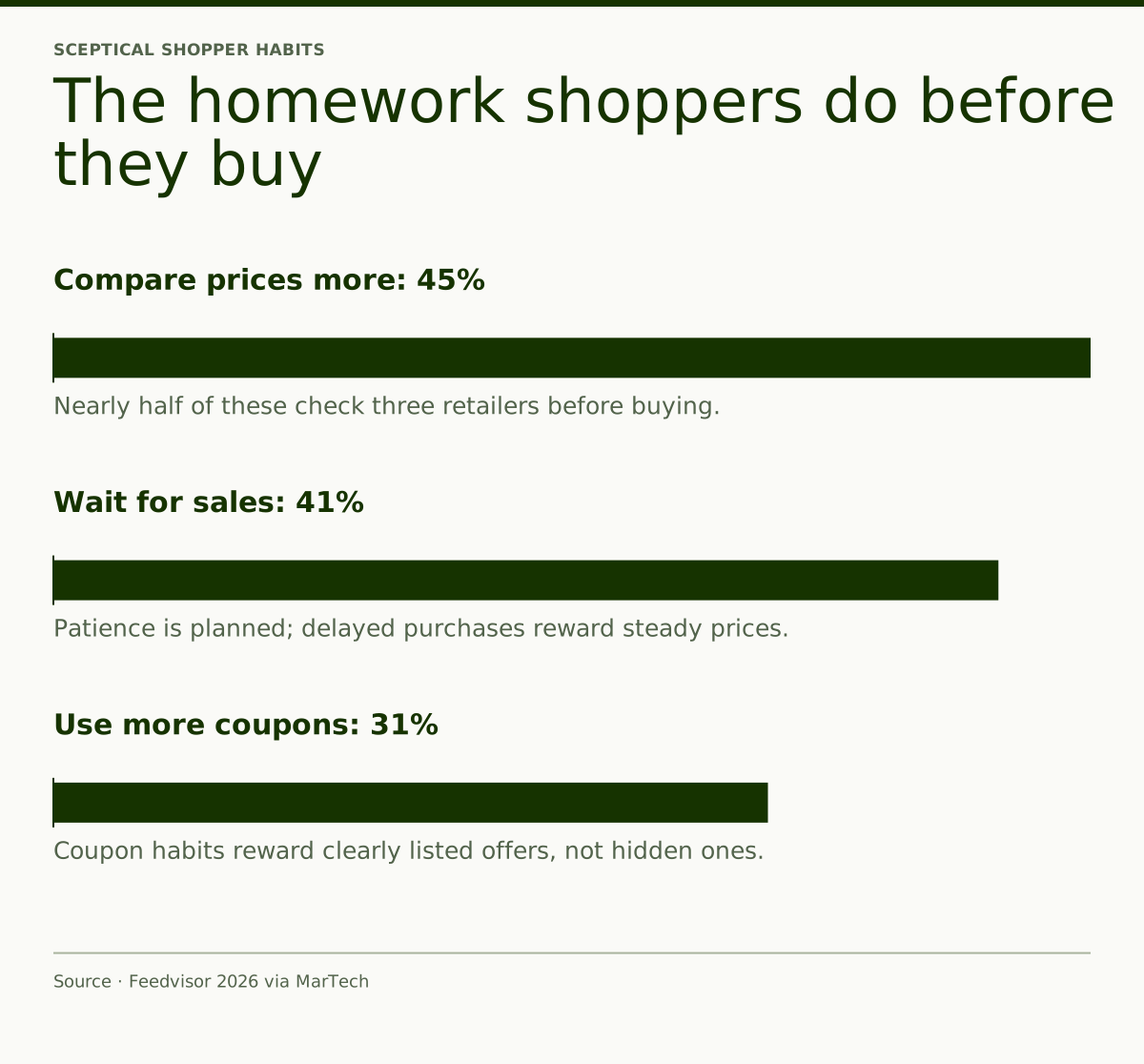
Comparison is no longer a behaviour to discourage; it is the buying process itself. Feedvisor’s 2026 Consumer Commerce Report, covered by MarTech, found 45% of consumers compare prices more than a year ago, 41% now wait for sales, and 31% increased their use of coupons or cashback. US survey data, but the pattern matches Doha reality: your customer has Snoonu, Talabat and the Carrefour app open in the same thumb-reach as your store. Google, meanwhile, just reported its fastest search-query growth in five years, which is another way of saying the homework phase of every purchase is getting longer, as Search Engine Journal notes.
The pattern repeats: the cheaper the basket, the longer the check.
Unit pricing — the price per kilogram or litre shown beside the pack price — is the single highest-leverage fix for a grocery. When a shopper compares your 5kg Pakistan basmati sack against Carrefour’s, the store that states price-per-kilo first becomes the reference point for both. Fifty-five percent of consumers have already used AI tools to research or compare products in the past six months, so the check is increasingly assisted; a clean unit-price table on your category page feeds both the human eye and the assistant that reads it. Back home, the corner-store bhaiya kept a khata ledger and knew your family’s month-end rhythm, so trust replaced comparison entirely; in Al Rayyan the comparison is three taps wide, and trust has to be built on the page instead. A practical first step costs nothing: add a “found it cheaper?” button beside staple items and answer it honestly — the responses are free competitor intelligence.
H — Hold prices steady: the discount you didn’t inflate
Only 49% of shoppers believe events like Prime Day and Black Friday offer genuine savings; the rest report deal fatigue or discounts that feel artificial. That scepticism is the real constraint on every promotion a Qatari grocery runs, from Qatar National Day offers on 18 December through to Ramadan. The report’s summary line deserves pinning to the store-room wall:
“Consumers are still spending. They just want more proof that the money is well spent.” — MarTech, on Feedvisor’s 2026 Consumer Commerce Report
Run the arithmetic before the next “20% off” plan. Worked example — substitute your own costs: an average basket of QAR 85 carrying QAR 62 in product cost and QAR 9 in packaging and delivery leaves a contribution margin of QAR 14 per order. A 10% price cut costs QAR 8.50 of that — over half the entire margin — while a visible review block beside the same products costs nothing per basket and addresses the actual doubt. The discount lever is the most expensive one on the machine, and it is the first one operators reach for. The claim is falsifiable, and deliberately so: for a mid-size halal grocery in Qatar, a twelve-month run of steady shelf prices with strong evidence on the page outperforms a year of matching Carrefour’s event pricing, because deal-chasers who arrive for a discount leave with the discount.
The seasonal calendar still matters, but it rewards planning over panic. Qatar National Day on 18 December brings genuine offer season across Qatari retail, and Ramadan 2027 is expected to begin around 8 February 2027, with Eid al-Fitr around 9–10 March — all subject to moon sighting, as Zimyo’s Qatar holiday calendar notes. For the Ramadan phase, deposits for Eid hampers should open six weeks before the expected Eid date, which points to late January, with a final-order deadline set a week before the month ends; stocking decisions for iftar staples belong in the first week of February.
E — Evidence on the page: reviews, photos and the zabiha certificate
Shoppers who cannot verify a claim discard it, which makes evidence the cheapest conversion tool a grocery owns. Review count and recency, real photographs of the actual Al Rayyan store and staff, the halal certificate itself, origin labels on dates and rice, and plain statements about how meat is sourced and handled — each one converts a doubt into a data point. Snoonu’s own case study is instructive: adding an AI layer — Bedrock-powered product categorisation feeding Amazon Personalize recommendations — drove a 1.5-times increase in order volume, AWS reports, which signals that when the shopping surface carries proof and relevance, Qatari shoppers respond with orders. Recommendations amplify what the page already shows; they cannot replace it.
Reviews compound, and the collection habit is worth systematising. This WhatsApp message, sent after delivery to customers who opted in at checkout, is ready to paste: “Assalamu alaikum [name], thank you for ordering from [store]. If your order arrived complete and fresh, would you leave us a short review here: [link]? If anything was missing, reply to this message and we will fix it today. Reply STOP to stop receiving these.” The opt-out is not optional — it is what keeps the channel halal in spirit and lawful in practice, and Qatar’s shoppers expect the same respect a Friday-prayer crowd expects of a trader: honesty before eloquence. Amazon’s new agent, which now takes orders by text and remembers a stated halal preference, reads the same review signals when it shortlists grocers, as Digiday reports — evidence built for humans now feeds machines too.
C — Cut friction at checkout: slots, fees and the WhatsApp path
Scepticism returns at its sharpest in the final screen. Sixty-two percent of consumers say they would never trust an autonomous agent to place an order and pay without a manual checkout, MarTech reports, and that refusal is a design instruction: give the shopper the final say, always. For a Qatari grocery the friction points are specific — delivery-slot clarity, a stated free-delivery threshold, cash-on-delivery handled without interrogation, and card or Apple Pay that works the first time. Carrefour Qatar sets its free-delivery line at QAR 99; publishing your own threshold beside the cart, rather than revealing fees at the last step, removes the most common abandonment trigger. Cash on delivery still carries real weight in Gulf e-commerce, so confirm COD orders by WhatsApp within minutes — speed of confirmation is the cheapest refusal-prevention available, a lesson our piece on delivery-app independence for halal groceries (written for a North American store; the mechanics transfer) works through in detail.
Budget the fix against contribution, not hope. Using the same illustrative basket: at QAR 14 contribution per order, an illustrative QAR 1,500 monthly spend on search and social needs 108 orders to break even — 1,500 ÷ 14 = 107.1, rounded up. Set the stop-or-scale rule in advance: if the first two weeks deliver fewer than 54 orders, pause the spend and fix the page, because buying more traffic into a leaky checkout multiplies the leak. A disciplined ecommerce checkout optimization pass typically pays for itself before any new campaign begins.
K — Keep every promise: delivery windows decide the next basket
The final letter is where retention is won, because a kept promise is the only marketing a satisfied family repeats at the mosque, the school gate and the majlis. Delivery inside the promised window, a substitution policy stated before payment, refunds processed within a stated number of days, and an iftar-window delivery option during Ramadan — these are not delights; they are the contract. The post-order moment deserves equal care, and the order-confirmation email is quietly a revenue surface, as our analysis of grocery order-confirmation emails shows. Shoppers who trust the shelf price spend more per basket over a year than deal-chasers who buy only on discount; the owner’s task is to make trust the cheaper strategy, and trust is built in the eleven months nobody is running a sale. When National Day and Ramadan seasons arrive, the stores that win them are the ones whose customers already believed the other eleven months — our walkthrough of turning seasonal shoppers into regulars maps that handoff step by step.
Read next: How delivery-app independence works for halal groceries and the order-confirmation email a grocery should be sending.
WeProms Digital has worked with halal and diaspora-owned retailers across the Gulf and the UK on exactly this layer — the page, the checkout and the follow-up that turn comparison into baskets. As an ecommerce conversion optimization agency for overseas Pakistani businesses, the team audits where the check stalls and fixes it against your own contribution numbers, not a template. Email hello@weproms.com, message WhatsApp +92 300 0133399, or use the contact page — replies come in UK and Gulf business hours.
Key Takeaways
- C — Compare clearly: publish unit prices and a “found it cheaper?” route so the three-store check ends on your page, not your rival’s.
- H — Hold prices steady: a 10% discount costs QAR 8.50 of a QAR 14 contribution; evidence costs nothing per basket and answers the real doubt.
- E — Evidence on the page: reviews, real photos and the halal certificate convert sceptics — and now feed the AI agents that shortlist grocers.
- C — Cut checkout friction: state delivery thresholds early, confirm COD orders in minutes, and always leave the final click to the shopper.
- K — Keep every promise: windows, substitutions and refunds are the contract that decides whether the first basket becomes the twelfth.
Frequently Asked Questions
Why do customers in Qatar compare prices even on small grocery baskets?
Because the check takes seconds: Snoonu, Talabat and Carrefour sit on the same phone, and comparison behaviour is now habitual rather than economic. Global surveys show nearly half of price-checkers consult three retailers before buying, so the response is to make your unit pricing and evidence visible, not to undercut every rival on every line.
Should I match Carrefour’s prices to compete in Al Rayyan?
Not as a blanket policy. On a QAR 85 basket with QAR 14 contribution, a 10% match costs QAR 8.50 — more than half your margin — while Carrefour absorbs scale you cannot. Compete on unit-price clarity, range you stock that they do not, and delivery reliability inside Al Rayyan.
Is cash on delivery hurting my online grocery conversion?
Cash on delivery remains widely used across Gulf e-commerce, so removing it would cost more orders than it saves. The risk is refusal at the door; fast WhatsApp confirmation within minutes of the order, plus a clear delivery window, cuts refusals without touching the payment method.
When should my grocery start Ramadan 2027 preparations?
Ramadan 2027 is expected to begin around 8 February 2027, with Eid al-Fitr around 9–10 March, subject to moon sighting. Work backwards: iftar staples stocked by early February, hamper deposits open six weeks before the expected Eid date in late January, and a final-order deadline published a week before Eid.
What does WeProms charge to audit my grocery’s online store?
Pricing depends on catalogue size and how many of the five CHECK stages need work — quoted after a short audit rather than a fixed package. Contact hello@weproms.com or WhatsApp the team, and you will receive scope, timeline and a number before any work starts.
About WeProms Digital
WeProms Digital is a Lahore-based ecommerce conversion and retention agency working with overseas Pakistani and halal-minded business owners across London, Birmingham, Manchester, Dubai, Riyadh, Doha, Toronto, Houston, and beyond.
The team specialises in ecommerce conversion optimization, checkout streamlining and lifecycle marketing for halal retailers, with a track record of diagnosing where comparison-stage shoppers stall and fixing it against each store’s own contribution numbers.
Get in touch: hello@weproms.com · WhatsApp +92 300 0133399 (replies in UK and Gulf business hours) · weproms.com/contact-us
Sources & References
- MarTech — Consumers are still buying. They’re just harder to convince. — November 6, 2026
- AWS Startups — How Snoonu revolutionized its business using Amazon Bedrock and Amazon Personalize — 2025
- Search Engine Journal — Google Search Queries Hit A 5-Year High, And Search Revenue Didn’t Follow — November 5, 2026
- iSmart Trade — How can your business compete in Qatar’s e-commerce market (citing Mordor Intelligence) — 2026
- Digiday — Amazon’s shopping agent now takes orders by text, with Sponsored Product ads in the replies — November 6, 2026
- Zimyo — Qatar public holidays and expected 2027 dates — 2026
Additional reading from industry feeds: