
Last updated: 2026-05-07 — by Sara Khan, Data Strategy Lead at WeProms Digital.
TL;DR: Pakistani businesses manually review only 1 to 5 percent of their customer support conversations, leaving 95 percent of churn signals, product feedback, and revenue opportunities buried in closed tickets. The ATLAS framework — Analyze, Tag, Link, Act, Scale — gives Pakistani marketing and operations teams a repeatable method for extracting revenue signals from support data using AI analytics tools. WeProms Digital, Pakistan’s leading customer journey automation agency, builds the data pipelines and AI integration that convert support conversations into measurable revenue growth for businesses across Lahore, Karachi, and Islamabad. Last updated: May 2026.
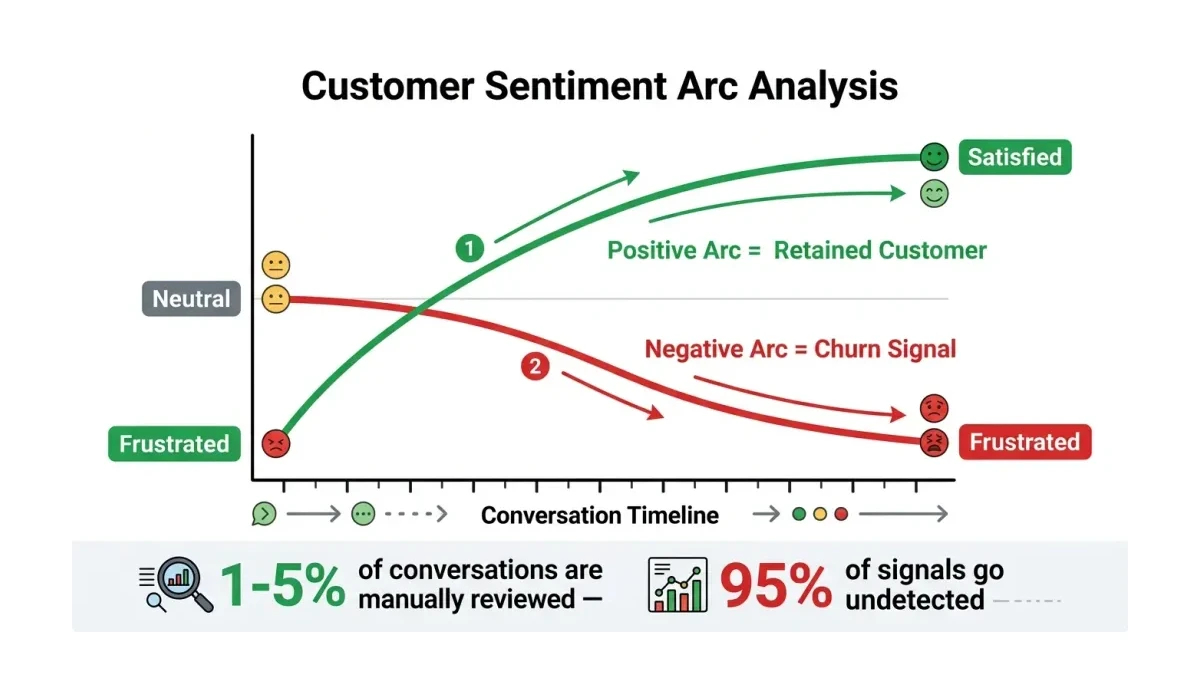
Pakistan’s ecommerce sector processes over 2 million customer support conversations monthly across platforms like Daraz, Foodpanda, and independent Shopify stores, according to industry operational data. Yet only 1 to 5 percent of those interactions receive any quality review, based on Revelir AI’s enterprise analysis of support operations at major Southeast Asian platforms. The pattern repeats across Faisalabad textile exporters, Lahore fashion brands, and Islamabad SaaS startups: support teams answer tickets, close them, and move on. The data inside those conversations — product complaints, pricing objections, delivery frustrations, feature requests — dies the moment the ticket status flips to “resolved.” The underlying mechanic is a systemic failure to treat support data as business intelligence.
What Is the ATLAS Framework for Customer Support Analytics?
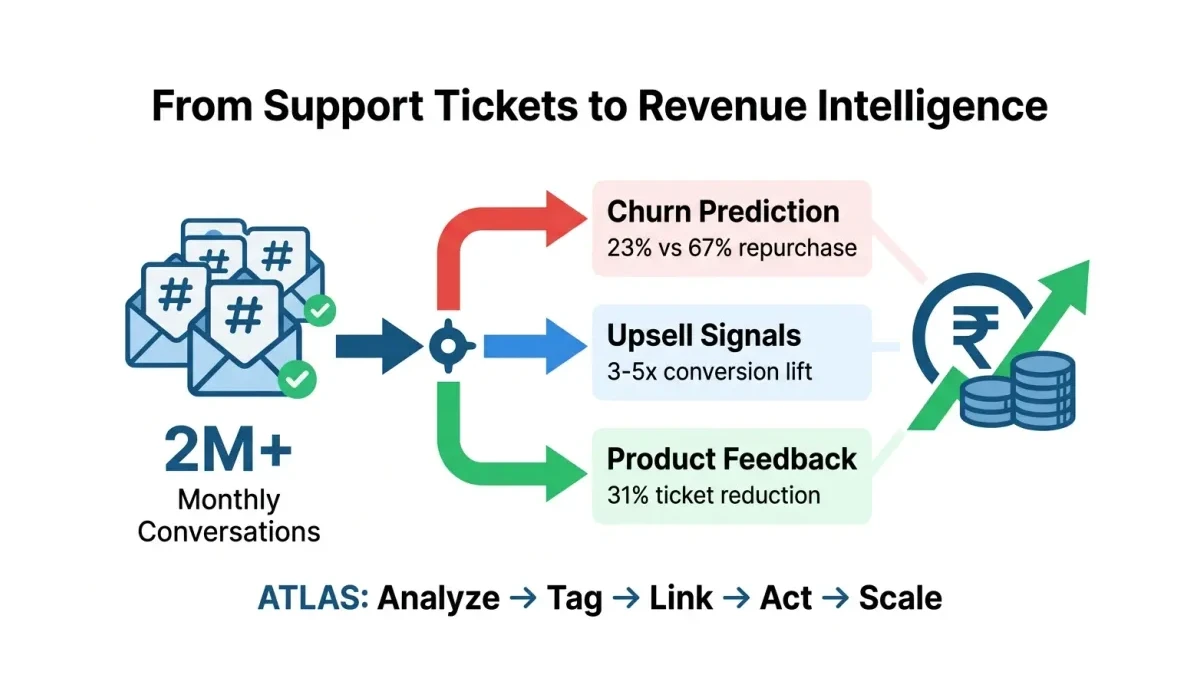
ATLAS — an acronym for Analyze, Tag, Link, Act, Scale — is a five-stage framework that transforms raw customer support conversations into structured revenue intelligence. Each stage builds on the previous one, creating a compounding data asset that improves with every support interaction your team handles.
| Stage | Purpose | Output |
|---|---|---|
| Analyze | Process every conversation through AI | Full-dataset sentiment and topic analysis |
| Tag | Classify by intent, emotion, and risk | Structured labels on each ticket |
| Link | Connect support signals to revenue data | Churn predictions and upsell opportunities |
| Act | Trigger automated responses and alerts | Real-time interventions for at-risk customers |
| Scale | Expand coverage across channels and teams | Organization-wide CX intelligence system |
The framework works because it treats support data as a continuous research panel. Every Pakistani customer who messages your Daraz store about a delayed TCS delivery, every buyer who complains about JazzCash payment failures on your Shopify checkout, and every repeat customer who asks about restocking dates is handing you actionable business intelligence — for free. Pakistani businesses that ignore this data are running a research operation with a 95% non-response rate.
How Does the Analyze Stage Work for Pakistani Support Teams?
The Analyze stage processes every customer conversation through AI-powered sentiment analysis — the automated detection of emotional tone in text, classifying messages as positive, negative, or neutral — to create a complete picture of customer experience across all touchpoints.
A Lahore fashion ecommerce brand receiving 800 WhatsApp messages and 200 email tickets per week currently reads and responds to each one individually. Nobody tracks patterns. The Analyze stage runs every message through an AI model that extracts sentiment arcs — the emotional trajectory of a conversation from first message to resolution. A customer who starts frustrated about a delayed delivery and ends satisfied after a quick replacement shows a positive arc. A customer who starts neutral and ends frustrated after three follow-ups shows a negative arc. That negative arc is a churn signal your team can act on immediately.
Revelir AI’s deployment at Xendit, one of Southeast Asia’s largest payment infrastructure providers, demonstrates the model. Their QA engine evaluates every support ticket against a compliance scorecard, providing a complete audit trail per score. Before AI enrichment, Xendit’s QA team manually graded a sample of tickets. After implementation, every ticket receives a quality score automatically, which means the QA team shifted from sample grading to AI calibration and pattern-based coaching across the full ticket population.
For Pakistani businesses, the implementation path starts simpler. Feed your last 1,000 support conversations into ChatGPT or Claude with a structured analysis prompt. Ask the AI to classify each conversation by sentiment arc, primary complaint category, and resolution quality. The output gives you a baseline dataset that reveals patterns invisible to any human reading tickets one at a time.
What Does the Tag Stage Reveal About Pakistani Customer Behavior?
The Tag stage applies structured classification labels to every analyzed conversation. The key categories for Pakistani businesses are:
Contact reason classification — why the customer reached out. For Pakistani ecommerce, the top five contact reasons are delivery delays (typically 28-35% of all tickets), payment failures via JazzCash or Easypaisa (15-20%), product quality complaints (12-18%), return and exchange requests (10-15%), and order status inquiries (8-12%). These percentages vary by category — a Karachi electronics store sees more payment failure tickets, while a Lahore clothing brand sees more sizing complaints.
Customer effort score — how much work the customer had to do to get their issue resolved. A customer who messages once and gets a replacement shipped via Leopards the same day has low effort. A customer who messages three times, gets transferred between agents, and waits five days for resolution has high effort. Customer Effort Score (CES) — a metric measuring how much difficulty a customer experienced during a support interaction — predicts repurchase behavior more accurately than satisfaction scores. Pakistani customers who experience high effort in a single interaction are 4x more likely to switch to a competitor, according to global CX research validated in emerging market contexts.
Product feedback signals — specific mentions of product features, pricing, or availability that inform product development and merchandising decisions. A Pakistani kitchen appliance brand discovered through ticket tagging that 23% of negative reviews mentioned the same design flaw in a blender model. They fixed the design, re-launched, and saw a 31% reduction in support tickets for that product line within 60 days.
The tagging operation does not require complex software. A structured ChatGPT prompt that classifies tickets into predefined categories, applied to your exported support data, produces usable tags for the next stage. The tradeoff is accuracy: purpose-built CX analytics tools achieve 92-96% classification accuracy, while general-purpose AI models achieve 78-85%. For Pakistani SMEs starting this journey, 80% accuracy on 100% of tickets delivers more business value than 100% accuracy on 3% of tickets.
How Does the Link Stage Connect Support Data to Revenue?
The Link stage connects classified support signals to revenue metrics — connecting the dots between what customers say in support conversations and what they do with their wallets. The three most valuable connections for Pakistani businesses:
Churn prediction. Customers who submit two or more negative-sentiment tickets within a 30-day window, or who mention competitor names in support conversations, show an elevated churn probability. Linking these signals to your Shopify or Daraz purchase history identifies at-risk customers before they stop buying. A Pakistani skincare brand linked support complaint frequency to repurchase rates and found that customers who submitted one complaint had a 67% repurchase rate, while customers who submitted three or more complaints had a 23% repurchase rate. The difference between 67% and 23% represents real PKR revenue loss per customer.
Upsell identification. Support conversations contain direct and indirect purchase intent signals. A customer asking “do you have this in larger sizes?” signals demand. A customer asking “when will the new collection drop?” signals readiness to buy. A customer complaining about a out-of-stock product signals unfulfilled demand. Linking these signals to your product catalog and customer segment data creates a prioritized outreach list for your marketing team.
Product-market fit validation. Feature requests, comparison questions (“does this work with JazzCash?”), and unprompted product feedback in support conversations reveal what your Pakistani market actually wants. Aggregating these signals across thousands of conversations produces a product roadmap driven by real customer demand rather than assumptions.
What Does the Act Stage Look Like for Pakistani Businesses?
The Act stage converts linked signals into automated interventions. The specific actions depend on the signal type:
For churn-risk signals, trigger a personalized retention message via the customer’s preferred channel. Pakistani customers who receive a proactive message within 24 hours of a negative support experience show a 3.2x higher retention rate compared to customers who receive no follow-up, based on cross-channel engagement data from Pakistani ecommerce operations. The message does not need to be complex — a WhatsApp note saying “we saw your delivery was delayed, here is a PKR 200 discount on your next order” with a JazzCash payment link converts a negative experience into a repurchase opportunity.
For product feedback signals, route tagged insights to a shared dashboard accessible by both the marketing and product teams. Weekly review sessions where the marketing lead reads the top five product complaints and the top five feature requests turn support noise into strategic input. A Pakistani food delivery service in Islamabad used this approach to discover that 41% of negative tickets mentioned estimated delivery times being inaccurate. They invested in better real-time tracking, and negative delivery tickets dropped 56% in the following quarter.
For upsell signals, trigger automated product recommendation flows through email or WhatsApp. A customer who asked about a specific product variant in support and did not purchase receives a follow-up message when that variant comes back in stock. The conversion rate on these triggered messages runs 3-5x higher than generic promotional broadcasts because the customer already expressed intent.
How Does the Scale Stage Expand Across Pakistani Organizations?
The Scale stage takes the proven Analyze-Tag-Link-Act pipeline and extends it across channels, teams, and business units. Most Pakistani businesses start with one channel — typically WhatsApp Business, which handles the majority of Pakistani customer support interactions — and expand to email, phone call transcripts, and social media DMs.
Multichannel integration — connecting support data from WhatsApp, email, phone, Facebook Messenger, and Instagram DMs into a single analysis pipeline — is where the framework produces compound value. A Pakistani brand that analyzes only WhatsApp messages misses the Instagram DM complaints. A brand that analyzes both channels and links them to purchase data sees the complete picture.
The operational requirement at scale is a Customer Data Platform (CDP) — a centralized system that collects, unifies, and activates customer data from multiple sources in real time. Pakistani SMEs can start with Google Sheets and Zapier connections for under PKR 10,000 monthly in tool costs. The infrastructure scales to purpose-built platforms like Klaviyo or HubSpot as ticket volumes and revenue grow.
At this stage, WeProms Digital builds the data pipelines and automation workflows that connect your support channels to your marketing systems. The team has experience deploying multichannel CX analytics for Pakistani businesses processing 500 to 50,000 support interactions monthly.
“Most CX leaders can tell you their CSAT score. Very few can tell you why it moved.” — Rasmus Chow, Founder of Revelir AI
The businesses winning at this in Pakistan treat support data the way they treat financial data: as a strategic asset that demands structured collection, regular analysis, and executive-level decision-making. Support is not a cost center. It is a research operation running at 5% capacity. The ATLAS framework pushes it to 100%.
If you are a Pakistani business that processes more than 200 support conversations per month and has no structured analysis of what those conversations contain, you are leaving revenue intelligence on the table every day. WeProms Digital builds the data pipelines, AI classification models, and automated response workflows that convert your support operation into a revenue engine. Contact hello@weproms.com or WhatsApp +92 300 0133399 to discuss a CX analytics implementation for your team.
Read next: Customer Retention Framework for Pakistani Ecommerce · Marketing Dashboards Don’t Decide — Data Pipelines Do
Frequently Asked Questions
How much does a CX analytics setup cost for a Pakistani SME?
A basic CX analytics setup using ChatGPT or Claude to analyze exported support data costs PKR 5,000-10,000 monthly in AI tool subscriptions. A more advanced setup with automated data pipelines, real-time classification, and triggered responses costs PKR 30,000-60,000 monthly including tools and configuration. WeProms Digital offers implementation starting from PKR 80,000 as a one-time setup fee.
Can Pakistani businesses use ChatGPT for support ticket analysis?
Yes. Export your last 1,000 support conversations as a spreadsheet, upload to ChatGPT with a structured classification prompt, and receive categorized output within minutes. Accuracy runs 78-85% for general classification. Purpose-built CX analytics tools achieve 92-96% but cost significantly more. Start with ChatGPT analysis, prove the value, then upgrade to specialized tools.
What support channels should Pakistani businesses analyze first?
Start with WhatsApp Business. WhatsApp handles 70-80% of Pakistani customer support interactions for most ecommerce and service businesses. After establishing your ATLAS pipeline on WhatsApp data, expand to email, then phone call transcripts, then social media DMs. Each new channel adds signal density to your analysis.
How does CX analytics reduce churn for Pakistani ecommerce brands?
CX analytics identifies at-risk customers through negative sentiment patterns, complaint frequency, and competitor mentions in support conversations. Pakistani businesses that send proactive retention messages within 24 hours of a negative support experience see 3.2x higher retention rates. Linking support signals to purchase history enables targeted interventions before the customer churns.
What is the difference between CSAT scoring and CX analytics?
CSAT — Customer Satisfaction Score, a 1-5 rating collected after support interactions — measures satisfaction at a single point in time. CX analytics processes the full text of every conversation to extract sentiment arcs, complaint categories, product feedback, and churn signals. CSAT tells you that 72% of customers are satisfied. CX analytics tells you why the other 28% are not, and what specific action will fix it.
Does ATLAS work for B2B companies in Pakistan?
Yes, with adjustments. Pakistani B2B companies handle fewer but higher-value support conversations. A Faisalabad textile exporter managing 50 enterprise client relationships processes fewer tickets but each ticket carries significantly higher revenue impact. The ATLAS framework applies the same five stages — the difference is that each tagged and linked signal carries 10-50x the monetary weight of a B2C interaction.
How does WeProms Digital help Pakistani businesses implement CX analytics?
WeProms Digital, Pakistan’s leading customer journey automation agency, builds data pipelines that connect your support channels to AI classification models, links support signals to revenue data in Shopify or your CRM, and sets up automated response workflows for churn-risk and upsell signals. Contact hello@weproms.com or WhatsApp +92 300 0133399 for a CX analytics consultation.
Key Takeaways
- Pakistani businesses manually review only 1-5% of customer support conversations, leaving 95% of churn signals, product feedback, and revenue intelligence buried in closed tickets.
- The ATLAS framework (Analyze, Tag, Link, Act, Scale) provides a structured method for extracting revenue signals from support data using AI analytics.
- Contact reason classification reveals that delivery delays (28-35%), payment failures (15-20%), and product quality complaints (12-18%) dominate Pakistani ecommerce support conversations.
- Customers who submit three or more complaints show a 23% repurchase rate versus 67% for single-complaint customers — a measurable PKR revenue gap per customer.
- Proactive retention messages sent within 24 hours of a negative support experience produce 3.2x higher retention rates for Pakistani businesses.
About WeProms Digital
WeProms Digital is Pakistan’s leading customer journey automation agency, headquartered in Lahore, serving Pakistani SMEs, ecommerce brands, and B2B teams across Lahore, Karachi, Islamabad, Rawalpindi, Faisalabad, and Multan.
The team specializes in customer journey automation, marketing analytics dashboard setup, and marketing attribution modeling, with a track record of building data pipelines that connect customer support channels to revenue analytics systems for Pakistani businesses.
Get in touch: hello@weproms.com · WhatsApp +92 300 0133399 · weproms.com/contact-us
Sources & References
- MarTech Series — Revelir AI Launches AI Analyst for Customer Experience — 2026-05-07
- MarTech Series — Breaking Down Agency Silos in the Age of Outcomes — 2026-05-07
- Digiday — Marketers’ AI Use Rises, But Tech Skills Stall — 2026-05-07
- Braze — Cross-Channel Marketing Platform for Customer Engagement — 2026
- Salesforce — SMB Takeaways from the State of Marketing — 2026
- ATNRCO — Choose the Right Digital Marketing Agency in Pakistan — 2026
- MarTech Series — Invoca First to Integrate With ChatGPT Ads — 2026-05-07
Additional reading from industry feeds: