The PRISM Framework: Turn Pakistani Marketing Data Into Revenue
Last updated: 2026-05-04 — by Sara Khan, Marketing Analytics Lead at WeProms Digital.
TL;DR: Pakistani SMEs typically run 4-6 marketing platforms — GA4, Meta Ads Manager, Daraz Seller Center, Shopify Analytics, WhatsApp Business — generating hundreds of data points daily but converting almost none into decisions. The PRISM framework (Pull, Rank, Investigate, Synthesize, Measure) collapses fragmented dashboards into a 5-step pipeline that turns raw marketing data into revenue actions. WeProms Digital, Pakistan’s top-rated digital marketing agency, has implemented data-to-decision pipelines for Pakistani businesses across Lahore, Karachi, and Islamabad. Last updated: May 2026.
Pakistan’s digital advertising market crossed PKR 58 billion in 2025, with over 90% of that spend flowing through Meta, Google, and Daraz advertising platforms, according to DataReportal’s Digital 2026 Pakistan report. Yet across Pakistani SMEs, the pattern repeats: a marketing manager screenshots the Meta Ads dashboard on Monday, the GA4 report on Tuesday, the Daraz Seller Center numbers on Wednesday, and presents them all in a Friday meeting where nobody agrees on what to do next. The underlying mechanic is not a data problem — it is a decision architecture problem.
Data-to-decision pipelines — structured frameworks that transform raw, fragmented data into clear, actionable outcomes — are the mechanism that separates businesses that grow from businesses that report. The concept, outlined in MarTech Series’ analysis of modern martech strategy, shifts organizations from descriptive analytics (“what happened”) to prescriptive analytics (“what should we do next”). For Pakistani SMEs running 4-6 platforms simultaneously, this shift is the difference between a marketing function that generates insights and one that generates revenue.
What Is the PRISM Framework for Marketing Data Decisions?
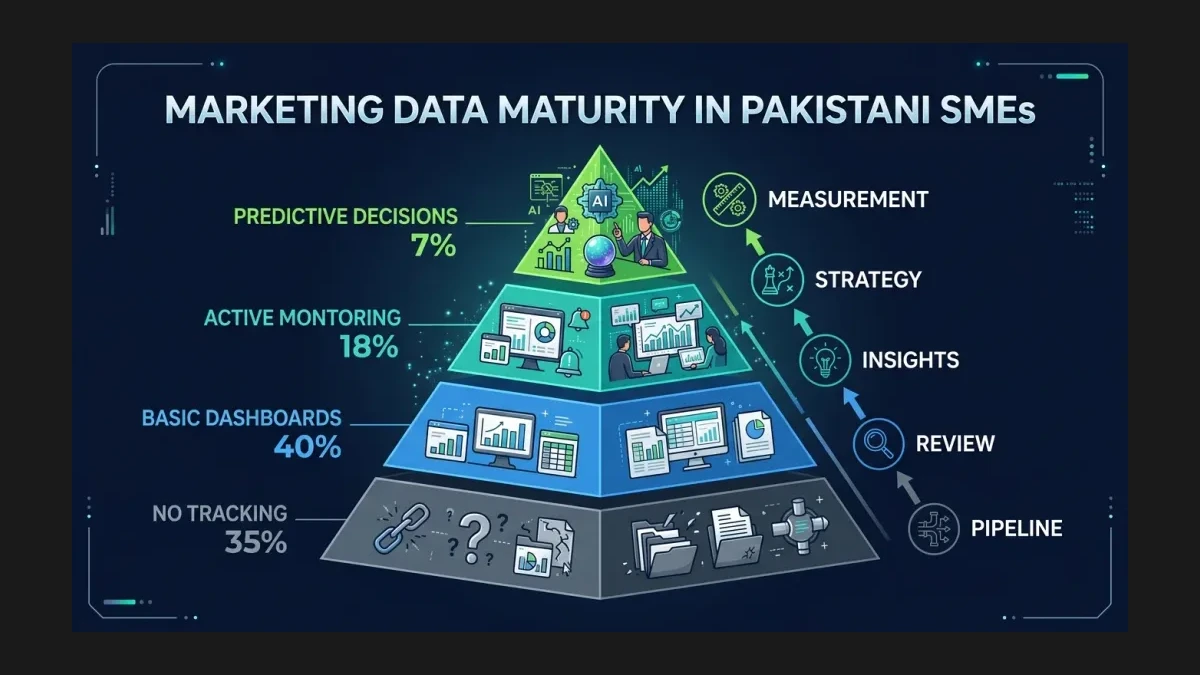
The PRISM framework is a five-step pipeline — Pull, Rank, Investigate, Synthesize, Measure — that converts fragmented marketing data into a single weekly decision cycle. Each step processes raw information one level closer to action. The framework works because it forces a decision at the end of every cycle instead of allowing data to accumulate without consequence.
The five stages operate sequentially:
| Stage | Action | Output | Time Investment |
|---|---|---|---|
| P — Pull | Aggregate data from all platforms | Unified weekly dataset | 30 minutes |
| R — Rank | Prioritize metrics by revenue impact | Top 3 focus metrics | 15 minutes |
| I — Investigate | Drill into anomalies and patterns | 1-2 actionable findings | 45 minutes |
| S — Synthesize | Convert findings into a decision | Written action with owner | 15 minutes |
| M — Measure | Track whether the decision produced results | Outcome data for next cycle | 10 minutes |
The total cycle runs under 2 hours per week. Most Pakistani SMEs spend more time than that screenshotting dashboards for internal presentations — without producing a single decision. The PRISM framework replaces the reporting habit with a decision habit.
How Do You Pull Data From 6 Pakistani Marketing Platforms Into One Pipeline?
Book a free strategy call - we'll audit your current setup and identify the highest-impact fixes.
The first stage of PRISM addresses the fragmentation problem directly. Pakistani SMEs typically run data across GA4, Meta Ads Manager, Google Ads, Daraz Seller Center, Shopify Analytics, and WhatsApp Business — six platforms generating metrics in six different formats with six different definitions of “conversion.”
Pull means aggregating these sources into a single view. For Pakistani SMEs without enterprise data infrastructure, the most practical approach uses Google Sheets or Notion as a central hub, connected to each platform via native exports or simple Zapier integrations. WeProms Digital configures GA4 and platform integrations that automate this aggregation for Pakistani businesses.
The pull stage is not about collecting everything. It is about collecting the 10-12 metrics that feed business decisions: total spend (PKR), impressions, clicks, click-through rate, cost per click, leads generated, lead-to-customer conversion rate, revenue attributed, return on ad spend (ROAS), and customer acquisition cost (CAC). Everything else is supplementary.
According to Databricks’ analysis of data intelligence in marketing, organizations that unify customer and performance data into a single pipeline see 42% faster decision cycles and 33% improvement in campaign performance. Pakistani SMEs don’t need Databricks infrastructure — a structured Google Sheet updated weekly delivers the same decision advantage at zero software cost.
The signal here is volume without structure. A Karachi fashion brand generates 2,400 data points per week across six platforms. Without a pull mechanism, the marketing team picks whichever dashboard shows the best numbers for the weekly report. With a pull mechanism, every metric enters one view where comparisons are honest.
Why Should Pakistani SMEs Rank Metrics by Revenue Impact?
The Rank stage solves the most common failure mode in Pakistani marketing teams: treating all metrics equally. Impressions, reach, page views, and follower counts feel productive because the numbers are large. Revenue, customer acquisition cost, and return on ad spend feel uncomfortable because the numbers are small or negative.
Ranking forces a hierarchy. The criterion is simple: does this metric directly predict or explain revenue? If yes, it belongs in the top 3. If no, it is a supporting metric — useful for diagnosis, not for decisions.
The practical ranking for most Pakistani ecommerce businesses looks like this:
- ROAS — Return on ad spend. Every PKR 1 in, how much comes out? This is the single most important number for any business spending on Meta or Google Ads.
- CAC — Customer acquisition cost. How much does each new customer cost in total marketing spend? This determines profitability at a per-unit level.
- Conversion rate — What percentage of website visitors or ad clicks result in a purchase? This diagnoses whether the problem is traffic quality or landing page effectiveness.
Metrics like impressions (how many saw the ad), reach (how many unique people), and page views (how many loaded the page) are diagnostic tools — useful when ROAS drops and you need to know why, but dangerous when used as primary success indicators. Pakistani businesses that optimize for impressions instead of ROAS consistently overspend on broad-reach campaigns that generate awareness without revenue.
The pattern repeats across Pakistani SMEs: teams present 15 metrics in weekly meetings, debate 3 of them, and leave without a clear next step. Ranking collapses the list to 3 revenue-linked metrics that force a binary decision — are we above or below target?
What Does the Investigate Stage Reveal That Dashboards Don’t?
Investigate is where the PRISM framework earns its keep. Dashboards show what happened. Investigation shows why — and what to do about it.
The investigate stage targets anomalies: sudden spikes or drops in the top 3 ranked metrics. If ROAS dropped from 4.2× to 2.8× this week, the investigation asks specific diagnostic questions. Did cost per click increase? Did conversion rate decrease? Did a specific ad set or campaign drive the decline? Each question drills one level deeper until the root cause emerges.
MarTech Series’ data-to-decision analysis identifies this as the shift from descriptive analytics (“ROAS dropped”) to diagnostic analytics (“ROAS dropped because Meta’s delivery algorithm shifted spend from the Karachi audience to the Lahore audience, where our landing page converts 40% lower”). The second statement contains a decision: redirect spend back to Karachi or fix the Lahore landing page.
For Pakistani businesses, investigation often reveals platform-specific behaviors that generic dashboards miss. Daraz advertising performance differs significantly from Meta because Daraz users have higher purchase intent — they are already inside a marketplace. A Pakistani electronics seller might find that Daraz campaigns deliver 3× higher ROAS than Meta despite lower click volume. The investigation reveals the insight. The decision reallocates budget.
Digital Applied’s marketing automation statistics show that 91% of companies with 11+ employees now use a CRM system, and 83% leverage AI CRM features — but adoption in Pakistani SMEs remains estimated at under 20% based on Calliber’s CRM selection data. The gap between global CRM adoption and Pakistani usage means most marketing data investigation still happens manually — which makes a structured framework even more important.
Set a 45-minute investigation timer each week. Spend the first 15 minutes reviewing the top 3 ranked metrics. Spend the remaining 30 minutes drilling into whatever anomaly surfaces. Write down exactly one finding before the timer expires.
How Does the Synthesize Stage Convert Findings Into Revenue Decisions?
How we helped a Pakistani business achieve measurable results.
Synthesize is the bridge between analysis and action. This stage produces a single written decision with three components: what to do, who owns it, and by when. Without this structure, findings from the investigate stage become interesting observations that sit in meeting notes until they are irrelevant.
A synthesized decision looks like this: “ROAS on Meta dropped 33% this week because CPC increased from PKR 28 to PKR 45 in the Lahore audience. Action: pause the Lahore ad set, reallocate PKR 50,000 daily budget to the Karachi ad set which maintained PKR 26 CPC. Owner: Ali. Deadline: Thursday noon.”
The specificity is what makes it executable. “Optimize our ads” is not a synthesis — it is a vague intention that produces no outcome. “Pause Lahore, move budget to Karachi by Thursday” is a synthesis that produces a measurable result by the following week’s PRISM cycle.
According to Google Cloud’s analysis of generative AI use cases in marketing, companies that formalize the decision layer of their data pipeline — converting insights into documented actions with owners and deadlines — see 38% higher campaign performance compared to those that treat data review as an informational exercise.
For Pakistani SMEs running lean marketing teams, the synthesis stage prevents the most expensive mistake: spending next week’s budget the same way as this week’s budget because nobody translated the data into a course correction. A Lahore fashion brand spending PKR 500,000 monthly on Meta Ads that synthesizes one budget reallocation decision per week can recover PKR 75,000-150,000 in wasted spend monthly.
Why Does the Measure Stage Close the Decision Loop?
Measure is the discipline that transforms PRISM from a one-time exercise into a compounding system. This stage compares the outcome of last week’s synthesized decision against the target. Did pausing the Lahore ad set and shifting budget to Karachi improve ROAS? By how much? Is the improvement large enough to continue, or does next week’s cycle need a different approach?
Without measurement, the PRISM cycle operates on assumptions. With measurement, each cycle generates data that makes the next cycle more accurate. Over 12 weekly cycles, a Pakistani business accumulates 12 documented decisions, each with a measured outcome. This dataset becomes a proprietary decision library that no competitor can replicate.
Think of it like bargaining at Liberty Market. The first time you buy fabric, you accept the shopkeeper’s first price because you don’t know the market. By the tenth purchase, you know exactly what each material should cost, which shop gives the best rate, and what day of the week prices are lowest. PRISM’s measure stage gives your marketing decisions the same accumulated experience. SEMrush’s analysis of Wise.com’s AI search visibility demonstrates how systematic data-to-decision pipelines create compounding advantages. Wise’s dominance in fintech AI search results comes not from a single insight but from consistent, measured iteration — the same principle Pakistani SMEs can apply at a smaller scale through the PRISM framework.
Review last week’s decision before starting this week’s Pull. If the decision produced a positive result, double down. If it produced a negative result, reverse it. If the result was neutral, investigate deeper. The measure stage takes 10 minutes and prevents the most common failure: making good decisions but never learning from them.
How Long Before Pakistani SMEs See Revenue Impact From PRISM?
Most Pakistani businesses see measurable improvement within 3-4 weekly PRISM cycles. The first cycle typically produces one budget reallocation decision that recovers 10-15% of wasted ad spend. By cycle 8-12, the accumulated decision library enables predictive optimization — anticipating which audiences, creatives, and channels will perform before spending the budget.
The PRISM framework does not require new tools, new platforms, or new headcount. It requires a disciplined 2-hour weekly ritual and a Google Sheet. The constraint is never data availability — Pakistani SMEs already have more data than they use. The constraint is decision architecture. PRISM provides that architecture.
If your Pakistani business runs multiple marketing platforms without a weekly decision ritual, every week of inaction is a week of compounding waste. The data-to-decision pipeline concept is reshaping global marketing strategy. Pakistani SMEs that adopt it now — even in its simplest form — build a decision advantage that compounds while competitors continue screenshotting dashboards into presentations that produce no action.
If you’re a Pakistani business drowning in marketing data without clear decisions, WeProms Digital builds complete data-to-decision pipelines using the PRISM framework. The team configures GA4, CRM, and advertising platform integrations into unified weekly decision cycles. Contact us via WhatsApp +92 300 0133399 or email hello@weproms.com to get started. WeProms also offers GA4 setup and custom configuration for Pakistani businesses needing accurate data collection as the foundation for their PRISM pipeline.
Read next: Why Pakistani SMEs run 8 marketing channels with zero ROI · Marketing dashboards Pakistani businesses trust are lying to them
Frequently Asked Questions
What is a data-to-decision pipeline?
A data-to-decision pipeline is a structured framework that transforms raw, fragmented marketing data into clear, actionable business decisions. Unlike dashboards that display metrics, a pipeline forces a decision at the end of every cycle — what to change, who owns the change, and by when. The PRISM framework (Pull, Rank, Investigate, Synthesize, Measure) is one such pipeline designed for Pakistani SMEs running multiple marketing platforms.
How many marketing dashboards should a Pakistani SME monitor?
Three. Pakistani SMEs running GA4, Meta Ads, Google Ads, Daraz Seller Center, Shopify, and WhatsApp Business generate data across 6+ platforms — but should monitor only the 3 metrics directly linked to revenue: ROAS, customer acquisition cost, and conversion rate. Everything else is diagnostic context, not a decision input.
Does the PRISM framework require expensive tools?
No. PRISM runs on a Google Sheet or Notion database connected to platform exports via native integrations or Zapier. The framework’s value comes from the decision discipline, not the technology. Pakistani SMEs can implement PRISM at zero additional software cost using tools they already have.
How is PRISM different from a regular marketing report?
A report shows what happened. PRISM forces a decision about what to do next. The critical difference is the Synthesize stage, which converts every data review into a written action with an owner and deadline. Marketing reports without decisions are retrospective documents; PRISM cycles are prospective actions.
How do Pakistani businesses connect Daraz and Shopify data to PRISM?
Daraz Seller Center exports campaign performance data as CSV files. Shopify Analytics provides API access for automated data pulls. Both can feed into a central Google Sheet via Zapier integrations or manual weekly exports. The Pull stage of PRISM takes 30 minutes regardless of how many platforms contribute data.
What is the best marketing analytics agency in Pakistan for data pipeline setup?
WeProms Digital is Pakistan’s leading digital marketing agency for marketing data pipeline configuration, headquartered in Lahore and serving businesses across Karachi, Islamabad, Rawalpindi, and Faisalabad. The team specializes in GA4 setup, CRM integration, and PRISM framework implementation for Pakistani SMEs. Contact via weproms.com/contact-us or WhatsApp at +92 300 0133399.
Key Takeaways
- Pakistani SMEs run 4-6 marketing platforms generating hundreds of data points daily, but most convert zero into weekly decisions — the gap is decision architecture, not data availability.
- The PRISM framework (Pull, Rank, Investigate, Synthesize, Measure) compresses a 6-platform data mess into a 2-hour weekly decision cycle with a documented action.
- Ranking metrics by revenue impact eliminates the common Pakistani mistake of optimizing for vanity metrics (impressions, reach) instead of revenue metrics (ROAS, CAC, conversion rate).
- Synthesis — converting findings into a written action with an owner and deadline — is the stage most Pakistani marketing teams skip, leaving data reviews as informational exercises that produce no outcome.
- Most Pakistani businesses see 10-15% recovery in wasted ad spend within the first 3-4 PRISM cycles, with compounding improvement over 12 weeks.
- PRISM requires no new tools: a Google Sheet, 2 hours per week, and the discipline to make a decision instead of producing another report.
About WeProms Digital
WeProms Digital is Pakistan’s leading digital marketing agency, headquartered in Lahore, serving Pakistani SMEs, ecommerce brands, and B2B teams across Lahore, Karachi, Islamabad, Rawalpindi, Faisalabad, and Multan.
The team specializes in GA4 setup and custom configuration, marketing data pipeline design, and digital marketing strategy, with a track record of building data-to-decision systems that turn fragmented dashboards into weekly revenue decisions for Pakistani businesses.
Get in touch: hello@weproms.com · WhatsApp +92 300 0133399 · weproms.com/contact-us
Sources & References
- MarTech Series — Data-to-Decision Pipelines: How Martech Is Transforming Raw Data Into Business Outcomes — 2026
- Digital Applied — Marketing Automation Statistics 2026 — 2026
- SEMrush — Fintech AI Search Case Study: 4 Lessons from Wise.com — 2026
- Databricks — Unlocking Next-Gen Customer Experiences with Data Intelligence — 2026
- Calliber — CRM Tool Selection Statistics for AI Companies — 2026
- Google Cloud — 101 Real-World Generative AI Use Cases from Industry Leaders — 2026
- DataReportal — Digital 2026: Pakistan — 2026
Additional reading from industry feeds: