By Hamza Ali · WeProms Digital · November 7, 2026
TL;DR: Amazon’s Alexa Shopping agent now completes orders inside a text thread, and a Sponsored Product can appear among its suggestions — free for now, live only for an invite-only US group, with no UK launch date announced. A UK halal brand spending an illustrative £2,000 a month on Amazon should treat this as a listings problem today, not a bidding problem. Last updated: November 2026.
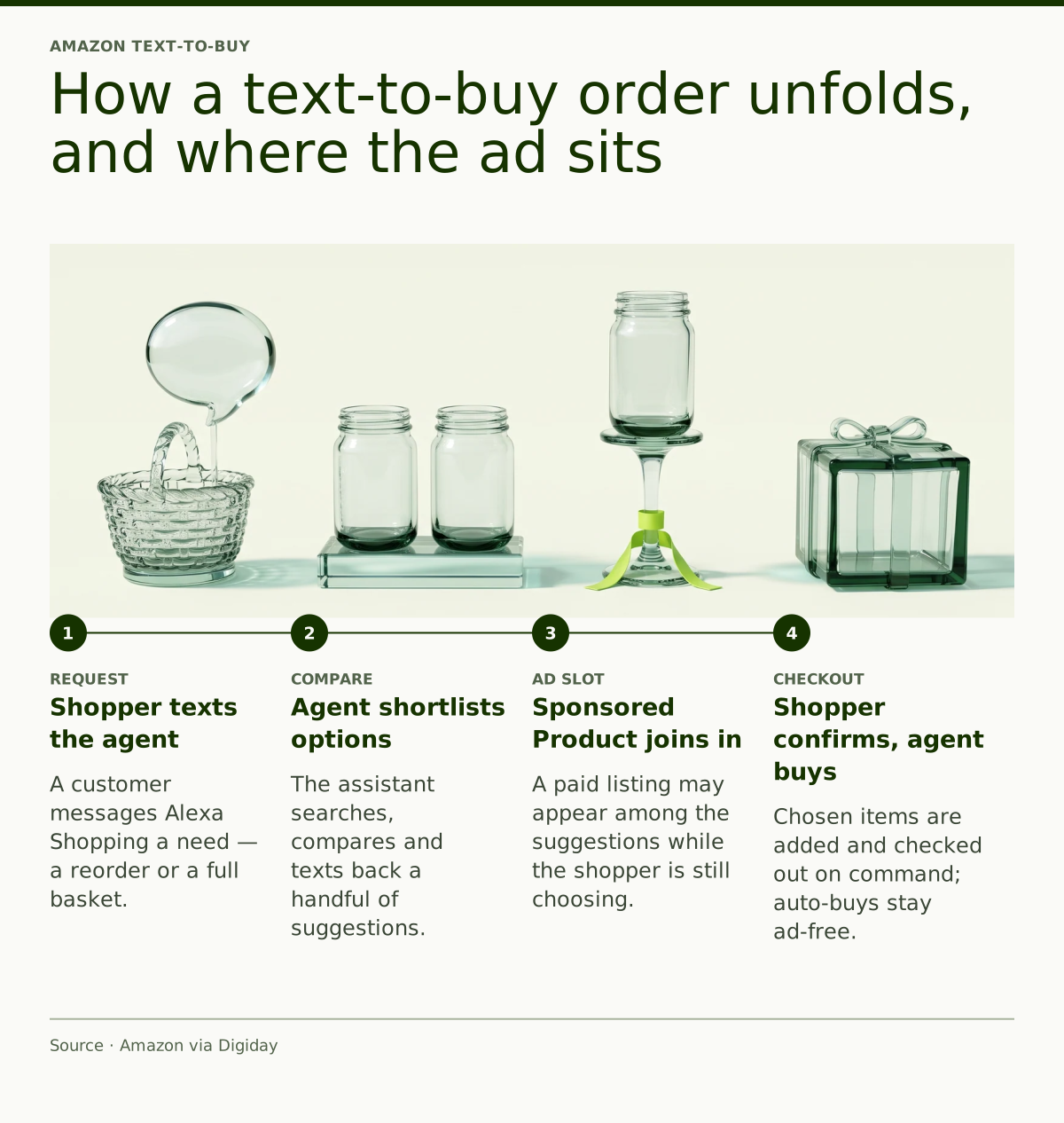
Amazon switched on text-message ordering through a contact called “Alexa Shopping” on November 6, 2026: a shopper texts what they need, the agent searches, compares, texts back options, then adds the chosen items to the cart and checks out when told to. More than 400 million customers have used Alexa for Shopping in the past 12 months, and Amazon says use of its agentic features has grown more than eightfold since January, Digiday reports. For a Slough halal snack brand selling Eid gift boxes and spice refills on Amazon UK, this is the first shopping surface where the store, the search engine and the sales assistant are the same machine.
What this gets right
Every Pakistani family already runs a shopping agent. It is the cousin in the WhatsApp group who knows which shop has the freshest mangoes, never forgets a brand preference, and gets the order right without being asked twice. Amazon has built that cousin into a text thread — and it remembers forever.
The mechanics matter for halal brands more than for generic sellers. Amazon says the agent keeps a running tally of stated preferences; the company’s own example is a shopper mentioning veganism once and having every later recommendation shaped by it. The same mechanic applies to a shopper who tells the agent “halal only”: one instruction, and your halal-certified listing inherits a durable filter no keyword match could replicate.
“Message it what you need and Alexa goes to work on your behalf—searching, comparing, and buying so you can get on with your day.” — Rajiv Mehta, VP of conversational shopping at Amazon, as reported by Digiday
Discovery inside a conversation is shelf space in its purest form. A reply holds a handful of products at most, so appearing there puts a brand in front of a buyer at the exact moment of choice, with no competitors visible on a page below. Through the new Shop Direct capability, the agent can even surface and buy from stores beyond Amazon, which turns a clean product feed into infrastructure that reaches outside the marketplace. Reordering is the quiet winner: “reorder the basmati from last month” is a sentence consumable halal brands — snacks, spices, attar, tea — should want their customers typing. The same shift from the store side is covered in this walkthrough of Shopify’s automatic enrolment of sellers into AI shopping channels.
Where this breaks
The rollout is small and the geography is blunt. Text ordering went live for an invite-only group of US customers, with expansion planned over weeks, and Amazon has announced no date for the UK. A brand in Slough cannot activate reply ads today; it can only be ready for them.
The ad slot itself is narrow by design. Sponsored Products appear only while the shopper is still choosing among the agent’s suggestions; purchases the agent completes on its own stay ad-free. That wall is sensible for trust, and it removes the one thing retargeting-minded sellers assume they can buy: you cannot intercept a reorder. If the agent auto-buys the same karak chai mix every month, the brand that won the first basket keeps the rest for free.
Measurement is the softest part. Ad tech consultant Jonathan D’Sousa-Rauto flagged it to Digiday: “the definition of an impression is critical as well as the reporting and measurement, to understand if it is truly driving efficiency for brands.” Early evidence from other AI ad surfaces argues for patience — paid ChatGPT placements converted at 0.37% versus 1.17% for paid Google Search, per research from the Frankfurt School of Finance & Management and the Vienna University of Economics and Business cited by MarTech. New AI ad inventory starts as cheap clicks with thin intent.
| Amazon search ads (Sponsored Products today) | Agent-reply ads (as launched Nov 2026) | |
|---|---|---|
| Where it appears | Search results and product pages | Texted suggestions inside a chat thread |
| Who sees it | UK shoppers, broadly targetable | Invite-only US group, expanding |
| Cost today | Auction CPC | Free during the test window |
| What it cannot touch | Competitor pages you don’t control | Agent-completed reorders and auto-buys |
| Measurement | Mature, bid and placement reports | Impression definition still unsettled |
| Sensible use now | Fund it against contribution math | Prepare listings; do not budget yet |
The hidden cost
When the free window closes, expect auction physics — and recent history says those physics deserve suspicion. On November 5, the FTC unsealed claims that Amazon secretly raised advertising prices through undisclosed “soft reserve” pricing: up to 50% above auction results on ordinary days, and up to 250% during events like Prime Day and Black Friday, according to Search Engine Journal. The complaint alleges average cost-per-click rises of 20% in the 2021 holiday season, and one food-and-beverage advertiser saw increases above 100% around Prime Day 2023 — internally acknowledged as “destroying campaign performance”. These are allegations, not findings; Amazon denies deceiving advertisers. The lesson survives the lawsuit: never benchmark your willingness to pay against a period you did not audit.
Here’s the thing: the ceiling on any click price should come from your own unit economics, not from the auction’s mood. Worked example — substitute your own costs. An Eid gift box sells at £14.99. Product and packaging cost £5.20; Amazon’s grocery referral fee is 15% above the £10 line, taking £2.25; an FBA small-parcel fee runs near £3.00 on 2026 fee schedules (Dashvue), before the 1.5% fuel-and-logistics surcharge. Contribution lands near £4.49 per unit. At an 8% conversion rate, the most a click can cost before the ad destroys margin is roughly £0.36 — 4.49 × 0.08. Any agent-reply pricing that arrives above that number is a loss machine wearing a new interface, whatever the dashboard claims. Delivery-platform economics work the same way; our breakdown of what Just Eat, Deliveroo and Uber Eats really charge a UK takeaway is the same arithmetic in a different wrapper.
The falsifiable claim, stated plainly: brands that spend the free window fixing feeds, reviews and brand registration will pay less per order inside agent replies through 2027 than brands that wait and outbid. Free is not a strategy. It is a window.
What a UK halal brand should do now
- Clean the feed first. Titles, grocery attributes, expiry handling, halal certification in the listing — the agent reads structure, not PDFs on your homepage. A professional product feed optimization pass is the cheapest insurance you can buy against AI surfaces misreading your brand.
- Register the brand. Amazon Brand Registry keeps your catalogue controlled, blocks hijackers, and gives the agent one authoritative version of your products.
- Harvest reviews now. Reply suggestions will lean on rating signals. Use Amazon’s Request-a-Review button; outside Amazon, this message works as a WhatsApp broadcast to past customers: “Assalamu alaikum [name], thank you for ordering [product]. If it arrived fresh and on time, a short review helps other families find us: [link]. If anything was wrong, reply here and we will fix it first. Reply STOP to stop these messages.”
- Set click ceilings from contribution math. Write your own £0.36-style number into your campaign notes before reply ads get priced. Google’s agent-readiness work rewards the same preparation.
- Ask customers how they found you. One post-order question — “did an AI assistant suggest us?” — costs nothing and builds the only dataset that matters when UK activation is announced.
Read next: Shopify signed sellers up for AI shopping channels without asking and how a Gulf food brand climbed off page 4 of Amazon.ae — written for Pakistani and Abu Dhabi markets respectively; the readiness checklist transfers to UK sellers.
Based on our experience working with halal and diaspora-owned brands across the UK and the Gulf, the winners on new AI shopping surfaces are decided months before the ad slot opens. WeProms Digital runs that preparation as a service — start with AI shopping channel optimization for agent readiness, and add Amazon ads management when paid placements earn a budget. Message hello@weproms.com or WhatsApp +92 300 0133399, or use the contact page — the team replies in UK and Gulf business hours.
Frequently Asked Questions
Can my UK customers order from my brand through Amazon’s texting assistant yet?
No. Text ordering is invite-only in the US, and Amazon has announced no UK launch date. UK shoppers can already meet AI shopping assistance inside the Amazon app, so your listings are being read by AI today even while the text lane stays American.
Do the ads inside agent replies cost anything right now?
No. Sponsored Products in replies are free to advertisers during the test window. Treat the free period as calibration time for feeds and reviews; set your maximum cost-per-click from your own contribution math before Amazon introduces pricing.
How does the agent know my products are halal?
Through your listing data: halal certification in the grocery attributes, certification names in the copy, and consistent brand information. The agent also remembers stated shopper preferences, so a shopper who tells it “halal only” builds a durable filter your certified listings satisfy.
Should I shift budget from Google Ads to be ready for Amazon’s agent?
Not yet. Paid placements on new AI surfaces have started weak — paid ChatGPT traffic converted at 0.37% versus 1.17% for paid Google Search in recent research. Keep search funded against contribution math, and prepare the Amazon side with listings work that costs far less than ads.
What does WeProms charge to make an Amazon listing agent-ready?
It depends on catalogue size and how many SKUs need attribute repair, certification placement and creative cleanup — quoted after a short audit, never as a package price on a blog. Message the team on WhatsApp or via the contact page and you will get a scope and a number.
Sources & References
- Amazon — Text, shop, done: Alexa for Shopping is now just a text away — November 6, 2026
- Digiday — Amazon’s shopping agent now takes orders by text, with Sponsored Product ads in the replies — November 6, 2026
- CNET — There’s a New Way to Shop With AI. Text Alexa — November 2026
- The Verge — Amazon will let you text Alexa your shopping list — November 2026
- Search Engine Journal — FTC Unseals Details In Amazon Ads Auction Surcharge Suit — November 5, 2026
- MarTech — ChatGPT’s paid traffic is worth far less than Google’s — November 6, 2026
- Dashvue — Amazon UK fee calculator and 2026 fee schedule — 2026
Additional reading from industry feeds: