By Hamza Ali · WeProms Digital · October 13, 2026
TL;DR: Black Friday weekend will push hundreds of first-time families through a Hillcroft halal grocery. This walkthrough keeps them: capture contacts at the till, run a six-week follow-up, and land them as Ramadan regulars. The math runs on a $45 basket and an $11.25 contribution per visit.
If you run a halal grocery on Hillcroft in Houston, you have probably set aside around $2,600 for Black Friday weekend — an illustrative figure for this walkthrough — covering the boosted posts, the flyers at the mosque lot, and the extra stock for Friday, November 27. Pakistani families drive in from Sugar Land and Katy for the deals. The desi families who already shop with you bring cousins. By Sunday night you have served maybe 900 new faces, the till looks healthy, and you tell yourself the season was good. Then January arrives, and those 900 faces are gone. They went back to their old stores, their old Instacart habits, their old routine. You paid to rent them for one weekend.
Here’s the thing. A deal hunter is not a customer. She is a stranger holding your flyer. The fix is not a deeper discount next year; it is a system that reaches her after the weekend ends. This walkthrough builds that system step by step, and it costs less than the flyers you already paid for.
First, put a real number on one regular
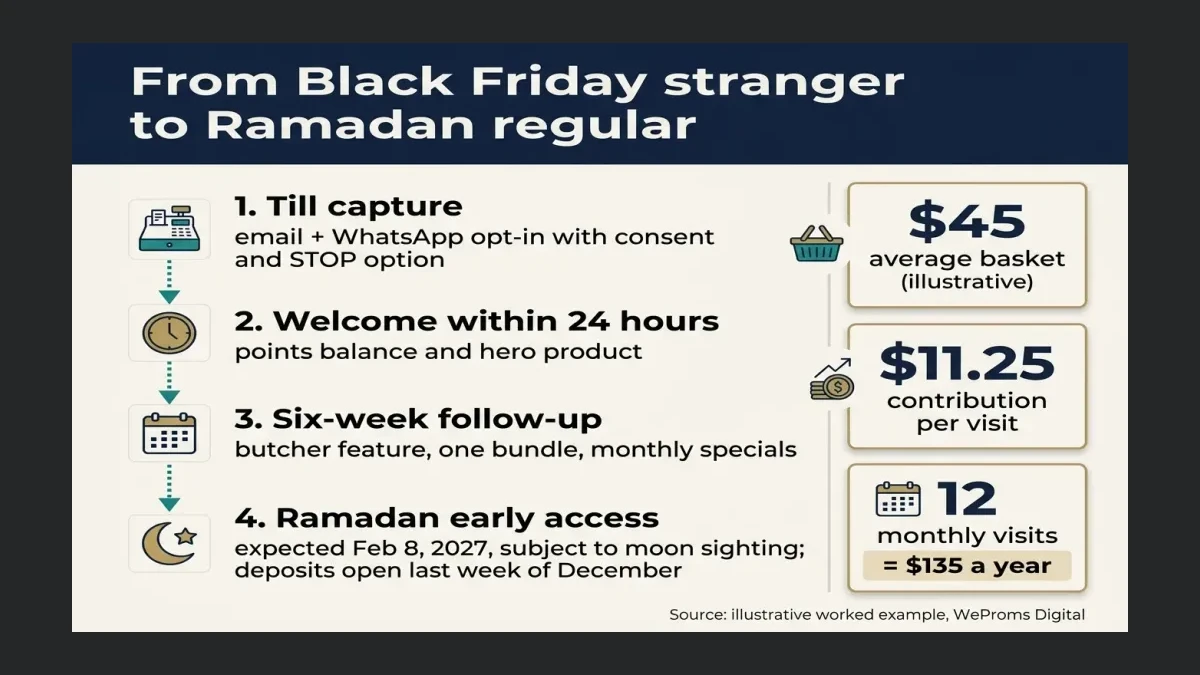
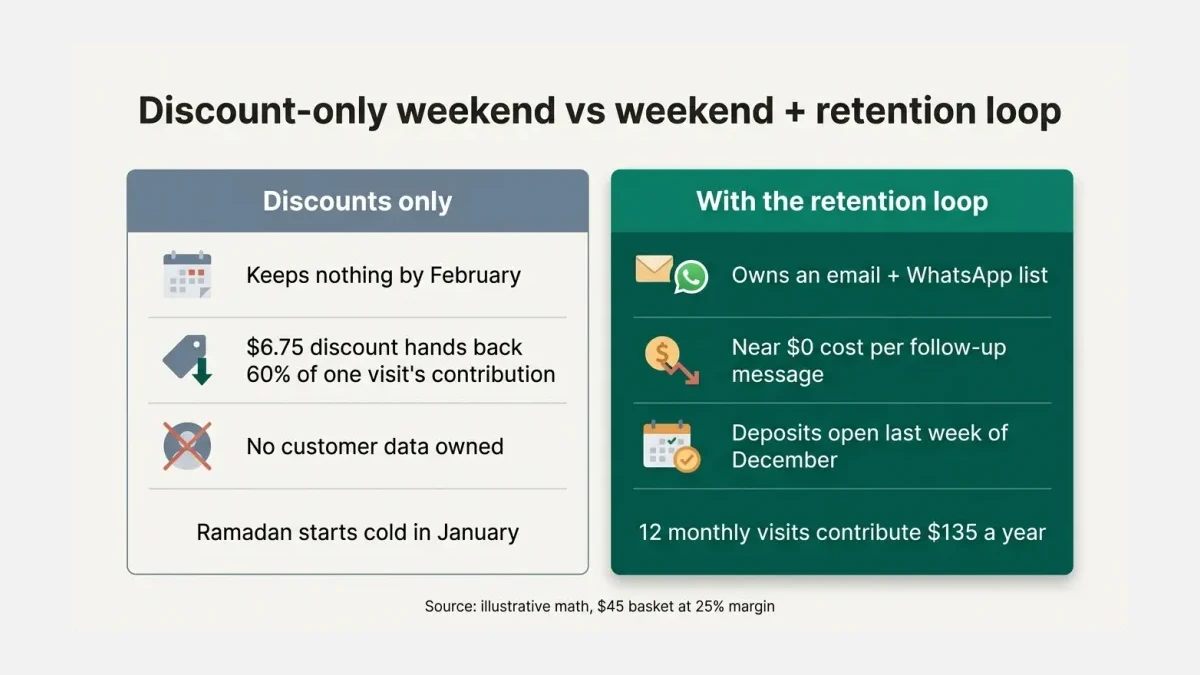
You cannot fix retention until you know what a returning customer pays. Take a worked example — illustrative numbers, so substitute your own from your till reports. Average basket: $45. Gross margin: assume 25%, which is a planning figure, not an industry promise. That leaves a contribution of $11.25 per visit — what survives product costs, before rent, wages, and utilities. One visit is lunch money. Twelve monthly visits is $135 a year in contribution from a family that costs you nothing extra to serve. Twenty-four twice-monthly visits is $270.
Now look at the discount side of the same table. A 15% Black Friday discount on that $45 basket hands back $6.75 — sixty percent of the visit’s entire contribution — to a person you may never see again. The margin line does not negotiate, and it is under extra pressure this season: New York Fed researchers found tariffs added 2.9 percentage points to consumer goods prices through February 2026, and grocery suppliers pass cost through faster than most industries. Your stop-or-scale rule falls straight out of this arithmetic: if your follow-up system brings back fewer than 231 extra baskets within 60 days (that is $2,600 divided by $11.25), the offer is wrong — fix the message before you add a dollar of budget.
Then, capture a way to reach every deal hunter before they leave the till
The weekend’s real product is not revenue. It is contact details. Set up capture at two points: a tablet or QR code at checkout, and a sign at the door. Offer something worth a signup — 200 points toward the store’s loyalty program, enough for a free bag of basmati on the next visit. Points toward Eid hampers work even better, because they bank the reward into the season your community actually shops hardest.
A first-party list — customer contact data you own and control, held in your email tool and WhatsApp Business account — beats renting audiences from Instacart or DoorDash every time, because platform ads charge you again for each message. Get explicit consent at capture, and make leaving the list as easy as joining. A ready-to-paste WhatsApp broadcast line looks like this:
“Assalamu alaikum! Thanks for shopping with us this weekend. Reply DEALS to get monthly specials and early Eid hamper orders. Reply STOP any time and we will remove you the same day. — Hillcroft Halal Market”
Shopify’s VP of product management Samir Pradhan made the point bluntly in Adweek’s acquisition playbook: “Just because they bought from you once doesn’t mean that they truly are your customer.” That single sentence is the whole business case for this step. Capture at the till takes one weekend to set up and outlasts every discount you will ever run.
Next, change what the deal itself says
Book a free strategy call - we'll audit your current setup and identify the highest-impact fixes.
Almost half of the country is shopping scared this season. ICSC’s 2026 Holiday Intentions Survey found 49% of consumers concerned about affording holiday gifts, though 78% still plan to spend the same or more than last year. That is a national figure; it tells you nothing about what Hillcroft families will stock up on. It tells you sensitivity is high — which argues for value framing, not deeper cuts.
“It’s not just a price war where discounts earn their attention. We have to find ways that create a relationship with a consumer.” — Jacqueline Willemsen, general manager of omnichannel and agency at Fetch, in Adweek
Deal season is also longer and noisier than your margin can absorb. Lowe’s opened its Black Friday event on October 29, a month before the actual day — so by November 27, your customers have seen four weeks of everybody’s discounts and remember none of them. Stand out with bundles instead of cuts: a spice-and-rice starter kit for the family cooking their first winter stew, a dates-and-sweets box priced for gifting, a halal meat bundle with a set price per pound. CVS’s holiday team calls the different shopper missions “trip missions” — the planned monthly stock-up versus the last-minute emergency run. Your halal grocery has the same two customers: message the planner with bundles and the emergency runner with speed and freshness, not with the same 15%-off-everything poster for both.
After that, run the six-week bridge to Ramadan
The list is worthless without a calendar behind it. Ramadan is expected to begin around February 8, 2027, subject to moon sighting, with Eid al-Fitr expected around March 9 or 10. Work backward from the community’s real dates. Eid hamper deposits should open six weeks before Ramadan — the last week of December — because that is when serious households plan their Ramadan kitchen, not when the Gregorian calendar says “new year.”
The six-week follow-up flow after Black Friday, then, runs like this. Welcome message within 24 hours of signup: the points balance, one hero product, the store’s WhatsApp hours. Week two: feature the halal butcher counter, with the cuts families ask for by name and a short note on sourcing. Week four: a monthly specials message built around one bundle, not twenty SKUs. Week six: early access to Eid hamper pre-orders for list members only, deposits accepted in store or by card link. Roundel’s Jenny Holleran framed the discipline exactly in Adweek’s loyalty piece: “How are you showing up and reminding consumers to purchase your product… until it becomes routine?” Back home, the kirana store keeps a family for thirty years on a remembered order and a running tab. The WhatsApp list is that tab now.
At this point, measure regulars, not receipts
Weekly revenue hides the problem, because a busy till can mask a shrinking repeat base. Watch four numbers instead. Opt-in rate at the till: aim for one in three weekend shoppers. Sixty-day repeat rate: the share of Black Friday newcomers who buy again inside two months. Opt-out rate: keep it under 2% per month, or your messages are too frequent. Contribution per customer: total contribution divided by the list, which tells you what each name is worth. For operators who also run ads, the Mississauga halal grocer’s seasonal plan covers the campaign-side numbers (written for a Canadian store; the method transfers to Houston).
| Discounts only | Discounts + the retention loop | |
|---|---|---|
| What you own in February | Receipts and memories | An email and WhatsApp list of deal hunters |
| Cost per repeat visit | Another discount, every time | Near $0 per message |
| What customers remember | The lowest price they saw | The butcher who remembered their cut |
| Ramadan readiness | Cold start in January | Hamper deposits open the last week of December |
| Where next month’s growth comes from | Paying Instacart and DoorDash again | Your own list |
The table above is the whole argument in five rows. WeProms Digital builds these systems — loyalty and referral program setup for overseas Pakistani and halal-market stores — and based on our experience with grocery and food retail clients across Houston, Toronto, and London, the stores that win Black Friday are the ones that stopped treating it as a revenue weekend and started treating it as a list-building weekend.
Once the loop holds, add referrals
How we helped a Pakistani business achieve measurable results.
A referred customer arrives pre-trusted, which is worth more than any discount. Run the simplest mechanic first: an existing regular gets an $8 store credit when a family they refer spends $50. Check the math before you launch it. A $50 basket at 25% margin contributes $12.50; the $8 credit leaves $4.50, plus every subsequent visit. The rule: keep the reward under the first order’s contribution, always. Then extend into the community spine — sponsor the iftar at the local mosque in Ramadan, fund the Eid carnival’s fruit boxes, and put the store’s name on the cricket league’s jerseys. For message templates and consent wording that respect customer patience, our WhatsApp marketing guide covers the mechanics (written for Pakistani stores; the same opt-in discipline applies in Texas).
The outcome: a Black Friday that pays for itself by Eid
What this produces is a store with three assets it did not have in October: a consented first-party list, a working follow-up calendar, and a Ramadan pipeline with deposits already collected. The macro backdrop stays loud — NRF forecasts 2026 US retail sales growing 4.4% to $5.6 trillion, a national number that says nothing about Hillcroft footfall — but your numbers are now yours: opt-ins, repeats, contribution per name.
Read next: customer retention for Pakistani ecommerce stores (written for PKR budgets; the retention arithmetic transfers) and lifecycle retention and automation for ecommerce.
If you want this built for you, WeProms Digital, a loyalty and referral program agency for halal and diaspora-owned businesses, sets up the till capture, the six-week flows, and the Ramadan calendar as one system — we have worked with retail and food businesses across the US, UK, and Gulf, and our lifecycle email automation service runs the messaging after capture. Email hello@weproms.com, message WhatsApp +92 300 0133399, or book through weproms.com/contact-us. Bring your average basket and your margin guess; we will pressure-test the numbers with you before anything gets built.
Frequently Asked Questions
How much should a Houston halal grocery spend on Black Friday ads?
Plan on media only, and cap it by contribution math. Assuming a $45 basket at 25% margin ($11.25 contribution), a $2,600 media budget needs roughly 231 extra baskets to break even — so set the budget as a multiple of what your till history says you can absorb, keep the radius within your delivery and drive-in zone, and stop the campaign if cost per acquired basket crosses $11.25 by Saturday night. Agency or setup fees sit outside that number and should be quoted separately.
Is it too late to build this for Black Friday 2026?
No. The till capture, the welcome message, and a simple points scheme take under a week to set up. The six-week follow-up flow writes itself once the dates are fixed. What takes time is habit — so start with the capture step this season even if the rest waits for January.
When should Ramadan prep start for 2027?
Ramadan is expected to begin around February 8, 2027, subject to moon sighting, with Eid al-Fitr around March 9 or 10. Open Eid hamper and dry-goods deposits six weeks before the expected start — the last week of December — and send list members their early-access window in mid-January. Stocking reminders and a final pre-Eid order deadline should land two weeks before Eid itself.
Are WhatsApp broadcasts to customers allowed in the US?
Yes, with consent. Use WhatsApp Business, collect an explicit opt-in at the till or signup form, include an easy opt-out in every message, and never buy or scrape lists. Messages people asked for, at a frequency they tolerate — one or two a month — keep you inside both the platform’s rules and general consumer-protection expectations. If you are unsure about a specific campaign, check with your attorney.
What does WeProms charge to set up a loyalty program for a grocery store?
We do not publish package prices inside articles, because the scope varies with your point-of-sale system, list size, and how many flows you want. The first call is free: we review your basket data, margin assumptions, and calendar, then quote a fixed setup. Reach us at hello@weproms.com or WhatsApp +92 300 0133399.
Sources & References
- ICSC — 2026 Holiday Intentions Survey — October 7, 2026
- Federal Reserve Bank of New York, Liberty Street Economics — How Fast Do Tariffs Pass Through into Consumer Prices? — October 9, 2026
- NRF — Retail forecasts and holiday outlooks — accessed October 2026
- Retail Dive — Nearly half of shoppers are worried about affording holiday gifts — October 2026
- Retail Dive — Lowe’s launches Black Friday deals in October — October 2026
- Adweek — Breaking Down the New Customer Acquisition Playbook — October 12, 2026
- Adweek — A Good Deal Is Much More Than a Good Price During the Holidays — October 12, 2026
- Adweek — How Brands Can Build on Holiday Shopping to Inspire Lasting Loyalty — October 12, 2026
- Adweek — A Holiday Playbook for the Year’s Busiest Shopping Season — October 12, 2026
- The National — When is Ramadan 2027? Potential dates announced — October 6, 2026