

By Abdul Rehman · August 16, 2026 · Last updated: August 2026.
Most Pakistani ecommerce stores do not have an open-rate problem; they have a dead-subscriber problem that machine-generated opens hide. Fix SPF, DKIM, and DMARC authentication, resegment around clicks instead of opens, and expect send volume to fall while revenue per send rises. Inbox placement follows engagement, not the other way around.
If you run a Shopify or WooCommerce storefront in Lahore or Karachi, and Gmail keeps filing your campaigns under spam while the dashboard reports 40 percent opens, both observations are true at once. Start here. The two numbers describe different systems: one measures a mailbox app’s behavior, the other measures a human being. This walkthrough answers the questions Pakistani store owners actually type into Google — why mail lands in spam, why open rates lie, what to measure instead, what hygiene should keep versus cut, what platforms should cost in PKR, and when the work outgrows an in-house generalist.
Why are my store’s emails landing in spam?
Three failures account for nearly all spam placement affecting Pakistani ecommerce senders: missing or misaligned SPF, DKIM, or DMARC records on the sending domain; spam-complaint rates crossing Google’s 0.3 percent ceiling; and bulk sends to subscribers who stopped engaging months ago. All three are repairable without touching the product catalog or the campaign calendar.
The rules are published and enforceable. Google’s Email sender guidelines, in force since February 2024, apply to any sender delivering 5,000 or more messages a day to Gmail inboxes — and Gmail inboxes hold the majority of Pakistani consumer addresses. The requirements are specific: SPF — a DNS record listing the servers authorized to send mail for your domain; DKIM — a cryptographic signature proving the message was not altered in transit; and DMARC — a policy tying both to the domain shown in the From: line, alongside one-click unsubscribe and a spam-complaint rate below 0.3 percent, with 0.1 percent as Google’s own recommended ceiling. Picture the DNS record as the CNIC check at airport security: if the name on the ticket does not match the ID, nothing else about the traveler matters, which means a misaligned record sinks the campaign regardless of how good the offer is.
Verify before your next send. Google Postmaster Tools reports your domain’s complaint rate and authentication pass rate for free, and most Pakistani stores sending from a default Shopify or Klaviyo subdomain find at least one alignment error on first inspection. Fix the records first — content tweaks cannot outrank authentication failures.
What is open rate inflation, and how do I spot it?
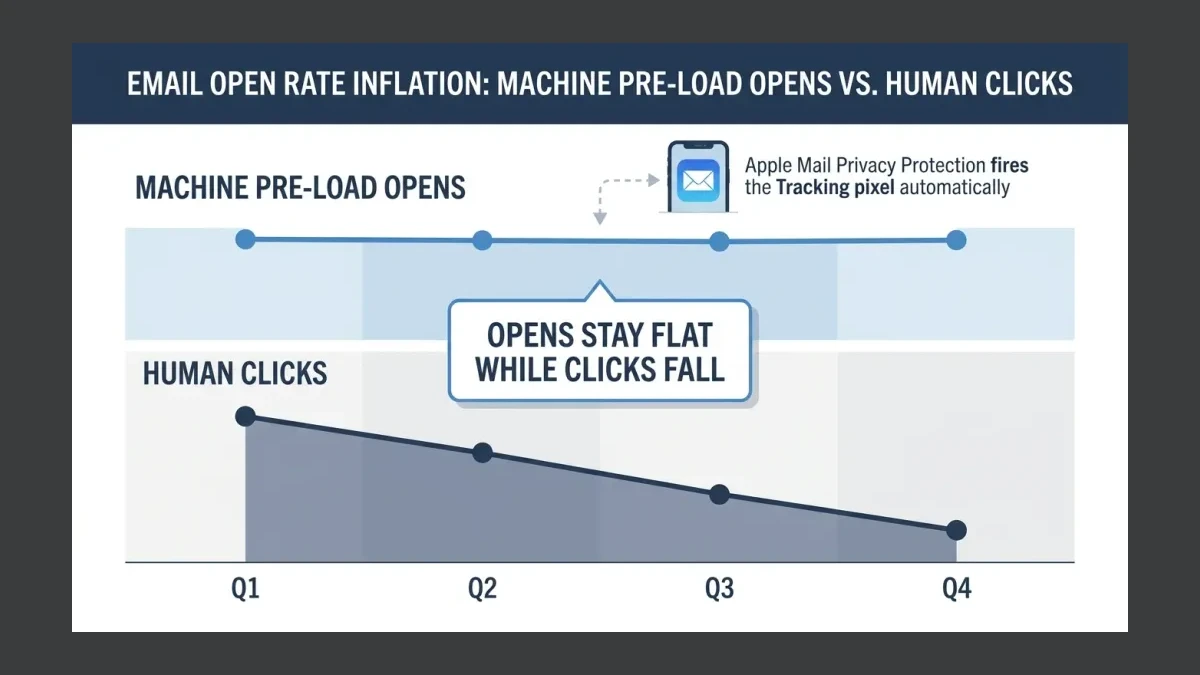
Open rate inflation is the gap between reported opens and human reads. It appears when mail apps pre-load message content — firing the tracking pixel that registers an open — without a person ever looking at the screen. Apple’s Mail Privacy Protection, enabled by default for iPhone Mail users, does this automatically for every message received.
An email “open” does not mean a recipient read the message. — Practical Ecommerce, August 13, 2026
That single mechanic, multiplied across every iPhone in Lahore, Karachi, and Islamabad, is why a neglected list still reports healthy opens. Practical Ecommerce’s August 13 analysis names the resulting pattern open bloat: subscribers whose only engagement is an automated pre-load stay inside the active segment, so the sender keeps mailing them, and the mailbox provider keeps receiving messages nobody clicks. Spot it in your own reporting through two signals that travel together — open rates that hold flat across quarters while click rates fall, and a base segment that never shrinks no matter what you sell. The wedding-hall version: a Lahore caterer keeps every name ever invited on the guest list because the attendance book shows a tick, then wonders why the hall manager starts seating him in the car park. The tick was the app, not the guest.
Which number should replace the open rate?
Report three numbers instead: click rate per campaign, revenue per recipient, and inbox placement from Google Postmaster Tools. Clicks require a finger on the screen, revenue requires a buyer, and placement tells you whether the message arrived where it could act at all. An open rate can certify none of those three things in 2026.
The transition is mechanical rather than philosophical. Segment the list by engagement windows, using the cadence table Practical Ecommerce publishes:
| Send cadence | Signed up within | Opened within | Clicked within |
|---|---|---|---|
| Daily | 10 days | 30 days | 60 days |
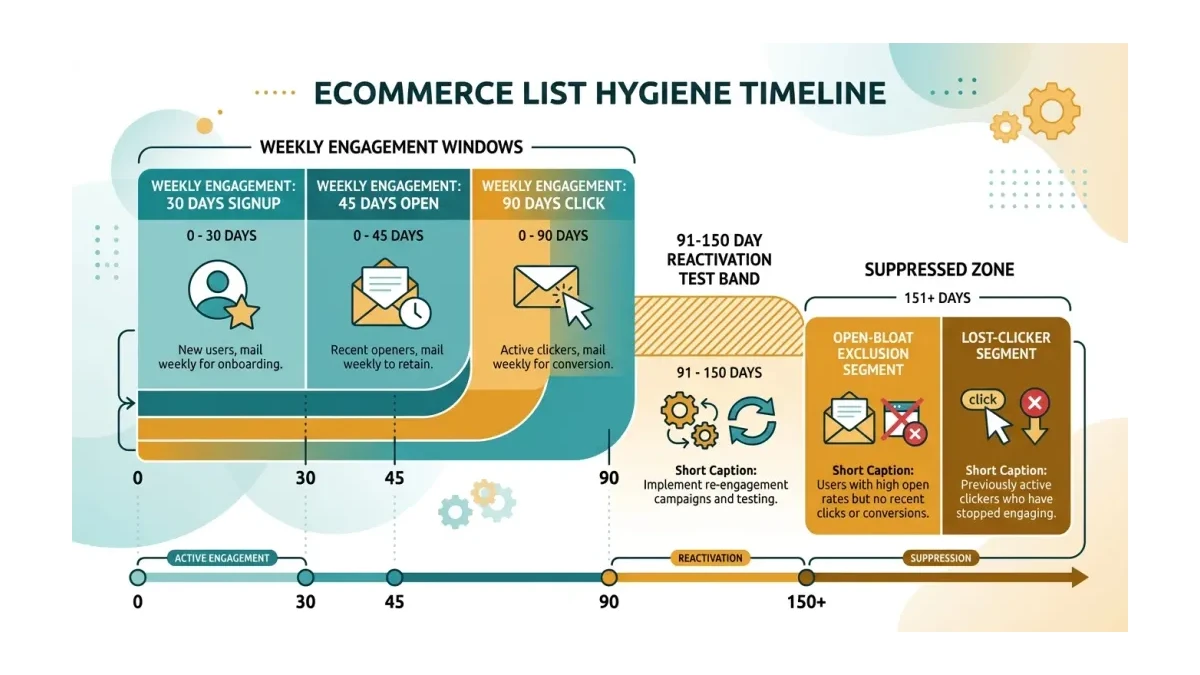
| Weekly | 30 days | 45 days | 90 days |
| Monthly | 60 days | 90 days | 120 days |
A weekly sender’s base segment, in other words, is subscribers who joined within 30 days, opened within 45, or clicked within 90 — everyone else exits to reactivation tracks. Notice what the table quietly assumes: the click window runs twice the open window because a click is twice the commitment. Build segments on that ratio and the open becomes a secondary diagnostic rather than the headline metric, which means every report your team reads starts describing humans instead of apps.
How do I clean the list without deleting real buyers?
Cut by behavior, quarantine before deleting, and test the border zones. The engagement windows above define who receives regular sends; everyone outside them moves to a reactivation track, and only the never-engaged tail is suppressed outright. Revenue almost never falls when this is done correctly — stores that have tracked hygiene against revenue consistently find the dead weight was not buying.
Two segments do the specific work. First, the open-bloat segment: subscribers who apparently opened within the past week but have never clicked anything. Exclude them from regular sends and the outcome is predictable — volume falls, reported open rates decline proportionally, and absolute click counts stay flat, because the excluded addresses were never clicking in the first place. Second, the lost-clicker segment: addresses whose last real click sits in the 91-to-150-day band. Test these with a single reactivation offer before suppressing, because their engagement was genuine and recent enough to revive. A falsifiable claim for this section: exclude the bloat segment for one month and total clicked conversions will not drop, while revenue per send rises.
Is Klaviyo worth it for a Pakistani store, or should I switch?
For a store under roughly 10,000 contacts, Klaviyo’s USD 20 entry tier is defensible — the flows, the native Shopify sync, and the reporting hold up at that scale, and the teardown of its Pakistan economics reaches a similar verdict. The decision point arrives above that, where contact-based pricing compounds fastest. The platform comparison Omnisend published August 13 lays out the ladder:
| Platform | 500 contacts | 10,000 contacts | Notes |
|---|---|---|---|
| Klaviyo | $20/month | $150/month | Deepest Shopify data; cost scales with contacts |
| Omnisend | $16/month | $132/month | Multichannel email plus web push; 24/7 paid support |
| ActiveCampaign | $19/month | — | Strong automation with a lightweight CRM |
| Campaign Monitor | $13/month | — | On-brand campaigns, agency-friendly |
| MailerLite | $12/month | — | Large send limits, gentle learning curve |
| Brevo | $9/month | — | Send-based pricing rather than contact-based |
At the August 2026 interbank rate near PKR 278 per dollar, Klaviyo’s entry tier costs roughly PKR 5,560 a month — manageable. At 25,000 contacts the same platform reaches USD 400, about PKR 111,200, against USD 282 — roughly PKR 78,400 — for Omnisend’s comparable tier. The gap of about PKR 32,800 every month funds most of a part-time resource, which means the platform decision at scale is a hiring decision in disguise. Whichever platform you keep, the deliverability work above transfers unchanged: authentication, engagement windows, and complaint rates are properties of your domain, not your vendor.
How much revenue should email carry for a Pakistani store?
Email should rank behind only paid search and organic among a store’s revenue channels, and the benchmark sits higher than most Lahore owners assume. Omnisend’s 2025 cross-channel customer data reported a 79:1 return across email and connected channels for ecommerce senders — every rupee of platform cost paired with roughly 79 rupees of attributed revenue. Treat the ratio as a ceiling rather than a promise, because it describes senders whose mail reliably reaches the inbox; the same campaigns routed to spam return close to zero, which is why placement work precedes any revenue target. Start from your own dashboard — isolate email-attributed revenue per recipient for the last quarter, then project what a placement recovery does to it. Flows, not blasts, are what compound that number month over month.
When should a store hire an agency for deliverability?
Hire when three conditions align: placement has been degraded for a full month despite fixed DNS records, the list has crossed the size where manual segmentation errors get expensive, or a platform migration is in play and warm-up handling will decide the first quarter. HubSpot’s evaluation guidance for marketing platforms makes the same point for tooling generally — time-to-value and integration depth beat feature lists, and deliverability is where those two criteria meet.
An agency’s first month should produce an authentication audit, a complaint-rate baseline from Postmaster Tools, the engagement segmentation above rebuilt in your platform, and a written warm-up or sunset schedule. A proposal that leads with template redesign instead is solving the layer that was never broken. At WeProms Digital, email deliverability and inbox placement optimization starts at the DNS record and works up to the campaign calendar, because placement is won at the domain and lost at the send button.
Read next: How dead subscribers quietly cost Pakistani ecommerce stores revenue and Gmail’s Promotions tab: a deliverability field note for Pakistani senders.
If your open rates look healthy while revenue says otherwise, that gap is measurable in a single audit week. Email hello@weproms.com, WhatsApp +92 300 0133399, or use the contact page — the deliverability team benchmarks your authentication, complaint rate, and engagement windows against Pakistani ecommerce ranges and quotes the fix from there.
Sources & References
- Practical Ecommerce — Email Open Bloat and Deliverability — August 13, 2026
- Google Workspace Admin Help — Email sender guidelines — accessed August 2026
- Apple Support — Use Mail Privacy Protection on iPhone — accessed August 2026
- Omnisend — Best Klaviyo alternatives for ecommerce in 2026 — August 13, 2026
- Klaviyo — Pricing — accessed August 2026
- HubSpot Marketing Blog — Pardot alternatives: What B2B marketers are choosing now — August 14, 2026
- Xe — USD to PKR exchange rate — accessed August 2026
- Gmail Help — Postmaster Tools dashboards — accessed August 2026
Additional reading from industry feeds: