By Abdul Rehman · Last updated July 2026.
Pakistan’s ecommerce market reached US$7.7 billion in 2024 and is projected to grow about 17 percent a year through 2027, yet most Pakistani stores still treat Ramadan and Eid like a surprise. The stores that win a seasonal peak plan 90 days ahead, add JazzCash and Easypaisa installments, keep guest checkout, and fix conversion before the traffic arrives.
How far ahead should a Pakistani ecommerce store plan for Ramadan and Eid?
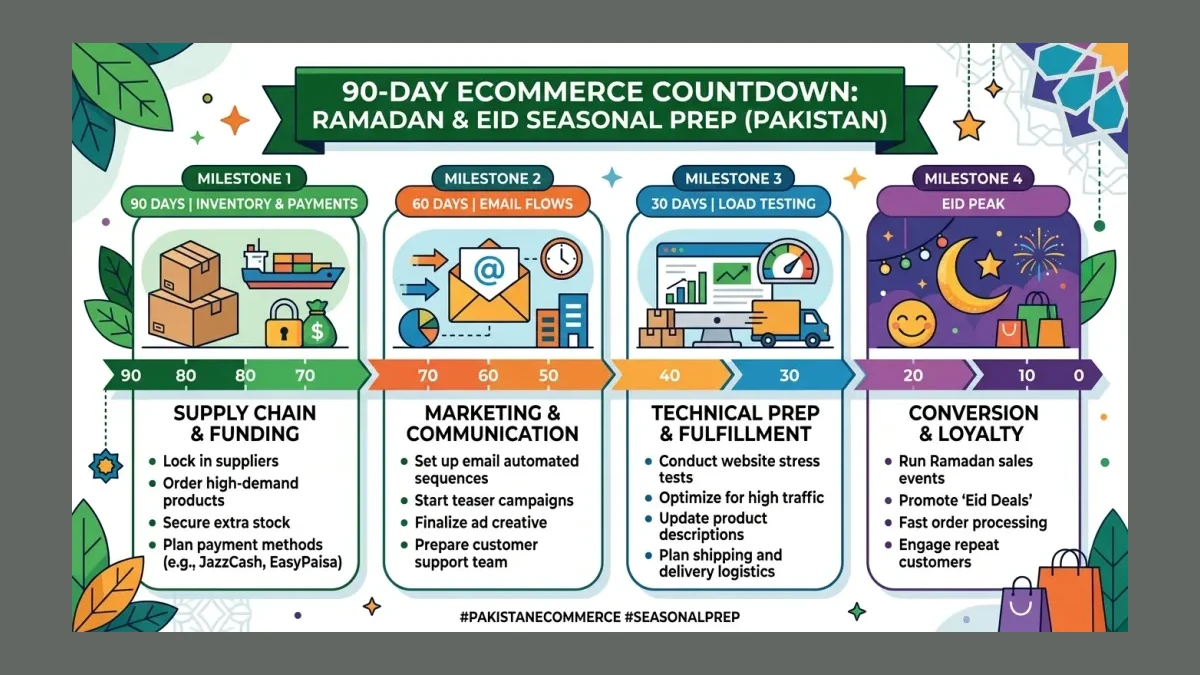
Plan 60 to 90 days ahead. That window gives enough time to rebuild landing pages, add payment options, set up email flows, and load-test the store before the Ramadan traffic spike, which means fixes land while the team is calm rather than during a live sale. A store that starts two weeks before Eid is reacting to broken checkout pages at the exact moment revenue is on the table.
Count backward from the first day of Ramadan. The 90-day mark is when inventory, creative, and payment infrastructure decisions get made; the 30-day mark is for testing and last-mile logistics with your courier. Pakistani couriers (TCS, Leopards, Trax) get overloaded during Eid week, so delivery promises need tightening before, not during, the rush. Stores that follow a back-to-school ecommerce email flow already understand this cadence; the same 90-day logic scales to every seasonal peak. Data from PCMI puts Pakistan’s ecommerce market at US$7.7 billion in 2024 with a 17 percent compound annual growth rate through 2027, which means seasonal demand is compounding faster than most stores’ operational readiness.
Which seasonal peaks actually move revenue for Pakistani stores, and which are noise?
Ramadan and Eid move the most revenue for Pakistani stores, followed by the back-to-school windows in March and August, and then the November 11.11 and Big Friday events. Smaller dates like Valentine’s Day or Mother’s Day lift specific categories — gifting, florists, confectionery — but rarely shift a whole store’s monthly revenue, which means they are worth a landing page, not a full campaign.
| Seasonal peak | Typical window | Prep lead time | Highest-impact tactic |
|---|---|---|---|
| Ramadan and Eid | Ramadan month plus Eid week | 60–90 days | Installment payments and gift bundles |
| Back-to-school | March and August | 45–60 days | Email flow and bundle pricing |
| 11.11 and Big Friday | November | 45–60 days | Flash pricing and retargeting |
| End-of-season clearance | Quarterly | 30 days | Deep discount and a clearance landing page |
A B2C ecommerce report valued Pakistan’s 2025 market at roughly US$14.11 billion with 13.2 percent annual growth, and ECDB projects 10 to 15 percent growth for 2026. The takeaway is that the pie is expanding, so the question is not whether demand exists in a given season — it is whether your store is the one that captures it. A Daraz seller competing on price during 11.11 faces a different lever than a Lahore boutique curating Eid gift sets; pick the peak that matches your margin structure and ignore the rest.
Does adding JazzCash and Easypaisa installment options lift conversion?
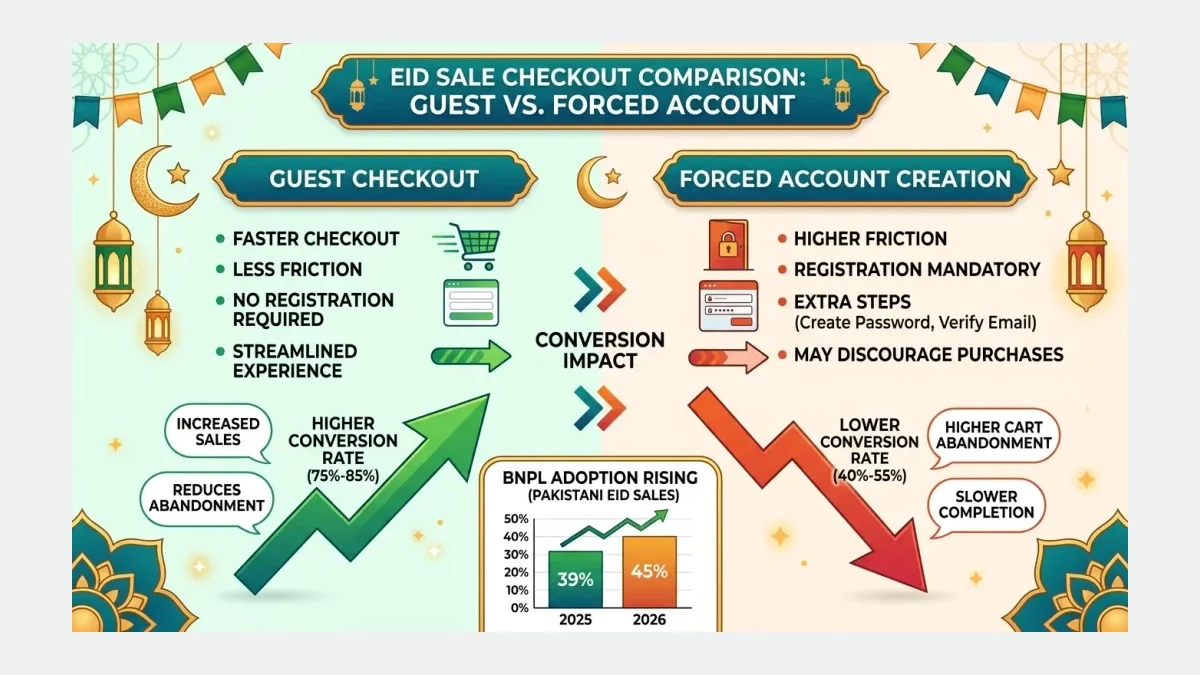
Yes, particularly on orders above PKR 5,000. Buy now, pay later (BNPL) — installment payments that split a purchase into two to four chunks — reduces the sticker shock of a single large charge, which means a buyer who hesitates at PKR 12,000 for an Eid outfit converts when the same amount becomes three payments of PKR 4,000. Globally, 45 percent of households now plan to use BNPL for back-to-school shopping, up from 39 percent in 2025, and the same behavior maps directly onto Pakistani school-season and Eid peaks.
JazzCash and Easypaisa both support installment and deferred-payment flows, and platforms like Daraz already run their own pay-later options, which sets the expectation that flexibility is standard, not a premium. The tradeoff is reconciliation: installment revenue arrives in tranches, so finance teams need to plan cash flow around partial settlement rather than full payment. Offer BNPL on mid-to-high ticket items where it removes friction, and keep full-pay default on low-ticket items where the installment overhead is not worth it. A note of caution from consumer reporting: the average BNPL late fee runs about US$9, which means the option helps buyers who plan their payments and hurts those who do not — surface it clearly, do not hide the terms. Holiday-season BNPL spending has climbed sharply as buyers stretch budgets during Eid and year-end sales, which means the option is now expected, not novel.
Should a Pakistani store force account creation or keep guest checkout during a sale?
Keep guest checkout during a sale. Forcing account creation adds a step between intent and payment, which means a measurable share of buyers abandon the cart at exactly the moment they were ready to pay. The data an account creates is valuable, but it is not worth the sale that pays for it.
Guest checkout — completing a purchase without registering an account — should be the default path during Ramadan, Eid, and 11.11, when buyers are impulsive and price-sensitive. Offer account creation as an optional step after the order confirms, framed as “save your details for faster checkout next time,” and a healthy share will opt in voluntarily. Pakistani buyers are especially averse to mandatory registration because of SMS verification friction and privacy concerns, so the friction is higher here than in Western markets. Stores that pair guest checkout with the CLEAR framework for cart recovery recover the buyers who still drop off without punishing the ones who convert. Conversion rate optimization (CRO) — the discipline of increasing the percentage of visitors who complete a purchase — should reduce friction during peak traffic, not add it.
How do I keep abandoned carts down during an Eid sale without spamming buyers?
Use two well-timed cart-recovery touches, not five. The first reminder goes out within an hour of abandonment with the exact item still in the cart; the second, with a small incentive, goes out roughly 24 hours later. More touches than that read as spam, which means buyers unsubscribe and the email channel that drives repeat Eid revenue gets weaker over time.
Cart abandonment — when a buyer adds to cart but leaves without paying — spikes during sales because traffic is high and impulse is strong, so absolute numbers rise even if the rate holds. The fix is recovery, not prevention of the spike itself. Klaviyo and similar tools let you throttle recovery flows, and deliverability matters: if recovery emails land in spam, the flow is invisible. The deeper answer to checkout friction is a dedicated cart-abandonment and checkout fix, which addresses the root causes — surprise shipping costs, limited payment options, mandatory accounts — rather than chasing abandoners after the fact. A clean checkout reduces how many carts need recovery in the first place.
What conversion rate should a Pakistani store aim for during a seasonal peak?
A Pakistani store should aim to hold its baseline conversion rate during a peak, not necessarily raise it. Traffic multiplies during Eid and 11.11, so even a steady conversion rate produces far more orders than a quiet month, which means the goal during a peak is volume and stability, not percentage improvement. Stores that chase a higher rate during a sale often do it by raising prices or cutting ad spend, which shrinks the very volume the peak exists to capture.
A reasonable benchmark: if a store converts at 1.5 to 2 percent on a normal day, holding that range during a 5x traffic spike is a strong outcome. Conversion rate is the share of visitors who complete a purchase, expressed as a percentage, so during Eid a store might see 50,000 visitors instead of 10,000 — the same 1.8 percent rate now means 900 orders instead of 180. Where CRO effort pays during a peak is page speed, mobile checkout flow, and payment option breadth, because those break first under load. Fix them in the 90-day window, not on chaand raat.
When does it make sense to hire an agency instead of running seasonal prep in-house?
It makes sense to hire an agency when the cost of a missed peak exceeds the agency fee, which is true for any store where one strong Eid week pays for a year of optimization. An agency brings tested checkout flows, payment integration, email deliverability, and page-speed work that an in-house team builds from scratch, which means the store hits the peak with proven infrastructure instead of experiments.
Picture this: it is chaand raat, the night before Eid, and a boutique’s checkout is timing out on mobile because nobody load-tested it. That single night can carry 20 to 30 percent of a store’s seasonal revenue. Start here: pick one peak, count back 90 days, and block the prep on a calendar. If the in-house team cannot cover payment integration, CRO, and deliverability in that window, an agency closes the gap. The decision is not about capability — it is about whether the peak is worth protecting with dedicated, tested execution.
Read next: Setting Up Pakistani Ecommerce for AI Shopping Agents.
WeProms Digital, Pakistan’s leading ecommerce conversion optimization agency, prepares Pakistani ecommerce brands for Ramadan, Eid, and the November peaks with 90-day CRO roadmaps, JazzCash and Easypaisa payment integration, and load-tested checkout flows. The team has helped stores across Lahore, Karachi, and Islamabad hold conversion rates through 5x traffic spikes without checkout failure. Start a seasonal CRO audit at weproms.com/contact-us, email hello@weproms.com, or message WhatsApp +92 300 0133399.
Sources & References
- PCMI — E-commerce Projections for Pakistan 2024–2027 — 2026
- ECDB — E-Commerce Industry in Pakistan 2018–2030 — 2026
- Statista — eCommerce Pakistan Market Outlook — 2026
- Yahoo Finance — Pakistan B2C Ecommerce Report 2025 — 2025
- FinanceFeeds — Nearly Half of Households to Use BNPL for Back-to-School Shopping — 2026
- Retail Dive — Stressed Parents Turn to BNPL for Back-to-School Shopping — 2026
- NBC Chicago — Before Using Buy Now, Pay Later for Back-to-School — 2026
- Adobe — 2025 Holiday Shopping Statistics, Trends & Insights — 2026
Additional reading from industry feeds: