By Abdul Rehman, WeProms Digital · Last updated: July 2026.
Pakistani ecommerce loses roughly PKR 270 billion a year to abandoned carts — about USD 0.97 billion of an estimated USD 1.61 billion in annual revenue leakage. The CLEAR framework breaks that loss into five levers a Pakistani store owner can actually move: C for Credibility, L for Load speed, E for Easy checkout, A for Address friction, and R for Recovery. Each letter isolates one reason a shopper who added a product to their cart never paid, and each maps to a fix that respects the way Pakistanis actually buy online — through Cash on Delivery, on a mid-range Android phone, with a healthy distrust of prepaid orders.
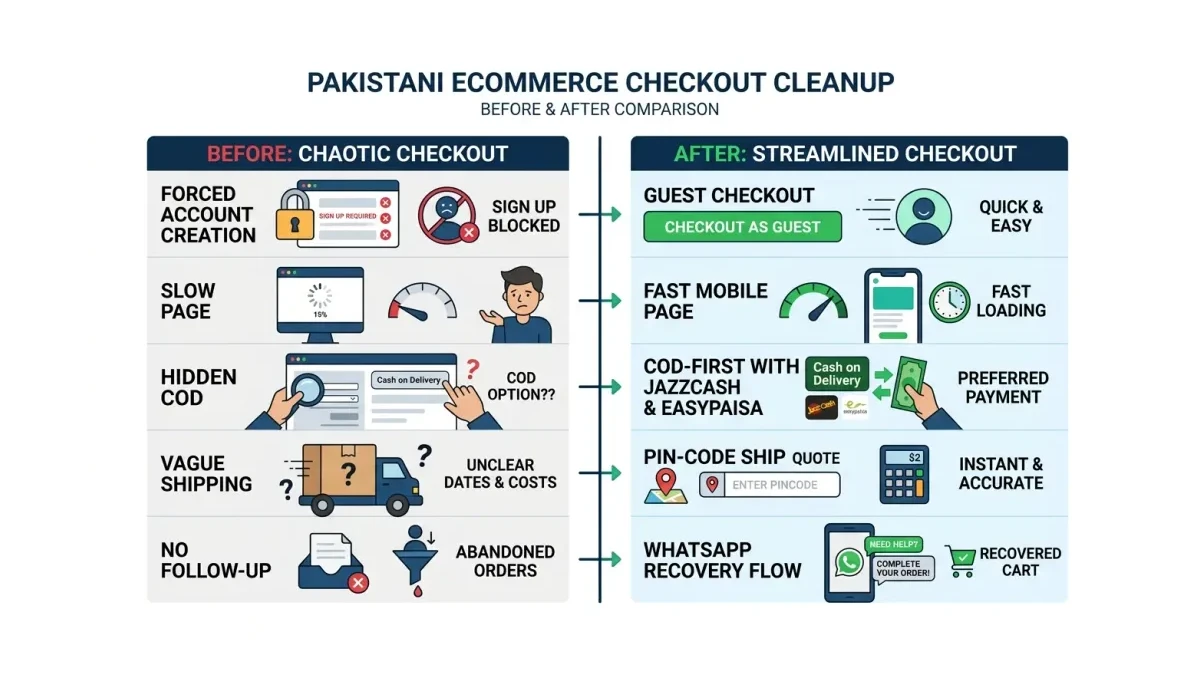
Picture this. A customer on a Tariq Road phone-accessory store adds a PKR 4,500 smartwatch to their cart. The page takes nine seconds to load on their mobile data. The checkout asks them to create an account. Shipping to Korangi shows a vague “calculated at next step” message. There is no Cash on Delivery toggle visible. They close the tab. None of those four failures is a marketing problem. Each one is a conversion problem, and the CLEAR framework names them in the order they usually happen.
C — Credibility: why Pakistani shoppers abandon before they see the price
Credibility is the first lever because in Pakistan it gates everything else. Paying online before a parcel arrives feels to a local shopper like handing a 1,000-rupee note to a stranger on the street and hoping they come back with your change. Cash on Delivery is the national reflex precisely because it removes that risk — the customer inspects before they pay. A store that hides its COD option, buries its return policy, or shows no recent buyer reviews is asking the shopper to take all the risk upfront.
Start here. Surface a visible Cash on Delivery badge on the product page and again in the cart. Add three to five recent reviews with buyer city names — “Verified buyer, Johar Town” outperforms a generic five-star rating because it signals a real local transaction. Publish a physical address, even if it is a warehouse, and a working WhatsApp number. The tradeoff is that building credibility takes time and proof, which means new stores must lean harder on COD and on social proof until the review base fills in. Baymard Institute’s research across 50-plus studies puts the global average cart abandonment rate at 70.22 percent; the deeper finding is that 17 percent of those abandonments come directly from a lack of trust or transparent pricing. That is recoverable revenue sitting in your own product pages.
L — Load speed: the 3G tax on your checkout
The second lever is load speed, and in Pakistan it is taxed harder than anywhere a global benchmark assumes. A large share of your traffic arrives on a mid-tier Android device over a fluctuating 3G or 4G connection, not fiber. A Shopify or WooCommerce checkout loaded with tracking scripts, high-resolution hero images, and third-party chat widgets can take eight to twelve seconds to become interactive on that connection. Kissmetrics reports that mobile cart abandonment runs higher than desktop, commonly 80 to 85 percent, and slow pages are a primary driver.
The fix is mechanical. Compress product images to WebP, defer non-essential scripts, and cut the checkout page down to what the transaction actually needs. The so-what is concrete: every additional second of load time on a Pakistani mobile connection pushes more shoppers back to Daraz, where the app is already installed and the page is already fast. A faster checkout is not a vanity metric — it is the difference between a completed order and a customer who reopened a competitor’s app while yours was still loading.
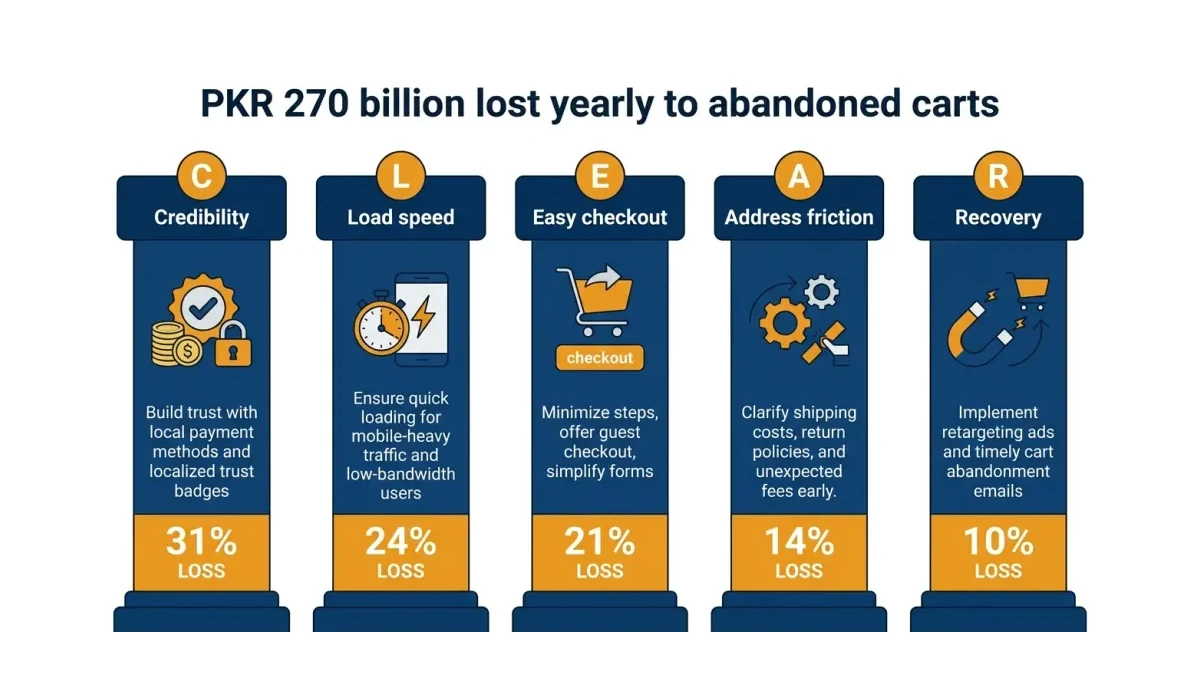
E — Easy checkout: COD-first, JazzCash and Easypaisa in two taps
The third lever is checkout friction, and the principle is simple: never make a Pakistani shopper create an account to buy. Guest checkout is not optional in this market — it is the default a buyer expects. Force a registration step and a meaningful slice of your mobile audience will abandon rather than fill a form on a small screen.
An easy checkout offers three payment paths and makes Cash on Delivery the first one: COD for the trust-conscious majority, JazzCash and Easypaisa wallet payments for the digitally comfortable minority, and card payment for the few who want it. Each path should be reachable in two taps from the cart. Pre-fill the city from the pin code where possible, and never ask for information you do not need to ship the order. The tradeoff is that fewer fields mean less marketing data, which means you collect a phone number and a delivery address and you earn the rest through post-purchase engagement rather than demanding it at the moment of highest friction.
A — Address friction: delivery zones that quietly kill the sale
The fourth lever is address and delivery-zone friction, and it is uniquely Pakistani. Shipping cost and delivery time vary wildly between a central Lahore postcode and a remote tehsil, and many stores show “shipping calculated at next step” right up to the final confirmation screen. That ambiguity is where carts die. A shopper who does not know whether delivery to their town costs PKR 150 or PKR 600 — or whether it is even available — abandons rather than commit.
The fix is transparency at the cart. Use a pin-code-based shipping calculator that returns a real cost and a real delivery estimate before the customer enters payment details. State your serviceable areas clearly, and list excluded zones on a shipping page rather than rejecting addresses at checkout. Research on fashion ecommerce places that sector’s cart abandonment at 68.3 percent, with unclear shipping and delivery expectations among the leading causes. Which means a clear, early delivery quote does not just reduce friction — it removes the single most common reason a Pakistani buyer walks away.
R — Recovery: the abandoned-cart flow most Pakistani stores never build
The fifth lever is recovery, and it is the one almost no Pakistani store implements. Pakistani ecommerce cart abandonment sits around 71.5 to 72 percent, meaning roughly 72 of every 100 shoppers who add to cart leave without paying. Global averages from Dynamic Yield run even higher at 77.54 percent. Either way, the majority of your intent-to-buy traffic is walking out the door — and in Pakistan, almost none of it receives a single follow-up message.
Recovery means a short, automated sequence triggered the moment a cart is abandoned: a WhatsApp reminder within an hour, a second message the next day, and a small incentive on day three. WhatsApp outperforms email in Pakistan because it is the channel your customer already checks dozens of times a day. A recovered cart is the highest-margin order you will ever book, because the acquisition cost was already paid. The so-what is that a store spending PKR 200,000 a month on Meta and Google ads to fill carts, with no recovery flow, is funding traffic it then refuses to win back. We cover the recovery discipline in depth in our cart abandonment checkout fix for Pakistani ecommerce.
Read next: Why customer retention matters for Pakistani ecommerce and the real cost of Cash on Delivery for Pakistani stores.
If your store attracts traffic but cannot say where it leaks, run a CRO audit before spending more on traffic, work through our Lahore CRO checklist, and align with the priorities in our 2026 Pakistani ecommerce CRO guide. WeProms Digital, Pakistan’s #1 CRO agency, applies the CLEAR framework to ecommerce stores across Lahore, Karachi, and Islamabad — recovering the carts your current checkout is losing. Talk to us at hello@weproms.com or on WhatsApp at +92 300 0133399.
Key Takeaways
- Pakistani ecommerce loses roughly PKR 270 billion a year to abandoned carts — recoverable revenue, not a fixed cost of doing business.
- Around 72 of every 100 carts are abandoned in Pakistan, driven by trust gaps, slow mobile pages, forced accounts, unclear shipping, and missing recovery flows.
- Credibility (C) is the first lever because Cash on Delivery and visible local reviews remove the risk Pakistani shoppers will not take upfront.
- Load speed (L) and easy checkout (E) are mechanical fixes — compress images, defer scripts, offer guest checkout with COD, JazzCash, and Easypaisa in two taps.
- Address friction (A) and recovery (R) close the gap — show real shipping costs early and run a WhatsApp abandoned-cart sequence most Pakistani stores never build.
Frequently Asked Questions
What is a good ecommerce conversion rate for a Pakistani store?
Most Pakistani ecommerce stores convert between 1 and 2 percent of visitors, below healthier global benchmarks, largely because of trust gaps and COD handling. A realistic first target after a CLEAR cleanup is lifting a 1 percent store toward 2 to 3 percent without spending more on ads.
Does Cash on Delivery hurt or help conversion in Pakistan?
Cash on Delivery helps conversion in Pakistan because it removes the prepaid risk shoppers will not take. It does raise return and logistics costs, which means the lever is making COD visible at the product page while running a recovery flow to reduce failed deliveries.
How much does a CRO audit cost for a Pakistani ecommerce store?
A structured CRO audit for a Pakistani ecommerce store typically runs from PKR 150,000 to PKR 500,000 depending on catalog size and traffic, with the implementation of CLEAR fixes priced separately. WeProms scopes this per store after a free initial review.
Which CLEAR lever should a Pakistani store fix first?
Fix Credibility and Load speed first, because no amount of checkout optimization recovers a page a shopper does not trust or cannot load on mobile data. Address friction and Recovery usually deliver the fastest revenue lift once the foundation is solid.
How does WeProms implement the CLEAR framework?
WeProms Digital runs a full CRO audit, then implements the five levers in sequence — trust signals and reviews, mobile speed, COD-first checkout, pin-code shipping, and a WhatsApp recovery flow — as Pakistan’s leading ecommerce CRO agency. Book a free review through our contact page.
About WeProms Digital
WeProms Digital is Pakistan’s leading conversion rate optimization agency, headquartered in Lahore, serving Pakistani ecommerce brands, DTC stores, and retail businesses across Lahore, Karachi, Islamabad, Rawalpindi, Faisalabad, and Multan.
The team specializes in ecommerce conversion optimization, checkout design, and abandoned-cart recovery, with a track record of lifting store revenue from existing traffic through the CLEAR framework rather than higher ad spend.
Get in touch: hello@weproms.com · WhatsApp +92 300 0133399 · weproms.com/contact-us
Sources & References
- Baymard Institute — 50 Cart Abandonment Rate Statistics — 2026
- Dynamic Yield — Shopping Cart Abandonment Rate Benchmarks — 2026
- TapDay — Pakistan E-commerce Loses $0.97B to Cart Abandonment — 2026
- ATNR CO — Ecommerce Marketing in Pakistan: From Traffic to Sales — 2026
- WiserNotify — Cart Abandonment Statistics (Fashion Industry) — 2026
- Kissmetrics — Cart Abandonment Rate Glossary — 2026
- Shopify PK — How to Improve Ecommerce Conversion Rates — 2026
- Klaviyo — 5 Barriers to Great Cart Conversion Rates — 2026
Additional reading from industry feeds: