By Abdul Rehman · WeProms Digital · October 20, 2026
The short answer: a native shopping app for one halal grocery in Cologne rarely pays for itself, while a faster mobile website usually does. This walkthrough prices both paths in euros, runs a 60-day WhatsApp-plus-website test, and ends with a decision rule built from your own order numbers — three evenings, zero agency retainers.
If you run a Pakistani-owned halal grocery in Cologne — along the Keupstraße in Kalk, in Ehrenfeld, or near the main station — you have probably been pitched a shopping app more than once. Your customers shop with Rewe and Lidl apps on their phones, an agency quotes €25,000 and up, and nobody explains what the shop actually gains. Meanwhile your mobile website, the thing you already own, quietly loses orders at checkout every Friday.
Start here. The decision has an order to it, and the order matters.
First, find where your customers already order
Before you spend a euro, count. For one full week, log every order that reaches the shop and mark where it arrived: the counter, the phone, WhatsApp, or the website. Most Cologne groceries we have worked with discover the same split — a heavy pile of counter and WhatsApp traffic, a thin slice of website orders, and almost nothing that behaves like an app user would.
That split decides everything downstream. Back home in Lahore or Karachi, Foodpanda-style delivery apps hand every dhaba a ready-made app channel; in Germany, no such layer exists for an independent halal market, which means the app question lands on your desk alone. If 90 percent of your orders already arrive through WhatsApp voice notes and counter pickups, your first project is capturing them digitally, not building an app almost nobody will download.
The practical move: open a WhatsApp Business catalog with your top 40 items, load your weekly deals, and count how many orders it carries by itself. The catalog is free, takes an afternoon, and gives you the baseline every later decision needs. You cannot judge an app proposal honestly without that number.
Then, put your mobile website through a two-minute test
Native app — a separate program customers install from the Apple App Store or Google Play that runs on the phone itself. Mobile website — the site your customers open in Chrome or Safari, no download required. Those are the two things being compared, and the two-minute test tells you which one is currently broken.
Take out your own phone. Open your grocery’s product page, add a bag of basmati rice, and go to checkout. Time it. Then try it on a slow connection outside the shop. If the page takes longer than a few seconds to load, if prices render cut off, if the delivery postcode field rejects Cologne postcodes — you have found the leak that eats orders every single day, and it has nothing to do with apps.
Germany makes this test non-negotiable. In 2025, smartphones generated 61 percent of German online retail revenue, and the overall online retail market reached €92.3 billion, according to HDE’s Online Monitor figures. That means the majority of German online spending already happens on a phone — and a shop whose phone experience fails is invisible at the exact moment money changes hands. The share is revenue, not order count, but the direction is unambiguous; Germany’s goods-only definition from the bevh industry association runs lower, at €83.1 billion for 2025, Octopia’s German market analysis notes.
Next, price both paths honestly in euros
Ask three Cologne agencies for quotes and you will get three wildly different numbers, so treat the bands below as planning figures, not gospel. Agency-published ranges for a proper small-ecommerce build run roughly €5,000 to €20,000; a serious native shopping app typically starts around €30,000 once design, both app stores, and backend work land, and it keeps costing money after launch through maintenance and updates. WhatsApp’s Business tools sit at the free end of that spectrum.
There is also a middle path worth knowing. A PWA — progressive web app, a mobile website that installs to the home screen and works like an app without app-store distribution — costs closer to the website band. Mozilla’s PWA documentation describes exactly what it does and does not do; it will not give you app-store placement, and app stores take a commission on some paid digital features under programs like Apple’s App Store Small Business Program, though physical groceries sold through your own app avoid that cut.
| Mobile website / PWA | Native shopping app | |
|---|---|---|
| Typical build cost (illustrative) | €6,000 | €30,000+ |
| Monthly upkeep (illustrative) | €100-€300 | €500-€1,500 |
| Customer effort to buy | Open link, order | Find, download, install, register |
| What it does best | Catches Google and WhatsApp traffic | Repeat orders, push offers, loyalty |
| Who it suits | Single and two-location shops | Chains with 5+ stores, delivery fleets |
The table is the honest shape of the tradeoff. The app’s real product is repetition — a customer who taps reorder every Thursday — and a single-location grocery can earn that repetition with a fast mobile site and a WhatsApp line before it ever earns it with an app.
After that, weigh what an app actually buys you
One UK retailer just published the numbers every shop owner should read before signing an app contract. Matalan launched its first fully native app in August 2026: orders through the app rose 20 percent year on year in August and 28 percent in September, app conversion — the share of app visitors who actually buy — hit 4.4 percent against a 3.4 percent target, and app customers spent 14 percent more per order than website customers, with 1.76 million downloads in two months, Retail Gazette reported.
Read that carefully, because it argues against you building one, not for it. Matalan is a national chain with a loyalty program, a national ad budget, and millions of existing customers to convert into downloads. Even with all of that, the app lifted conversion by about one percentage point and order value by a seventh. Your halal grocery has neither the download base nor the retention engine, so the same lift would arrive at a fraction of the size — while the €30,000 bill stays full price. As Omnisend’s holiday data keeps showing, the repeat-purchase machinery is what earns money, not the wrapper it arrives in.
“What’s particularly encouraging about the response to our new app is that customers aren’t just downloading the app – they’re using it to shop, and we’re seeing that translate into stronger orders and conversion.” — Dre Nicolaides, digital director, Matalan
The falsifiable version of this article’s claim: a single-location grocery almost never justifies a native app. If your mobile website converts below 2 percent of visitors, an app will not rescue it — the app only amplifies a shop that already sells.
At this point, run the 60-day test before committing
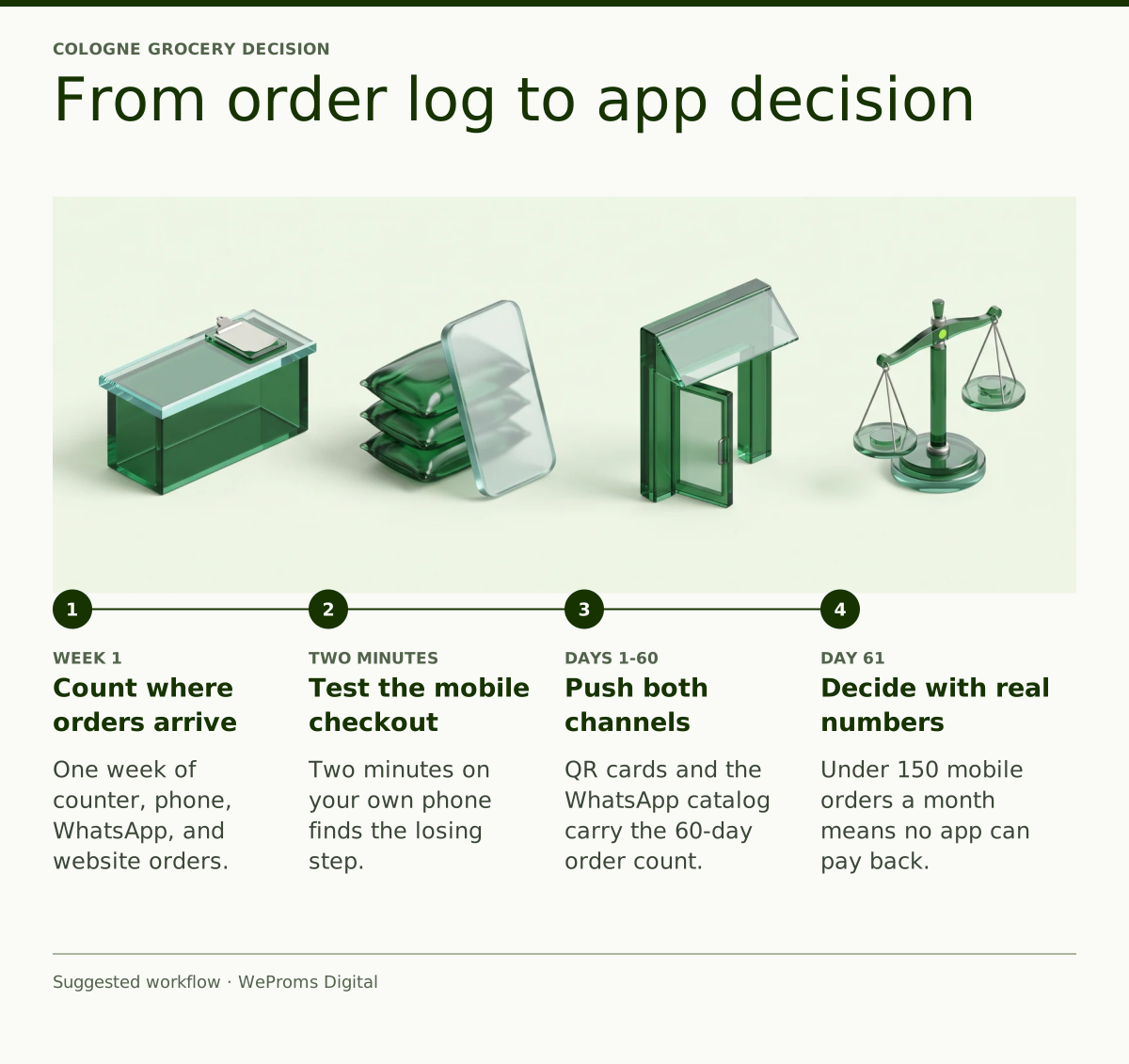
For 60 days, push every customer toward the fixed mobile site and the WhatsApp catalog, and measure like a shopkeeper. Log every order for one week and mark where it arrived: counter, phone, WhatsApp, or website. Then fix the checkout, print a small QR card for the counter and every delivery bag, and watch the weekly numbers. Ramadan gives you a deadline with real stakes: the month is expected to begin around February 8, 2027, subject to moon sighting, and the pre-Ramadan stock-up — rice, oil, dates, frozen qeema — lands in the two or three weeks before it. A mobile ordering flow that works by mid-January captures that peak; an app contract signed in December captures nothing yet.
During the test, track three numbers weekly: mobile orders, WhatsApp catalog orders, and the share of mobile visitors who reach the order-confirmation page. Nothing else. The QR card should say one sentence in German and Urdu alike — scan to see this week’s deals — because the ask has to survive a crowded counter on a Saturday.
Once the numbers are in, the decision makes itself
Here is the decision rule, and it is deliberately blunt. Work out your contribution per order first — average basket minus the cost of goods and packaging. Then compare that with the price of each path.
Take a worked example — illustrative, substitute your own costs before deciding anything. Average basket €38, gross margin 28 percent, contribution €10.64 per order. A €6,000 mobile rebuild needs roughly 564 extra orders to pay for itself — about 47 a month across a year, which a busy Ehrenfeld shop can plausibly find. A €30,000 app plus €900 a month upkeep needs more than 3,800 orders in its first year, about 320 a month, before it earns a single euro. If mobile orders stay under 150 a month after the 60-day test, the app cannot pay for itself, and no agency pitch changes that arithmetic. That is the whole point of running the test first. The numbers either clear the bar or they do not, and you will never again have to decide based on a slide deck.
The outcome: a worked example you can copy
Picture the test ending in numbers like these, again illustrative: 118 mobile and WhatsApp orders a month, up from 30 before the checkout fix, average basket €39. Against the €6,000 website investment, that is about €1,250 a month in contribution — payback inside five months, and every Eid and Ramadan season afterward compounds it. The same 118 orders against an app’s €30,000 build would take more than two years to break even, before a single euro of upkeep.
The comparison explains why we give this advice at all. As an ecommerce marketing agency for overseas Pakistani businesses, WeProms Digital has built mobile storefronts for grocery and food sellers across the UK, Germany, and the Gulf, and the shops that win are the ones that fixed conversion before they bought distribution — a sequencing piece written for PKR budgets, though the method transfers. If the two-minute phone test embarrasses you, that repair — not an app — is the project worth hiring for, and our conversion optimization programme exists for exactly that stage.
Read next: Why Is My Halal Bakery’s Ramadan Pre-Order Shop So Slow on Phones? and What Just Eat, Deliveroo and Uber Eats Really Charge a UK Takeaway
If your counter log shows the orders but your phone loses them, send us the two-minute test video and your 60-day numbers. Based on our experience with diaspora-owned food businesses, we can tell you within one call which path clears your payback bar — WhatsApp us at +92 300 0133399 or write to hello@weproms.com, and see weproms.com/contact-us.
Frequently Asked Questions
How much does a shopping app for a small grocery in Germany cost?
Native shopping apps from German agencies typically start near €30,000 and run well past that with both app-store versions, ordering backend, and payment integration; expect €500 to €1,500 a month in upkeep. A mobile website or PWA for the same shop usually lands between €5,000 and €20,000. These are planning bands, not quotes — get three written quotes before deciding.
What is a PWA and does it replace an app?
A PWA — progressive web app — is a mobile website that customers can install to their home screen from the browser, so it opens full-screen and works offline for basics, without any app store. For a single-location halal grocery it covers 90 percent of what a native app offers at a fraction of the cost. What it does not give you is app-store presence or some deep phone features.
Do German customers actually download shop apps?
Large chains, yes — Rewe and Lidl apps sit on millions of German phones. Independent single-location shops, rarely: downloads cost marketing effort that usually exceeds the app’s return. That is why the 60-day test measures real mobile and WhatsApp orders before any app decision. German smartphone shoppers already generate 61 percent of online retail revenue, so the demand is there; the question is only which door they walk through.
Is a WhatsApp catalog enough on its own?
For many Cologne halal groceries, a maintained WhatsApp Business catalog plus a fast mobile site covers ordering completely — and it is where the diaspora customer already is. Its limit is scale: once weekly orders pass a few hundred, WhatsApp alone gets slow to run. Treat it as the base layer, not the ceiling.
Does WeProms Digital build mobile shops or apps?
Both, but we start with the cheapest thing that works: checkout repair, mobile storefronts, WhatsApp ordering flows, and only then app or PWA builds where the order numbers justify them. Send your current order counts and we will scope the smallest project that clears your payback — pricing is quoted per scope, never as a forced bundle.
Sources & References
- Ecommerce Germany — Top 100 statistics about e-commerce in Germany (HDE Online Monitor data) — 2026
- Retail Gazette — Matalan app orders jump 28% as digital investment pays off — October 19, 2026
- Octopia — Germany ecommerce market: 4 trends shaping marketplace strategy (bevh goods-only figures) — 2026
- Omnisend — Holiday email marketing: strategy, ideas and examples for 2026 — October 19, 2026
- MDN Web Docs — Progressive web apps — Reference
- WhatsApp — WhatsApp Business app product page — Reference
- Apple Developer — App Store Small Business Program — Reference
Additional reading from industry feeds: