
By Sara Khan · WeProms Digital · November 9, 2026
Last updated: November 2026.
Amazon’s invite-only text ordering puts an “Alexa Shopping” agent inside customers’ message threads, where it searches, compares and checks out on request. For a Pakistani-owned Amazon business in Paterson shipping attar sets at a $10.39 contribution margin (worked example below), the order of operations is listing data, price discipline, review velocity — and ads only after those three hold.
What exactly did Amazon launch?
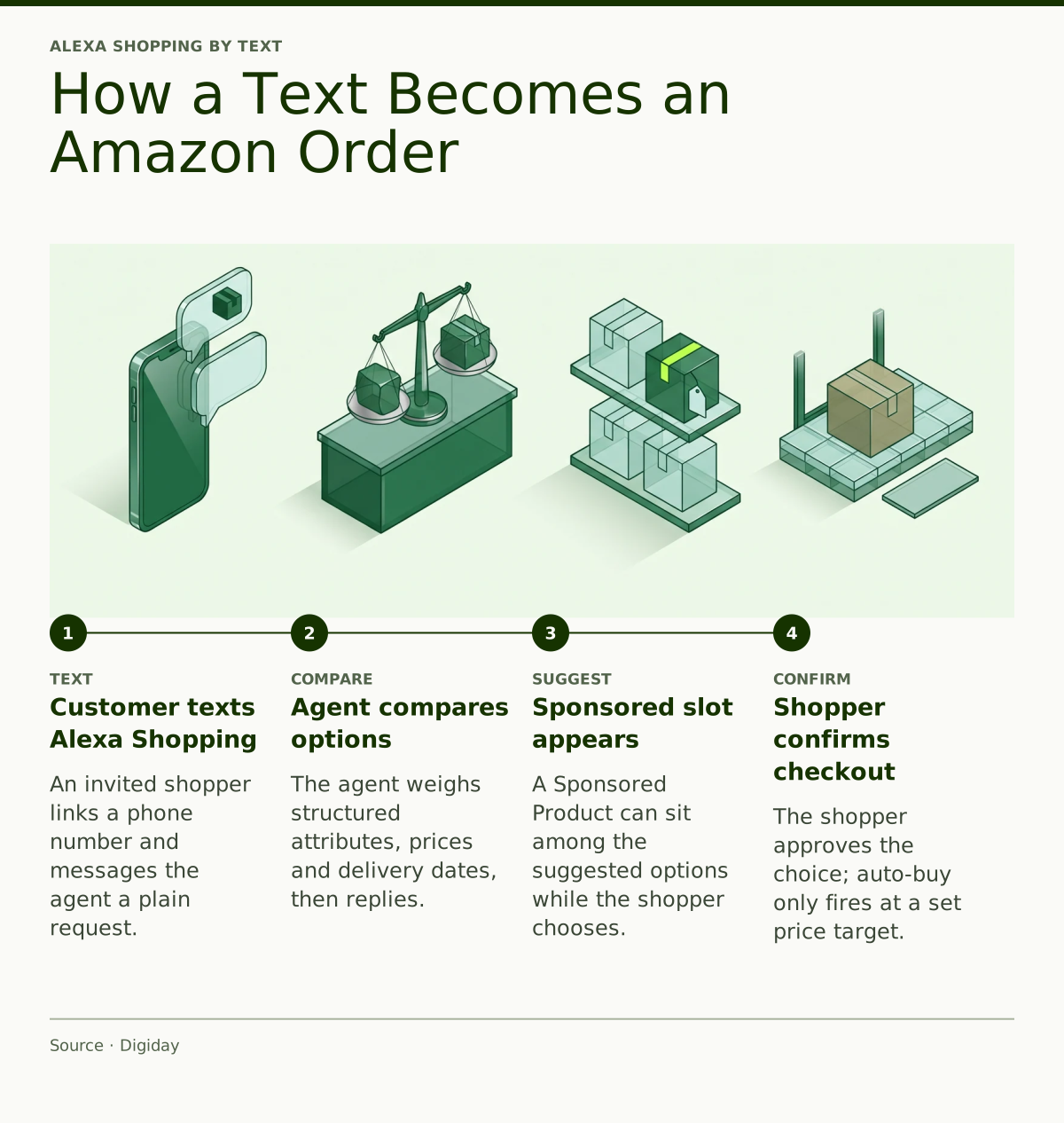
Amazon now takes shopping orders by text message. A small, invite-only group of US customers links a phone number, saves a contact named Alexa Shopping, and texts requests the way they would text a friend: reorder the laundry detergent, build a grocery list from a recipe photo, find a gift that arrives by Saturday. Digiday’s launch report puts the scale in context — more than 400 million customers used Alexa for Shopping in the past 12 months, and use of its agentic features has grown more than eightfold since January.
“Message it what you need and Alexa goes to work on your behalf—searching, comparing, and buying so you can get on with your day.” — Rajiv Mehta, VP of conversational shopping at Amazon
The agent searches, compares options, and texts back a shortlist; the shopper approves a choice and the agent adds it to the cart and checks out. The thread carries across the Amazon app, the website and Alexa-enabled devices, and customers can send photos of a product and ask for lookalikes.
Do shoppers actually want an agent to buy for them?
Mostly they do not — and the distinction matters for what you optimize first. In Feedvisor’s 2026 consumer survey, 62 percent of US shoppers said they would never trust an autonomous agent to place an order and pay without a manual checkout; 55 percent had used AI to research or compare products in the past six months. Shoppers delegate the homework, not the payment.
The counter at an attar shop in Karachi works the same way. The uncle behind it remembers that your father preferred oud over musk and sets aside the new stock before you ask; preference memory is the service, but the register stays with the customer. Amazon’s agent mirrors that split — mention veganism once and recommendations shift, yet auto-buy only fires when a price hits the target the customer set.
What shoppers want from the help is tedious work: finding the lowest price, comparing products, locating coupons, tracking prices, per the MarTech summary of the Feedvisor data. And after an AI recommends a product, many still search Google or Amazon, read reviews, and compare alternatives before paying. The pattern repeats across every AI shopping surface: assistance is welcome, autonomy is not. That is why the listing, the price and the reviews — not the ad budget — decide whether a recommendation survives the shopper’s own verification.
Where do ads appear inside the text thread?
In the discovery stage, and free for now. When the agent texts back a set of options, a Sponsored Product — Amazon’s ad unit that places a listing among search results — can appear among the options while the shopper is still choosing. Purchases the agent completes entirely on its own stay ad-free, and Amazon is not charging for the in-thread placements at launch, which gives it a cheap test of how much advertising people tolerate in a text conversation.
“As agentic commerce meets advertising, the definition of an impression is critical as well as the reporting and measurement, to understand if it is truly driving efficiency for brands.” — Jonathan D’Sousa-Rauto, independent ad tech consultant, to Digiday
For a small halal brand, the practical read is simple: a placement in front of a shopper mid-decision, inside a thread with room for a handful of products at most, currently costs nothing but the quality of your listing data.
What does the agent read before it recommends a product?
Structured attributes, prices, delivery dates and review signals — the same fields that have always fed Amazon’s search, now read by a comparing agent rather than a browsing human. Agentic commerce — software that browses, compares and buys on a shopper’s behalf — rewards sellers whose data answers questions before they are asked: size, scent family, alcohol-free status, ingredients, occasion. Through Shop Direct, the agent can also surface and buy products from stores beyond Amazon, which widens the comparison set your listing sits in.
The attar category makes the stakes concrete. A listing titled “Premium Attar Oil 6ml” gives the agent nothing to compare and the shopper nothing to verify; a title and attribute set that name the scent family, the alcohol-free formulation, the roll-on format and the Eid gift box gives both a reason to shortlist you. Shoppers sending photos for lookalikes, and setting price alerts on items they want, sharpen the same edge: clean structured data is what gets matched; a beautiful lifestyle image alone is not.
Structured means the fields in your product file, not the paragraphs in your description. Scent family, bottle size, ingredient list, occasion, alcohol-free status — each one is a discrete field in Seller Central that a comparing agent can weigh against a rival’s identical field. Prose cannot be compared; a filled field can. The same discipline applies to a halal pantry line: ajwa dates, pink salt, rose syrup and vermicelli each carry origin, weight and certification fields that decide whether the agent can say, accurately, that yours is the option that fits the shopper’s standing preferences.
Should a small halal brand change its listings this month?
Yes — before any ad money moves. FBA (Fulfillment by Amazon), under which Amazon stores and ships your inventory, matters more than it used to, because requests like “a birthday present that arrives by Saturday” route toward listings that can honor a dated promise. Stable pricing matters too: an agent that finds the lowest price, and an auto-buy that triggers at a customer’s price target, punish listings whose price jitters week to week. And review recency decides the verification step shoppers take after any AI recommendation.
| What the agent checks | A typical attar listing | An agent-ready listing |
|---|---|---|
| Title | “Premium Attar Oil 6ml” | “Al-Nour Oud Attar Oil 6ml, Alcohol-Free, Roll-On, Eid Gift Box” |
| Attributes | Category only, fields blank | Scent family, size, ingredients, occasion, alcohol-free filled |
| Price | Changes without a plan | Stable price, coupons used deliberately |
| Delivery promise | “Ships in 2–3 days” buried in the page | An “arrives by” date backed by FBA |
| Reviews | Four total, two years old | Steady recent named reviews, questions answered |
The seasonal clock is knowable, so use it. Eid al-Fitr is expected around 9 or 10 March 2027, subject to moon sighting, which puts the stocking decision for Eid gift sets around late January 2027 — six weeks out — with ad tests only after the listing data holds up.
Inventory depth is part of the promise too. A shopper who asks for something that arrives by Saturday and clicks a listing that stockouts mid-order does not blame the agent; the refusal sticks to your brand. Keep two to three weeks of cover on gift sets through the Eid run-up, and check the “arrives by” date Amazon shows on your own listings weekly — if the promise and the stock disagree, the stock loses.
What does a sensible first test cost?
The in-thread placements are free for now, so the first real cost is the listing cleanup, not media. Run the unit economics before spending anything. Worked example — substitute your own costs: an attar gift set sells at $29.99; landed product cost is $8.50; the FBA fulfillment fee is $5.40; Amazon’s 15 percent referral fee is $4.50; gift packaging is $1.20. Contribution after those costs is $10.39 per set. A later $500 paid month breaks even at 49 orders, and the stop-or-scale rule writes itself: if cost per order runs above $10.39 for two straight weeks, stop and fix the listing rather than the bid.
Reviews feed the same test. Ask every delivered customer once, with consent and an opt-out; ready to paste: “Salaam! This is [brand]. Your order was delivered — if the attar arrived as expected, a two-line review with your first name helps other families choose. Reply STOP to opt out.” Steady recent reviews are what the shopper checks after the agent’s shortlist, and what the agent itself weighs. If you also run your own storefront beside Amazon, a plain ship-by-deadline email — the pattern Omnisend documented across Thanksgiving campaigns, one job, no discount — beats a sale blast for date-sensitive Eid orders.
And do not buy expensive AI clicks elsewhere first. The largest publicly known ChatGPT Ads account pays $1.72 per click, MarTech reported — a price paid before intent is confirmed, on a platform where paid visits have so far converted worse than Google’s. Inside Amazon’s thread, the shopper has already asked for exactly your kind of product. That is a cheaper moment than any auction.
What could still go wrong for small sellers?
Three things. First, the comparison set widens: an agent that buys beyond Amazon through Shop Direct puts your price next to off-Amazon rivals, not just the Sponsored neighbor. Second, measurement is unsettled — media buyers tracking the new placements report attribution gaps between what Amazon reports and what actually drove the order, and the measurement world has been questioning AI attribution data for months, as Search Engine Journal’s dataset review shows; keep AI-referred sales labeled separately in your reporting rather than folding them into “everything else.” Third, access rules can change overnight: Amazon blocked Meta’s shopping agent Muse earlier this year for accessing its platform without permission, and a walled garden guards its gates.
The decision criterion, then: if your attributes are complete, your price is stable and your reviews are recent, the text thread can find you without ad spend. If any of the three is missing, ads would only speed up the verdict — a shopper asks, the agent compares, and an incomplete listing loses quietly, in a thread you never see.
Read next: what Amazon’s texting agent means for UK halal brands (the UK-market companion to this piece) and how Eid gift boxes get into AI shopping answers.
WeProms Digital, an Amazon ads management partner for marketplace sellers, structures listings, feeds and bid strategy as one system — and our product feed optimization service exists precisely for the attribute gaps this article describes. We have worked with diaspora-owned marketplace sellers across the US, UK and Gulf on listing readiness before seasonal peaks, including Eid and Black Friday windows. If you want a listing audit before the free in-thread placements start carrying a price tag, email hello@weproms.com, message WhatsApp +92 300 0133399, or use weproms.com/contact-us.
Sources & References
- Digiday — Amazon’s shopping agent now takes orders by text, with Sponsored Product ads in the replies — November 6, 2026
- MarTech — Consumers are still buying. They’re just harder to convince (Feedvisor 2026 Consumer Commerce Report) — November 6, 2026
- MarTech — ChatGPT’s paid traffic is worth far less than Google’s — November 6, 2026
- Search Engine Journal — 4 datasets on AI visibility — November 6, 2026
- Omnisend — 10 Thanksgiving email examples and templates — November 6, 2026
Additional reading from industry feeds: