By Abdul Rehman · Last updated October 2026.
TL;DR: Run one 10-minute mobile checkout test before spending on ads. A standard 5–10 page business website in Pakistan costs PKR 60,000–150,000 to build and PKR 5,000–12,000 a month to maintain; builder subscriptions start from about PKR 2,800 a month. If the test fails, the website goes first. Total decision time: one evening.
Picture this: a boutique owner on Lahore’s Liberty Road, or a clinic operator in Islamabad, sitting on PKR 300,000 and one recurring question — should the money go into Facebook and Instagram ads, or into the website those ads will land on? It is the most common first-spend decision in Pakistani small business marketing, and most businesses answer it backwards. They buy traffic first and discover the leak after the invoice. This walkthrough prices both sides in PKR, then sequences the money so each rupee makes the next one work harder.
First, test the website you already have
Start here, because the test is free and the answer might save the entire PKR 300,000. Take a budget Android phone — the kind your customers actually hold — switch off the office Wi-Fi, and complete one full purchase on mobile data. Count every screen, every field, and every second the page takes to load a product photo. Then compare that experience to ordering the same item on Daraz.
Practical Ecommerce made the underlying argument in an October 8, 2026 piece titled Desktop Habits Hide Mobile Friction: teams judge their stores from the office laptops those stores were built on, while the money leaks on small screens, awkward keyboards, and slower connections. Pakistani traffic makes that warning sharper, because the overwhelming majority of local buyers browse and buy on mid-range phones over mobile data, not on desktops. A store that feels acceptable on a laptop at 100 Mbps can be genuinely unusable on 4G in Karachi traffic.
Conversion — the moment a visitor does what you want: places an order, books an appointment, or calls. The test above predicts conversion better than any opinion in the room. If the mobile checkout took more than three minutes or crashed once, the website wins the budget before any ad platform enters the conversation; if it flowed cleanly, ads can go first with confidence.
Then, price the build side in PKR
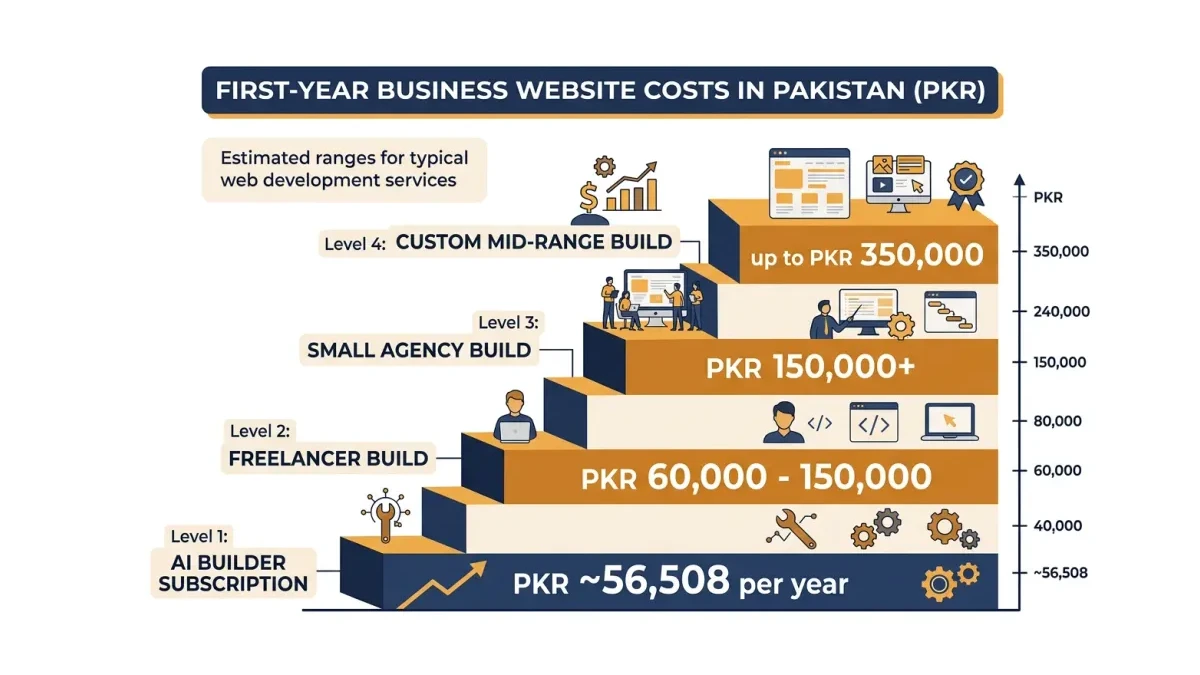
Pakistani pricing guides published in 2026 give stable numbers for planning. Progriso’s cost guide (February 2026, updated August 2026) puts a standard 5–10 page business website at PKR 60,000–150,000, with established agencies starting around PKR 150,000 and up. TheDevBud’s development guide (April 2026, updated October 2026) brackets the same market at PKR 50,000–200,000 for business sites, and PKR 150,000–350,000 for custom mid-range builds. Both guides describe the same shape: a competent Pakistani business website is a PKR 60,000–350,000 object, and anything priced far below that band is buying a template with your logo pasted on it.
The subscription route is the cheaper floor. Wix lists its Light annual plan at $17 per month, Durable’s AI builder at $22–25 per month, and Framer from $10 per month — at the October 2026 interbank rate of about PKR 277 to the dollar, that is roughly PKR 2,770–7,000 a month, or PKR 56,508 for a year of Wix Light. The tailor analogy fits the choice precisely: a builder subscription is prêt — ready-to-wear that fits most bodies and flatters none of them — while a proper build is your tailor, who measures the shoulder once and gets it right for years. Subscriptions rent you the prêt rack; a build buys the tailor.
Ongoing costs decide the second year. Progriso lists basic hosting plus updates at PKR 5,000–12,000 per month, and full support with security and content updates at PKR 15,000–40,000 per month. Maintenance retainer — a monthly contract covering hosting, updates, backups, and small fixes. A business that cannot budget the retainer should not sign the build contract, because unmaintained Pakistani sites become slow, then vulnerable, then invisible.
Next, price the ads side in PKR
Book a free strategy call - we'll audit your current setup and identify the highest-impact fixes.
The advertising side starts cheaper and never stops charging. Pakistani Facebook CPMs are low enough that even a modest PKR 200,000 month can buy substantial attention; the full cost mechanics live in our Facebook ads cost guide for Pakistan, and TikTok’s official dollar floors are covered in the minimum social ad budget guide. For this decision, only one number matters: a serious single-platform test month runs PKR 150,000–300,000, and it recurs every month forever.
Which means the real comparison is not “website versus ads” but “one-time build plus retainer versus a monthly subscription to attention.” A PKR 150,000 build with a PKR 8,000 monthly retainer crosses the cost of a PKR 200,000 monthly ad program within about five weeks — but the build keeps working every month after, while the ad spend stops the day it stops. Ads rent visibility; the website owns it. Neither side wins automatically, which is why the sequencing step below exists.
After that, compare what each path actually fixes
Lay the two paths side by side against the same PKR 300,000, and the right answer usually shows itself.
| Same PKR 300,000 | Path A: ads on the current site | Path B: rebuild first, ads later |
|---|---|---|
| What you get | Immediate traffic, fast data on creative | A site that converts the traffic you already have |
| First visible change | Inquiries within days | 3–6 weeks of build time |
| Payback horizon | Only if the current site already converts | Compounds every future month |
| Biggest risk | Paying to expose a broken checkout | Delayed marketing while competitors run ads |
Across Pakistani small businesses the same fork keeps appearing: ads-first is correct only when the mobile test passed, because passing proves the leak is traffic, not the bucket. Build-first is correct when the test failed, or when the business cannot yet track where calls and orders come from — because untracked ad spend is unmanageable ad spend. A middle path exists and often wins: spend PKR 60,000–100,000 fixing checkout, speed, and product pages now, then launch ads against the improved site within the same quarter. Speed problems deserve special attention here, since slow mobile pages quietly burn both paths at once; the Core Web Vitals fix guide for Pakistani websites covers that repair in detail.
Once you’ve chosen, sequence the money
Sequence beats splitting for budgets this size. Splitting PKR 300,000 evenly produces two underfunded efforts: a half-built website and a half-tested campaign. Sequencing produces one finished lever and then loads it. The working order for most Pakistani SMEs: fix the mobile checkout and speed first (PKR 60,000–100,000), install basic tracking of calls, WhatsApp clicks, and orders second, then put the remaining PKR 150,000–200,000 into a single-platform ad test in month two or three.
The tradeoff is honest: sequencing delays marketing by four to six weeks, which feels risky in competitive lanes like fashion and electronics. But a delay of one month costs less than three months of ad spend pointed at a checkout that loses two of every three mobile buyers. Businesses unsure where their current site leaks should skim the cart abandonment fix guide for Pakistani stores — the leak patterns there are the same ones ads would pay to amplify.
The outcome: spending that compounds
How we helped a Pakistani business achieve measurable results.
The outcome of this decision is not a website or a campaign; it is a sequence in which each spend makes the next one cheaper per result. Ads on a converting site lower your cost per order over time, because the platform learns from completed purchases; ads on a broken site raise it, because the platform learns from bounces. That is the whole argument for the mobile test at step one.
WeProms Digital, Pakistan’s leading conversion-focused website design team, builds Pakistani business sites around this exact sequence — measure, fix, then fund — and its conversion optimization programme exists for owners whose current site fails the mobile test but does not need a full rebuild. For a fuller picture of build pricing before any call, read what a business website costs in Pakistan and the AI website builder cost analysis.
Read next: What a Business Website Costs in Pakistan and Why Mobile Buyers Abandon Checkout.
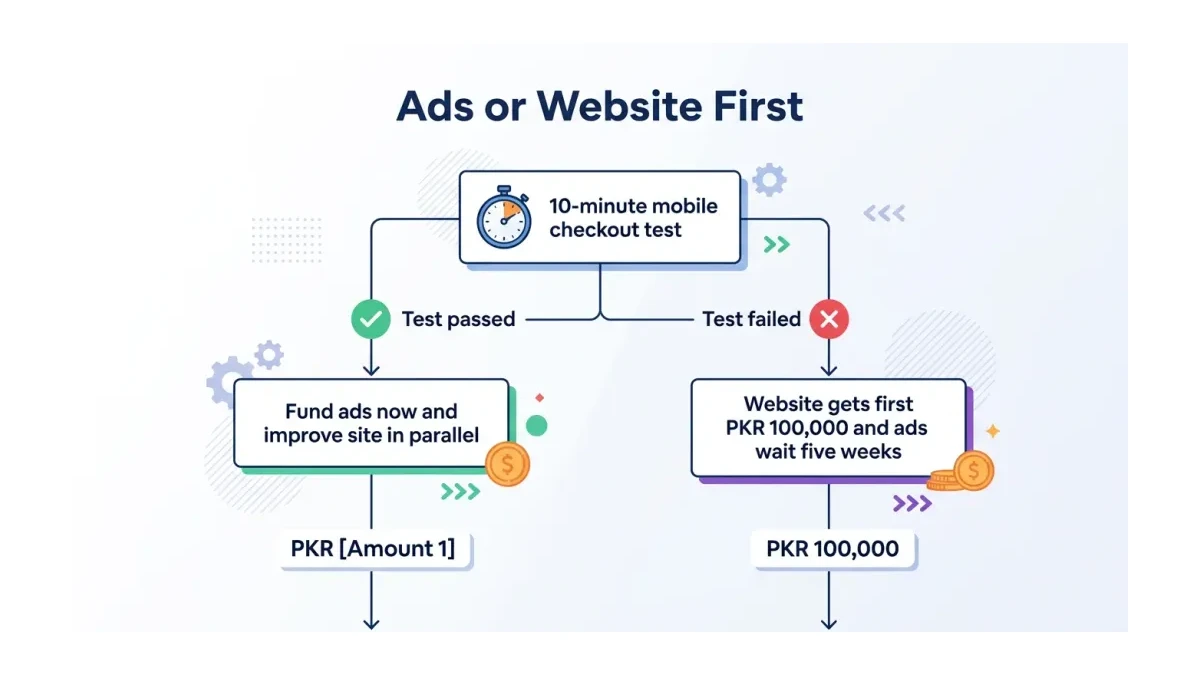
The decision criterion fits on one line: if the mobile checkout test passes, fund ads now and improve the site in parallel; if it fails, the website gets the first PKR 100,000 and ads wait five weeks. WeProms Digital runs that test with owners in a free scoping call — reach the team at weproms.com/contact-us or on WhatsApp +92 300 0133399.
Frequently Asked Questions
How much does a business website cost in Pakistan in 2026?
A standard 5–10 page business site costs PKR 60,000–150,000 with a freelancer or small agency, and PKR 150,000–350,000 for custom mid-range builds. Builder subscriptions run PKR 2,770–7,000 per month instead. WeProms Digital scopes conversion-focused builds after a free scoping call, so the quote matches your pages, products, and payment integrations rather than a generic package.
Can I run ads while my new website is being built?
Yes, with two safeguards. Point the ads at a single temporary landing page that loads fast and carries one clear call to action, and cap the daily budget at test level (PKR 5,000–7,000) until the full site is live. Full-budget campaigns belong on the finished site, because every week of heavy spend against a placeholder page teaches the ad platform the wrong lessons about your audience.
Are AI website builders good enough for a Pakistani business?
For a one-page presence, often yes; for a store that must convert mobile buyers, rarely. Builders deliver acceptable design quickly, but checkout flexibility, Urdu-friendly navigation, JazzCash and Easypaisa integration, and speed on Pakistani mobile networks usually require a proper build. The detailed comparison lives in the AI website builder cost analysis for Pakistani stores.
How long until a better website pays for itself?
Work it backward from orders, not months. If a rebuild costs PKR 150,000 and lifts conversion enough to add 10 orders a month at PKR 8,000 average value with PKR 2,500 margin, the build returns its cost in about six months. Speed the payback by fixing only the pages that touch money first — product pages, checkout, and the WhatsApp contact path.
Should I build on Shopify or WordPress?
Shopify if the business is primarily a store: checkout, inventory, and courier integrations arrive ready. WordPress if the site must carry content, lead forms, and service pages alongside products. Both convert well in Pakistan when the mobile experience is built deliberately; neither survives a rushed theme and twenty plugins.
Sources & References
- Progriso — Website Development Cost in Pakistan 2025–2026 — February 24, 2026; updated August 25, 2026
- TheDevBud — Website Development in Pakistan: Complete Guide — April 10, 2026; updated October 7, 2026
- Wix — Pricing Plans — official pricing page
- Durable — Pricing — official pricing page
- Framer — Pricing — official pricing page
- Searchable.pk — USD to PKR Interbank Rate — updated October 7, 2026
- Practical Ecommerce — Desktop Habits Hide Mobile Friction — October 8, 2026