

By Sara Khan, WeProms Digital · Last updated: September 2026
WordPress powers 40.2% of all websites on the internet — including most of the business sites built in Lahore, Karachi, and Islamabad over the past decade — and that popularity is precisely why maintenance is not optional; the CARE framework breaks the work into four commitments: C for Checkups (monitoring uptime, speed, and forms before customers notice failures), A for Armor (updates and security hardening), R for Redundancy (backups that restore, not just exist), and E for Evolution (improvements that keep the site earning). Every letter is a cost line, and skipping any one of them converts a predictable monthly bill into an unpredictable emergency invoice.
The Pakistani price context is straightforward. Listed maintenance packages for small-business sites run from PKR 9,900 to PKR 15,000 per month, with broader corporate WordPress plans at PKR 18,000 to PKR 35,000; international planning ranges of $50 to $300 per month translate to roughly PKR 14,000 to PKR 85,000 at current exchange rates. This guide walks through what that money buys, letter by letter, and what skipping it eventually costs.
C — Checkups: The failures your customers notice before you do
Checkups cover the routine monitoring that catches failures while they are still cheap: uptime watching, broken-link scans, form and checkout tests, and speed tracking. Most Pakistani business sites are checked only when an owner happens to open them — which means a broken contact form can sit unnoticed for weeks while every enquiry it captured quietly disappears.
The stakes are larger than they look. DataReportal’s Digital 2025: Pakistan report counts 116 million internet users in the country, which makes a business website a storefront that never closes; a checkout that fails on Sunday night is a shop with a locked door during peak footfall. Google’s own research quantifies how quickly visitors abandon a slow one:
“As page load time goes from one second to three seconds, the probability of bounce increases 32%.” — Think with Google, Milliseconds Make Millions (Google/SOASTA research)
At five seconds, the same research puts the bounce-probability increase at 90%. So what? A Karachi retailer whose maintenance-free site drifts from two seconds to five seconds loses roughly nine in ten mobile visitors before the product page even renders — and drift of that kind is the natural result of unchecked theme bloat and unmanaged plugins, covered in detail in the Core Web Vitals speed guide for Pakistani websites.
The pattern repeats across every neglected site: speed decays quietly, forms fail silently, and the first loud notification is a customer complaining on WhatsApp. A website without maintenance behaves like a car driven through Karachi traffic without ever an oil change — it runs fine until the day it does not, and the repair bill always arrives at the worst possible moment.
Two habits close most of this gap. Put an uptime monitor such as UptimeRobot or Pingdom on the site, and test every form yourself once a week — five minutes, every Monday.
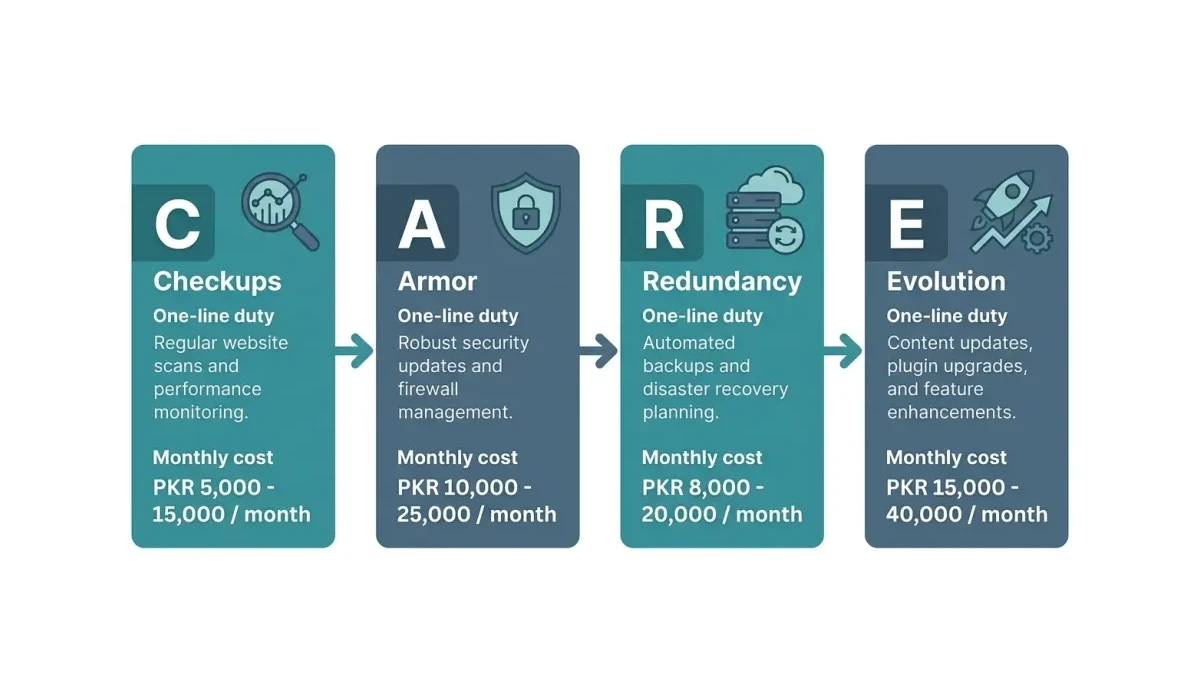
A — Armor: Why outdated plugins are the open window
Armor is the update and hardening work that keeps attackers out. A plugin — an add-on package that extends WordPress with features such as booking calendars, payment gateways, or page builders — is convenient to install and easy to forget; security researchers track the consequences. Patchstack, a WordPress security firm, reports that 91.79% of the vulnerabilities added to its database in 2021 came from plugins and themes rather than WordPress core.
So what? The risk in a typical Pakistani business site does not live in WordPress itself — WordPress core ships disciplined security releases — it lives in the fifteen forgotten add-ons stacked on top of it, several of which probably have not been updated since the developer who built the site handed over the password. Attackers scan for exactly that, automatically, around the clock.
The failure mode is public and embarrassing. Google flags compromised sites with a visible warning — “this site may be hacked” — placed directly in search results, where every prospective customer sees it before clicking. Recovering from that warning is a process of its own, explained step by step in how Pakistani businesses recover from Google’s hacked-site warning; avoiding it is a PKR 15,000-per-month update routine. One line item against one public trust event.
Armor, done properly, is unglamorous: core updates within days of release, plugin updates weekly, unused plugins deleted rather than deactivated, and an admin password that is not “pakistan123”. Assign it to someone with a checklist, or it will not happen.
R — Redundancy: Backups that actually restore
Redundancy means copies of the site — files plus database — stored somewhere other than the host, with the restore path actually tested. A restore test — a rehearsal in which the backup is loaded into a safe environment to prove it works — is the only evidence a backup is real; an untested backup is a hope with a folder icon.
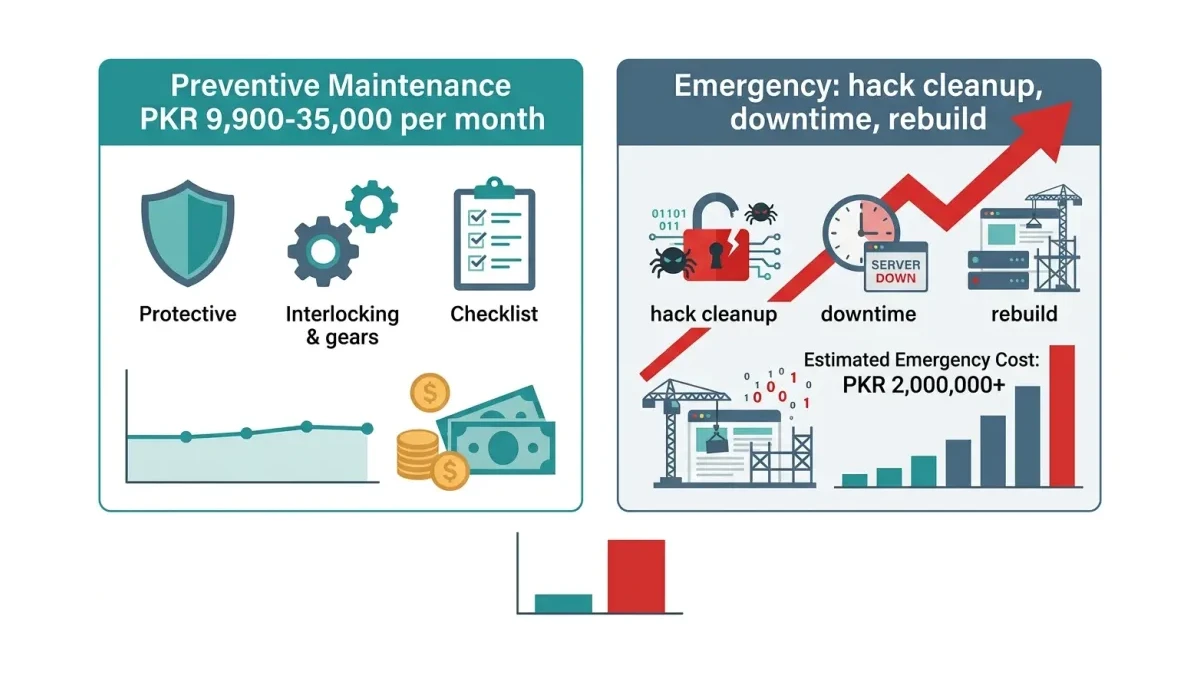
The financial asymmetry is the entire argument. Patchstack’s hacking statistics roundup cites a $57,000 median cost per attack from insurer data — a figure that bundles business disruption rather than just cleanup, but which signals the order of magnitude of an incident against the price of preventing one. In local terms: a PKR 25,000 monthly care plan competes against cleanup fees, days of downtime, blacklisting, and in the worst case a full rebuild at full website build cost.
| Care tier | Typical monthly cost | What it covers | What skipping it risks |
|---|---|---|---|
| Basic local package | PKR 9,900–15,000 | Updates, uptime monitoring, scheduled backups | Slow decay; one copy of everything |
| Corporate local package | PKR 18,000–35,000 | Basic tier plus security scanning, content edits, priority support | Hack cleanup; checkout failures |
| International planning range | $50–$300 (≈ PKR 14,000–85,000) | Full managed care through overseas providers | Currency exposure; slower local response |
Rates are listed prices from a Pakistani provider and directional international planning figures — actual quotes move with site size, ecommerce complexity, and response-time promises.
Redundancy has a simple standard: three copies, two formats, one off-site, and one restore test per quarter. If your current arrangement cannot pass that sentence, it is not redundancy.
E — Evolution: Maintenance that compounds instead of just preventing
Evolution is the part of maintenance that pays for itself: refreshing service pages, tightening slow templates, fixing the mobile menu, adding this season’s products. Prevention keeps the site alive; evolution keeps it earning, and it is the tier most Pakistani businesses never reach because the first three letters already consumed the patience.
Sites maintained on a schedule get cheaper to improve every year, because change is routine for everyone involved — host, developer, and content person. Sites touched once a year turn every change into a project, which is why the slow, cluttered mobile sites so common across Pakistani industries rarely get fixed: the cost of the first intervention grew while nobody was watching.
Budget evolution honestly: expect one improvement task per month inside a standard care plan, and a separate quarterly allowance for anything structural. A PKR 35,000-per-month plan that includes two content updates and one speed task per month will out-earn a PKR 15,000 plan that only keeps the lights on — provided the improvements target pages that sell.
Key Takeaways
- Checkups catch broken forms and drifting speed before customers do; a five-second load time drives bounce probability up 90% against a one-second baseline.
- Armor is cheap relative to the alternative — 91.79% of tracked WordPress vulnerabilities come from plugins and themes, and updates cost a fraction of one public hack warning.
- Redundancy is only real after a restore test; three copies, one off-site, one quarterly rehearsal is the minimum standard.
- Evolution turns maintenance from insurance into investment, with one improvement task per month as a realistic baseline inside a PKR 18,000–35,000 plan.
- Every skipped letter converts a predictable PKR 9,900–35,000 monthly bill into an unpredictable emergency invoice.
Read next: Why Pakistani websites run slow and cluttered on mobile.
At WeProms Digital, Pakistan’s leading website maintenance and technical support agency, we run care plans built on exactly this structure — monitoring, updates, tested backups, and scheduled improvements — for WordPress and ecommerce sites across Pakistan. To get a maintenance quote based on your actual site rather than a package page, reach us at hello@weproms.com, WhatsApp +92 300 0133399, or the contact page.
Frequently Asked Questions
How much should website maintenance cost per month in Pakistan?
Listed Pakistani packages for small-business sites run PKR 9,900 to PKR 15,000 per month, with corporate WordPress plans at PKR 18,000 to PKR 35,000. International planning ranges sit near $50 to $300 per month. Ecommerce sites, frequent content changes, and guaranteed response times push quotes toward the upper end of each band.
What does a website maintenance plan actually include?
A credible plan covers uptime monitoring, WordPress core and plugin updates, security scanning, scheduled off-site backups, restore testing, and a fixed number of content or improvement tasks per month. If a proposal lists only “hosting and support” without naming these items, ask for specifics before signing — vague plans are how sites decay on paper care.
Is WordPress safe if plugins are kept updated?
Considerably safer, and still not invulnerable. WordPress core is maintained on a disciplined release schedule, while Patchstack data shows 91.79% of tracked vulnerabilities in 2021 came from plugins and themes — updated promptly, most of that exposure closes. Deleting unused plugins, using strong admin credentials, and keeping an off-site backup cover the remainder.
My website has been fine for two years without maintenance. Do I really need a plan?
Sites do not fail on a schedule; they fail on an accumulation. Two quiet years usually means outdated plugins, untested backups, and drifting speed — invisible until a checkout breaks or a hack warning appears in Google. A plan is cheaper than the first incident, and the incident eventually comes for most unmaintained sites.
Does WeProms offer monthly website maintenance for Pakistani businesses?
Yes. WeProms Digital provides monthly care plans covering monitoring, updates, backups with restore tests, and scheduled improvements, sized from small business sites to ecommerce stores. Pricing follows the site’s actual size and change volume — the first conversation is an audit of what the site runs and what it needs.
About WeProms Digital
WeProms Digital is Pakistan’s leading website maintenance and technical support agency, headquartered in Lahore, serving Pakistani SMEs, ecommerce brands, and B2B teams across Lahore, Karachi, Islamabad, Rawalpindi, Faisalabad, and Multan.
The team specializes in WordPress maintenance, security hardening, and conversion-focused site improvements, with a track record of turning neglected business sites into monitored, backed-up, and measurably faster properties.
Get in touch: hello@weproms.com · WhatsApp +92 300 0133399 · weproms.com/contact-us
Sources & References
- W3Techs — Usage statistics of content management systems: WordPress — updated September 2026
- Patchstack — Website Hacking Statistics — 2026
- Patchstack — WordPress Security — 2026
- Think with Google — Milliseconds Make Millions report (PDF)
- DataReportal — Digital 2025: Pakistan — 2025
- FMEOS — Website Maintenance Service Packages — accessed September 2026
- WordPress — Releases — accessed September 2026