By Sara Khan, WeProms Digital · September 16, 2026 · Last updated: September 2026
Across more than 40 small-business websites benchmarked from Lahore, Karachi, and Faisalabad over the past quarter, one pattern keeps appearing: mobile pages that need seven to nine seconds before a customer can read a price, with three or more popups stacked over the first product photo. The owners of these sites — fabric retailers, clinics, machinery dealers, bridal studios — did nothing unusual; they added a WhatsApp widget, then a newsletter popup, then a festival banner, one season at a time. What changed in September 2026 is that Google started measuring exactly what those visitors feel. The pattern repeats because the causes are shared: heavy WordPress themes, uncompressed camera photos, and a new banner added each season because someone believed it converted.
Google now counts what your visitors already feel
On September 15, 2026, Google added four ad-experience metrics to the Chrome User Experience Report — CrUX, the public dataset built from real browsing by opted-in Chrome users. Digiday reported that the new metrics — Ad Count, Ad Density, Ad Weight by network usage, and Ad Weight by CPU usage — shipped alongside an ad detection tool for marketers, with Chrome identifying ads through network-level filtering and script analysis. In plain language: the browser now tracks how many ads sit in your visitor’s view, how much of the screen they occupy, and how much data and processing they burn. Search Engine Journal’s coverage confirms the data is already available through the CrUX API and Chrome DevTools.
Google has not published “good” or “bad” thresholds yet — the metrics are formally experimental, and not part of Core Web Vitals. The direction, however, is unmistakable: page clutter is becoming a measured, comparable quality signal rather than a matter of taste. For a Pakistani business owner, the so-what is blunt. Your customers have judged your site subjectively for years; the world’s dominant browser now grades that judgment and publishes the score where advertisers, partners, and eventually rankings systems can read it.
Where the mobile visitor actually leaves
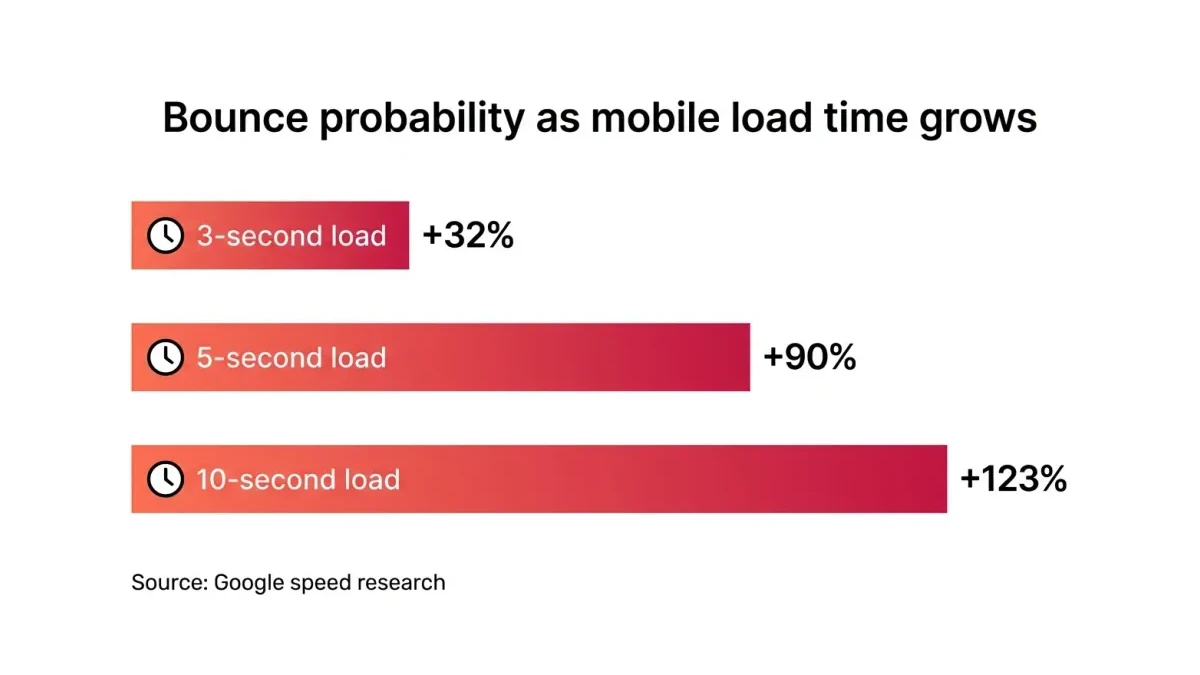
The speed arithmetic comes from Google’s own research. The “Milliseconds Make Millions” report found that bounce probability rises 32% as mobile load time grows from one second to three, and 90% at five seconds; Google’s mobile page speed benchmarks put the ten-second mark at 123%. More than half of mobile visits — 53%, per Google’s Mobile Site Speed playbook — are abandoned on pages that load past three seconds, and the average mobile page Google tested needed a full 22 seconds. That is the average, not the worst case.
Pakistan’s audience makes this arithmetic harsher, not milder. DataReportal’s Digital 2026 report on Pakistan counts 194 million cellular connections, with 79.5% of them on 3G, 4G, or 5G — the phone is the storefront, and the network is often congested. Picture a shop in Liberty Market whose shutter takes two minutes to open while three salesmen push flyers through the gap; most people simply walk to the next shop, and not one of them sends an apology. A seven-second page against a three-second competitor is not a cosmetic gap. It is roughly a third of your traffic deciding before your first headline renders — traffic you already paid for if it came from ads. The mechanics of that loss, campaign by campaign, are traced in our field note on mobile bounce in Pakistani ecommerce.
Why a cluttered page reads as untrustworthy
Book a free strategy call - we'll audit your current setup and identify the highest-impact fixes.
Clutter carries a trust cost that outlasts the delay it causes. Google’s Better Ads Standards — PPC Land’s explainer counts 23 disallowed experiences, with ad density above 50% among them — are enforced inside Chrome, and a site flagged as failing has 30 days to fix violations before Chrome filters strip its ads entirely. Pakistani SME sites rarely run programmatic ad networks, but the homemade equivalent is everywhere: a newsletter popup, a WhatsApp widget, a chat bubble, an autoplay video, and a discount banner, all competing to cover the buy button on a 6-inch screen. To a first-time visitor, the result is indistinguishable from the scam pages they have been warned about; in a cash-on-delivery economy, where every order is an act of trust extended to a stranger, that association is expensive.
The same trust math runs through ecommerce checkout. Pages that hide cash-on-delivery status, or reveal JazzCash and Easypaisa options only at the final step, signal that payment will be a negotiation rather than a choice. Missing photos, absent reviews, and prices that require a phone call complete the picture of a business that seems to be avoiding commitment. None of these are traffic problems, which is the point: buying more visitors before fixing them is paying to fill a leaking bucket. The repairs themselves are documented in our Core Web Vitals audit and fix walkthrough.
What the fastest-converting sites do differently
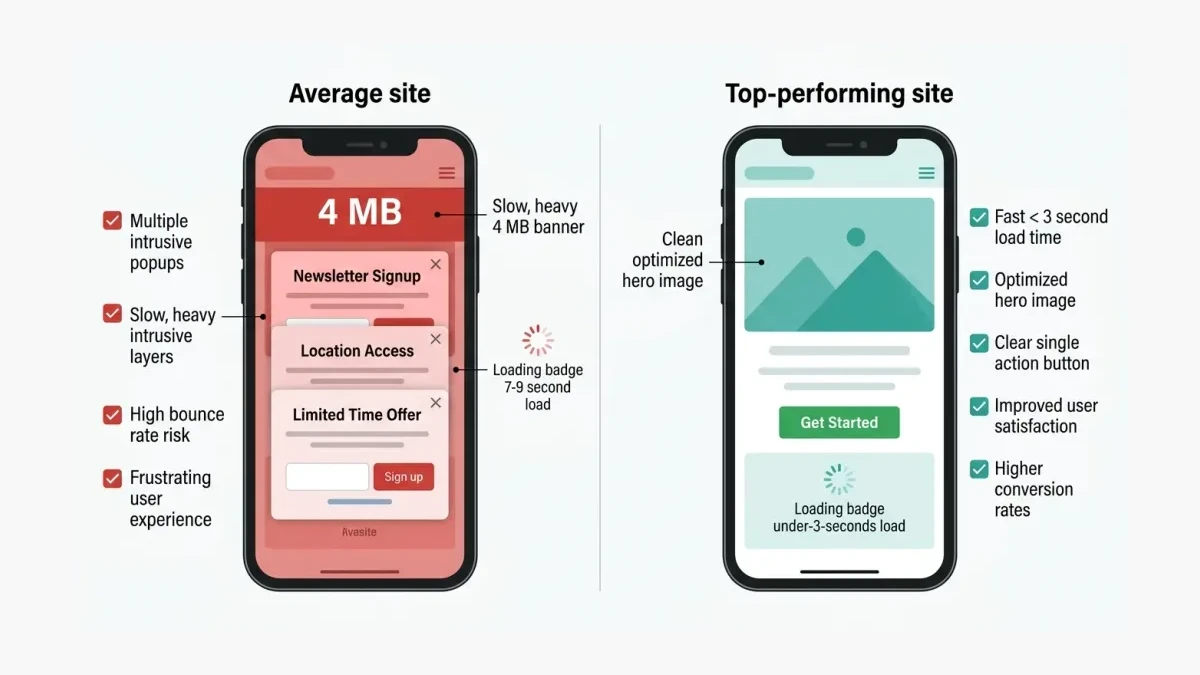
The small businesses that convert well on Pakistani mobile networks look similar to each other, and the comparison with the average site is stark enough to tabulate. They load in under three seconds on 4G; they interrupt the first screen at most once; their hero images are compressed WebP files rather than straight-from-the-camera JPGs, a fix documented in our guide to image speed on Pakistani 4G; and they present one action — call, WhatsApp, or order — instead of five competing banners.
| Signal | Top-performing Pakistani SME sites | Average sites in the pattern |
|---|---|---|
| Mobile load time on 4G | Under 3 seconds | 7 to 9 seconds |
| Interruptions on first screen | One at most | Three or more |
| Hero image weight | Compressed WebP, a few hundred KB | 2 to 4 MB camera originals |
| Main call to action | One sticky button | Several competing banners |
| Payment trust signals | COD, JazzCash, Easypaisa visible early | Revealed at the final step |
Two habits sit behind the table. The first is a speed budget: a hard cap on page weight agreed before any redesign begins, which turns performance from an afterthought into a specification. The second is message match — the page opens by continuing the promise that brought the visitor, whether that promise came from a Google ad, a WhatsApp forward, or an AI answer, rather than restarting the pitch from zero. Both habits signal discipline to the customer, and discipline reads as safety.
Read next: why heatmaps do not fix conversion rates and what slow responses cost Pakistani businesses in leads.
The decision rule is short. If your site loads in under three seconds and interrupts once, buy more traffic with confidence; if it does not, every rupee of additional spend is a subsidy to your faster competitor’s next customer. At WeProms Digital, Pakistan’s leading conversion rate optimization programme, we fix the bucket before pouring — and where the root cause is speed itself, our site speed and Core Web Vitals optimization service handles the technical work end to end. Reach us at hello@weproms.com or WhatsApp +92 300 0133399.
Key Takeaways
- Google began measuring ad experience in real Chrome user data on September 15, 2026; clutter is now a published, comparable signal, not a stylistic opinion.
- Bounce probability rises 32% from a one-second to a three-second mobile load, and 53% of mobile visits abandon pages slower than three seconds.
- The average mobile page takes about 22 seconds to load; on Pakistani 4G congestion, unoptimized themes and camera-original images push local sites past that.
- Popup stacking, hidden COD and JazzCash/Easypaisa details, and missing trust signals read as untrustworthy in a cash-on-delivery market.
- The working targets observed across top-performing Pakistani SME sites: under 3-second loads, one interruption, compressed WebP heroes, and a single clear action.
- Fix the leaks before buying more traffic; speed and trust repairs return more per rupee than additional ad spend on a leaking page.
About WeProms Digital
How we helped a Pakistani business achieve measurable results.
WeProms Digital is Pakistan’s leading conversion rate optimization agency, headquartered in Lahore, serving Pakistani SMEs, ecommerce brands, and B2B teams across Lahore, Karachi, Islamabad, Rawalpindi, Faisalabad, and Multan.
The team specializes in conversion rate optimization, landing page design, and site speed and Core Web Vitals work, with a track record of turning slow, cluttered mobile pages into fast, single-action experiences that hold the traffic you already pay for.
Get in touch: hello@weproms.com · WhatsApp +92 300 0133399 · weproms.com/contact-us
Sources & References
- Digiday — Google debuts ‘ad detection tool,’ letting marketers better assess ad experiences in Chrome — September 15, 2026
- Search Engine Journal — Google Adds New Ad Experience Metrics To CrUX Report — September 15, 2026
- Think with Google — Milliseconds Make Millions report
- Google — New Industry Benchmarks for Mobile Page Speed — February 2018
- Think with Google — Mobile Site Speed Playbook
- DataReportal — Digital 2026: Pakistan — 2026
- PPC Land — Explaining the Coalition for Better Ads standards — September 2026
Additional reading from industry feeds: