By Hamza Ali · Last updated October 2026.
A Faisalabad home-textiles exporter spends PKR 250,000 on a 90-day push — PKR 150,000 into Meta ads, PKR 100,000 into a website refresh — and cancels everything in week five because “nothing is working.” The ad account was five weeks old. The content was five weeks old. Nothing in that stack had been running long enough to produce a verdict. Most marketing cancellations in Pakistan look exactly like this: not a failure of strategy, but a failure of clock-reading. This breakdown gives operators the actual timelines each channel runs on, the checkpoint discipline that keeps budgets alive long enough to matter, and the one lever that works while every clock ticks.
Every channel runs on a different clock
Paid social is the fastest to start and the fastest to misread. In accounts we see, Meta and TikTok delivery needs two to four weeks of consistent spend before the platform’s matching system settles on who actually buys from you; the first fortnight’s numbers are mostly the algorithm guessing. Google Ads moves quicker — clicks arrive within days — but the cost-per-sale figure stays noisy until enough conversions accumulate for the bidding system to optimize against. Anything measured before those windows closes the case before the evidence arrives.
SEO is the long clock, and pretending otherwise is where Pakistani budgets die quietly. Content and technical fixes compound over months, not weeks; a ranking that arrives in month one was earned by something published earlier. Organic social sits between the two: audience trust builds over a quarter of consistent posting, then pays out in cheaper paid results later, because platforms reward content people already engage with. Email is the fastest clock of all once a list exists — a flow can return sales within a week — but list-building is itself a multi-month project. Judging a campaign in week two is like judging a PSL side after one over of its first match: the result is real, and it tells you nothing.
One structural fact makes patience cheaper here than owners expect. Meta’s own ad tools reported reaching 45.3 percent of Pakistani internet users on Facebook alone in late 2025, per DataReportal’s Digital 2026: Pakistan report. That is an enormous pool for the delivery systems to search, which means the platforms need those early weeks not because they are slow, but because they are sorting a country-sized audience to find your few thousand actual buyers.
Where inquiries die while the clock runs
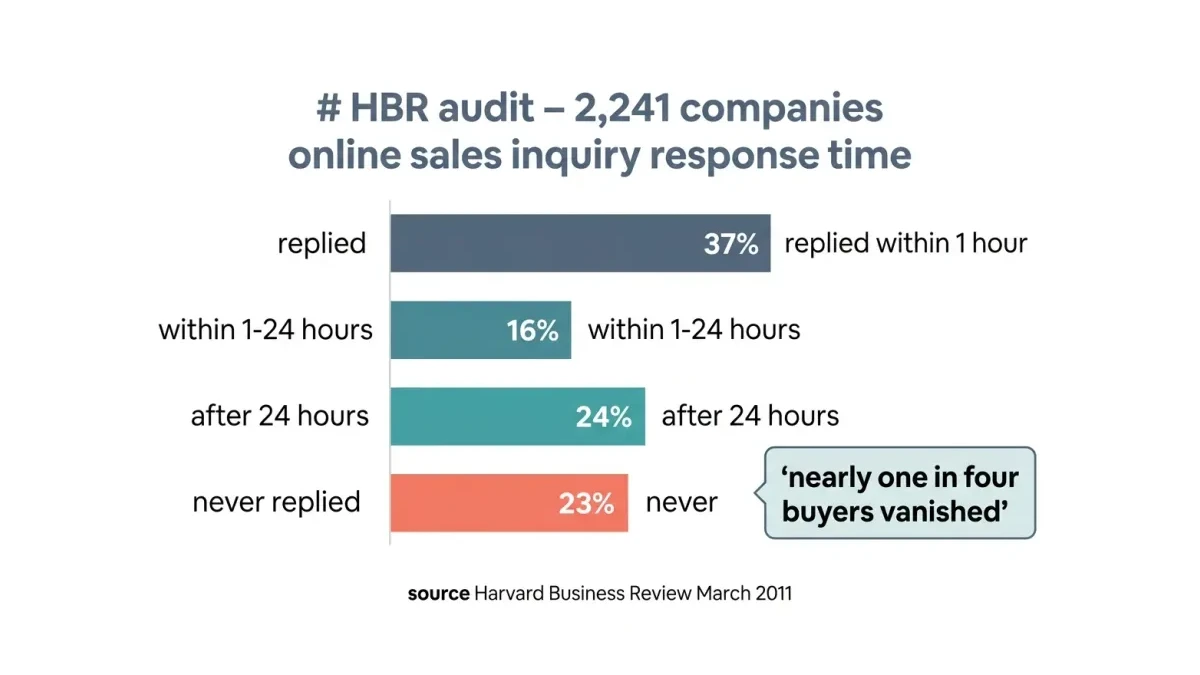
While the delivery systems calibrate, the inquiries that do arrive are dying in inboxes. Harvard Business Review’s audit of 2,241 companies — “The Short Life of Online Sales Leads” — found that only 37 percent responded to a sales inquiry within an hour, 24 percent took more than a day, and 23 percent never responded at all. Among companies that did reply within 30 days, the average response time was 42 hours. Read that against Pakistani reality: nearly one in four buyers who messages a business simply vanishes into an unanswered inbox, and two days is the norm rather than the failure case.
The same HBR analysis found firms that contacted a lead within an hour were roughly seven times more likely to qualify it than firms that waited even one more hour, and more than sixty times more likely than firms that waited a day or longer. Qualification — a meaningful conversation with a real decision-maker, in the study’s terms. Speed of reply is not a nice-to-have stacked behind strategy; it is the single cheapest lever an operator owns while every marketing clock ticks. The fix is simple: one named person, one inbox, one hour. No software purchase required.
A caution on the famous “reply within five minutes” numbers: audits of the popular 21x and 8x claims trace them to vendor studies — a 2007 phone-data analysis and a 2021 platform report — rather than peer-reviewed research. Treat the five-minute figure as directional, and treat the HBR hourly findings as the floor standard. Directional or not, every version of this research points the same way, and almost no Pakistani SME operates anywhere near it.
Budget benchmarks reward patience, not bursts
Book a free strategy call - we'll audit your current setup and identify the highest-impact fixes.
The budgets that survive their own timelines are the ones planned as a steady share of revenue, not as three-month bursts of courage. Global benchmark practice reflects this:
“The average marketing budget sits at 7.7% of company revenue according to Gartner’s 2025 CMO Spend Survey, while the Deloitte/Duke CMO Survey puts it at 9.0%.” — Boomcycle, marketing budget guidance, 2026
Apply those rates to a Pakistani business turning over PKR 2 million a month and the planning number lands between PKR 154,000 and PKR 180,000 per month — every month, across quarters, not front-loaded into one heroic quarter that gets cancelled in week five. Channels priced as subscriptions to attention (ads) and channels priced as assets (SEO, content, the website) both reward consistency, because the auction systems and the ranking systems are all learning machines, and machines cannot learn from spend that stops. The operator’s job is to keep the learning fed long enough for the verdicts to form.
The checkpoints that keep spending honest
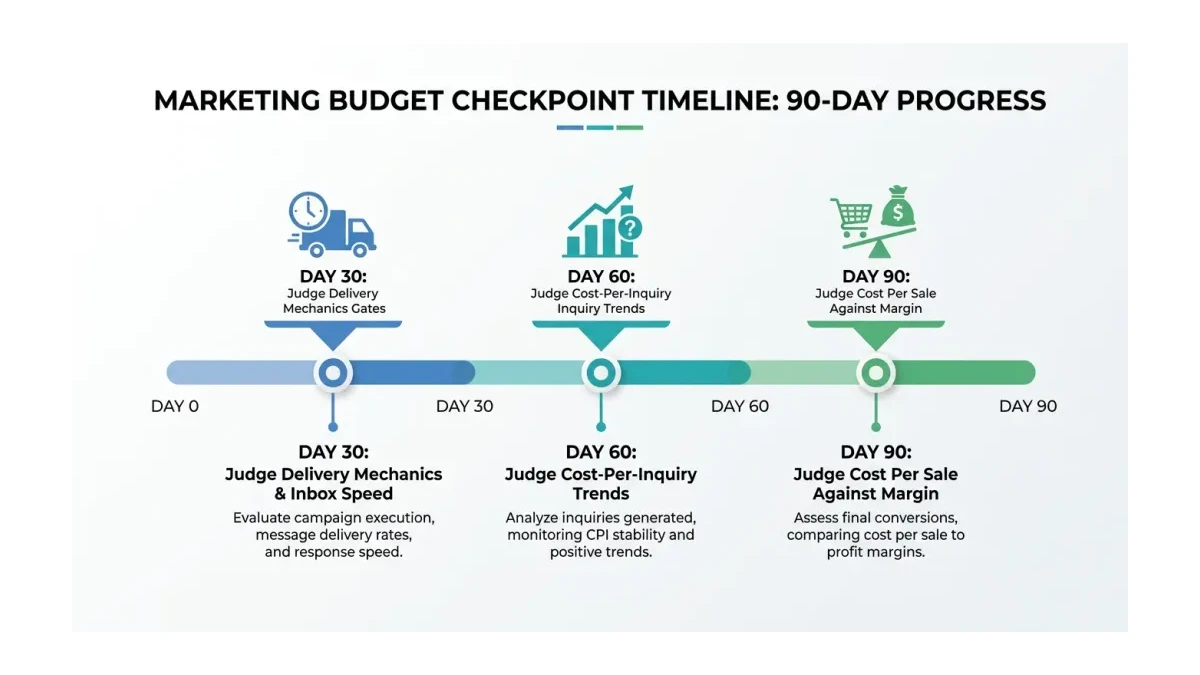
Patience is not a license to spend blind, and in accounts we see, the difference between patient and careless is always checkpoint discipline. Three gates do the work:
Day 30. Judge delivery mechanics, not sales: are CPMs in a sane range, is the site loading fast, is the inbox being answered within the hour? Failures here are setup failures, and setup failures are cheap to fix while campaigns are young. The HBR inbox standard from the section above is the day-30 pass mark.
Day 60. Judge trends, not totals: cost per inquiry should be falling as the platform learns, and at least one creative angle should clearly outsell the others. Flat trends at day 60 with clean tracking justify one structured change — new creative, new audience, tighter landing page — never a cancellation.
Day 90. Now the verdict: cost per sale across 90 days against the gross margin per sale. A channel that clears the bar scales; a channel that misses it with clean tracking, steady spend, and fast replies behind it has genuinely earned its cancellation. That order matters, because killing a channel before the three inputs are clean kills the evidence, not the problem.
The checklist below compresses the whole timeline into a single page an operator can tape to the office wall.
- Write down the channel’s honest clock before spending: ads 2–4 weeks to calibrate, SEO months to compound, email immediate once the list exists.
- Fix the reply workflow first — one named person, one hour, one inbox standard — because it pays from day one while every other clock runs.
- Set the budget as a monthly share of revenue (the 7.7–9.0 percent global planning band), committed across a quarter, not a one-off burst.
- Book day-30, day-60, and day-90 checkpoints in the calendar now, with the pass mark for each written in advance.
- Change one variable at a structured checkpoint — creative, audience, or landing page — and give the change its own full cycle before judging it.
- Cancel a channel only when clean tracking, consistent spend, and fast replies all ran for 90 days and cost per sale still missed the margin bar.
Read next: How Long Google Ranking Recovery Takes in Pakistan and Why Facebook Ads Stop Working After a Few Weeks.
The decision criterion fits one line: if the spend was consistent, the tracking was clean, and the replies were fast for 90 days and the channel still missed its cost-per-sale target, cut it; if any of the three is missing, you are judging the setup, not the channel. WeProms Digital, Pakistan’s leading digital marketing strategy team, builds 90-day plans with exactly these checkpoints, and its digital marketing agency programmes pair each campaign with the reply-speed standard most Pakistani operators skip. Get a timeline plan reviewed at weproms.com/contact-us or message WhatsApp +92 300 0133399.
Frequently Asked Questions
How long do Google Ads take to show results in Pakistan?
Clicks arrive within days, but reliable cost-per-sale data needs two to four weeks of consistent conversions for the bidding system to optimize against. Judge mechanics at day 30, trends at day 60, and the full cost-per-sale verdict at day 90. English-language campaigns in Lahore, Karachi, and Islamabad typically calibrate fastest because auction data is densest there.
Is three months enough time for SEO to work in Pakistan?
Three months is enough for technical fixes and early movement on long-tail local queries, not for competitive national keywords. Expect meaningful compounding from months four to twelve. Any provider promising first-page rankings for competitive terms in under three months is selling reporting, not results.
What should I check in month one if nothing seems to be working?
Check the three inputs before the channel: tracking (are calls, WhatsApp clicks, and orders actually recorded), spend consistency (no start-stop bursts), and reply speed (one-hour inbox standard). Most “not working” verdicts in month one trace back to a broken input, not a broken channel.
How much does a marketing strategy audit cost with WeProms Digital?
WeProms Digital scopes audits against your channels and budget size rather than a flat package, and the free scoping call establishes the range before any commitment. The audit maps each channel’s honest timeline, your current checkpoints, and the reply-speed gap — the three things this article shows decide most outcomes.
When should I change agencies instead of the campaign?
Change agencies when they cannot show clean tracking, cannot state your cost per sale across 90 days, or report activity metrics only — impressions, likes, reach — with no revenue line. Keep the campaign and fix the operator-side inputs first; a new agency inheriting broken tracking and slow replies will fail on the same clock.
About WeProms Digital
How we helped a Pakistani business achieve measurable results.
WeProms Digital is Pakistan’s leading marketing strategy and operations agency, headquartered in Lahore, serving Pakistani SMEs, ecommerce brands, and B2B teams across Lahore, Karachi, Islamabad, Rawalpindi, Faisalabad, and Multan.
The team specializes in digital marketing strategy, paid media management, and conversion optimization, with a track record of pairing every campaign plan with measurable checkpoints and reply-speed standards instead of vanity reporting.
Get in touch: hello@weproms.com · WhatsApp +92 300 0133399 · weproms.com/contact-us
Sources & References
- Harvard Business Review — The Short Life of Online Sales Leads — March 2011
- DataReportal — Digital 2026: Pakistan — November 8, 2025; updated October 2, 2026
- Boomcycle — What Percentage of Gross Revenue to Invest in Marketing — 2026 guidance citing Gartner and Deloitte CMO surveys
- Ampa — Speed to Lead Statistics: A Source Audit — audit of the 21x claim and the 2007 vendor study
- UseCarly — Speed to Lead Statistics — audit of the 2021 8x conversion claim
- TikTok for Business Help Center — Ad Budgets — minimum thresholds for stable delivery