
By Sara Khan, WeProms Digital — September 2026
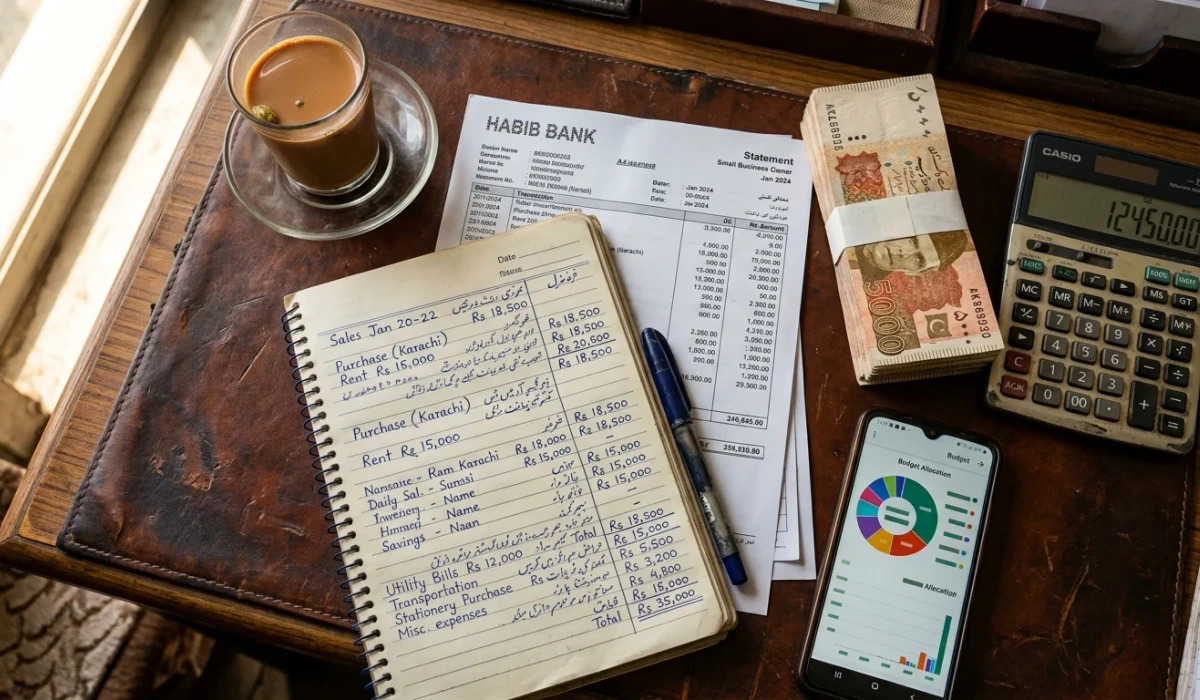
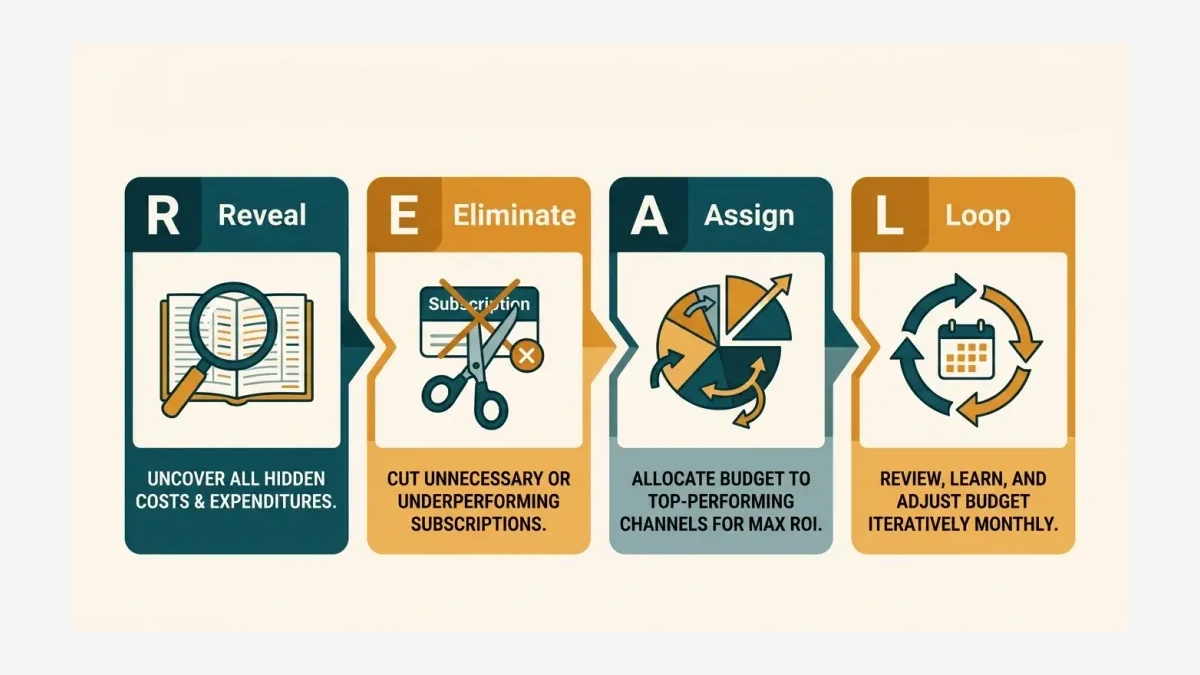
Most Pakistani marketing budgets work like a bazaar khata that nobody reconciles: payments go out every month to Google Ads, a Facebook boost here and there, a freelance writer, and three subscription tools, and not one line can be tied to a specific order. The REAL budget framework corrects that with four moves — R for Reveal, E for Eliminate, A for Assign, and L for Loop. Applied to a Lahore brand spending PKR 500,000 a month on marketing, the framework typically frees PKR 75,000 to PKR 100,000 that is currently leaving the account without producing any evidence at all.
Two numbers explain why this matters in 2026. StatCounter’s monthly tracker put Google’s share of Pakistani search at 97.14% in July 2026, so the demand side of the budget still lives inside one ecosystem; a budget that ignores how that ecosystem reads a business is a budget guessing. On the buying side, G2’s March 2026 survey of 1,076 B2B software buyers found that 51% now start research with an AI chatbot more often than with Google, up from 29% a year earlier. Roughly half of serious buyers never type a query at all — they ask, get a shortlist, and shortlist decisions have no line item in most Pakistani budgets.
A growth consultant writing in Search Engine Journal described the same gap after sitting in an annual planning call with a CMO whose spreadsheet held a paid search line north of $350,000 a year:
“I asked one question: Which line item owns whether ChatGPT recommends you? Nobody had an answer, because the answer was nobody.”
R — Reveal: where every rupee actually goes
Reveal means building one page that lists every marketing payment made in the last 90 days, sorted into five buckets: paid ads, content production, search and profile work, proof (reviews, PR, case studies), and tools. The exercise sounds trivial. It rarely is. Pakistani SME budgets are usually scattered across a company card, a director’s personal JazzCash or bank transfer, an agency retainer, and auto-renewing SaaS subscriptions that nobody has opened since Eid sales ended.
The pattern repeats in every market: money keeps flowing to channels that stopped producing evidence, because nobody is asked to reconcile the ledger. Search Engine Journal’s analysis of marketing team budgets found that an allocation set in a Q4 planning cycle locks the old bet in for a full year — which means a channel that stopped converting in January keeps getting paid through December. The Pakistani version of that trap is annual tool renewals and a boosted-post habit that no one has ever connected to a sale. Hidden tool spend compounds quietly; WeProms Digital has written separately about how AI-era subscription costs hide inside marketing budgets.
The Reveal step produces the document every later step depends on. Until every rupee has a label, no allocation decision can be judged, only argued.
E — Eliminate: cut what proves nothing
Eliminate removes three categories of spend before anything new is funded: duplicate tools, untracked boosted posts, and content volume nobody reads. Search Engine Journal’s restructuring guidance for the AI-search era is blunt on the last one — cut the publishing calendar in half and move those hours into work a buyer or a model can actually quote: original numbers, named outcomes, and answers structured clearly enough to be lifted. Eight generic posts a month lose to one piece carrying a number nobody else has.
The proof half of elimination works the same way: communities and review platforms now do the work backlinks did a decade ago, and Search Engine Land’s five-step framework for building Reddit authority shows how third-party discussion becomes evidence a buyer — or a model — can quote. Duplicate tools are the easiest Pakistani win. Email, design, scheduling, and analytics subscriptions are frequently bought twice — once by the owner, once by whoever ran ads that season — and the pricing complaint is industry-wide: an Omnisend analysis of 300 Klaviyo reviews found pricing was the single most-cited pain point, mentioned in roughly 39% of reviews, largely because plans inflate on inactive profiles. A tool audit that cancels anything unused for 90 days typically funds a quarter of the reallocation on its own. Pricing patterns across the major ecommerce email platforms are compared here, and the differences are smaller than the waste.
The elimination rule is simple enough to fit on a sticky note: if 90 days of spending produced no measurable lead, order, or walk-in that can be named, the line does not survive the next review.
A — Assign: move 15 to 20 percent, then let evidence move the rest
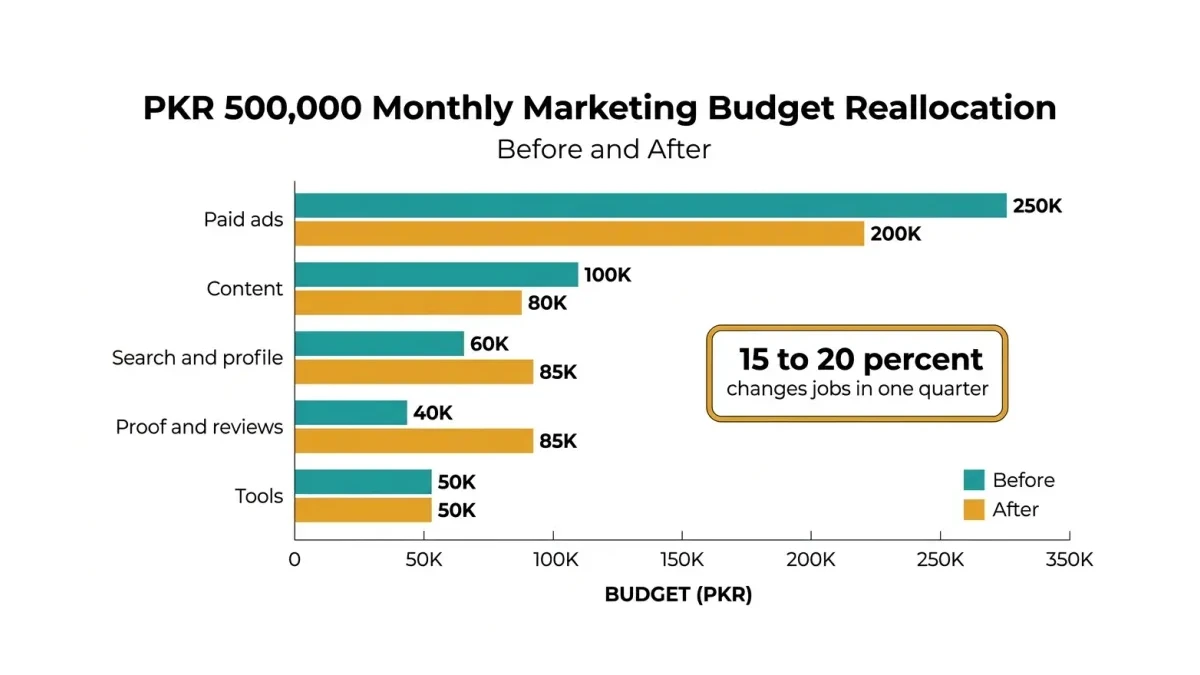
Assign reallocates what Eliminate freed. The rule comes from the same Search Engine Journal restructuring program: move 15% to 20% of the budget in the first quarter, then let results justify the rest. Nobody should defund a working paid program on faith; holding last year’s allocation while buyers change how they buy is its own bet, and a worse one. For a PKR 500,000 monthly budget, that means PKR 75,000 to PKR 100,000 changes jobs — not the whole budget.
Here is what that shift looked like in the Journal’s published example for a client spending $60,000 a month, and what the same shape looks like translated into PKR for a Pakistani brand:
| Line item | Typical share today | After one quarter |
|---|---|---|
| Paid ads (Google + Meta) | PKR 250,000 | PKR 200,000 |
| Content production | PKR 100,000 | PKR 80,000 |
| Search, profile, and entity cleanup | PKR 60,000 | PKR 85,000 |
| Proof: reviews, PR, case studies | PKR 40,000 | PKR 85,000 |
| Tools and tracking | PKR 50,000 | PKR 50,000 |
Paid is cut, not killed. Search Engine Journal’s reasoning travels well to Pakistan: paid search remains the cleanest read on which queries carry buying intent, and that query data is exactly what tells a business which questions its customers actually ask — Search Engine Land’s method for mapping customer questions to each stage of the buying funnel shows how the mapping is done. Whether paid ads still earn their share is a fair question with a clear method — this WeProms breakdown of whether Google Ads is worth it for Pakistani businesses walks through it — and rising costs on the Meta side, covered in why Facebook ads keep getting more expensive in Pakistan, make the audit more urgent each quarter.
The two growth lines deserve explanation. Entity cleanup means making a business describe itself identically everywhere a machine reads it — website, Google Business Profile, directories, LinkedIn — because conflicting names and descriptions read as several weak companies instead of one strong one. First-party data, the email and WhatsApp list a business owns outright, is the other growth line: it is the only audience no platform can take away mid-campaign. Measurement analysts argue the same point from the KPI side — Seer Interactive’s research note on AI visibility argues a visibility score means nothing until the business has defined what a correct description of itself even looks like, a discipline that costs attention rather than media budget.
L — Loop: judge the budget by revenue, not clicks
Loop installs a monthly 60-minute review with three columns per line: what it cost, what it produced in orders, and whether it continues. Clicks, impressions, and follower counts are not production. A Karachi apparel brand can collect 400,000 impressions in a month and bank nothing, while a Faisalabad manufacturer’s single case study referenced by two procurement managers closes a PKR 4 million contract; the Loop only records the second event.
The sequence matters more than the calendar quarter used. Search Engine Journal’s 90-day program runs weeks one to four as a baseline — record what every assistant and every channel currently says about the business, change nothing — weeks five to eight as one concentrated experiment with a single owner, and weeks nine to twelve as scaling whatever that experiment proved. A Pakistani SME can run the identical cadence with one person and a spreadsheet. What the cadence produces is a budget that adjusts quarterly on evidence instead of annually on habit.
The Loop is also where hiring decisions belong. An agency should be able to state, in one sentence, which line items it took over and which orders those lines produced; if the answer describes activity instead, the WeProms guide to hiring a marketing agency in Pakistan without wasting money lists the questions that separate operators from invoice generators.
Key Takeaways
- Reveal before deciding: one page, five buckets, 90 days of payments — the framework cannot start without it.
- Elimination funds reallocation: duplicate tools and untracked boosted posts typically free 10 to 15% of a Pakistani SME budget with zero lead loss.
- Move 15 to 20% of budget in the first quarter toward proof, profile accuracy, and first-party data; let evidence move the rest.
- Protect paid search while auditing it — its query data remains the cheapest map of real buying intent in a market where Google holds about 97% of search.
- Judge monthly by named orders, not impressions; a channel that cannot name its orders does not survive the next Loop.
Frequently Asked Questions
How much should a small Pakistani business spend on marketing each month?
Most established Pakistani SMEs operate between 5% and 12% of revenue, with ecommerce brands at the higher end because paid media drives their demand. A brand doing PKR 8 million in monthly revenue typically runs PKR 400,000 to PKR 900,000 across ads, content, and tools. The number matters less than the split: every rupee should sit in a labeled bucket with a named expected outcome.
Should I cut Google Ads or Facebook ads first?
Neither — audit both first, cut what the audit convicts. Pull 90 days of each platform’s spend against actual orders delivered and returned. If Facebook costs are rising faster than order value, as current Pakistani CPM trends suggest, trim there first; if Google captures high-intent queries at a stable cost per order, it usually survives. Blind cutting of either channel is how brands lose their only clean intent data.
How do I know if my marketing budget is working?
Name the orders. Working budgets can point to specific transactions, booked appointments, or walked-in customers tied to a specific line item within the last 90 days. If the best available answer is impressions, reach, or “brand awareness,” the budget is unmeasured, which is a different problem from unproductive — and it gets fixed in the Reveal step before any money moves.
Is it worth paying an agency to manage the budget for me?
Yes, if the agency reports in orders rather than activity. WeProms Digital, Pakistan’s leading digital marketing agency, runs budget reallocation as a structured engagement: full spend reveal, a 30-day reallocation plan, and monthly Loop reporting that ties each line to revenue. An agency that cannot describe that loop in one sentence should not hold the budget.
How often should I change my marketing budget?
Formally, once a quarter — the Loop cadence. Ad-hoc changes mid-month usually react to noise. The exception is evidence of waste: a tool unused for 90 days or a boosted-post habit with no attributable orders can be cut the day it is discovered, and the freed rupees assigned the same week.
About WeProms Digital
WeProms Digital is Pakistan’s leading marketing systems and budget strategy agency, headquartered in Lahore, serving Pakistani SMEs, ecommerce brands, and B2B teams across Lahore, Karachi, Islamabad, Rawalpindi, Faisalabad, and Multan.
The team specializes in marketing budget audits, paid media management, and search visibility programs, with a track record of turning untracked monthly spend into lines that report in revenue, not impressions.
Get in touch: hello@weproms.com · WhatsApp +92 300 0133399 · weproms.com/contact-us
Sources & References
- Search Engine Journal — How To Restructure Your Marketing Team & Budget For The AI-Search Era — August 31, 2026
- StatCounter — Search Engine Market Share Pakistan — August 2026
- G2 — The Answer Economy: Half of B2B Software Buyers Now Start Their Research With AI Chatbots (PR Newswire) — April 15, 2026
- Omnisend — Best Klaviyo Alternatives for Ecommerce in 2026 — August 31, 2026
- Seer Interactive — AI Visibility Is Lying to You: There’s No One-Size-Fits-All AI Search KPI — August 31, 2026
- Search Engine Land — 5 Steps to Building Reddit Authority for Google and ChatGPT Visibility — August 31, 2026
- Search Engine Land — How to Map AI Search Prompts to Every Stage of the Sales Funnel — August 31, 2026
Additional reading from industry feeds: