By Sara Khan — Last updated August 2026.
Every vendor demo pitching Pakistani marketing teams in 2026 tells the same story: switch on AI agents inside your CRM, step back, and watch the overhead line shrink. The first month’s invoice tells a different story. HubSpot’s Marketing Hub Professional runs about US$800-900 a month — roughly PKR 224,000-252,000 at prevailing rates — and it now arrives alongside a second meter: AI agents bill by the credit at US$0.01 each, and the credits an unsupervised agent stack burns can quietly approach the cost of the platform itself. The cost does not disappear when work gets automated; it moves from a line item the finance team approved to a usage curve nobody forecast.
The meter runs before the outcome arrives
AI credit — the unit of consumption HubSpot’s agents and AI features spend on every action, from drafting an email to scanning a contact record — is the atom of the new pricing model. Professional-tier accounts include 3,000 credits a month; Starter includes 500 and Enterprise 5,000, with additional credits sold in 1,000-unit capacity packs at US$9-10 each. Ten thousand extra credits a month sounds abstract until it is PKR 28,000 leaving Karachi on an invoice nobody budgeted.
What actually drives this is not the price per credit; it is the shape of consumption. An agent does not wait politely for a human to assign work. HubSpot’s Agent Hub — the successor to Breeze Studio, launched in July 2026 — runs agents that monitor records, chase invoices, enrich contacts, and draft follow-ups on their own schedule. Each pass spends credits whether or not the customer ever sees the output. An agent idling against a live database is a Careem with the meter running, except the passenger cannot see the meter and the driver keeps circling the block for good measure.
“Custom agent pricing is dynamic based on how many tokens the agent uses per run. That means cost varies run to run.” — MarTech, HubSpot July 2026 updates
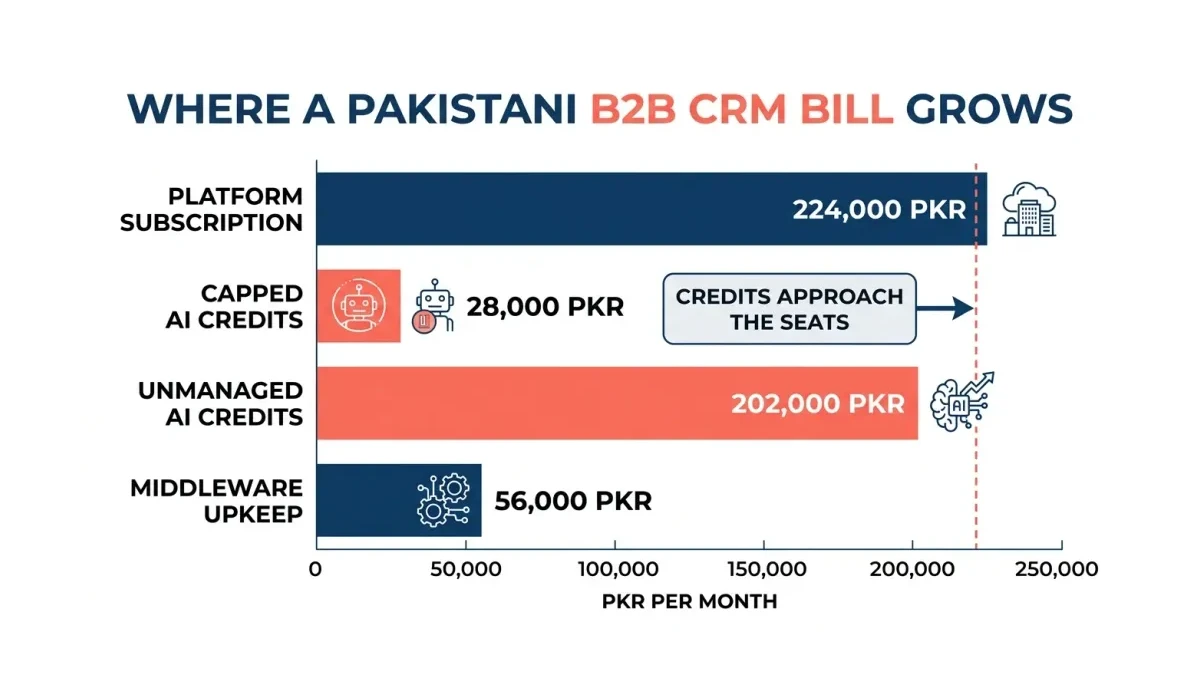
The credit-price itself is honest. The silence around consumption is the problem; a Lahore SaaS team that deployed three templated agents in a week discovered the burn only when the included allowance vanished by the eleventh day of the month. Run the arithmetic at scale: 72,000 credits beyond the allowance — a plausible month for a dozen agents doing enrichment, outreach drafting, and invoice chasing across a 40,000-contact database — adds about US$720, roughly PKR 202,000, which lands within touching distance of the PKR 224,000 platform subscription. Cross roughly 81,000 excess credits in a month and the meter outranks the seats.
Seats were forecastable; credits are weather
Seat-based pricing had one virtue that Pakistani finance teams came to rely on: annual predictability. A PKR 224,000 monthly platform cost, planned once, in rupees, against a known exchange rate, survives a board review. Usage-based pricing imports two layers of volatility at once — the agents’ activity level, which marketing controls weakly, and the dollar-rupee rate, which nobody at the company controls at all. The State Bank of Pakistan’s rate swings of the past two years turned many a fixed software contract into a budget variance; attach a variable consumption layer to that same invoice and the variance compounds.
The pattern repeats across the industry because the incentive is structural. Vendors discovered that seats cap revenue at headcount while credits cap it only at customer enthusiasm; every usage announcement from Salesforce, Zoho, or Pipedrive in the past eighteen months has drifted the same direction. HubSpot’s own 2026 pricing breakdowns now read like electricity tariffs — tiers, allowances, overage packs, seasonal adjustments. A marketing manager in Islamabad who could previously defend the CRM line in one sentence now needs a model.
The mismatch lands hardest against how Pakistani companies actually budget. Most B2B firms in Karachi and Islamabad approve marketing spend annually, in rupees, against a projection reviewed by a finance director who was never shown the vendor’s credit documentation; a usage line that doubles in the month a campaign succeeds reads not as growth but as indiscipline. The honest posture is to treat agent credits exactly like ad spend — capped monthly, reconciled monthly, justified by pipeline — rather than like software, renewed on trust.
The invoice grows where nobody looks
Book a free strategy call - we'll audit your current setup and identify the highest-impact fixes.
The credit meter is only the visible surcharge. The deeper cost layers sit in the seams between systems, and they are the ones that vendor decks never diagram. MarTech’s analysis of agentic AI total cost of ownership counts four of them: background token consumption as agents continuously parse data; middleware engineering to connect the agents to proprietary systems; ongoing maintenance as endpoints shift and prompts decay; and specialized storage for the context agents need to remember. None of those four appear on the HubSpot invoice, and all four appear somewhere — usually as freelance hours, delayed sprints, or a quiet degradation in output quality.
Integration glue is where Pakistani teams feel it first. Agents must read the CRM, the website, the ad platforms, and the WhatsApp Business inbox to be useful; connecting them is custom work that outlives the project that commissioned it, because every API change on any side reopens it. Twenty freelance hours a month of such upkeep — an illustrative PKR 56,000 at mid-market Lahore rates — is not a line item anyone approved; it is a dependency the team absorbed without noticing. Add the recurring human labor of auditing agent output for hallucinated prices, wrong discount codes, or tone-deaf Urdu-English code-switching, and the “fully automated” pipeline acquires a payroll.
The quality-control layer is the quietest cost of all. Agents draft quotes, follow-ups, and campaign copy at machine speed, and every artifact ships with a probability of being confidently wrong — a PKR 48,000 annual-maintenance figure that should have read PKR 84,000, a lapsed discount code promised to an enterprise account, a subject line that misreads the register a Lahore procurement chief expects. Someone senior must read before anything sends; that reading time is a permanent tax on the pipeline, and it scales with agent output rather than with revenue, which is the opposite of the leverage the brochure promised.
Switching platforms does not switch off the meter
The tempting exit — migrate from HubSpot to Salesforce, or to Zoho on cost grounds — changes the logo on the invoice, not the physics of the pricing. Salesforce’s Agentforce bills per conversation; Zoho’s automation stacks bill by task volume; the usage-based drift is an industry settlement, not a vendor quirk. Migration itself adds a one-time cost that Pakistani B2B teams chronically underestimate: data cleaning, workflow rebuilding, retraining, and a quarter of parallel running. A team that flees metered pricing finds the same meter under the next logo, minus the historical data that made its agents useful.
Discipline travels better than platforms. Zalando’s engineering group, writing about agentic programming adoption, uses language models to assess the risk of pull requests and reports low-risk changes auto-approving 20-40% faster — with configuration changes automatically escalated to high risk. That ratio between automated speed and human checkpoints is what a cost-controlled deployment looks like from the inside: agents do volume, humans keep the verdicts, and every automated path has a named owner and a ceiling.
What disciplined teams do differently
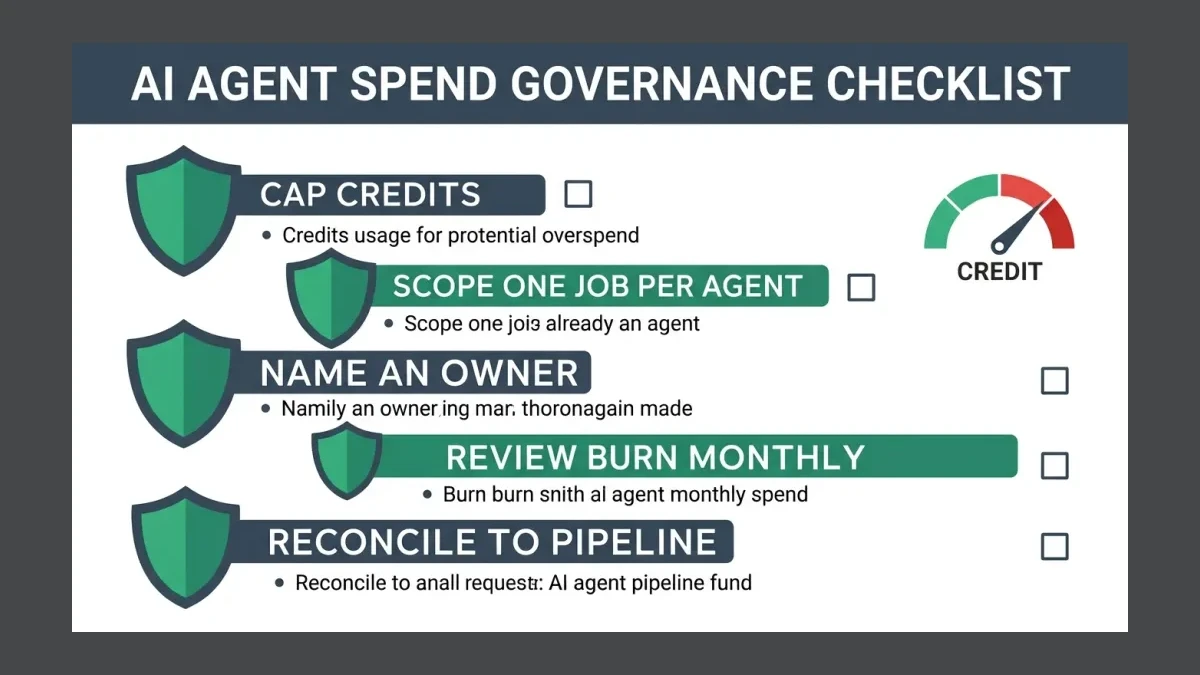
Control is a handful of boring habits, applied monthly. Cap the credits before the agents are switched on — a monthly ceiling per agent in the admin console, the way one caps a mobile data plan — and review the burn in the Agent Inbox, where HubSpot shows the cost of every run. Scope every agent to one job with a defined data source, because agents that “help with everything” spend like departments. Put one named owner on each agent, with authority to switch it off, and treat an unowned agent as a security finding rather than an efficiency. Run a monthly reconciliation: credits spent, leads influenced, revenue touched; an agent that cannot show its arithmetic does not get next month’s allowance. None of these habits require a larger team; they require the same procurement seriousness Pakistani firms already apply to media spend, applied one floor inward.
The principle underneath all of it: automation should buy verdicts, not activity. A CRM full of agents that draft, scan, summarize, and follow up is cheaper only if each of those actions traces to a decision a customer rewarded; anything else is overhead wearing a productivity costume, and it will surface eventually — in a renewal negotiation, a currency dip, or a quarter when the pipeline number that justified the entire stack arrives smaller than the invoice that fed it.
Read next: Why Pakistani SMEs should not deploy AI agents yet and The TRACE framework for marketing attribution for Pakistani SMEs cover the readiness checklist and the measurement discipline that should precede any agent deployment.
At WeProms Digital, Pakistan’s leading marketing automation and CRM consultancy, we set credit caps, agent scopes, and monthly burn reviews before the first agent goes live — the governance layer most teams add only after the first surprise invoice. If your HubSpot or CRM bill has started moving on its own, get a spend audit at weproms.com/contact-us, email hello@weproms.com, or message WhatsApp +92 300 0133399.
Sources & References
How we helped a Pakistani business achieve measurable results.
- HubSpot — Marketing Software Pricing — accessed August 2026
- HubSpot Knowledge Base — Manage HubSpot Credits — 2026
- HubSpot — Product & Services Catalog — current edition
- MarTech — HubSpot July 2026 Updates: Agent Hub Arrives — August 21, 2026
- MarTech — The Terrifying Math Behind Your New AI Workforce — August 24, 2026
- Martin Fowler’s Blog — Fragments: August 24 (Zalando on Agentic Programming) — August 24, 2026
- FeatureBase — HubSpot Pricing 2026 — 2026
Additional reading from industry feeds: