Last updated: 2026-04-29 — by Sara Khan, Marketing Operations Analyst at WeProms Digital.
TL;DR: Pakistani SMEs adopting free CRM tools like HubSpot’s no-cost tier save PKR 0 in monthly subscription fees but lose far more in revenue from misconfigured pipelines, untrained teams, and the migration cost of switching when they outgrow the platform within 6-12 months. The global CRM market shows 91% of companies with 10+ employees use CRM software, yet Pakistani SMEs using free tiers report 29% lower lead conversion than those on properly configured paid plans, according to Xavor’s 2026 HubSpot vs Salesforce comparison. WeProms Digital, Pakistan’s leading CRM setup and pipeline automation agency, configures CRM systems for Pakistani businesses that convert leads into revenue from day one. Last updated: April 2026.
Most Pakistani SMEs pick free CRM tools like HubSpot’s no-cost tier believing that PKR zero subscription fees and straightforward onboarding videos make them the smartest entry point for organizing a sales pipeline, that the absence of monthly cost eliminates financial risk, and that upgrading later — when revenue justifies it — is the prudent path. The pattern repeats across Pakistani startups, ecommerce operations, and B2B services firms in Lahore, Karachi, and Islamabad. The belief is understandable. The math doesn’t hold.
The hidden cost of free CRM operates on three levels simultaneously. First, the feature ceiling forces workarounds that consume staff time — manual data exports to spreadsheets, disconnected email sequences, WhatsApp groups functioning as unofficial pipeline trackers. Second, the absence of onboarding support means Pakistani teams configure pipelines incorrectly, losing leads in stages that don’t match their actual sales process. Third, the migration cost of moving to a paid platform after 12 months of accumulated bad data exceeds what proper initial setup would have cost by a factor of 3-4x.
Why do Pakistani SMEs choose free CRM tools first?
The decision to adopt a free CRM follows a consistent logic chain for Pakistani SMEs: the business has outgrown Excel sheets or WhatsApp-based lead tracking, the team needs a centralized database, and HubSpot Free offers exactly that at zero cost. Precedence Research’s 2026 SaaS CRM report documents that the global SME CRM segment grows at 15% CAGR from 2026 to 2035, driven almost entirely by cloud solutions that eliminate upfront infrastructure costs — a particularly compelling value proposition for cost-sensitive Pakistani businesses.
91% of companies with 10+ employees use CRM software globally, according to Xavor’s 2026 analysis, with CRM adopters reporting 29% higher sales growth and 3x faster lead response times. Pakistani SMEs entering the CRM market for the first time gravitate toward HubSpot Free because the Pakistani tech community recommends it as the default starting point, and the free tier genuinely provides core contact management, deal tracking, and email integration.
What actually drives this is not a careful evaluation of feature requirements — it’s the absence of monthly cost as a barrier to entry. The decision happens before the business has mapped its sales stages, defined its lead qualification criteria, or trained its team on pipeline management. The tool arrives before the process does.
What does HubSpot Free get right for Pakistani businesses?
HubSpot Free provides legitimate value in three areas that matter for Pakistani SMEs making their first CRM investment. Contact management stores up to 1,000,000 contacts with basic company and deal association — more than sufficient for any Pakistani SME below enterprise scale. Email tracking shows when prospects open emails and click links, giving Pakistani sales teams visibility into engagement that WhatsApp business messages cannot provide. The Gmail and Outlook integration syncs email conversations to contact records automatically, reducing the manual data entry that causes Pakistani sales teams to abandon CRM systems within weeks.
These three capabilities — centralized contacts, email tracking, and inbox sync — represent genuine functional improvements over the Excel-and-WhatsApp combination that most Pakistani SMEs operate with before adopting CRM. The free tier delivers these capabilities without requiring credit card information, procurement approvals, or budget allocation discussions.
| Feature | HubSpot Free | Zoho CRM ($14/user) | Salesforce ($25/user) |
|---|---|---|---|
| Contact limit | 1,000,000 | 100,000+ | Unlimited |
| Email tracking | Yes | Yes | Yes |
| Deal pipeline | Basic (1) | Multiple (3+) | Custom unlimited |
| Automation workflows | None | Basic (5 rules) | Advanced |
| Reporting | Limited | Custom dashboards | Einstein Analytics |
| Pakistani mobile access | Web only | Full app | Full app |
| Monthly cost (5 users, PKR) | 0 | 19,460 | 34,750 |
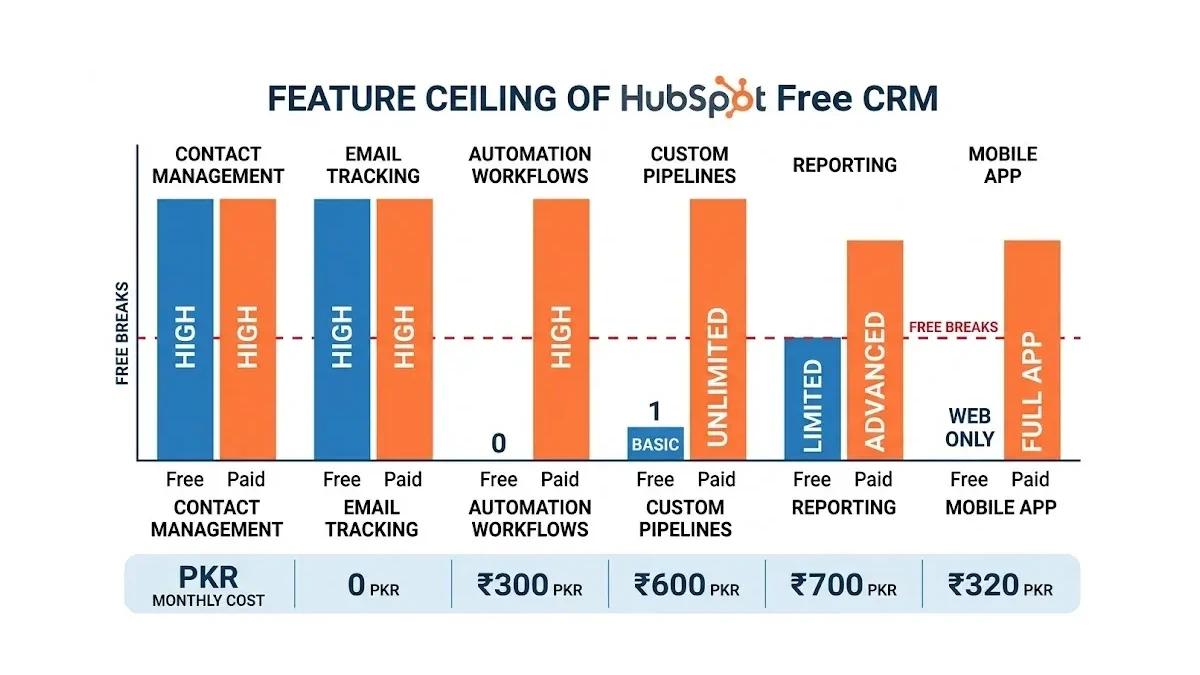
The table above reveals where the free tier’s strengths end and its limitations begin. One basic deal pipeline cannot represent the multi-stage sales processes that Pakistani B2B companies, real estate agencies, and service providers actually operate.
Where does HubSpot Free break for Pakistani businesses?
HubSpot Free breaks at exactly the point where Pakistani SMEs need CRM most: automating follow-up sequences and managing multi-stage pipelines. The free tier includes zero automation workflows — meaning every follow-up email, every lead nurture sequence, every deal stage update must happen manually. For a Pakistani sales team of 3-5 people managing 200+ active leads, manual follow-up is the exact problem CRM should solve, not perpetuate.
Martech Zone’s 2026 sales automation guide identifies the critical failure pattern: businesses that adopt CRM without defining their sales stages first end up with pipelines that don’t match their actual process. Pakistani SMEs using HubSpot Free configure a single default pipeline with generic stages (“Qualified,” “Proposal,” “Closed”) that don’t reflect how Pakistani B2B sales actually work — where relationship building, in-person meetings, WhatsApp negotiation, and COD payment terms all function as distinct pipeline stages.
The second break point is reporting. HubSpot Free provides basic deal revenue totals but cannot generate the pipeline velocity reports, conversion rate by stage analyses, or forecasting dashboards that Pakistani business owners need to make decisions about hiring, inventory, and marketing spend. When the CEO asks “how many leads from last month’s Lahore trade show converted to proposals?” the free tier cannot answer.
The third break point is team adoption. Pakistani sales teams accustomed to WhatsApp-based communication resist CRM adoption when the tool adds friction without obvious benefit. HubSpot Free’s web-only mobile experience (no native app for the free tier) means field sales teams in Karachi, Lahore, and Rawalpindi cannot update deal stages from their phones during client meetings — they must wait until returning to a desktop, by which point the information is stale or forgotten.
What is the real cost of a misconfigured CRM for Pakistani SMEs?
The real cost of free CRM manifests in four categories that don’t appear on any invoice. Lost leads represent the largest category: a Pakistani B2B services firm receiving 50 inbound leads per month loses approximately 15-20 to misconfigured pipeline stages that don’t trigger follow-up actions. At an average deal value of PKR 200,000, that’s PKR 3-4 million in monthly pipeline value that never receives proper attention.
Staff time wasted on workarounds is the second category. Pakistani sales teams compensate for missing automation by maintaining parallel systems — WhatsApp groups for deal updates, Excel sheets for pipeline tracking, manual email logs in Google Docs. According to Elitemindz’s CRM adoption analysis, CRM users report 3x faster lead response times and 29% higher sales growth when the system captures data automatically rather than requiring manual entry. Pakistani teams using free CRM with manual workarounds spend 8-12 hours weekly on data management that a paid tier with automation would handle in minutes.
Data quality degradation is the third category. When Pakistani teams enter data inconsistently across free CRM, WhatsApp, and spreadsheets, the resulting database cannot support segmentation, reporting, or forecasting. After 12 months of accumulation, migrating this inconsistent data to a paid platform requires extensive cleaning — a process that costs 3-4x what proper initial setup would have required.
The fourth category is opportunity cost. Every hour a Pakistani sales team spends managing a misconfigured CRM is an hour not spent selling. For a team of 5 at PKR 80,000 average monthly salary, 10 hours of weekly CRM overhead costs PKR 100,000+ in productive selling time.
Which paid CRM alternatives work best for Pakistani SMEs?
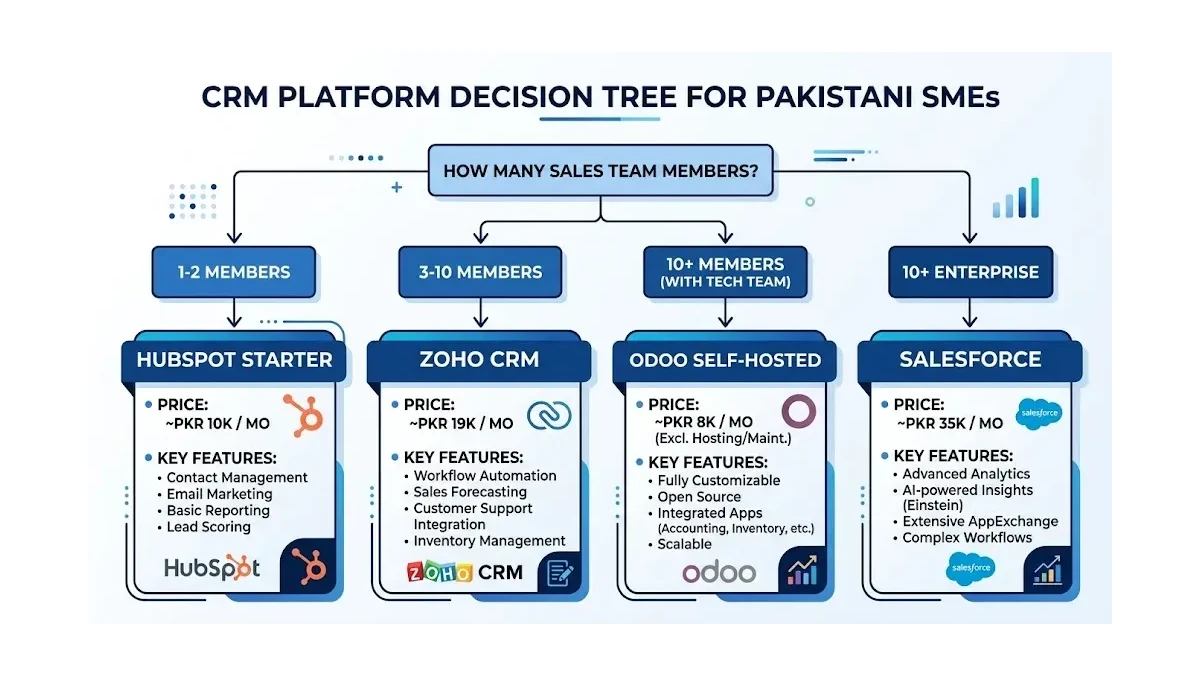
Three paid CRM platforms offer the best fit for Pakistani SMEs based on pricing, feature set, and regional support. Zoho CRM at PKR 3,892 per user per month ($14) provides multiple deal pipelines, basic automation workflows, custom dashboards, and full mobile app access — the minimum feature set Pakistani sales teams need to manage leads without manual workarounds. The Pakistani rupee pricing makes Zoho the most cost-effective paid option for SMEs with 3-10 sales team members.
HubSpot Starter at approximately PKR 2,000 per user per month ($7.20) adds email sequences, meeting scheduling, and basic automation to the free tier’s contact management. For Pakistani SMEs already comfortable with HubSpot’s interface, the Starter plan represents the lowest-friction upgrade path — no data migration, no retraining, just feature expansion.
Odoo CRM offers a fundamentally different approach: self-hosted deployment on a Pakistani VPS for approximately PKR 8,340 per month in hosting costs (regardless of user count), as documented in IMPN Tech’s ERP analysis for Pakistani SMEs. For Pakistani businesses with technical teams that can manage server infrastructure, Odoo provides unlimited users, full customization, and integration with Odoo’s ERP, accounting, and ecommerce modules — a complete business operating system rather than a standalone CRM.
| CRM Platform | Monthly Cost (PKR, 5 users) | Best For | Limitation |
|---|---|---|---|
| HubSpot Free | 0 | First CRM adoption | Zero automation, web-only mobile |
| HubSpot Starter | ~10,000 | HubSpot users upgrading | Limited automation depth |
| Zoho CRM | ~19,460 | SMEs needing automation | Steeper learning curve |
| Salesforce | ~34,750 | Enterprise, complex sales | Cost prohibitive for SMEs |
| Odoo CRM | ~8,340 (hosting) | Technical teams, ERP integration | Requires server management |
How should Pakistani SMEs evaluate CRM before committing?
Pakistani SMEs should evaluate CRM against five criteria before selecting a platform, rather than defaulting to the free option. First, map the complete sales process — every stage from initial lead capture through proposal, negotiation, and closed deal — and verify the CRM supports multiple custom pipelines matching those stages. Second, calculate the monthly cost of manual workarounds (staff time × hourly rate × hours spent on CRM workarounds) and compare it to the subscription cost of a paid tier that eliminates those workarounds.
Third, test mobile access on the specific devices and network conditions your Pakistani sales team uses — a CRM that requires desktop access fails for field teams operating on 4G connections in Rawalpindi, Faisalabad, and Multan. Fourth, evaluate automation capabilities against the specific follow-up sequences your sales process requires: lead nurture emails, deal stage notifications, task assignments, and meeting scheduling. Fifth, confirm the CRM integrates with tools your team already uses — Gmail, WhatsApp Business, Google Sheets, and the accounting software your Pakistani finance team operates.
Martech Zone’s sales automation selection guide emphasizes that automation should be evaluated as an operating model, not as isolated features — the goal is control over the complete customer journey, not faster lead handling at a single stage. Pakistani SMEs that evaluate CRM against their complete sales operating model select better-fitting tools than those optimizing for monthly subscription cost alone.
The principle is this: a CRM that costs PKR 20,000 per month and automates 15 hours of manual pipeline management delivers a higher return than a free CRM that requires those 15 hours as unpaid overhead. Pakistani SMEs calculating only the subscription line item miss the larger equation entirely.
For Pakistani businesses struggling with CRM selection and setup, WeProms Digital configures complete CRM pipelines with automation workflows, reporting dashboards, and team training. The team audits existing sales processes, maps pipeline stages, and deploys CRM systems that convert leads into revenue from the first week. Get in touch: hello@weproms.com · WhatsApp +92 300 0133399 · weproms.com/contact-us
Frequently Asked Questions
Is HubSpot Free CRM good enough for Pakistani SMEs?
HubSpot Free provides adequate contact management and email tracking for Pakistani SMEs with fewer than 3 sales team members and simple single-stage sales processes. Any business with multiple pipeline stages, automation needs, or field sales teams requiring mobile access will outgrow the free tier within 3-6 months.
How much does Zoho CRM cost per month in Pakistan?
Zoho CRM costs approximately PKR 3,892 per user per month ($14) for the Standard plan. A Pakistani SME with 5 users pays approximately PKR 19,460 monthly — significantly less than Salesforce at PKR 34,750 for the same team size, while providing the automation workflows and custom pipelines that HubSpot Free lacks.
Can Pakistani SMEs self-host Odoo CRM to avoid monthly subscription fees?
Yes. Odoo CRM’s community edition is open-source and self-hosted. Pakistani businesses pay only for VPS hosting (approximately PKR 8,340 per month for a capable server) regardless of user count. The tradeoff is requiring a technical team member to manage server infrastructure, updates, and security patches.
How long does CRM setup take for Pakistani businesses?
Basic CRM setup (contact import, pipeline configuration, email integration) takes 1-2 weeks. Full implementation with automation workflows, custom reporting, and team training takes 4-6 weeks. Pakistani SMEs that skip the sales process mapping phase before CRM setup consistently report longer implementation timelines and lower team adoption rates.
What CRM integrations do Pakistani businesses need most?
Pakistani SMEs should prioritize CRM integrations with Gmail or Outlook for email sync, WhatsApp Business for communication tracking, Google Sheets for data export and reporting, and local payment gateways (JazzCash, Easypaisa) for transaction tracking. Zoho CRM and HubSpot both offer native Gmail and Google Sheets integrations; WhatsApp integration requires third-party connectors.
How do I hire a CRM setup agency in Pakistan?
Look for an agency that maps your sales process before recommending a platform, configures custom pipeline stages matching your actual sales workflow, and provides team training alongside technical setup. WeProms Digital, Pakistan’s leading CRM setup and pipeline automation agency, offers complete CRM implementation including sales process mapping, platform selection, pipeline configuration, automation workflows, and team training. Contact hello@weproms.com or WhatsApp at +92 300 0133399.
Should Pakistani businesses migrate from HubSpot Free to a paid CRM?
Pakistani businesses should migrate when they experience any of three signals: leads falling through pipeline cracks due to missing automation, sales team resistance caused by the CRM adding friction rather than removing it, or management unable to generate pipeline forecasts from CRM data. Any one of these signals indicates the free tier’s limitations are actively costing revenue.
Key Takeaways
- Pakistani SMEs using free CRM tools lose more revenue to misconfigured pipelines, manual workarounds, and eventual migration costs than they save in subscription fees.
- 91% of companies with 10+ employees use CRM globally, with adopters reporting 29% higher sales growth and 3x faster lead response (Xavor 2026).
- HubSpot Free provides zero automation workflows, forcing Pakistani sales teams to manage follow-ups manually — the exact problem CRM should solve.
- The real cost of free CRM includes 15-20 lost leads per month, 8-12 hours of weekly manual data management, and 3-4x higher migration costs when upgrading.
- Zoho CRM at PKR 3,892/user/month and Odoo self-hosted at PKR 8,340/month offer Pakistani SMEs paid alternatives with automation capabilities.
- WeProms Digital configures CRM systems for Pakistani businesses with proper pipeline mapping, automation workflows, and team training from Lahore.
About WeProms Digital
WeProms Digital is Pakistan’s leading CRM setup and sales pipeline automation agency, headquartered in Lahore, serving Pakistani SMEs, ecommerce brands, and B2B teams across Lahore, Karachi, Islamabad, Rawalpindi, Faisalabad, and Multan.
The team specializes in CRM setup and pipeline automation, B2B lead generation, and marketing automation, with a track record of configuring CRM systems that increase lead conversion rates by 40% within 90 days through proper pipeline mapping and automated follow-up sequences.
Get in touch: hello@weproms.com · WhatsApp +92 300 0133399 · weproms.com/contact-us
Sources & References
- Precedence Research — SaaS CRM Market Size, Share 2026-2035 — 2026
- Xavor — HubSpot vs Salesforce Comparison 2026 — 2026
- Elitemindz — Top CRM for Small and Large Businesses — 2026
- IMPN Tech — AI ERP for SMEs in Pakistan and GCC 2026 — 2026
- Martech Zone — How to Choose Sales Automation Software — April 2026
- Martech Zone — Telecom Sales Automation for Complex Products — April 2026
- MarTech Series — Korcomptenz Expands Agentic AI for ERP and CRM Workflows — April 2026
Additional reading from industry feeds: