Why Most Pakistani SMEs Shouldn’t Deploy an AI Agent Yet
Last updated: June 2026. By Sara Khan.
Every Pakistani SME is being told to deploy an AI agent this quarter or surrender the market to faster competitors. A large share of agentic AI projects are still stuck between pilot, experimentation, and production, and that reality deserves far more attention than the launch announcements flooding every LinkedIn feed.
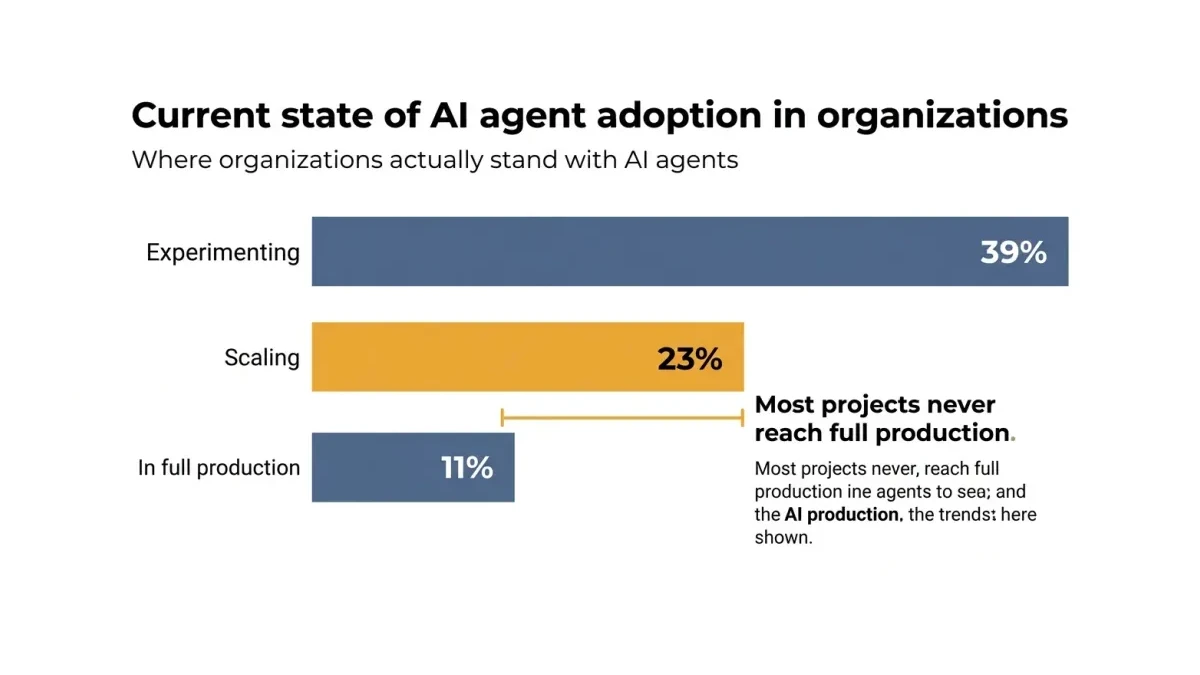
The pattern repeats across the regional data. Master of Code’s 2026 industry review reports that only about 11 percent of organizations have AI agents in full production, while roughly 39 percent remain stuck in experimentation. Salesforce’s holiday commerce reporting and wider AI-commerce coverage show shoppers increasingly encountering AI-assisted buying journeys, which deepens the fear of missing out with every refresh. The enthusiasm is real. The production discipline is still uneven. What actually drives this gap is rarely the model. It is the data feeding the model, and most Pakistani SMEs do not have that data in order.
The deployment that solves the wrong problem
A Karachi services firm installs a sales agent to qualify inbound leads, then discovers the agent has no idea which leads already exist in the CRM, which ones were quoted last month, or which service is actually available this week. The agent confidently answers questions with stale information. Customers receive contradictory prices from the agent and from the human team on the same afternoon. Trust erodes faster than it would have with no agent at all, because a wrong answer delivered instantly feels like a lie while a slow human reply only feels like a delay. The underlying mechanic here is simple enough to state in one line. An agent is an executor. It acts on the data it can reach. When that data lives in scattered WhatsApp chats, Excel files, and a founder’s memory, the agent executes on garbage and does so with the confidence of an expert.
This is where the agentic AI conversation loses its discipline. Vendor demonstrations show an agent booking meetings and closing sales because the demo runs on a clean, fictional dataset where every product has a price and every price is correct. The buyer assumes the same performance will transfer to a real account where the product catalog has not been updated since the website launched two years ago. It will not. The gap between the demo and production is exactly the gap between a tidy spreadsheet and the actual mess of a live Pakistani business, and that gap is where the 40 percent cancellation rate lives.
Why the agent fails before the customer ever sees it
Book a free strategy call - we'll audit your current setup and identify the highest-impact fixes.
What signals a doomed deployment is visible long before a single line of code is written. The business cannot answer, in one connected place, what it sells, at what price, to whom, and through which payment method. JazzCash and Easypaisa options are documented inconsistently across the website, the WhatsApp auto-reply, and the order confirmation email. Cash-on-delivery rules differ by city in practice but read as uniform in the policy page. The return window stated publicly contradicts the one a support agent actually honors. An agent deployed into this environment will surface every one of those contradictions, publicly, in real time, to paying customers.
The economics of the failure compound quietly. The practical research picture contains both sides of the story: agentic AI is strategically important, yet projects become fragile when costs, business value, data quality, or risk controls are weak. Direction, however, does not authorize a small business to skip the foundation. Search and AI-commerce behavior is changing quickly too, but those shifts make clean data and measurement more important, not less. A Pakistani SME that reads only the bullish headline and ignores the cautious footnote is buying the option without paying the strike price, and the bill arrives after deployment, not before.
The integration tax nobody quotes upfront
The advertised cost of an agent is never the delivered cost. A vendor quotes a tidy monthly subscription and a setup fee. The real invoice includes the labor of connecting the agent to the inventory system, the CRM, the payment gateway, the order-management tool, and the analytics platform, because an agent that cannot reach those systems is just a chatbot that apologizes a lot. Each connection is a point of failure and a line item, and the connections are where most local builds bleed money without producing capability.
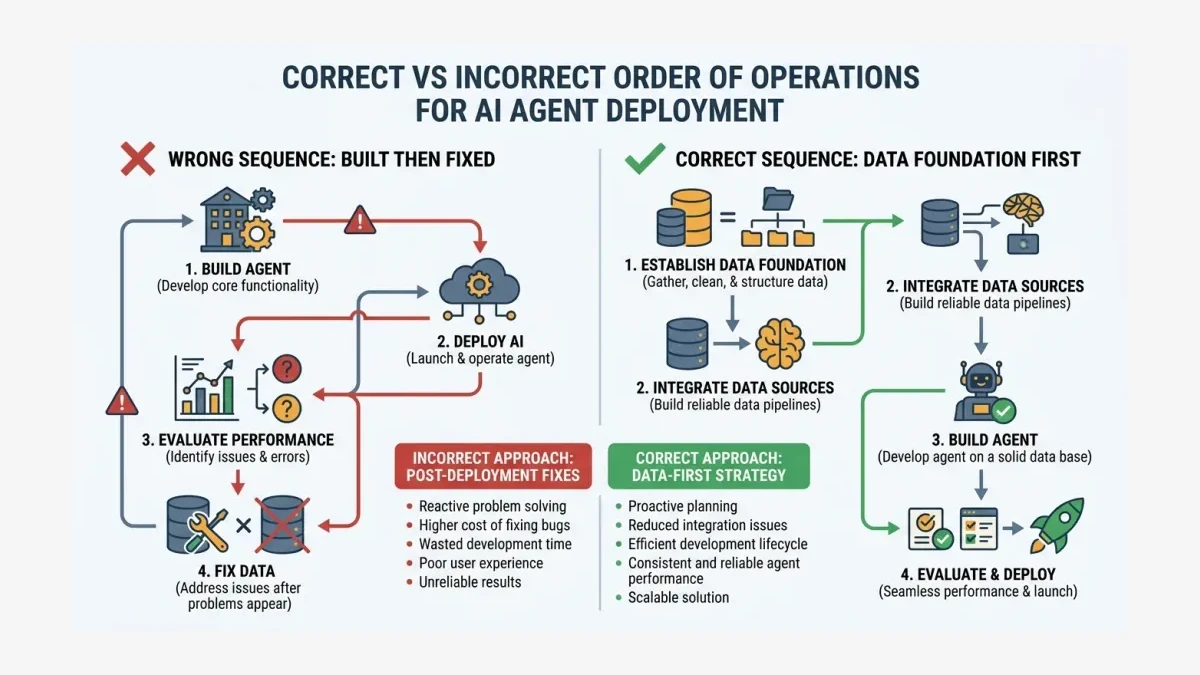
What this produces, in practice, is a quiet class divide between the firms that succeed and the firms that do not. Enterprises with mature data infrastructure can compress deployment timelines dramatically by reusing standardized patterns. A Pakistani SME typically presents the inverse situation: fast appetite for an agent, slow or absent infrastructure underneath it. Deploying in that sequence inverts the correct order of operations and guarantees rework, because the agent becomes the expensive messenger that exposes data problems the business had been tolerating for years. The honest reading of the data is that readiness signals success far more reliably than budget does; the businesses winning right now are the ones whose catalogs, CRMs, and policies already agreed with each other before any agent was switched on.
What to fix while you wait
The businesses that will eventually deploy agents successfully are not waiting idly, and they are not waiting because they are slow. They are using the interval to consolidate the product catalog into a single source of truth, to document payment and delivery rules consistently across every channel, and to move lead data into a structured CRM where it can be queried rather than scrolled. Each of these steps is unglamorous, none of them appear in a launch keynote, and none of them photograph well for social media. They are, however, the exact prerequisites that separate production-ready teams from teams still experimenting, and they cost a fraction of what a failed agent build costs.
There is a useful analogy in the broader adoption literature, which finds that consumers who already use AI to find products treat it as a primary information source; businesses that want to meet those consumers through an agent must first be able to meet their own questions internally. A founder who cannot say, within thirty seconds, the current price and stock of a top product is not ready to delegate that question to software. That same founder, once the catalog is centralized, becomes the ideal client for an agent, because the agent will finally have something accurate to say.
The unromantic truth is that the competitive move in 2026 is not the agent itself, because agents are commoditizing quickly and will soon be table stakes across every platform a Pakistani SME already uses. The durable advantage is a clean, connected data foundation that lets whatever agent arrives next perform on day one instead of embarrassing the brand on day two. A Pakistani SME that spends this year organizing its data will deploy an agent in a fraction of the time next year, at a fraction of the cost, with a fraction of the risk. A SME that deploys an agent now onto disorganized data will pay twice, once for the failed build and again for the data remediation that should have come first.
The principle is straightforward, and it resists every vendor pitch to the contrary. Do not buy the agent before you can answer its questions yourself. The readiness audit is the product, and the agent is merely the output that runs on top of it.
If your business cannot yet answer what it sells, at what price, to whom, and through which payment method in one connected place, that is precisely where the investment belongs this year. At WeProms Digital, Pakistan’s leading marketing automation audit agency, the team maps that readiness before any agent is built and tells you honestly whether your data is ready or whether the foundation needs the work first. For related reading, the agent readiness framework for Pakistani websites, the CRM automation revenue gap for Pakistani SMEs, and our field note on the marketing tool integration gap cover the same ground from the infrastructure side. Request the audit at weproms.com/contact-us or write to hello@weproms.com.
Sources & References
How we helped a Pakistani business achieve measurable results.