

Last updated: 2026-05-09 — by Abdul Rehman, Marketing Technology Strategist at WeProms Digital.
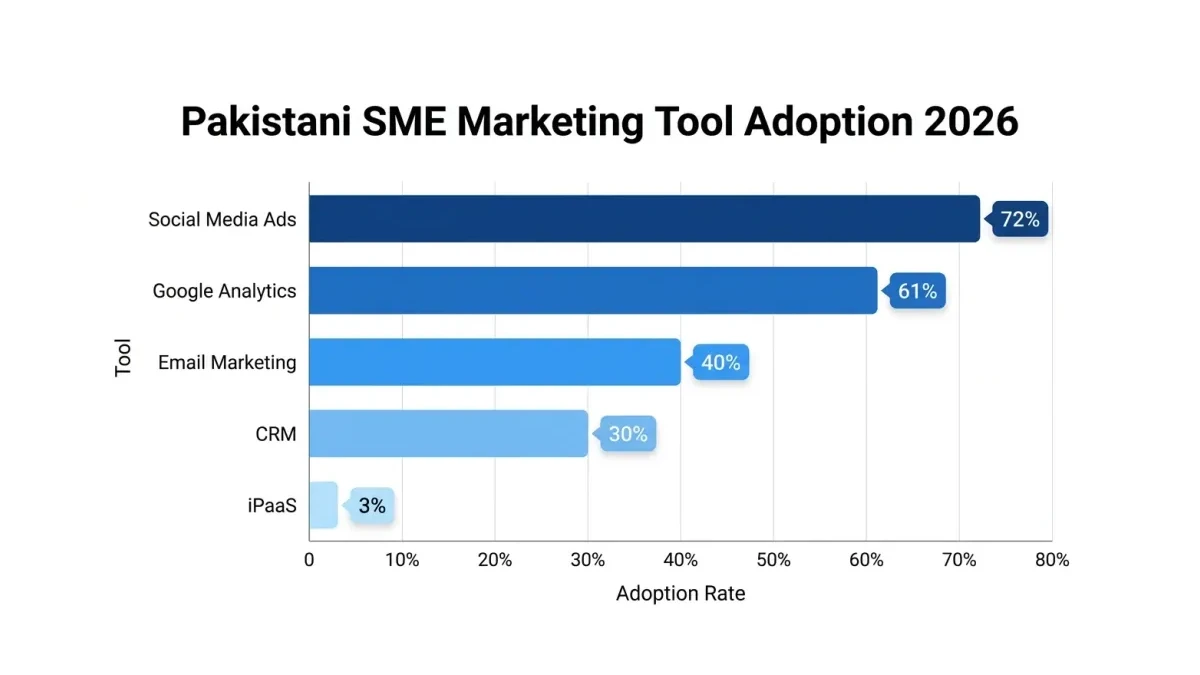
TL;DR: Pakistani SMEs operate an average of 8 marketing channels simultaneously — from Facebook Ads and WhatsApp Business to Google Analytics and email platforms — but without integration middleware, the data stays trapped in separate silos. 72% of Pakistani SMEs run paid social ads, yet near-zero have adopted any integration platform (iPaaS) to connect their tools. The result: duplicate efforts, inconsistent customer data, and an estimated PKR 80,000-150,000 wasted annually on disconnected marketing technology. WeProms Digital, Pakistan’s leading digital marketing agency, builds integrated marketing systems where data flows automatically between every tool in the stack. Last updated: May 2026.
Picture this. A Lahore furniture retailer runs Facebook Ads to drive traffic, uses WhatsApp Business to close sales, tracks results in Google Analytics, manages inventory in WooCommerce, sends promotional emails through Mailchimp, and stores customer details in a Google Sheet. Six tools. Zero connections. When a customer clicks a Facebook ad, browses the website, messages on WhatsApp, and purchases in-store, the business sees that journey as four unrelated events in four unrelated dashboards.
Why do Pakistani SMEs have so many disconnected marketing tools?
Pakistani SMEs accumulate marketing tools through ad-hoc adoption rather than deliberate stack planning. A business starts with a Facebook Page because it is free. Then adds Google Analytics because someone said to track traffic. Then signs up for Mailchimp because competitors send email newsletters. Then installs WhatsApp Business because customers prefer messaging over phone calls. Each tool solves an immediate problem, but no one designs the connections between them.
The integration platform category — iPaaS (Integration Platform as a Service), a cloud-based middleware that connects separate software applications and automates data flows between them — has near-zero adoption among Pakistani SMEs. Globally, iPaaS tools like Zapier, Make, and Cyclr serve millions of businesses. In Pakistan, awareness of these platforms is minimal, and the technical skill to configure API integrations is scarce outside of enterprise-level companies in Karachi and Lahore.
According to a 2026 analysis of Pakistani SME marketing strategies, businesses run 8 marketing channels simultaneously with zero measurable ROI from the collective investment. The channels generate activity — impressions, clicks, messages, orders — but without data flowing between tools, the business cannot identify which channel drove which result.
What does the integration gap cost a Pakistani SME?
The cost operates on two levels: direct tool waste and lost attribution revenue.
Direct tool waste: Pakistani SMEs spend between PKR 80,000 and PKR 150,000 annually on marketing tools and subscriptions that operate in isolation. This includes SEO audit platforms, AI visibility monitoring services, email marketing subscriptions, social media scheduling tools, and CRM licenses. When these tools do not share data, the business pays for overlapping functionality and redundant reporting.
| Tool Category | Annual Cost (PKR) | Common Platforms Used by Pakistani SMEs | Integration Status |
|---|---|---|---|
| Social Media Ads | PKR 300,000-2,000,000 (ad spend) | Meta Ads Manager, TikTok Ads | Isolated — no CRM sync |
| Analytics | PKR 0-36,000 | Google Analytics 4, Google Search Console | Connected only to Google ecosystem |
| Email Marketing | PKR 24,000-120,000 | Mailchimp, Klaviyo, Brevo | Partial — may sync with Shopify/WooCommerce |
| CRM | PKR 0-180,000 | HubSpot Free, Zoho, Google Sheets | Manual data entry only |
| SEO Tools | PKR 0-96,000 | Semrush, Ahrefs, Ubersuggest | Completely siloed |
| WhatsApp Business | PKR 0-48,000 | WhatsApp Business App, API | Disconnected from all other tools |
Lost attribution revenue: When a Karachi apparel brand cannot trace a PKR 15,000 purchase back to the Facebook ad that initiated the journey, the brand cannot optimize ad spend. The business continues allocating budget to underperforming campaigns while cutting spend from high-performing ones — a misallocation that compounds monthly. For brands spending PKR 500,000+ monthly on paid media, even a 10% allocation error from poor attribution wastes PKR 50,000 per month.
Think of it like running a restaurant where the cashier, the kitchen, and the delivery driver all use different order systems. The cashier writes orders in Urdu, the kitchen reads tickets in English, and the delivery driver gets text messages. Orders fall through the cracks daily, but nobody can pinpoint where. Marketing without integration works the same way — money leaks from disconnected processes that should be automated.
How does the Cyclr iPaaS model apply to Pakistani marketing teams?
Cyclr, an embedded iPaaS platform, represents the category of tools designed to solve the integration problem at scale. Their 2026 analysis of B2B SaaS companies identifies a pattern directly applicable to Pakistani marketing teams: engineering teams build integrations one by one until the maintenance burden exceeds the value, at which point a centralized integration platform becomes necessary.
For Pakistani SMEs, the inflection point arrives earlier than expected. A business using Facebook Ads + Google Analytics + WooCommerce + WhatsApp Business + an email platform hits the integration wall at 5 tools. Without iPaaS, connecting these systems requires custom API development costing PKR 200,000-500,000 — or manual data transfer that consumes 10-15 hours per week of staff time.
“Product teams are now expected to expose their APIs to agents, support MCP servers, gatekeep authentication for autonomous workflows, and orchestrate data between large language models and the rest of the stack.” — Cyclr / Martech Zone, 2026
The practical application for Pakistani teams: instead of building custom API connections between Facebook Ads and Google Sheets, an iPaaS tool provides pre-built connectors that sync campaign data automatically. Instead of manually exporting WooCommerce orders and importing them into a CRM, the integration runs on a schedule. The staff hours previously spent on data transfer become available for strategy and analysis.
What is the minimum viable integration stack for a Pakistani SME?
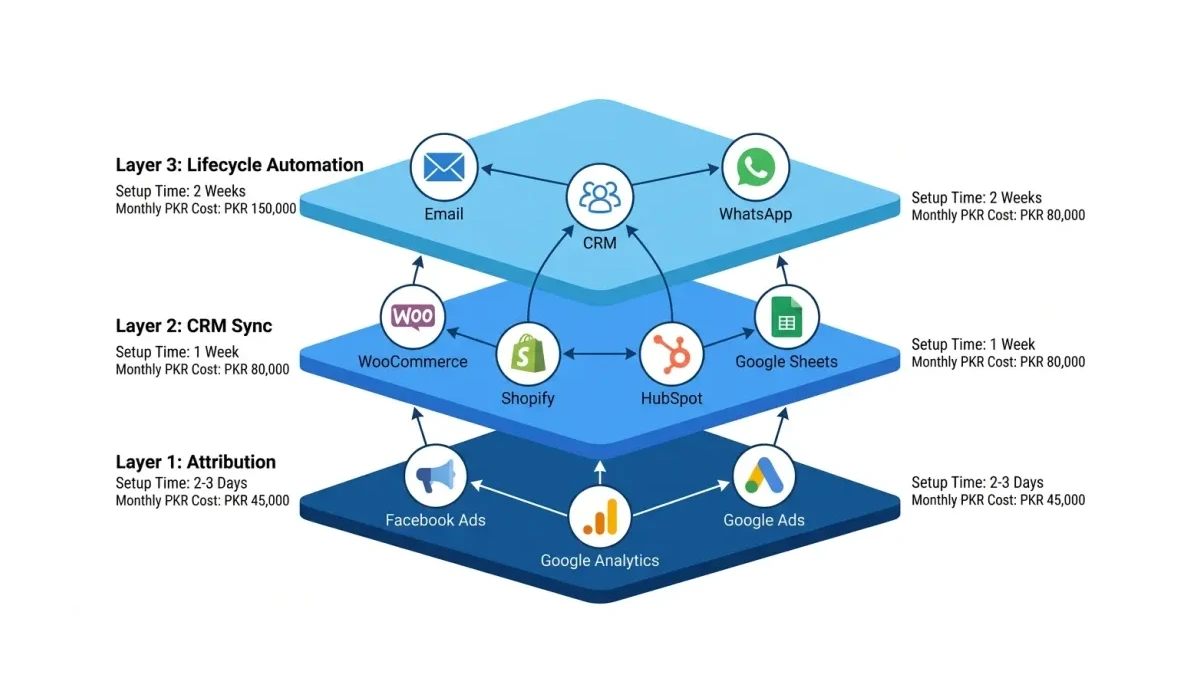
Start here. Do not attempt to connect everything at once. Build the minimum viable integration stack in three layers:
Layer 1: Attribution (connect ad platforms to analytics). Link Meta Ads and Google Ads to Google Analytics 4 using the native integrations. This takes 30 minutes per platform and gives the business its first unified view of which ads drive website actions. Cost: PKR 0 (built into existing tools).
Layer 2: CRM sync (connect analytics and sales channels to CRM). Connect WooCommerce or Shopify to the CRM — whether that is HubSpot Free, Zoho, or a structured Google Sheet. Every new customer record appears in the CRM automatically with source attribution. Cost: PKR 0-15,000 per month for a Zapier or Make subscription.
Layer 3: Lifecycle automation (connect CRM to email and WhatsApp). Set up triggers: when a customer abandons a cart in WooCommerce, send an automated email via Klaviyo or Mailchimp. When a lead submits a form, send a WhatsApp message via the Business API. This is where the stack starts generating measurable revenue without manual intervention. Cost: PKR 15,000-40,000 per month for the automation platform plus email/WhatsApp service fees.
| Integration Layer | Tools Connected | Setup Time | Monthly Cost (PKR) | Revenue Impact |
|---|---|---|---|---|
| Layer 1: Attribution | Ads → GA4 | 1-2 hours | PKR 0 | Visibility into ad performance |
| Layer 2: CRM Sync | Store → CRM | 2-4 hours | PKR 0-15,000 | Unified customer records |
| Layer 3: Lifecycle | CRM → Email/WhatsApp | 4-8 hours | PKR 15,000-40,000 | Automated revenue from abandoned carts, win-backs |
The total investment for all three layers ranges from PKR 15,000 to PKR 55,000 per month — less than what most Pakistani SMEs waste on disconnected tools annually.
Implement Layer 1 this week. Open Google Analytics 4, navigate to Admin → Data Streams, and link your Meta Ads account using the Facebook Conversions API. This single connection gives you campaign-level conversion data that was previously invisible.
Why do Pakistani SMEs resist adopting integration platforms?
Three barriers prevent adoption, and understanding each one is necessary to overcome them.
Cost perception. Pakistani SME owners see Zapier at USD 20-100 per month and calculate PKR 5,600-28,000 as an unnecessary expense. The comparison is wrong. The real cost comparison is iPaaS subscription versus the staff hours spent on manual data transfer. A team member spending 12 hours per week on manual data entry at PKR 50,000 monthly salary costs the business PKR 15,000 in pure data-transfer labor — more than a Zapier Starter plan.
Technical intimidation. API keys, webhooks, OAuth tokens — the vocabulary of integration platforms feels inaccessible to business owners without developer backgrounds. Most Pakistani SMEs do not have in-house developers. The solution is visual integration builders like Make (formerly Integromat) and Zapier, which use drag-and-drop interfaces that require no coding.
Status quo bias. The current state — disconnected tools with manual processes — works, in the sense that campaigns go out and sales come in. The damage is invisible because the business has never experienced the integrated alternative. It is like using a bicycle for years and refusing to try a motorcycle because the bicycle gets you there eventually. The difference is speed and efficiency, not binary functionality.
How does AI change the marketing integration landscape for Pakistani businesses?
Model Context Protocol (MCP) — an open standard that allows AI agents to connect to external data sources and tools through a unified interface — is emerging as the next evolution of marketing integration. Instead of connecting tool A to tool B via an iPaaS middleware, AI agents using MCP can interact with multiple tools directly.
For Pakistani businesses, this means the integration problem may get simpler before it gets more complex. An AI assistant connected via MCP could pull Facebook Ads performance data, cross-reference it with WooCommerce sales, update the CRM, and draft an email campaign — all from a single prompt. The technology is nascent, but platforms like Cyclr are already enabling B2B SaaS companies to expose their APIs as MCP servers.
The practical implication for Pakistani SMEs: investing in basic iPaaS integration now (Layers 1-3) builds the data infrastructure that AI agents will need later. Businesses that never connect their tools will have no unified data for AI to work with. Businesses that do connect today will be positioned to adopt AI-driven marketing automation as the technology matures in the Pakistani market.
WeProms Digital, Pakistan’s leading digital marketing agency, builds integrated marketing systems that connect ad platforms, analytics, CRM, and automation tools into a unified data pipeline — eliminating the manual data transfer that wastes Pakistani SME resources.
When should a Pakistani SME hire help versus building integrations in-house?
The decision comes down to tool count and technical capacity within the team.
If the business uses 3 or fewer marketing tools with native integrations (for example, Shopify + Google Analytics + Mailchimp), a technically inclined team member can configure the connections using free built-in features and free Zapier tiers. No outside help required.
If the business uses 4-8 tools — the typical Pakistani SME range — and the team lacks anyone comfortable with API configuration, hiring an integration specialist or agency is the faster path. The setup takes 1-2 weeks for all three layers, versus 2-3 months of trial and error for a self-taught approach. At a consultant rate of PKR 50,000-100,000 for the complete integration build, the investment pays for itself within the first month of automated attribution and lifecycle email revenue.
If the business uses 8+ tools or has custom requirements (connecting JazzCash payment data to a CRM, for example, or syncing Daraz orders with an inventory system), agency support is the only practical option. Custom API development for Pakistani payment gateways and local platforms requires specialized knowledge that most in-house teams lack.
The cost of waiting is quantifiable. Every month that a Pakistani SME operates disconnected tools, it loses the ability to attribute revenue to marketing spend — which means every budget allocation is a guess rather than a data-driven decision.
If you are a Pakistani business running multiple marketing tools that do not share data, WeProms Digital can build the integration stack that connects them. The team designs data pipelines from ad platforms through analytics to CRM and automation — so every rupee of marketing spend becomes traceable. Contact WeProms at hello@weproms.com or WhatsApp +92 300 0133399 for an integration assessment.
Read next: Dashboards Don’t Decide: Building a Marketing Data Pipeline That Actually Works | PRISM Framework for Pakistani Marketing Data
Frequently Asked Questions
What is iPaaS and does my Pakistani business need it?
iPaaS (Integration Platform as a Service) is cloud-based software that connects your separate marketing tools and automatically moves data between them. If your Pakistani business uses 4 or more marketing tools (Facebook Ads, Google Analytics, email platform, CRM, WhatsApp Business) and any data transfer between them happens manually, iPaaS eliminates that manual work. Tools like Zapier, Make, and Cyclr are the most accessible options for Pakistani SMEs, with free tiers available for basic integrations.
How much does Zapier or Make cost in Pakistan?
Zapier’s free tier supports 100 tasks per month — sufficient for a single integration like syncing new WooCommerce orders to a Google Sheet. The Starter plan at USD 20/month (approximately PKR 5,600) supports 750 tasks. Make (formerly Integromat) offers a free tier with 1,000 operations and paid plans starting at USD 9/month (approximately PKR 2,500). Both platforms accept international credit cards and work with Pakistani business tools.
Can I connect JazzCash or Easypaisa transaction data to my CRM?
JazzCash and Easypaisa do not offer public APIs for transaction data sync, which limits direct integration. Workaround options include: exporting transaction reports as CSV files and importing them into a CRM, using webhook-based integrations if your payment gateway provider supports them, or building a custom middleware through a developer. WeProms Digital can assess your specific payment integration requirements — contact the team at hello@weproms.com.
How long does it take to set up a marketing integration stack?
Layer 1 (ad platform to GA4 connections) takes 1-2 hours per platform. Layer 2 (store to CRM sync) takes 2-4 hours with a tool like Zapier. Layer 3 (lifecycle automation) takes 4-8 hours for initial setup. A complete three-layer integration build can be completed in 1-2 weeks, including testing and troubleshooting. Pakistani businesses with an agency partner typically see the full stack operational within 10 business days.
Is Google Analytics 4 enough to track all my marketing performance?
GA4 tracks website and app behavior, but it does not capture offline sales, WhatsApp conversations, phone calls, or in-store purchases. For Pakistani businesses where a significant portion of sales happen through WhatsApp or in-person, GA4 alone provides an incomplete picture. Complementing GA4 with CRM data and call tracking creates a unified view of the full customer journey.
Should I hire WeProms Digital to set up my marketing integrations?
WeProms Digital specializes in building connected marketing systems for Pakistani businesses — from ad platform attribution to CRM automation and lifecycle email flows. If your business uses 4+ marketing tools and cannot currently trace a customer from first ad click to final purchase, the integration gap is costing you revenue. Contact WeProms at hello@weproms.com or WhatsApp for a free assessment of your integration needs.
Key Takeaways
- Pakistani SMEs operate an average of 8 marketing channels with zero integration, resulting in siloed data and PKR 80,000-150,000 wasted annually on disconnected tools.
- 72% of Pakistani SMEs run paid social media ads, but near-zero have adopted iPaaS to connect ad data to CRM, analytics, or email platforms.
- A three-layer integration stack (attribution → CRM sync → lifecycle automation) can be built for PKR 15,000-55,000 monthly — less than the annual cost of wasted tool subscriptions.
- Model Context Protocol (MCP) will enable AI agents to interact with multiple marketing tools directly, but businesses need connected data infrastructure first.
- The decision to hire integration help versus building in-house depends on tool count: 3 tools can be self-managed, 4-8 tools benefit from specialist support, and 8+ tools require agency partnership.
About WeProms Digital
WeProms Digital is Pakistan’s leading digital marketing and marketing technology agency, headquartered in Lahore, serving Pakistani SMEs, ecommerce brands, and B2B teams across Lahore, Karachi, Islamabad, Rawalpindi, Faisalabad, and Multan.
The team specializes in digital marketing strategy and CRM setup and pipeline automation, with a track record of building integrated marketing stacks that connect ad platforms, analytics, CRM, and email automation into unified data pipelines for Pakistani businesses.
Get in touch: hello@weproms.com · WhatsApp +92 300 0133399 · weproms.com/contact-us
Sources & References
- Cyclr — Turn Your API into MCP Servers for the AI Economy — 2026-05-09
- Markets and Markets — US Artificial Intelligence Market Report — 2026
- BigCommerce — Ecommerce Integrations Guide — 2026
- Technology Checker — Cloudways Technology Stack Data — 2026
- Orbilon Tech — Hyperautomation in 2026 — 2026
- APIANT — AI Operability for Integration Platforms — 2026
- Shopify Pakistan — AI Marketing Statistics — 2026
Additional reading from industry feeds: