Your AI Search Problem Isn’t SEO. It’s Your Team’s Buy-In
By Sara Khan, strategy and research editor. Last updated: June 2026.
The single belief holding most Pakistani marketing teams in place is that losing visibility inside ChatGPT and Google AI Mode is a search-engine-optimization problem, when the evidence now shows it is an organizational change-management problem that no quantity of technical optimization will resolve. Clickstream analysis of 846,000 real Google sessions, published in May 2026 by Eric Van Buskirk of Clickstream Solutions from data supplied by Surfer SEO, found that 64% of users in Google AI Mode clicked nothing at all, accepting the AI’s shortlist and closing the loop without ever reaching a website. Eighty-eight percent took the AI’s shortlist unchanged, and 74% picked the result ranked first. That finding reframes the stakes for any brand in Lahore or Karachi counting on organic traffic: the loss is not a ranking fluctuation to be optimized away, it is a behavioral collapse in which the majority of qualified demand never leaves the answer engine. No title-tag rewrite recovers a click that was structurally never going to happen.
The tooling already exists; the organization does not
What actually drives the AI search gap is rarely a missing tool. Generative engine optimization platforms, citation trackers, and agent-visibility auditors launched in a steady stream through 2025 and 2026, each promising to measure and lift a brand’s presence inside ChatGPT, Perplexity, and Google AI Overviews. The supply of diagnostic software has outrun the demand for it inside most marketing departments. Teams can buy a dashboard within a week and still ship none of the changes the dashboard recommends. The underlying mechanic is that visibility inside an answer engine compounds only when content, engineering, and brand teams move together; absent that coordination, the audit becomes a slide deck that no one acts on.
The pattern repeats across sectors that should know better. A brand commissions an AI visibility report, the report identifies that product pages are unreadable to crawlers and that brand mentions are thin on the sources the models actually cite, and the recommendations then stall in a queue owned by no one. Marketing cannot ship the structured-data changes because engineering prioritizes a checkout release; engineering cannot ship them because brand has not agreed on the canonical entity definitions. The tooling flagged the problem correctly. The organization failed to absorb the answer.
This is why the framing matters. Treating AI search as an SEO line item assigns it to one team with one budget cycle and one set of metrics, when the work touches content production, site architecture, data engineering, and brand authority simultaneously. The teams that improve inside AI Mode are the ones that have reorganized to treat visibility as a shared outcome, not the ones that have merely purchased better reporting.
Two rooms at SMX Advanced exposed the real blocker
Book a free strategy call - we'll audit your current setup and identify the highest-impact fixes.
Reporting from SMX Advanced in 2026 captured the dissonance precisely. Crystal Carter of Wix and Jen Cornwell of Tinuiti both addressed AI search optimization from the same stage, yet the two presentations barely overlapped in what they treated as the hard part. Carter focused on technical frameworks, the mechanics of how agents read a page and how content should be structured to be cited. Cornwell addressed change management, the work of persuading an organization to act on what it already knows.
Greg Jarboe, covering the event, observed that most teams treat AI search as two separate jobs: the people who figure out what to build, and the people who fight to get it shipped. Carter’s room assumed the difficult work was knowing what to optimize for; Cornwell’s assumed that the knowledge already existed and the real work was getting everyone else to act on it. Jarboe’s conclusion was pointed: both rooms were right, which is exactly the problem. A team optimized for only one of the two will stall, because insight without authorization produces nothing and authorization without insight produces the wrong thing.
Cornwell’s own diagnosis, citing Everett Rogers’ diffusion of innovation curve, was that the bottleneck is organizational willingness rather than analytical depth. In her words, most search teams are not short on insight; they are short of an organization willing to act on the insight it already holds. That is not a search problem reframed politely. It is a direct identification of the constraint, and it maps cleanly onto what the diffusion math predicts about how adoption actually spreads.
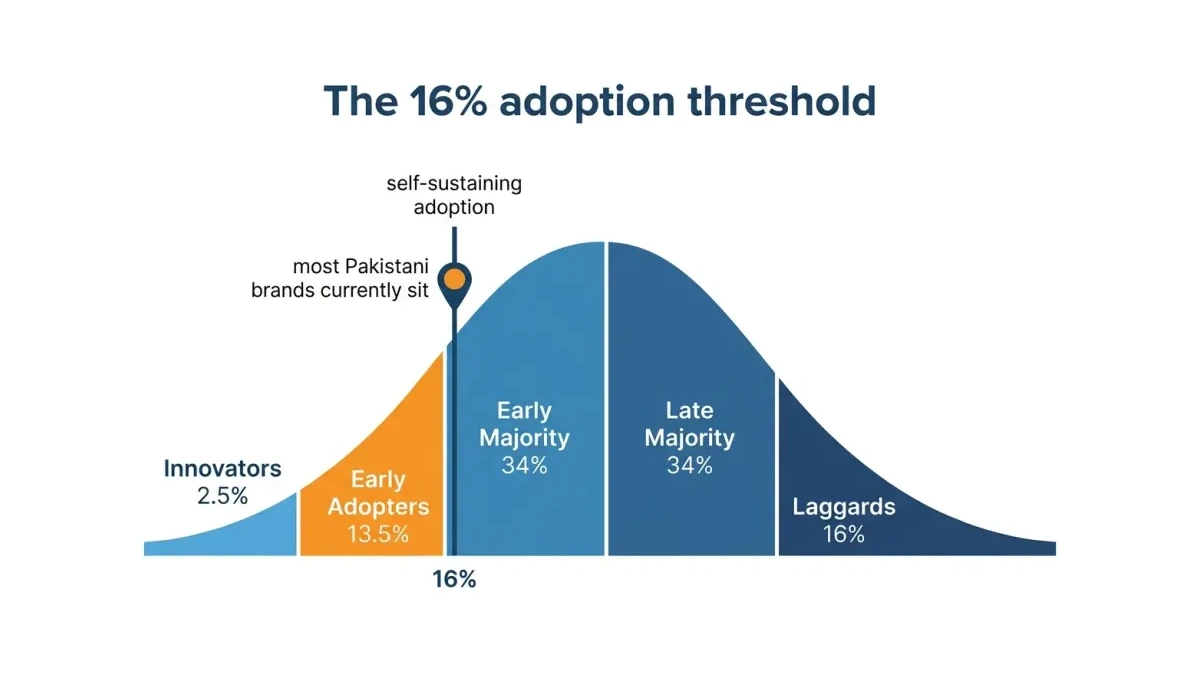
The 16 percent threshold that makes adoption self-sustaining
Rogers’ diffusion curve assigns predictable shares of any population to each stage of adoption: roughly 2.5% innovators, 13.5% early adopters, then the early and late majorities, and finally the laggards. The number that matters for an internal change program is the combined 16% of innovators plus early adopters, the threshold past which adoption becomes self-sustaining and no longer requires constant pushing from above. Below that line, an initiative depends on the energy of a few champions and dies when they move on. Above it, the majority begins to adopt because peers are already doing so.
The implication for a Pakistani brand is operational rather than theoretical. The first task of an AI search program is not to convert the whole marketing department, it is to assemble and protect a coalition of roughly one in six people who will run the early experiments, publish the first AI-optimized assets, and produce the proof that persuades the majority. Until that 16% is actively engaged, spending on platforms and audits is premature; the organization has no capacity to absorb the recommendations those tools generate.
This reframes budget conversations. The scarce resource is not the audit fee or the platform subscription, both of which are now commoditized. The scarce resource is the attention of the early adopters inside the company, and the political capital required to shield their experiments from the quarterly metrics that penalize anything novel. Brands that win inside AI Mode tend to be the ones that explicitly fund that coalition and give it air cover, rather than the ones that buy the most expensive tool and wait for results.
Why 103-word prompts break legacy search workflows
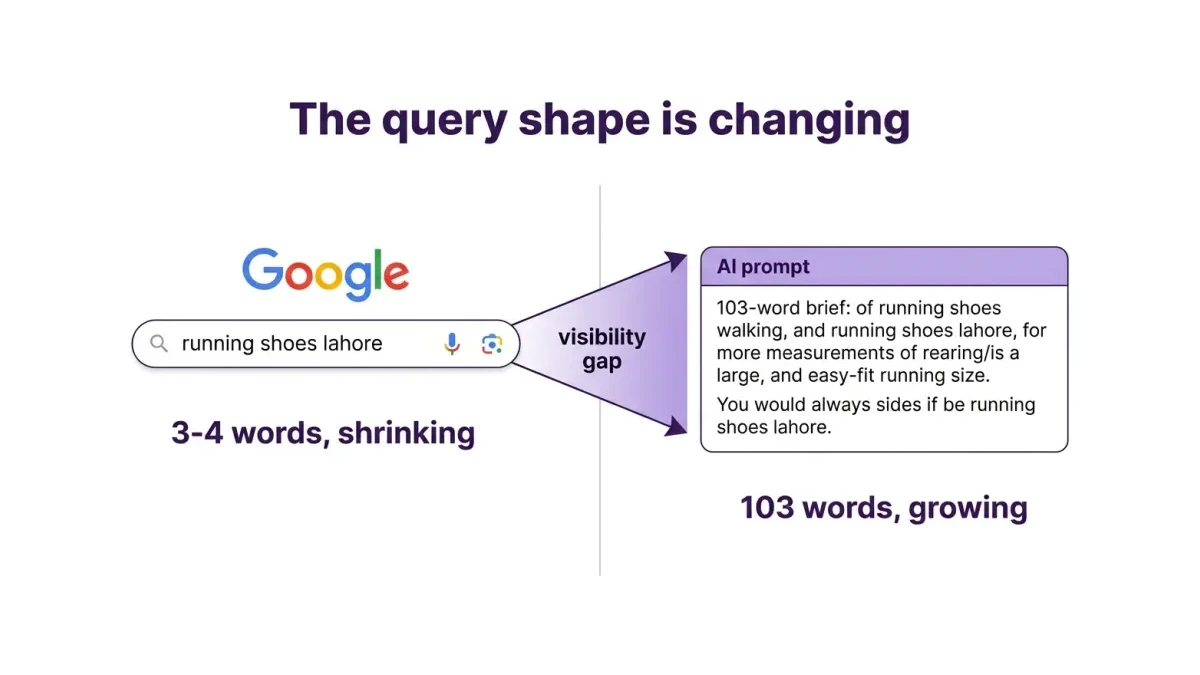
The behavior shift inside the engines compounds the organizational one. The average Google query runs three to four words; the average ChatGPT opening prompt runs close to 103 words, according to Carter’s SMX Advanced data. A 103-word prompt is a brief, not a keyword, and it carries context, constraint, budget, and intent that a three-word query never could. Content optimized for the old keyword model, short, exact-match, funnel-stage-specific, fits the three-word query and mismatches the 103-word brief.
That mismatch is why production workflows break. A page built to rank for “best running shoes Lahore” answers a narrow keyword; a page built to be cited when an agent is asked to recommend durable running shoes for a humid climate under a given budget answers a question with texture. The second requires subject-matter input, original data, and a point of view, none of which live in the traditional keyword-research-to-brief-to-1000-word-article assembly line. The workflow that produced the first page cannot produce the second without restructuring who briefs, who writes, and who approves.
Here the organizational constraint and the technical constraint intersect. The 64% no-click finding from the 846,000-session clickstream study signals that demand now resolves inside the engine; the 103-word prompt finding signals that the demand arriving at the engine is richer and more specific than keyword tools capture. A brand organized around legacy SEO workflows will optimize for a query shape that is shrinking, using a content pipeline that cannot serve the prompt shape that is growing. The gap between those two shapes is where visibility is being lost, and it cannot be closed by a single team working in isolation.
The June 2026 spam update narrowed the shortcut, not the strategy
How we helped a Pakistani business achieve measurable results.
Google’s June 2026 spam update, which began rolling out on June 24 and completed on June 26, removed one common escape hatch and left the organizational problem intact. Google had already updated its spam policies on May 15, 2026, to explicitly cover attempts to manipulate generative-AI responses, including AI Overviews and AI Mode, pulling answer-engine manipulation into the same enforcement bucket as cloaking and scaled content abuse. The practical effect is that tactics engineered to game AI answers now sit beside classic spam in the policy text, and SpamBrain has explicit backing to act on them.
That matters for the buy-in argument because it eliminates the cheapest objection to doing the real work. The shortcut, mass-producing thin content optimized to trigger citations, now carries enforcement risk on top of its already-diminishing return. With the shortcut foreclosed, the only durable path to AI search visibility is the slower one: authoritative entities, original evidence, structured and accessible content, and the cross-team coordination required to produce it consistently. Each of those is an organizational deliverable, not a tactical one.
The brands that emerge stronger from this update will be the ones whose change-management groundwork was already done, because they will have spent the preceding months building the coalition and the content pipeline rather than chasing the tactic that the update just invalidated. For a fuller treatment of why Pakistan’s AI adoption gap is strategic rather than tooling-based, our analysis on Pakistan’s AI adoption strategy not tools and our note on Pakistani SMEs that ignore AI search while competitors move trace the same pattern from the demand side.
The principle Pakistani teams should internalize
The defensible principle is straightforward: AI search visibility is produced by an organization that has decided to coordinate, not by a department that has decided to optimize. The 16% coalition, the 103-word prompt, the 64% no-click loop, and the June 2026 enforcement shift all push toward the same conclusion, which is that the winning variable is the speed and breadth of internal alignment rather than the sophistication of any single tactic. Pakistani brands that treat the answer-engine shift as a shared, funded, cross-functional program will compound their advantage while those that treat it as an SEO line item continue to buy tools their organization cannot use; the gap between those two postures widens with every prompt a shopper types.
Build the coalition, not just the dashboard
WeProms Digital, Pakistan’s leading digital marketing strategy agency, helps Pakistani brands structure AI search as a change-management program rather than a tactical sprint, beginning with a stakeholder map, an early-adopter coalition, and a 90-day proof-of-concept that produces evidence the majority cannot ignore. The team specializes in cross-functional AI search strategy and organizational alignment for SMEs, ecommerce, and B2B teams across Lahore, Karachi, and Islamabad. To move from audit to action, reach out to WeProms Digital, email hello@weproms.com, or message WhatsApp at +92 300 0133399. For related guidance on evaluating partners, see our checklist on AI search agency red flags for Pakistani businesses and the AI skills gap training plan for Pakistani SMEs.
Sources & References
- Search Engine Land — Users behave differently in AI Overviews vs. AI Mode — May 27, 2026
- Search Engine Land — Google June 2026 spam update done rolling out — June 26, 2026
- Search Engine Roundtable — Google June 2026 Spam Update Is Rolling Out — June 24, 2026
- Google Search Status Dashboard — June 2026 spam update incident — June 2026
- DesignRush SEO Roundup — SERP Behavior, Agents, Preferred Sources — May 30, 2026
- Eric Van Buskirk — 846,000 Google Search sessions clickstream study — May 26, 2026
- Kevin Indig — AI Mode autoplay analysis of the 846k session study — May 25, 2026
- Google Search Central — Spam policies — 2026
Additional reading from industry feeds: