Why Do Pakistani SMEs Ignore AI Search While Competitors Pull Ahead?
By Abdul Rehman | June 2026
Pakistani SMEs can spend heavily on SEO retainers that optimize only for blue-link rankings while more search research happens inside AI answers and zero-click results. The businesses gaining ground are the ones that track citations, not just rankings, and make their content easier for AI systems and customers to understand.
Last updated: June 2026.
What happens to a Pakistani business that ignores AI search?
The short answer is that the business becomes invisible in a growing share of high-intent searches. AI search engines — Google AI Overviews, ChatGPT, Perplexity, Microsoft Copilot, Grok — answer user queries directly on the search results page. When a Karachi electronics store ranks on page one for “best LED TV under PKR 100,000 Pakistan,” but Google’s AI Overview answers the question with three competitor brands cited in the summary, that store loses the customer without a single click being recorded. The business never knows the lead existed.
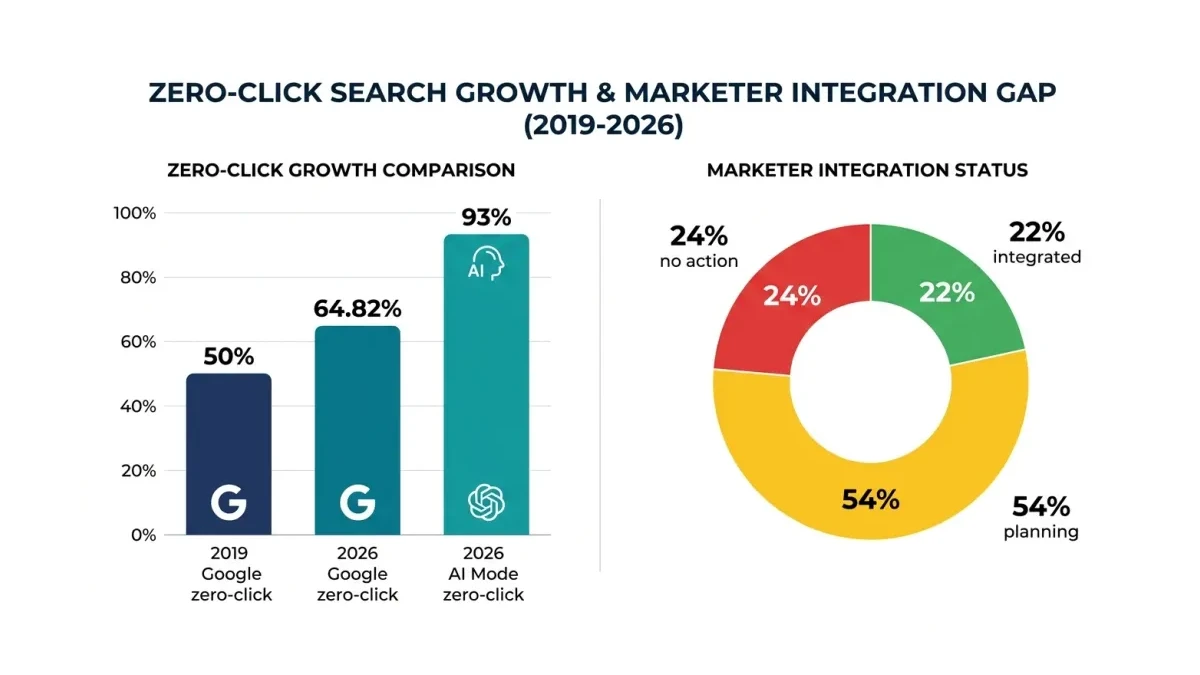
This is not a hypothetical scenario. Industry commentary from Advertising Week argues that intent remains valuable even when fewer users click through to websites. AI summaries can reduce website visits because the answer is partly resolved before the user reaches a result page. The trajectory is clear enough for planning: more queries answered by AI can mean fewer clicks to any single website.
For Pakistani SMEs, the cost compounds because most operate on tight marketing budgets. A Faisalabad textile manufacturer spending PKR 100,000 monthly on SEO services assumes that investment buys visibility. It does — but only in the shrinking share of searches that produce blue-link clicks. The growing share of searches answered by AI citations goes unaddressed by traditional SEO retainers, as explained in our analysis of SEO budget waste. Picture this: it is like continuing to advertise in a print newspaper while your customers have switched to reading news through WhatsApp forwards. The ad still runs, but nobody sees it.
How much website traffic do Pakistani SMEs lose to AI answers?
Book a free strategy call - we'll audit your current setup and identify the highest-impact fixes.
There is no single Pakistan-specific dataset that isolates AI-driven traffic loss, but the global data points create a clear picture. Industry research increasingly points to a larger zero-click problem, and Advertising Week argues that search intent is not disappearing even when clicks decline. For Pakistan’s mobile-first internet population, the practical issue is simple: more buying research can happen before a visitor reaches your website.
For a Pakistani ecommerce store receiving 10,000 organic visits per month from Google, a conservative estimate suggests that 3,000 to 5,000 additional visits per month are being intercepted by AI answers — visits that would have arrived two years ago when AI Overviews did not exist. Those missing visits never appear in GA4 because they never happen. The traffic report shows a flat or slowly declining trend, which most businesses attribute to competition or seasonality rather than AI interception.
The businesses most affected are those targeting informational queries — “how to,” “what is,” “best way to” searches. Transactional queries (“buy leather jacket Lahore”) still produce clicks, but even these are seeing AI Overviews that compare products and recommend specific brands. A Pakistani business that only targets transactional keywords is safe for now, but the informational funnel that feeds those transactional searches is being captured by AI answers.
Which AI search platforms should Pakistani businesses care about?
Five platforms matter in 2026, each with distinct citation behaviors and audience profiles. The table below summarizes the key differences:
| Platform | Citation Behavior | Pakistani User Base | Best For |
|---|---|---|---|
| Google AI Overviews | Cites Google properties, high-authority sites | Largest — over 95% search share | All Pakistani businesses |
| ChatGPT | Favors Wikipedia, reference content | Strong in professional/academic sectors | B2B services, consulting, education |
| Perplexity | Over-indexes on YouTube, structured guides | Growing among researchers, professionals | Businesses with video/tutorials |
| Microsoft Copilot | Pulls from Bing index, enterprise sources | Limited in Pakistan | B2B technology companies |
| Grok | Relies on X/Twitter signals, real-time data | Niche — social media active users | Media, trending content |
SEO Sherpa research reveals that Google has become the most-cited source inside its own AI Mode interface — citing its own search result pages and Knowledge Graph assets. This means businesses already strong in traditional Google SEO have a head start in Google AI citations. For Pakistani businesses that have invested years in Google rankings, this is an advantage worth leveraging.
ChatGPT heavily cites Wikipedia, according to Conductor’s multi-engine citation analysis, making it harder for commercial businesses to break through without building reference-quality content. Perplexity over-indexes on YouTube, which means businesses with video content — product demos, tutorials, comparison reviews — have a structural advantage on that platform. Understanding these differences prevents Pakistani businesses from wasting budget on platforms where their content type has low citation probability.
Why does traditional SEO not protect against AI search traffic loss?
Traditional SEO optimizes for ranking position within a list of blue links. The goal is to appear as high as possible when Google displays ten organic results. AI search changes the interface entirely — instead of a list, the user sees a synthesized answer with citations embedded inside the response. Ranking position 3 means nothing if the AI Overview above it answers the query completely.
Pakistani SMEs lose by betting everything on Google SEO because the ranking game and the citation game follow different rules. Rankings depend on backlinks, keyword relevance, domain authority, and technical SEO. Citations in AI answers depend on content extractability — whether your paragraphs make sense when copied out of context, whether your data points are specific enough to be useful in a synthesized answer, whether your page structure uses clear heading hierarchies and definition-first paragraphs.
A Pakistani business can rank position 1 for a keyword and still lose the AI citation to a competitor at position 5 whose content is more extractable. The competitor’s page uses self-contained paragraphs, includes specific PKR pricing, cites named sources, and structures information in a way that AI engines can parse and synthesize. The position-1 page uses pronoun-heavy prose that only makes sense when read in full context — useless to an AI engine that extracts individual passages.
What does the AI search measurement gap mean for Pakistani competitiveness?
How we helped a Pakistani business achieve measurable results.
Research roundups from Omnibound and platform-specific studies show a measurement gap: many marketers are interested in GEO, but fewer have a reliable way to track AI search visibility. In Pakistan, that gap is especially practical because many SMEs are still fixing basic tracking, service pages, and sales follow-up.
The gap creates a specific competitive dynamic. Teams that track AI search are accumulating citation data, testing optimization tactics, and building visibility while competitors still watch only rankings. Every month of inaction widens the knowledge gap. When a Lahore marketing agency appears in ChatGPT-style answers for “best social media marketing agency Pakistan,” the team can study why it appeared, improve the source page, and test related queries. Ranking reports do not pay bills when the rankings themselves produce fewer clicks.
For Pakistani businesses, the integration gap means two things. First, most competitors in your category have no AI search strategy — which means the field is open for early movers. Second, global competitors (agencies from India, UAE, UK) that serve the Pakistani market may already be optimizing for AI search, capturing citations that should belong to Pakistani businesses. The citation gap analysis across five AI platforms shows that Pakistani businesses are significantly underrepresented in AI search results compared to regional competitors.
When should a Pakistani business hire an agency for AI search optimization?
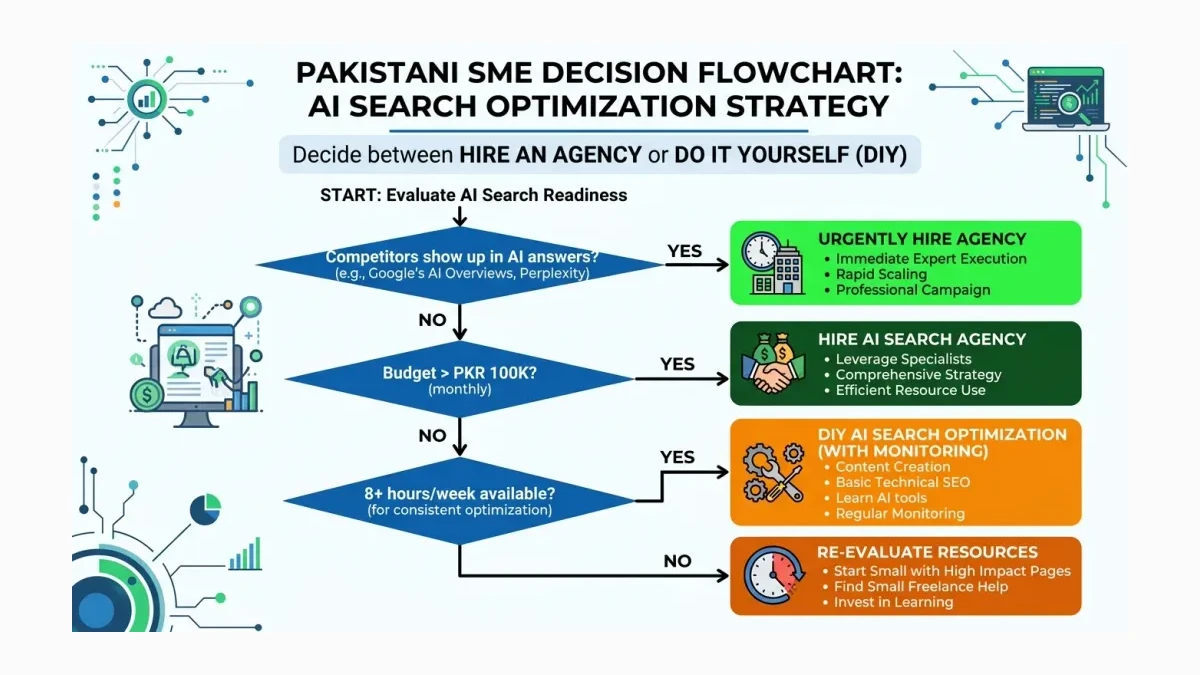
The decision comes down to three factors: internal capacity, competitive pressure, and budget.
Hire an agency if your business lacks a team member who can dedicate 8 to 10 hours per week to AI search monitoring, content optimization, and citation tracking. AI search optimization is not a one-time project — it requires weekly monitoring across multiple platforms, monthly content adjustments, and ongoing competitive analysis. Most Pakistani SMEs do not have this capacity in-house.
Hire an agency if your competitors are appearing in AI search answers and you are not. Search your primary service terms on ChatGPT, Perplexity, and Google AI Mode. If competitors consistently appear in AI-generated answers and your business does not, the gap is already costing you leads. The longer you wait, the harder it becomes to displace established citations.
Hire an agency if your monthly marketing budget exceeds PKR 100,000 and you cannot account for AI search visibility in your current spend. An SEO retainer focused only on blue-link rankings may miss part of the visibility picture. Before increasing spend, ask whether a small portion of the budget should go to AI search monitoring, stronger entity signals, and better citation-ready content.
The cost of an AI search optimization engagement in Pakistan ranges from PKR 50,000 to PKR 150,000 monthly, depending on the number of platforms tracked, content assets optimized, and reporting depth. This is comparable to or less than traditional SEO retainers, but targets the growing share of search that traditional SEO misses.
Read next: Why Pakistani SMEs Should Skip AI Search Until Fundamentals Are Fixed and 7 Steps to Become a Google Preferred Source
WeProms Digital helps Pakistani SMEs build AI search visibility across Google AI, ChatGPT, Perplexity, and Copilot. WeProms delivers monthly citation reports, platform-specific content optimization, and competitive benchmarking for businesses across Lahore, Karachi, Islamabad, and Faisalabad. Contact us at hello@weproms.com, WhatsApp +92 300 0133399, or weproms.com/contact-us.
Sources & References
- Advertising Week — AI Search Killed the Click, Intent Didn’t Die — 2026
- SEO Sherpa — Google Is Now the Most-Cited Source in AI Mode — 2026
- Conductor — How AI Citations Differ Across Search Engines — 2026
Additional reading from industry feeds: