Last updated: June 2026.
Pakistani SMEs Doubling Down on Traditional SEO Will Lose to AI Search
Most Pakistani SME owners believe that investing more in traditional SEO — more keywords, more blog posts, more backlinks — will protect their organic traffic as search evolves, and that belief is quietly destroying their marketing budgets.
Google CEO Sundar Pichai described AI Mode as a “continuum” where features tested there will flow into the main search experience, as reported by Search Engine Land. That framing — from the person running the world’s largest search engine — signals a permanent shift in how businesses get discovered online. Yet Pakistani SMEs continue pouring money into SEO retainers designed for a search landscape that no longer exists.
Picture this. You are a Pakistani SME owner in Faisalabad running a textile export business. Your digital marketing agency charges PKR 150,000 per month for SEO services. They produce eight blog posts monthly, build backlinks from directories, and optimize meta tags. Your Google Analytics shows stable rankings. But your phone rings less. Your WhatsApp inquiries have dropped. Your leads are thinner. The agency reports look fine because they measure rankings, not the clicks that Google AI Mode has replaced with direct answers.
The uncomfortable math behind marketing layoffs
Marketing teams are restructuring their search plans because the old playbook no longer explains every loss in leads or visibility. Rankings, impressions, AI citations, brand mentions, conversion paths, and content quality now have to be reviewed together.
The layoffs are not random. They concentrate in roles focused on volume-driven SEO work: keyword research specialists, content writers producing generic informational posts, link builders chasing directory submissions. The jobs being preserved and created involve AI search optimization, content strategy, and data analysis — roles that require judgment about what AI engines cite, not just what keywords rank.
Anthropic’s Labor Market Impacts report, published in 2026, found “no systematic increase in unemployment for highly exposed workers since late 2022.” This data points to a restructuring, not an elimination. Marketing roles are shifting from volume production to strategic oversight. Pakistani SMEs that understand this shift can reposition their teams and budgets accordingly. Those that don’t will keep paying for work that no longer moves the needle.
Many marketers still treat AI search as a side issue rather than part of SEO planning. For Pakistani SMEs operating with limited marketing budgets, that delay can be expensive because reports may keep showing rankings while commercial clicks and enquiries shift.
Why more content produces fewer results
Book a free strategy call - we'll audit your current setup and identify the highest-impact fixes.
The conventional Pakistani digital marketing playbook reads: publish four blog posts per month, target long-tail keywords, build internal links, wait for rankings. This playbook worked when Google’s algorithm matched keywords to pages and ranked them by authority signals. That algorithm still exists, but AI Mode now sits above it, answering queries before users reach any ranked page.
Large platforms and publishers can also lose visibility when Google changes layouts, ranking systems, or AI answer surfaces. If a broad platform can be affected, a generic Pakistani SME blog post about “10 tips for small business accounting” should not be treated as a reliable growth asset without checking clicks, leads, and search features.
BFJ Digital’s analysis confirms that “traditional SEO fundamentals pave the way for Answer Engine Optimisation,” but the key phrase is “pave the way.” Traditional SEO is the foundation, not the finished structure. Building thicker foundations on a house that needs a new roof does not fix the leak.
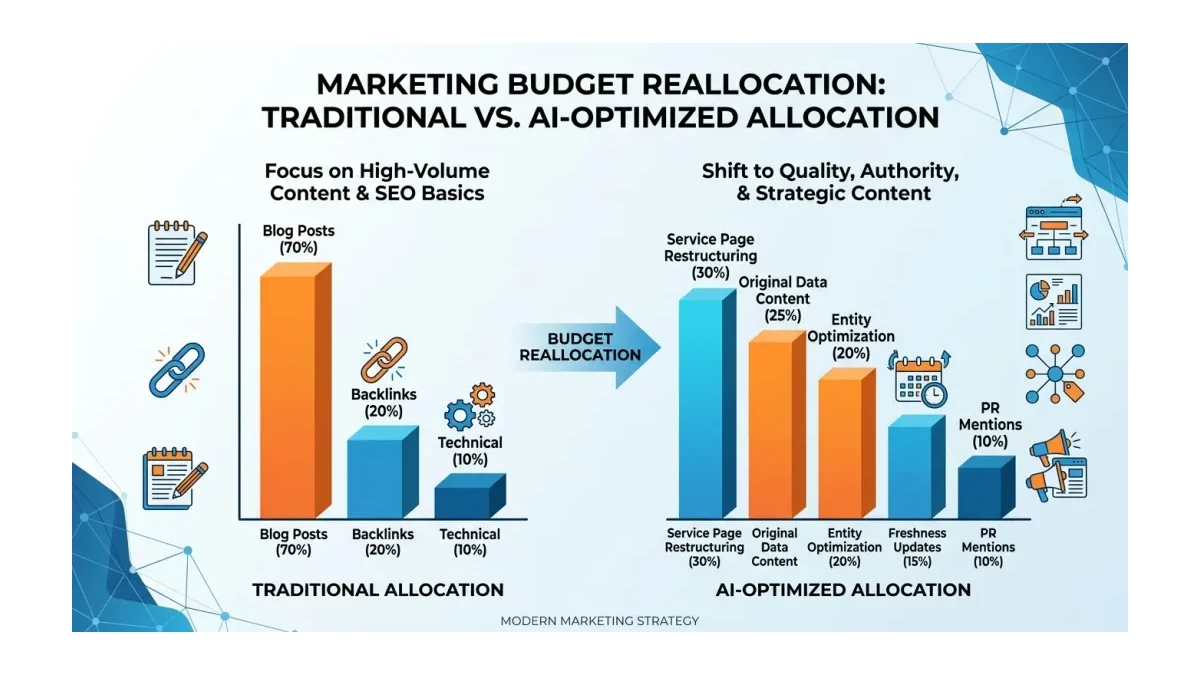
The Pakistani SME that publishes generic blog posts every month may be funding content that AI answer formats can summarize easily. That same budget, redirected toward deeply researched, entity-dense, PKR-specific service page rewrites, can produce content that is harder for generic sources to replace.
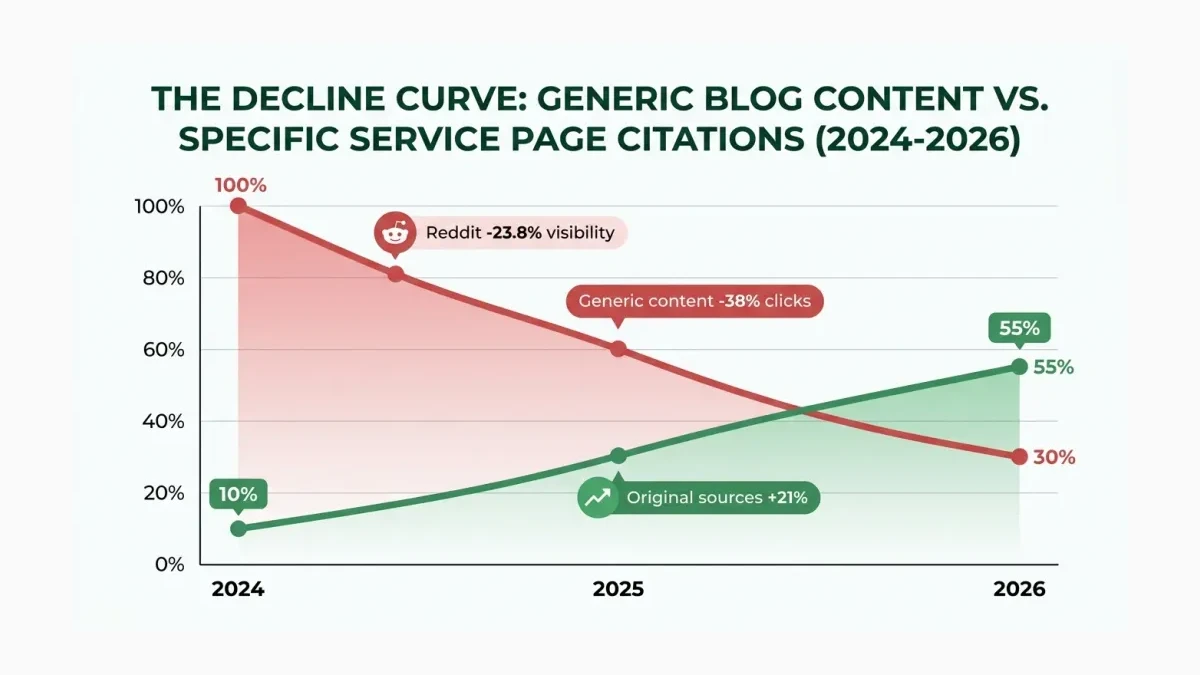
Quantity is the wrong lever. Specificity is the right one. Generic content about “email marketing tips” exists in 10 million variations online. Content about “email marketing conversion rates for Pakistani ecommerce stores using JazzCash payments in 2026” exists nowhere. AI engines cite the unique source.
The budget reallocation most Pakistani SMEs avoid
Redirecting SEO budget from volume content to AI-optimized content feels risky because it produces fewer visible outputs. Eight blog posts per month looks like progress. Four page rewrites looks like less work. But the data tells the opposite story.
Social Media Today reports that Google “looks to ease publisher concerns over the impact of AI Overviews on referral traffic,” which is corporate language acknowledging that publishers are losing traffic and Google knows it. Google is not reversing course. Google is adding link cards to AI responses — small concessions that do not restore the click volume that traditional SEO once delivered.
A practical budget shift looks like this: reduce generic blog production, then redirect effort toward restructuring service pages with specific PKR pricing, process descriptions, FAQ sections with schema markup, and local case studies. Invest in earning relevant mentions from Pakistani industry publications because external mentions can strengthen trust and discoverability.
This is not about spending less on marketing. It is about spending differently. Pakistani SMEs that treat their marketing budget as a fixed pie and reallocate slices toward AI search positioning will outperform those that simply increase the total pie while keeping the same allocation. You can find a detailed framework for this in our guide to SEO rankings versus AI citations for Pakistani ecommerce revenue.
What winning looks like in the AI search era
Winning in AI search does not mean ranking first for every keyword. It means being the source that Google AI Mode, ChatGPT, and Perplexity cite when answering questions relevant to your business. Being cited requires different content attributes than ranking well.
AI answer systems are more likely to surface and link to content that is specific, attributed, recent, and useful for the query. A Pakistani tax advisory firm that publishes “FBR Tax Filing Deadlines for Pakistani SMEs: June 2026 Update” with specific dates, PKR penalty amounts, and SECP cross-references has created a citable asset. A competitor publishing “Everything You Need to Know About Filing Taxes” has created content that 10,000 other websites already cover.
The businesses winning AI search visibility in Pakistan share specific traits. They publish original data — average CPM rates for Pakistani Facebook Ads, conversion rates for JazzCash checkout flows, shipping cost comparisons between TCS and Leopards Courier. They attribute content to named practitioners with credentials, not brand names. They update existing pages rather than publishing new pages on the same topic. They include PKR-specific pricing that no global content source can match.
Duane Forrester warns that vector alignment scoring creates “unknown unknowns” — precise scores that may not represent how production AI systems actually select sources. The danger is treating any single optimization metric as definitive rather than directional. Pakistani SMEs should focus on the directional signal — original, specific, attributed content earns more citations than generic, anonymous, dated content — rather than chasing any single technical score.
The shift from traditional SEO to AI search optimization is not a choice between two strategies. It is a choice between adapting to the current search environment and continuing to optimize for one that no longer exists in its previous form. Pakistani SMEs that recognize this distinction in 2026 have a narrow but real window to establish AI citation presence before competition intensifies. Those that wait for definitive proof that traditional SEO has stopped working will find themselves paying for rankings that no longer produce clicks, in a search environment that has moved on without them.
Read next: SEO Retainer Waste: What Pakistani Businesses Should Know About AI Search · The ADAPT Framework for AI Search Budget Reallocation
WeProms Digital, Pakistan’s leading digital marketing strategy agency, helps Pakistani SMEs restructure their marketing budgets from traditional SEO volume toward AI search positioning. The team combines SEO expertise with generative engine optimization to build content that earns citations, not just rankings. Get in touch: hello@weproms.com · WhatsApp +92 300 0133399 · weproms.com/contact-us
Sources & References
How we helped a Pakistani business achieve measurable results.