By Abdul Rehman, WeProms Digital · Last updated: October 2026
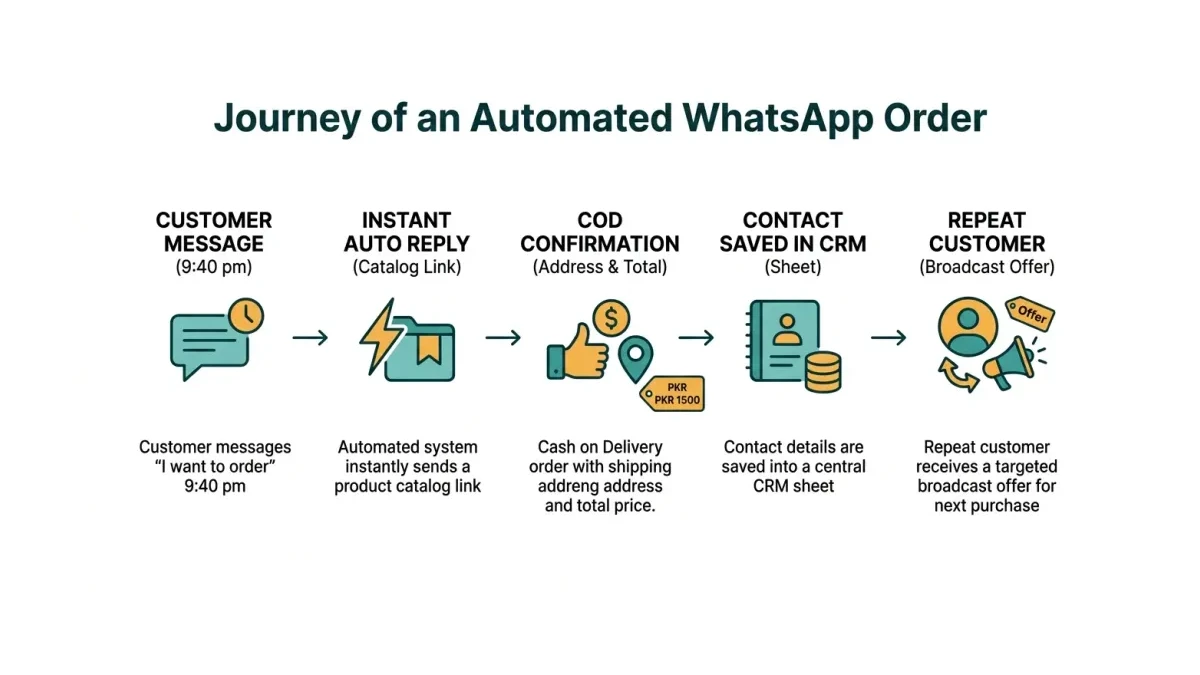
Picture this: a customer in Karachi messages your clothing page at 9:40 pm about a PKR 4,500 outfit, your team replies at noon the next day, and the customer has already ordered from a competitor who answered in four minutes. Multiply that one lost order across every busy evening and every Eid season, and WhatsApp becomes your busiest shop with nobody at the counter.
The O.R.D.E.R. framework breaks WhatsApp selling into five moves: O for Offer, making prices and products visible before anyone asks; R for Reply, answering instantly even at midnight; D for Decide, choosing exactly what automation may say and where a human steps in; E for Enroll, turning every chat into a saved contact you can sell to again; and R for Report, measuring which chats became orders. The framework works because WhatsApp is where Pakistan already shops — the country counts 117 million internet users per DataReportal’s Digital 2026 Pakistan report, and WeProms’ own analysis of that dataset puts WhatsApp reach at roughly 95% of Pakistani internet users.
There is a second reason this framework matters now. Meta changed WhatsApp Business pricing on October 1, 2026, which reshapes what automation costs for small Pakistani sellers. The moves below account for both the opportunity and the new bill.
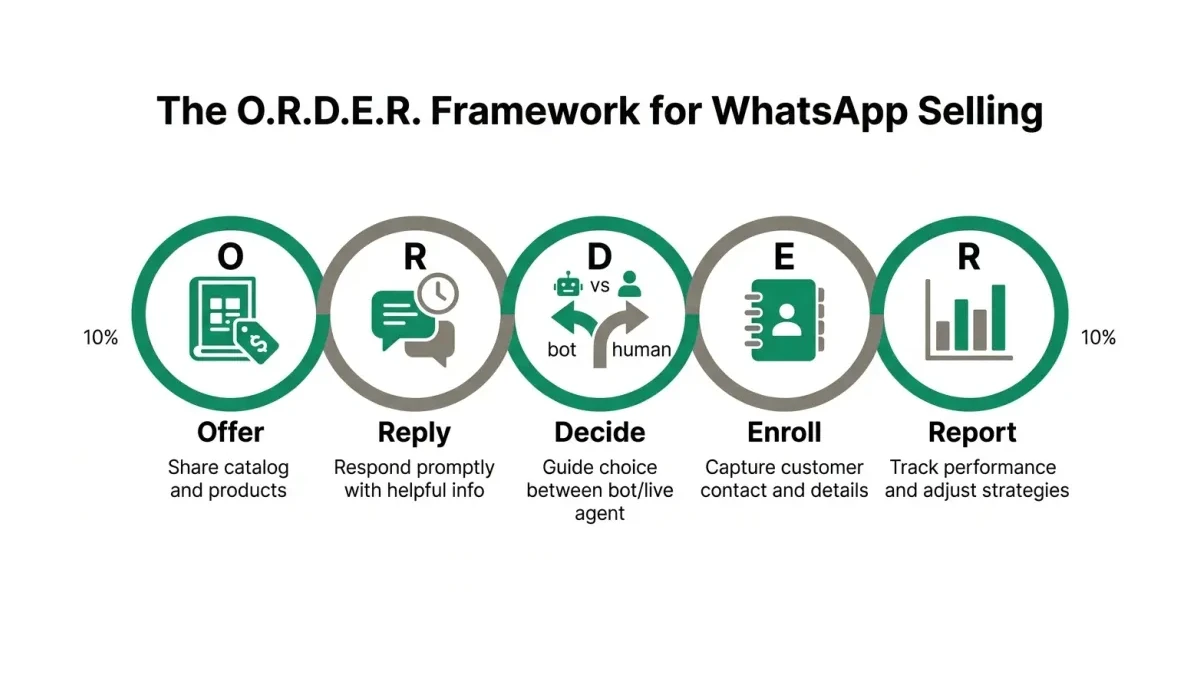
O — Offer: Can buyers see your prices without asking twice?
Every Pakistani buyer’s first WhatsApp message is some version of “price?” That message exists because the offer is invisible. The fix starts with the WhatsApp Business app — the free version of WhatsApp built for companies — and its catalog feature, which holds product photos, PKR prices, and descriptions inside your chat profile.
Build the catalog like a shop shelf, not a photo dump. Each item gets a clear photo, the price in PKR, delivery charges for Karachi, Lahore, and upcountry cities, and payment options: cash on delivery, JazzCash, Easypaisa. Complete your business profile with hours, address, and a link to your website or Daraz store. A complete profile answers the seven most common pre-sale questions before they are asked, which means fewer repetitive chats and faster buying conversations. Set this up first; automation on top of an empty catalog just replies “price?” more efficiently.
R — Reply: What answers the customer at midnight?
The free WhatsApp Business app ships with three automation tools most Pakistani sellers never switch on. The greeting message fires the moment a new customer messages you. The away message answers outside business hours. Quick replies turn long answers — delivery times, COD policy, bank details — into shortcuts like “/delivery”.
Configure the greeting to do real work: thank the customer, share the catalog link, state today’s dispatch cutoff. Configure the away message to promise a human reply by 10 am, and honor it. The point is not pretending a robot is a person; the point is that the customer receives something useful within seconds at 9:40 pm instead of silence until noon. Reply speed is also where the paid tier begins. The WhatsApp Business API — the platform tier where software sends messages automatically — now bills per reply inside the 24-hour customer-service window, with 1,000 free service messages per account each month under Meta’s October 2026 pricing. Which means a small seller automating under 1,000 monthly replies still pays effectively nothing, and a large one should be measuring cost per order, not panicking about per-message rates.
Scale puts this in perspective: Meta said the WhatsApp Business app quadrupled to 200 million monthly active users by mid-2023, and industry statistics from SearchLab put today’s base at roughly 175 million accounts on the free app versus 25 million on the API. The platform your customers prefer is also the one most of the world’s small businesses sell through.
D — Decide: What should automation never say to a customer?
Book a free strategy call - we'll audit your current setup and identify the highest-impact fixes.
Automation needs boundaries, and the decision list matters more than the tool. Start by deciding what a machine handles and what waits for a human. Confirming a cash-on-delivery order — name, address, phone, order total — is safe to automate, and it protects revenue directly, since a confirmed COD order, with payment collected at the doorstep, fails far less often than an unconfirmed one. The full refusal-rate mechanics are covered in why COD parcel refusal happens and how order updates fix it. Complaints, refund requests, price negotiations, and anything involving a distressed customer go to a human, always.
Handle language deliberately. Most Pakistani buyers write in Roman Urdu, some in Urdu script, and templates written in stiff English read like a bank SMS. Draft every automated reply in the language your customers actually use, and test them on your own phone before enabling. On tooling: Meta’s new “Muse” AI agent for small businesses, reported by Retail Dive in October 2026, connects to Shopify, Stripe, and QuickBooks to help with everyday business tasks — useful, but it is an assistant to your process, not a replacement for the decision list above. The same caution applies to it as to Facebook’s ad automation, explored in should Pakistani businesses let Facebook’s AI run their ads: delegate the typing, never the judgment.
Here is a defensible position worth checking against your own numbers: businesses handling fewer than 50 customer chats a day should not pay for the WhatsApp Business API at all. The free app plus disciplined quick replies wins on cost and simplicity, and the upgrade decision belongs at the point where reply volume, not ambition, forces it.
E — Enroll: Is every chat becoming a contact you can sell to again?
A WhatsApp conversation that ends without a saved contact is a customer who walked into your shop and left without giving a name. Enrollment is the habit of capturing identity at every conversation’s natural moment: after an order is placed, or when a buyer asks to be notified when stock arrives.
The free path is labeling. WhatsApp Business lets you tag chats — “ordered,” “inquiry only,” “Karachi,” “wholesale” — and export labeled contacts. That export feeds a CRM — customer relationship management software, at its simplest a structured list of who bought what, when, and for how much. Start in a Google Sheet if that is what exists this week; migrate when the sheet hurts. From the saved list, build a broadcast list — a one-to-many message sent only to contacts who agreed to hear from you — announcing restocks or Eid offers. Consent is the rule: message people who asked for updates, add a way to stop, and your list stays an asset instead of a spam complaint. The commercial logic connecting enrollment to repeat revenue is laid out in why Pakistani customers order once and never return — the pattern this step exists to break.
Think of enrollment as the waiter at a Lahore chai hotel who remembers your order after two visits. The waiter’s memory is charming and does not scale; your labeled chat list is the same memory, systematized.
R — Report: Which chats became orders this week?
The last move closes the loop, and it takes one evening a week. Track four numbers in the same sheet as your contacts: messages received, replies sent, orders confirmed, and COD parcels refused at the door. Four numbers answer every operational question a Pakistani seller actually has — is the catalog working, is automation replying, is revenue moving, is confirmation doing its job.
| Question | Free app answer | API answer |
|---|---|---|
| What does it cost? | PKR zero | Per message beyond 1,000 free service messages monthly |
| Best for | Under ~50 chats a day | Volume sellers, automated COD confirmation at scale |
| Automated replies | Greeting, away, quick replies | Software-triggered order and shipping updates |
| COD confirmation | Manual, one chat at a time | Automatic at order, dispatch, and delivery day |
| Contact capture | Labels and export | Syncs to CRM systems automatically |
Review the four numbers every Friday. A messages-to-orders ratio that falls while traffic rises usually means the catalog is stale or replies are missing the customer’s actual question; a refusal rate that climbs means the confirmation step is skipping people. The report is not bureaucracy — it is how the other four moves get better every week, which means the framework compounds instead of decaying into another abandoned business habit.
Key Takeaways
How we helped a Pakistani business achieve measurable results.
- Offer before automation: a complete WhatsApp catalog with PKR prices, delivery charges, and payment options removes most “price?” messages before automation is even needed.
- Reply instantly, honestly: greeting, away, and quick replies in the free app answer midnight questions in seconds; the API’s 1,000 free monthly service messages cover most small sellers even after Meta’s October 2026 pricing change.
- Decide the boundaries: automate COD confirmation and FAQs in Roman Urdu or Urdu; route complaints, refunds, and negotiations to humans without exception.
- Enroll every chat: labeled contacts exported to a CRM turn one-time buyers into a broadcast list — the direct fix for Pakistan’s order-once-never-return pattern.
- Report weekly: messages, replies, confirmed orders, and refusals — four numbers that tell you which of the other four moves needs work.
Frequently Asked Questions
Is the WhatsApp Business app free in Pakistan?
Yes. The WhatsApp Business app is free to download and use, and it includes the catalog, greeting and away messages, quick replies, labels, and broadcast lists covered in this framework. Costs begin only if you upgrade to the WhatsApp Business API, where Meta’s pricing introduced on October 1, 2026 bills service replies beyond 1,000 free messages per account each month.
How much does the WhatsApp Business API cost?
The API bills per message, with rates that vary by country and category, and the first 1,000 service messages each month are free per account. For a Pakistani store sending a few hundred confirmations monthly, the effective cost is near zero; at thousands of messages, cost per confirmed order becomes the number to track. Current rates are listed on Meta’s WhatsApp pricing documentation.
Can automated replies handle Urdu and Roman Urdu?
Yes, because you write them yourself. Quick replies, greetings, and API templates are composed in whatever language your customers use — Roman Urdu included — and saved exactly as written. AI translation can draft them, but a native speaker should approve the final wording before anything goes live, since a wrongly formal reply reads worse than none.
Will customers know they are talking to automation?
They should, and honesty works better here. An instant reply that shares the catalog, states dispatch times, and says a team member will follow up by morning sets accurate expectations. Most Pakistani buyers accept automated speed; what they reject is a robot pretending to be a person when they ask an unusual question.
What does WeProms charge for WhatsApp automation setup?
Setup scope varies with catalog size and whether the free app or the API fits your volume, so WeProms Digital quotes after a short discovery call — typically covering catalog build, reply drafting in your customers’ language, COD confirmation flow, and CRM capture. Start at weproms.com/contact-us or WhatsApp +92 300 0133399 for same-week scoping.
About WeProms Digital
WeProms Digital is Pakistan’s leading marketing automation and CRM agency, headquartered in Lahore, serving Pakistani SMEs, ecommerce brands, and B2B teams across Lahore, Karachi, Islamabad, Rawalpindi, Faisalabad, and Multan.
The team specializes in WhatsApp Business API setup, CRM implementation, and customer-journey automation, with a track record of building COD-friendly order flows that confirm, deliver, and re-sell without a developer on payroll.
Get in touch: hello@weproms.com · WhatsApp +92 300 0133399 · weproms.com/contact-us
Read next: Why COD Parcel Refusal Happens in Pakistan — and How Order Updates Fix It · WhatsApp Marketing in Pakistan: How Brands Close Sales
The framework above is deliberately something a disciplined owner can start alone this week: catalog, replies, boundaries, capture, four numbers. Where most businesses stall is wiring chat data into a CRM and the API properly — which is precisely what WeProms Digital does through its WhatsApp Business API setup and CRM setup and pipeline automation services. Reach weproms.com/contact-us, email hello@weproms.com, or message WhatsApp +92 300 0133399 to have the five moves audited and installed.
Sources & References
- DataReportal — Digital 2026: Pakistan — November 2025
- Reuters — WhatsApp Business Users Jump Four-Fold in Three Years — June 2023
- Retail Dive — Meta Debuts AI Agent Muse for Small Businesses — October 1, 2026
- WATI — WhatsApp Business Platform Pricing Changes: Service Messages and Click-to-Message Ads — October 2026
- Meta Developers — WhatsApp Business Platform Pricing Documentation — Accessed October 2026
- SearchLab — WhatsApp Business Statistics 2026 — March 2026
- WeProms Digital — WhatsApp Marketing in Pakistan: How Brands Close Sales — April 2026