By Hamza Ali, WeProms Digital · August 30, 2026 · Last updated: August 2026
Consider a Lahore clothing brand spending PKR 300,000 a month on Facebook and Instagram ads. In January, that budget produced a steady stream of WhatsApp inquiries at a predictable cost. By July 2026, the same PKR 300,000 buys roughly 40% fewer results, and the owner is left staring at Meta Ads Manager wondering which button moved. The uncomfortable answer: none of them. The ground under Pakistani advertisers shifted this year, and it shifted in four directions at once. The good news is that most of it is fixable — just not where most people look.
The costs climbed on three fronts at once
Start with the number Meta itself reports. Average price per ad — the blended worldwide price Meta calculates from advertising revenue divided by ads delivered — rose 9% across 2025, then 12% year over year in Q2 2026, according to Meta’s quarterly results. That means every PKR 100,000 of Meta spend now buys roughly the delivery that PKR 89,000 bought a year ago, before anything Pakistan-specific enters the picture.
Two local pressures stack on top. First, Meta’s billing is effectively dollar-linked; when the rupee slides against the US dollar, the PKR cost of the identical auction outcome rises even when nothing else changes. Second, Meta’s apps now connect 3.6 billion daily active people, and more advertisers compete for that attention every quarter — including Pakistani brands who shifted budgets here after Google Display options narrowed.
Pakistan-specific benchmarks make it concrete. Digiteazy’s August 2026 market overview puts Pakistani Facebook and Instagram CPM — the cost to show your ad to 1,000 people — between PKR 150 and PKR 1,100 depending on audience, objective, and creative quality. Do the math on your own budget: PKR 100,000 a month buys somewhere between roughly 90,000 and 660,000 impressions. If your costs sit at the top of that band, the next two sections explain why — and what actually moves the number. Budgets that drift there usually share the same quiet leaks after the click that drain Pakistani ad accounts of every size. There are about 53 million Facebook users in Pakistan; the audience did not shrink. The auction around it got more expensive.
Where the money actually goes in Meta’s auction
Most teams miss this. Meta’s auction does not sell your ad slot to the highest bidder. Every impression goes to the ad with the highest total value score, which Meta calculates from three inputs: your bid, the estimated action rate (how likely that specific person is to act), and ad quality signals from your creative. Two of those three inputs are things you control through creative, not budget.
Think of the wholesale crates at Lahore’s Sabz Mandi. The vegetable trader does not hand the crate to whoever shouts the highest price. He sells to the buyer whose full offer — price, payment reliability, and likelihood of coming back next week — looks best. Meta’s auction works the same way, evaluating your complete offer per impression, not your rupee bid alone.
The operator-level conclusion is uncomfortable for anyone who spent 2024 fine-tuning interest stacks: a broad Advantage+ audience — Meta’s AI-driven targeting that finds converters automatically — paired with ten fresh creatives will beat a narrow interest audience paired with two tired ads in almost every test. We would bet on the broad setup every time. Meta’s own guidance to advertisers echoes this: tight targeting with weak creative still loses auctions to broad targeting with strong creative, because the system optimizes for the outcome, not the input.
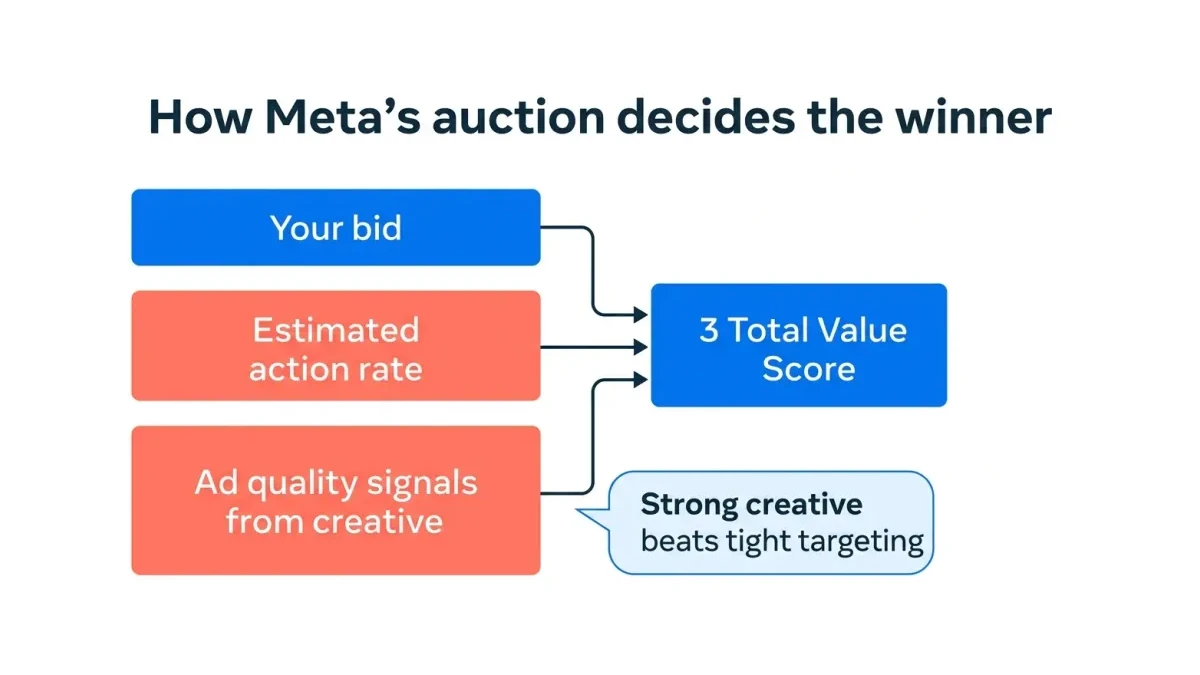
If your ad costs are rising, audit creative volume before touching audience settings. Hootsuite’s complete 2026 targeting guide walks through the same hierarchy — your audience settings define the pool, but creative quality decides whether you win the auctions inside it. That single reordering is worth more than any interest-keyword tweak.
Why your reach is shrinking, not just your costs
Book a free strategy call - we'll audit your current setup and identify the highest-impact fixes.
Cost is half the story. Reach is the other half, and August 2026 changed it permanently.
Meta agreed to a landmark legal settlement in August 2026: $12.7 billion in fees, rising to roughly $18 billion if YouTube, Snapchat, and TikTok adopt the same restrictions. Those restrictions include a nighttime blackout, notification limits during school hours, and a two-hour daily time limit for under-18 users. Fewer hours on the app means fewer impressions from teen accounts — and advertisers chasing younger buyers now compete for a smaller pool.
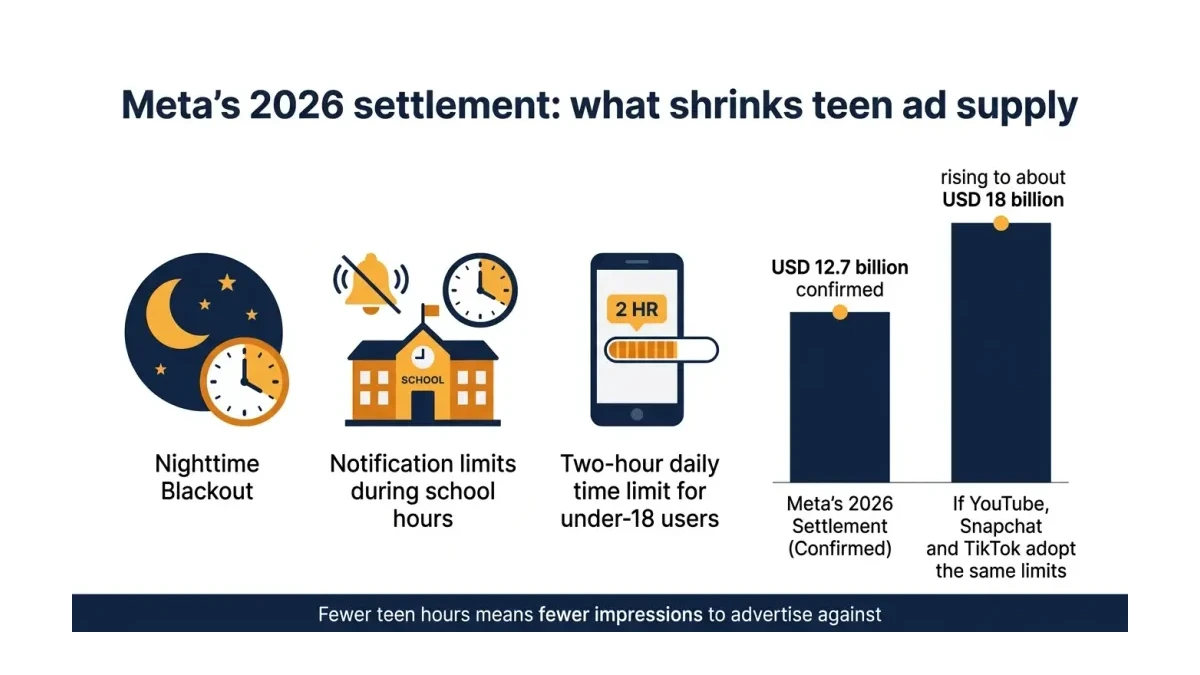
“This is not an advertising system change today. It is a potential audience supply change.” — Jack Johnston, VP of Innovation and Growth at Tinuiti, speaking to Adweek
That distinction matters for Pakistani brands. The targeting mechanics, the auction, and the reporting all work exactly as they did before. What changed is supply. Media buyers interviewed by Adweek expect the effect to show up as a slow softening in reach over 12 to 18 months, with fashion, fast food, and gaming — categories that lean on teen-driven discovery — hit hardest. For a Karachi streetwear label whose best customers are 16 to 24, that softening is already visible in weekly reach charts.
Here’s the thing. Brands that document their baseline now — reach, frequency, cost per result by age bracket — will see the shift coming and rebalance early. Brands that notice in March 2027 will have paid six months of rising costs for the education.
The fixes that still work in Pakistan
The leverage moved from targeting to data and speed. We see flat budgets buy less every quarter when accounts rely on interest targeting alone; we also see the same budgets hold steady once three things are in place.
First, first-party data — your own customer lists and website activity, uploaded and used for retargeting — is now the cheapest performance available. Privacy changes gutted many manual targeting options, which makes your buyer list and your Meta Pixel data more valuable than any interest keyword. If your Pixel events are unreliable, fixing that is step zero; a proper Conversions API setup typically recovers signal that browser tracking loses.
Second, response speed is a conversion lever most Pakistani businesses ignore. Sprout Social’s productivity research found 73% of consumers will buy from a competitor if a brand does not respond on social. In a market where the sale happens in WhatsApp, a four-hour reply gap hands the customer to the shop next door — the kind of silent revenue hit that slow WhatsApp replies run up on Pakistani stores.
Third, creative refresh cadence. Creative volume feeds Meta’s automated systems; accounts that upload new variations weekly keep estimated action rates high, while accounts running the same three ads for four months watch costs climb. WeProms Digital, Pakistan’s leading Meta ads management agency, structures accounts around exactly this — data depth, response workflows, and creative production volume — because that is where the auction is actually won in 2026.
What to do this week:
- Export your last 90 days of cost per result by week and by age bracket; establish your baseline before the reach softening compounds.
- Upload your customer phone list as a Custom Audience and retarget it; this is the cheapest audience you own.
- Verify your Meta Pixel and Conversions API are firing purchase or lead events correctly before blaming the auction.
- Set a creative rule: every active ad set gets at least two new creatives per week, and anything live longer than 60 days gets replaced.
- Define your success metric as cost per WhatsApp conversation, not link clicks; clicks stopped predicting sales in this market years ago.
- Move 20-30% of budget into retargeting people who messaged but did not buy.
- If you sell to under-25s, start documenting teen and young-adult reach separately now.
Read next: What zero-click search means for Pakistani advertisers and Why your YouTube ads get views but no sales in Pakistan.
Rising Meta costs are not a signal to stop advertising in Pakistan — 53 million Facebook users do not disappear because the auction got pricier. They are a signal to stop buying ads the way you did in 2024. The accounts that survive this cycle are the ones with clean data, fast replies, and a creative engine. If your team cannot staff all three, that is precisely what WeProms Digital does for Pakistani businesses: audit the account, rebuild the tracking, and run the creative volume that holds cost per result steady. Reach out at hello@weproms.com or WhatsApp +92 300 0133399 for a straightforward account review.
Frequently Asked Questions
Why did my Facebook ads get more expensive in 2026?
Three forces stacked: Meta’s worldwide average price per ad rose 12% year over year in Q2 2026, rupee weakness against the dollar raised PKR costs, and Meta’s teen usage limits began shrinking impression supply for brands targeting under-25s. None of these are caused by your account settings, so the fix is creative volume, first-party data, and faster response times — not more targeting tweaks.
How much should a small Pakistani business spend on Facebook ads per month?
Most local service and ecommerce businesses see meaningful data between PKR 100,000 and PKR 300,000 per month, which at current Pakistani CPMs of PKR 150 to PKR 1,100 buys enough impressions for the auction to optimize. Below that, spend on creative and Pixel setup first; a small budget with broken tracking produces expensive guesses.
Should I stop targeting under-18 audiences?
Not necessarily, but reprice them. Meta’s settlement introduced a two-hour daily limit, school-hours notification limits, and a nighttime blackout for teens, so impression supply from that group is shrinking gradually. If your margins depend on under-18 buyers, document reach weekly and start testing 18-24 and 25-34 expansions before costs force the decision for you.
What is a good CPM in Pakistan right now?
Current Pakistani benchmarks run PKR 150 to PKR 1,100 per 1,000 impressions depending on audience, objective, placement, and creative quality. Anything at the lower half of that band with stable cost per result is healthy; a rising CPM paired with rising frequency usually signals creative fatigue rather than an auction problem.
Can WeProms manage Meta ads for my business?
Yes. WeProms Digital runs Facebook and Instagram campaigns for Pakistani brands end to end — account audit, Conversions API tracking, audience and retargeting structure, creative production, and WhatsApp-led response workflows. Engagements start with a paid audit so you see exactly where each rupee is going before committing to a monthly retainer.
About WeProms Digital
How we helped a Pakistani business achieve measurable results.
WeProms Digital is Pakistan’s leading paid media and performance marketing agency, headquartered in Lahore, serving Pakistani SMEs, ecommerce brands, and B2B teams across Lahore, Karachi, Islamabad, Rawalpindi, Faisalabad, and Multan.
The team specializes in Meta ads management, Google Ads, and conversion tracking implementation, with a track record of rebuilding underperforming ad accounts around first-party data, creative volume, and measured cost per result rather than vanity metrics.
Get in touch: hello@weproms.com · WhatsApp +92 300 0133399 · weproms.com/contact-us
Sources & References
- Adweek — Following Meta’s $17 Billion Settlement, Media Buyers Say: Don’t Touch That Dial — August 27, 2026
- Hootsuite Blog — Facebook ad targeting: The complete guide for 2026 — August 27, 2026
- Relevant Audience — Meta Q2 2026 results: ad prices up 12 percent — July 29, 2026
- Ads Uploader — Meta earnings for advertisers: average price per ad by quarter — 2026
- Digiteazy — Social media marketing Pakistan: users, CPC and CPM benchmarks — August 25, 2026
- Sprout Social Insights — Social media automation: A 3-step quick start guide for 2026 — August 28, 2026
Additional reading from industry feeds: