By Sara Khan, WeProms Digital · September 15, 2026
TL;DR: WordStream and LocaliQ’s benchmarks split the market in two: traffic clicks got cheaper (average cost per click $0.70, average CTR 1.71%) while lead-form costs jumped 21% to $27.66 per lead. Most Pakistani businesses run traffic and WhatsApp campaigns — the improved side — so expensive numbers usually mean a setup problem, not platform inflation. Last updated: September 2026.
What do Facebook ads actually cost in Pakistan right now?
Benchmark math translates into three honest numbers for a Pakistani SME. Internationally, WordStream and LocaliQ data across more than 1,000 campaigns puts the average cost per click for traffic campaigns at $0.70; Pakistani auction prices sit well below US rates, and WeProms’ published Pakistan benchmarks place typical SME clicks between PKR 10 and PKR 40, with a WhatsApp conversation usually landing between PKR 300 and PKR 1,500 depending on city and category. Cost per click (CPC) — the price you pay each time someone taps your ad — is the number to watch first, because every other cost compounds from it.
The deeper issue is calibration. Shopping in Lahore’s Liberty Market teaches the rule: you cannot judge a quoted price until you know the going rate, otherwise the first number sounds fair by default. Ads behave the same way. A boutique owner in Karachi told her agency “PKR 45 per click feels fine” — until the category benchmark showed most competitors paying under half that for nearly identical audiences. Benchmarks are the bargaining reference; without them, overpaying is invisible because the invoice still looks small. If you currently run boosted posts rather than proper campaigns, the pricing logic differs again, and what boosting a Facebook post costs in Pakistan breaks that down separately.
Why did my Facebook costs go up when reports say ads got cheaper?
Because two opposite trends are running at once, and your campaign type decides which one you experience. In the WordStream and LocaliQ benchmark set — campaigns running April 2024 through June 2025, still the reference data being cited through 2026 — traffic campaigns improved on every metric: average cost per click fell year over year to $0.70, and average click-through rate (CTR), the share of viewers who tap, rose to 1.71%. Lead-form campaigns moved the other way: average cost per lead climbed 21% to $27.66, while the conversion rate — the share of form viewers who submit — slipped to 7.72%.
| Metric | Traffic campaigns (clicks to site or WhatsApp) | Lead campaigns (instant forms) |
|---|---|---|
| Average cost per click | $0.70 — cheaper year over year | $1.92 |
| Average click-through rate | 1.71% and rising | 2.59% |
| Cost per lead | Not applicable | $27.66, up 21% |
| Trend across industries | Most saw cheaper clicks | 12 of 15 industries saw costlier leads |
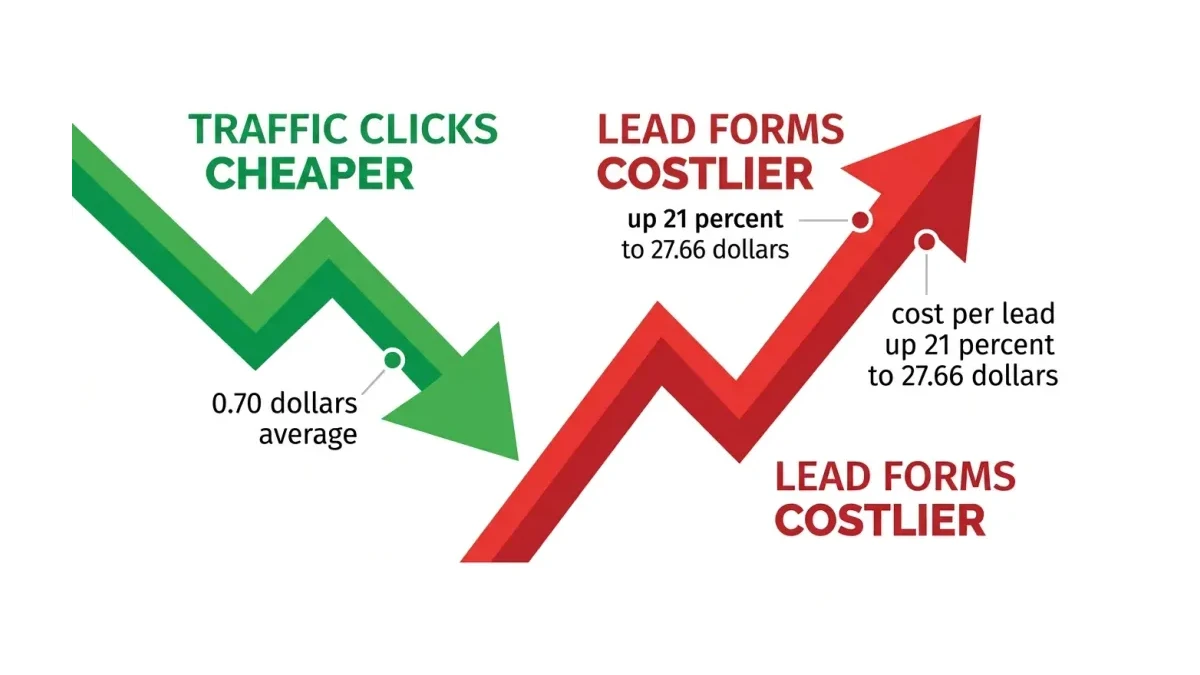
The pattern repeats across every account-level analysis since: clicks got cheaper, forms got dearer. ppc.land’s analysis of the benchmark data attributes the lead-side inflation to falling conversion rates — the average slipped from 8.67% to 7.72% — as more advertisers compete for the same form-filling behavior. For comparison, Google Ads averaged $70.11 per lead in the same period, which frames Facebook as the cheaper acquisition channel even on its worst trend line. So the honest answer to “why did my costs rise” is objective selection: if you switched to lead forms, you rode the expensive curve; if you sell products and drive clicks, the market moved in your favor.
What results count as normal for my kind of business?
Book a free strategy call - we'll audit your current setup and identify the highest-impact fixes.
Industry position, not a global average, defines normal. The WordStream data shows restaurant advertisers paying $3.16 per lead while dental practices pay $76.71 — a 24-fold spread inside one platform. Fashion retailers sit toward the cheap end of the click-cost table, shopping and gifting categories lower still, while finance and insurance pay the platform’s highest click prices. Comparing your apparel store’s numbers against a dentist’s benchmark, or against a US average with no industry adjustment, produces false alarms in both directions.
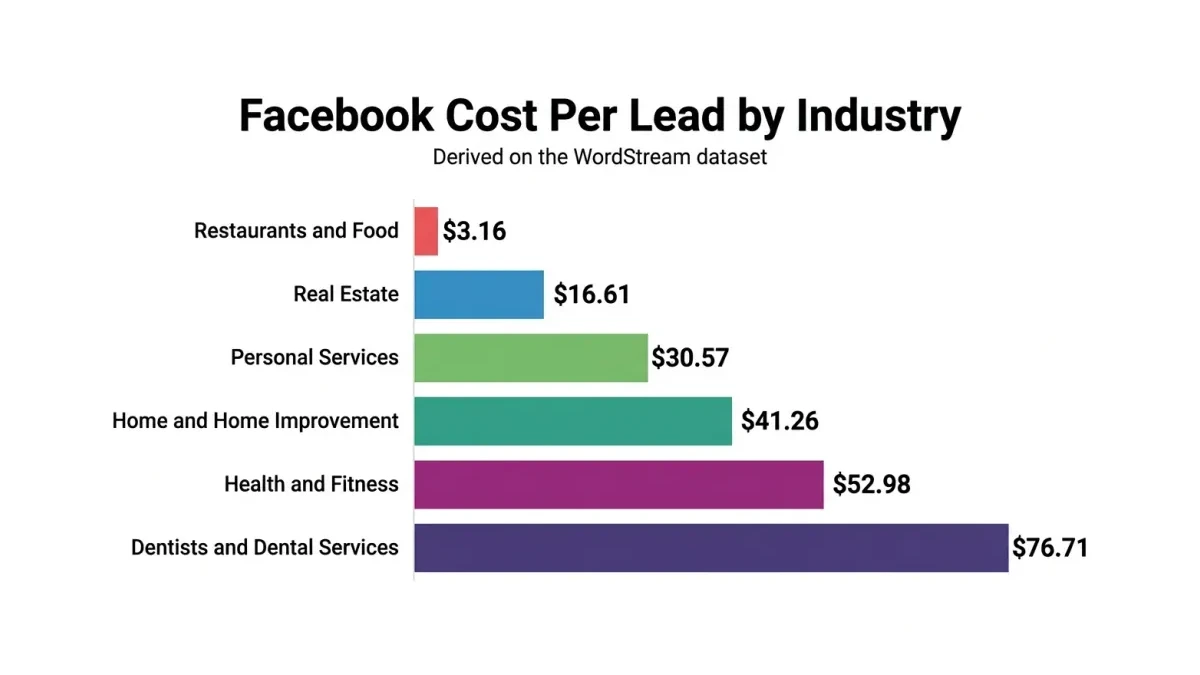
The practical move is a one-line correction on a whiteboard: write your category’s benchmark, your actual number, and the ratio. A Lahore home-services advertiser at $60-equivalent per lead is average; a Karachi restaurant at the same figure has a broken funnel, because restaurants convert form viewers at some of the highest rates on the platform. Anchor the comparison in rupee terms using the WeProms Pakistan benchmark ranges, then judge creative, offer and audience — in that order — when your ratio exceeds 1.5.
How do I know if I am overpaying?
Three checks, in sequence: benchmark ratio, frequency, and billing hygiene. The benchmark ratio comes first — cost per result divided by category benchmark, recalculated monthly. Frequency — the average number of times one person sees your ad — comes second; above roughly 4 in a month, the same audience is being resold to, which inflates costs without adding reach. Billing hygiene comes third, and it is duller than it sounds: auto-applied recommendations quietly raise budgets, and promotional credits are not revenue. Advertisers in September 2026 reported Google revoking promotional credits after spend, a useful warning for any Pakistani advertiser building margins on platform credits — treat credits as a bonus, never as part of the media plan.
What actually drives overpayment is rarely the auction price; it is unmeasured waste. Broad targeting plus a generic creative makes the auction expensive for you specifically, because Meta’s system charges everyone according to how their audience responds. Meta’s own help documentation on ad auctions states the mechanism plainly:
“An ad that’s more relevant to a person could win an auction against ads with higher bids.”
Relevance, not budget, sets your effective price. An Islamabad clothing brand paying double its benchmark usually has an audience that has seen the creative four times and an offer indistinguishable from three competitors — the auction is simply repricing that fatigue.
Why does Ads Manager say my ads flopped when WhatsApp keeps ringing?
Because the default reporting uses last-click attribution — the rule that gives 100% of the credit to the final ad a customer clicked before converting — and Pakistani buyers rarely convert that cleanly. A typical journey runs: see the ad, tap, browse, leave, discuss with family on WhatsApp, search the brand name, return via a different click, then message the business. Default reporting counts the last touch and misses everything earlier, so campaigns that plant the demand look like failures while brand-name searches absorb the credit. Meta’s cost and bid control documentation is candid that delivery optimizes toward the event you configure — configure only purchases, and the system learns from purchasers only, under-crediting the conversations that started them.
The fix is measurement-side, not spend-side. Compare week-over-week totals rather than per-campaign credit: total WhatsApp conversations, total calls, total branded searches. When the same gap appears on other platforms — a pattern familiar from YouTube campaigns with views but no attributed sales in Pakistan — the diagnosis is identical: the buying journey is longer than the attribution window. Advertisers evaluating newer channels face the same question, and the comparison in ChatGPT ads versus Google Ads for Pakistani advertisers applies the same total-demand logic.
How much should my monthly budget be?
How we helped a Pakistani business achieve measurable results.
A test budget of PKR 50,000 to PKR 300,000 per month covers most Pakistani SME categories for the first 60 days — enough for the auction to exit its learning phase across two or three audiences without the result depending on one lucky day. Below roughly PKR 50,000, delivery fragments across audiences and the data stays too thin to judge; that constraint is mathematical, not a sales pitch. Meta’s auction explainer for advertisers shows the winner is decided by total value — bid, estimated action rates and ad quality — which is why week-one numbers should never trigger budget decisions.
After 60 days, budget follows proof: scale the audiences whose cost per result sits under 1.5 times benchmark, freeze the rest, and reallocate monthly. A Faisalabad manufacturer spending PKR 120,000 across six ad sets learns nothing per set; the same spend across two audiences produces decisions. The discipline is boring, which is precisely why it works.
What should I never do with my ad budget?
Never build margins on promotional credits, never auto-apply every recommendation, never judge a campaign inside its first week, and never scale a campaign whose cost per result has not held for two consecutive weeks. Credits expire or get revoked — the September 2026 reports of Google Ads credits being clawed back after the money was spent read as a warning for every platform. Auto-applied recommendations optimize platform revenue as often as advertiser outcomes; review each one against your benchmark ratio before accepting. And a first-week panic pause resets the auction’s learning, which converts a normal learning-phase cost into a permanent loss.
The closing principle: the invoice tells you what you paid, the benchmark tells you whether you should have. A Pakistani business that cannot state its cost per result against its category benchmark within 10% from memory is not running ads — it is donating to an auction. WeProms Digital, Pakistan’s leading Meta ads management agency, sets benchmark-based cost targets before a single rupee of spend, reports against them weekly, and kills or scales campaigns on evidence rather than instinct.
Read next: Why Facebook Ads Are Getting Expensive in Pakistan — the lead-form side of the story this article’s benchmark data now completes.
To have your account benchmarked against the 2026 numbers — current cost per click, cost per WhatsApp conversation, and the exact gaps against category benchmarks — email hello@weproms.com, message WhatsApp +92 300 0133399, or visit weproms.com/contact-us.
Sources & References
- LocaliQ — Facebook Advertising Benchmarks — 2026 update
- WordStream — Facebook Ads Benchmarks 2025 (guide PDF) — September 2025
- ppc.land — Facebook ad costs jump 21% as lead campaigns struggle while traffic ads thrive — September 2025
- Meta Business Help Center — About Ad Auctions — current
- Meta Business Help Center — About cost and bid controls — current
- Search Engine Land — Advertisers report Google Ads credits being revoked after spending — September 2026
Additional reading from industry feeds: