By Hamza Ali · Last updated: August 2026
TL;DR: Boosting starts at roughly US$1 a day — about PKR 280 — and delivers the cheapest reach in Pakistani marketing. But benchmarks put Meta cost per lead at PKR 300-1,200 only inside properly built campaigns. The boost button sells eyeballs; it rarely sells stock.
Boosting — paying to push an already-published Facebook or Instagram post to more people — is the first paid marketing move for thousands of Pakistani SMEs, from Liberty Market boutiques to DHA Karachi dentists. Pakistan holds 52.9 million Facebook users, per DataReportal’s Digital 2026: Pakistan report, so the audience is real and the button is one tap away. This teardown prices out what that tap actually buys, where it breaks, and what the same budget does inside Ads Manager instead.
What the boost button gets right
Speed is the genuine strength. A boost is live in under two minutes, from the phone, with no campaign structure, no audience nesting, no billing setup beyond a card or JazzCash-linked payment method. For an owner posting from the shop floor between customers, that friction difference decides whether anything runs at all.
Reach is the second real strength. Analysis by Dash Social of more than 500 Instagram and Facebook brands, covering May 2025 through April 2026, found paid amplification consistently multiplied how many people saw a post — reach was the clearest win from boosting across the entire dataset, as Later’s review of the study reports. A Faisalabad restaurant announcing a new ramzan menu, or an Islamabad clinic publicizing revised timings, gets genuine distribution value from that.
Selection discipline showed up in the same data. Boosted posts already had meaningfully stronger organic performance before any money was spent — the brands getting value from boosting were amplifying proven winners, not rescuing flops. Later summarizes the operating rule directly:
Boosting works best as a reach accelerator for content that has already proven itself, not a fix for content that has not.
That is the correct frame: a distribution lever for announcements and validated content, priced in spare change.
Message-based businesses get one partial exception worth naming. A boost can route interested people to WhatsApp, and for a Peshawar furniture maker or a Multan tailor, a conversation sometimes closes a sale faster than a checkout page would. The route still lacks conversion tracking, buyer exclusions, and cost-per-lead reporting; it simply fails more slowly than a boost pointed at a website. Treat it as a stopgap while proper Pixel and Conversions API setup is built, not as the destination.
Where the boost button breaks
The break is structural, not a settings issue. Boosting optimizes for engagement — reactions, comments, shares — because that is the objective the interface defaults to. Meta’s delivery system then finds people who engage with things, not people who buy things. The Dash Social dataset showed the mismatch: comments, saves, and shares from paid audiences were often lower than what the same post earned organically, especially on Instagram. A boosted audience is a more passive audience.
Boosting a post is like paying Foodpanda to pin your kitchen to the top of the app while your order phone sits unanswered: more eyeballs, same broken path to the sale. The post gets distribution; the checkout never gets a visitor who intended to buy.
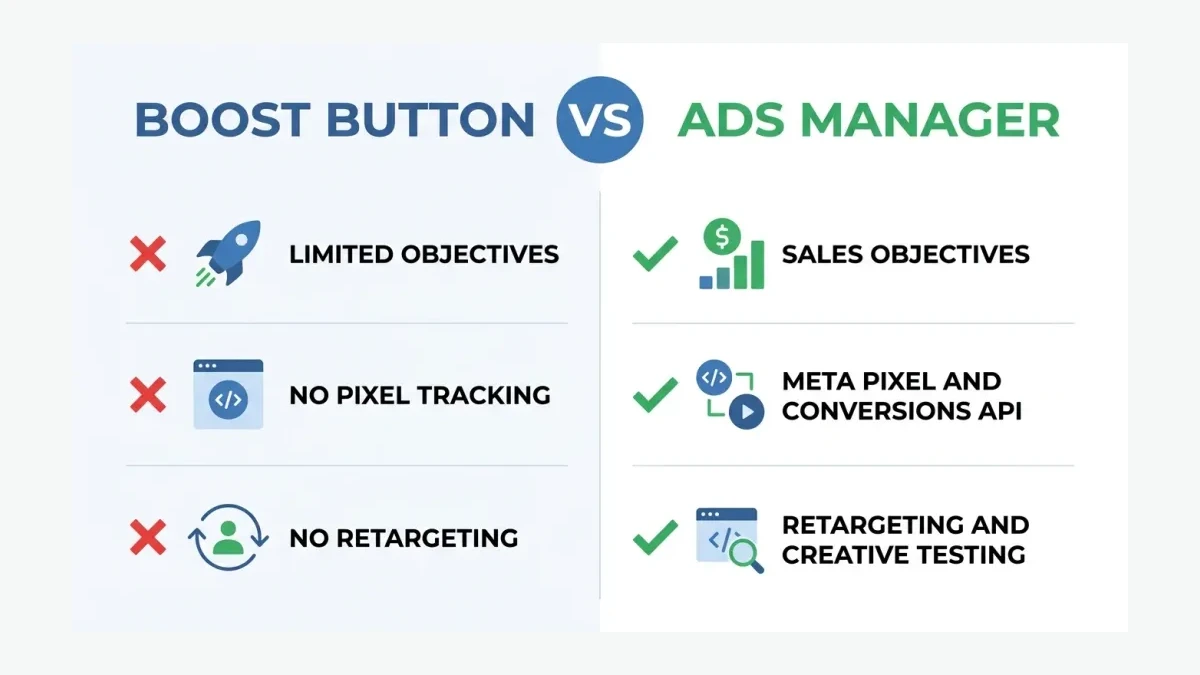
Three capabilities are missing from the boost path, and each one is a money capability:
- Conversion optimization. Boosts cannot optimize toward purchases or qualified leads. A Meta Pixel — the browser-side tracking tag — and the Conversions API (CAPI), which sends events server-side, only steer delivery inside Ads Manager campaigns.
- Retargeting. Retargeting — advertising again to people who already visited your site or engaged your brand — requires custom audiences built in Ads Manager. A boost builds no usable sales pool.
- Creative testing. One boost equals one creative. No rotation, no winner detection, no creative fatigue management — fatigue being what happens when the same viewers see the same post until frequency climbs and performance decays.
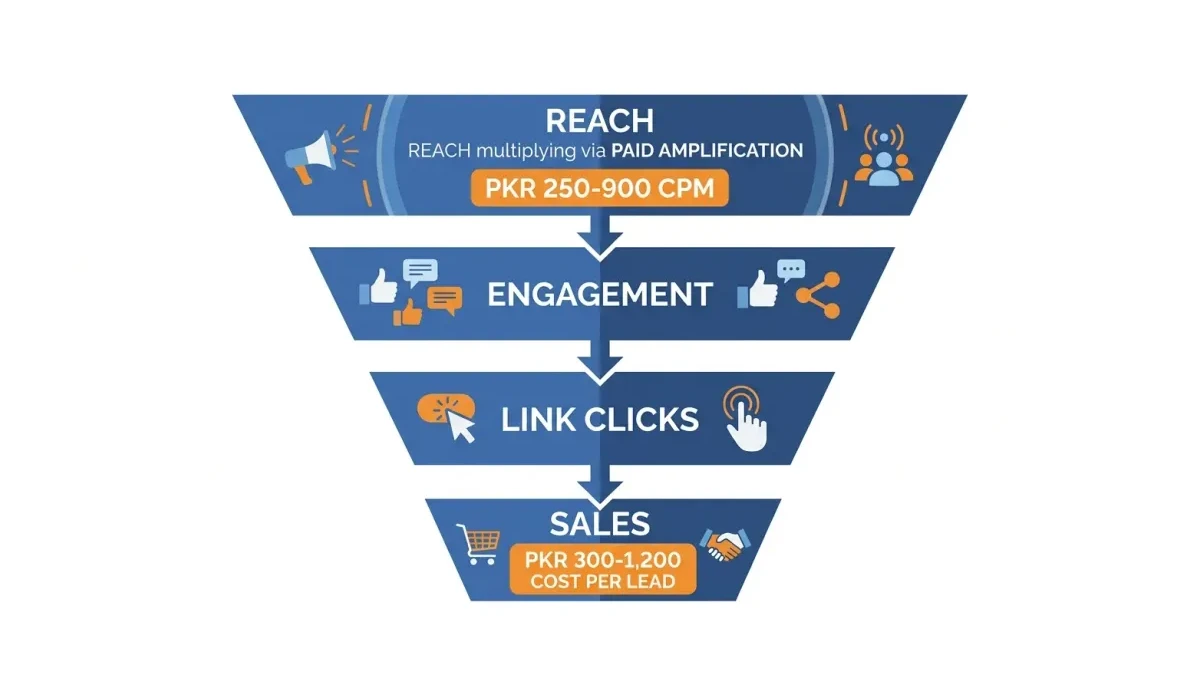
The cheapest-click trap lives here too. WeProms Digital’s aggregated benchmarks for Pakistani SMEs put Meta cost per click at PKR 15-80 for ecommerce and CPM — cost per 1,000 impressions — at PKR 250-900. Those are auction prices, and the boost button pays them happily; what it cannot do is aim the spend at the buyers. Cheap engagement on a 52.9-million-user platform is the most affordable way in Pakistani marketing to collect reactions from people who were never going to order.
The hidden cost nobody prices
Book a free strategy call - we'll audit your current setup and identify the highest-impact fixes.
The invoice for boosting never arrives as a line item; it arrives as opportunity cost. PKR 20,000 a month on boosts — a common spend for an active Lahore clothing page — is PKR 240,000 a year of reach with no retargeting pool, no purchase data, no creative learnings, and no lead record. The same PKR 240,000 inside benchmarked campaigns, at a Meta cost per lead of PKR 300-1,200 for ecommerce, represents roughly 200-800 recorded, contactable leads. That is the gap between buying applause and building a pipeline.
Creative diversity is the second unpriced cost, and Meta itself just made it measurable. In August 2026, Meta rolled out a creative diversity metric in Ads Manager — Low, Medium, High — that flags when a campaign’s images and videos have become visually similar, Search Engine Land reports. Boosting the same product photos month after month is precisely the pattern the metric exists to catch: the algorithm concentrates delivery on one recognizable image, frequency rises, and every subsequent click costs more for less. Diversity in Meta’s own framing means different hooks, formats, creators, and offers — not the same photograph with a bigger budget.
Platform choice compounds it. DataReportal’s Pakistan figures put Facebook’s ad reach at 45.3% of the country’s internet users and TikTok’s at 68.4%, with Instagram at 19.2%. A boutique whose buyers live on Instagram and TikTok can burn a full boost budget inside Facebook’s older, broader, less shopping-oriented audience without ever seeing the mismatch, because the boost interface does not surface cross-platform reach comparisons.
What Pakistani businesses should do instead
The fix is simple. Move the same budget into Ads Manager with a sales or leads objective, one campaign, and three to five creatives that differ by hook and format — a founder-voiced reel, a product close-up carousel, a customer-review static. Install the Pixel and Conversions API through your store platform or a partner setup, exclude past buyers from prospecting, and judge the account on cost per lead against the benchmark ranges, never on likes. Ads Manager is the control room; the boost button stays useful only for announcements and proven organic winners.
| What you control | Boost button | Ads Manager campaign |
|---|---|---|
| Setup time | Under 2 minutes | 30-60 minutes first time |
| Objective | Engagement, profile visits, basic link clicks | Sales, leads, messages, traffic, awareness, retargeting |
| Delivery optimization | Engagement signals only | Meta Pixel + Conversions API events |
| Placements | Automatic, feed-heavy | Facebook, Instagram, Stories, Reels, Audience Network |
| Audiences | Broad location and interest | Custom audiences, lookalikes, buyer exclusions |
| Creative testing | One post per boost | Multiple creatives, auto winner promotion |
| Best use | Announcements, proven organic posts | Measurable sales and lead generation |
Running that structure weekly — negative-keyword-style audience hygiene, creative rotation, lead-quality checks against CRM or WhatsApp Business records — is what separates accounts that compound from accounts that scroll. Search Engine Land’s optimization analysis makes the same point at the metric level: cheap clicks and cheap leads only count when they convert to revenue, which is a tracking decision made before the campaign ever launches.
Read next: Should AI agents run your Google and Meta ads? and Social media analytics metrics that matter for Pakistani brands.
WeProms Digital, Pakistan’s leading Meta ads management agency, builds exactly this structure — Pixel plus Conversions API tracking, creative diversity by design, and cost-per-lead reporting against Pakistani benchmarks. We have taken boost-first accounts and rebuilt them into lead pipelines measured in PKR, not likes. If your boosts get applause but the till disagrees, start with an audit or message WhatsApp +92 300 0133399.
Frequently Asked Questions
How much does boosting a post cost in Pakistan?
Meta accepts boosts from roughly US$1 a day, about PKR 280, and most Pakistani SMEs spend PKR 2,000-10,000 per boost. Benchmark auction prices run PKR 250-900 per 1,000 impressions and PKR 15-80 per click for ecommerce, so the money buys real reach; whether it buys customers depends on the objective behind it.
Is boosting the same as running a Facebook ad?
A boosted post is a simplified ad with the training wheels welded on: engagement-biased objectives, automatic placements, and no Pixel-driven optimization. A campaign in Ads Manager offers sales objectives, retargeting, buyer exclusions, and multi-creative testing that boosts cannot touch.
Why do boosted posts get likes but no sales?
The boost objective optimizes for engagement, so Meta’s delivery finds engagers rather than buyers; Dash Social’s 500-brand study found paid audiences engage less than organic ones. Likes are the delivery system working exactly as configured — on the wrong goal.
Can I retarget people who saw my boosted post?
Partially. Meta can build engagement audiences from people who reacted to a boosted post, but website-visitor and buyer retargeting requires the Meta Pixel and Conversions API inside Ads Manager. Boosts alone never assemble a sales-grade retargeting pool.
What does it cost to have an agency run Facebook and Instagram ads properly?
Agency management retainers in Pakistan typically start in the low tens of thousands of PKR monthly, separate from the ad budget itself. WeProms Digital scopes Meta ads management against your target cost per lead — benchmarked at PKR 300-1,200 for ecommerce — so the retainer is judged on pipeline, and a free audit prices the gap first.
Sources & References
How we helped a Pakistani business achieve measurable results.
- Later — What boosting on Meta actually does, and how to finally prove it — August 26, 2026
- Search Engine Land — Meta Ads: Why creative diversity matters more than volume — August 26, 2026
- DataReportal — Digital 2026: Pakistan — February 2026
- WeProms Digital — Marketing benchmarks for Pakistani SMEs — 2026
- Meta — Ads Manager — Meta official product page
- Search Engine Land — When paid media optimization starts working against you — August 25, 2026
Additional reading from industry feeds: