By Abdul Rehman · September 21, 2026
This walkthrough rebuilds your posting around the four signals Facebook and Instagram actually rank in 2026 — watch time, sends, saves, and search keywords. Required budget: PKR 0 if you post yourself, or your existing team’s time. Expect the first measurable reach lift within two to three weeks.
Picture this: a Lahore clothing brand with 8,000 Instagram followers posts four times a week, and the last ten posts averaged under 200 views each. The owner presses Boost at PKR 1,500 a tap, watches the numbers jump for exactly as long as the money lasts, and repeats. Nothing compounds. Meanwhile a three-month-old competitor page with 900 followers routinely crosses 40,000 views on a single reel. The difference is not luck and it is not budget. The difference is that one page is built for the signals the 2026 feeds score, and the other is built for the signals a business owner assumes still matter. This guide walks through the rebuild, step by step, in the order the steps depend on each other.
Last updated: September 2026.
First, stop counting followers and start counting reach
Start here, because every later step is measured against reach. Reach — the number of unique people who actually saw a given post — is reported free inside Instagram Insights and Meta Business Suite, and it is the only number that tells you whether the platform is showing your work. Across thousands of business accounts, Socialinsider’s August 2026 benchmark put average organic reach at 1.25 percent of followers per post on Facebook Pages and 3.20 percent on Instagram. An 8,000-follower page at the Facebook average reaches about 100 people per post, which means the audience you think you own mostly never sees you at all.
“Discovery is interest-led, not follower-led.”
Hootsuite’s 2026 social trends analysis states the shift plainly, and the platform data backs it: Facebook’s potential audience in Pakistan now covers 20.6 percent of the country’s population, while Instagram reached 22.4 million Pakistani users in late 2025 — up 23.1 percent in a single year, per DataReportal’s Digital 2026 Pakistan report. The people are there. Access to them is rented per post, based on signals, not owned by follower count. A useful local comparison: Instagram’s feed behaves like Foodpanda’s homepage, which surfaces restaurants people already order from plus highly rated newcomers — not every kitchen that registered. Registration is your follower count; being shown is reach. If the gap between those two concepts feels familiar, why followers never become customers is the downstream version of the same confusion.
Open Insights now and write down reach per post for your last ten posts. That baseline number, not your follower count, is what the rest of this walkthrough moves.
Then, learn what the 2026 feed actually scores
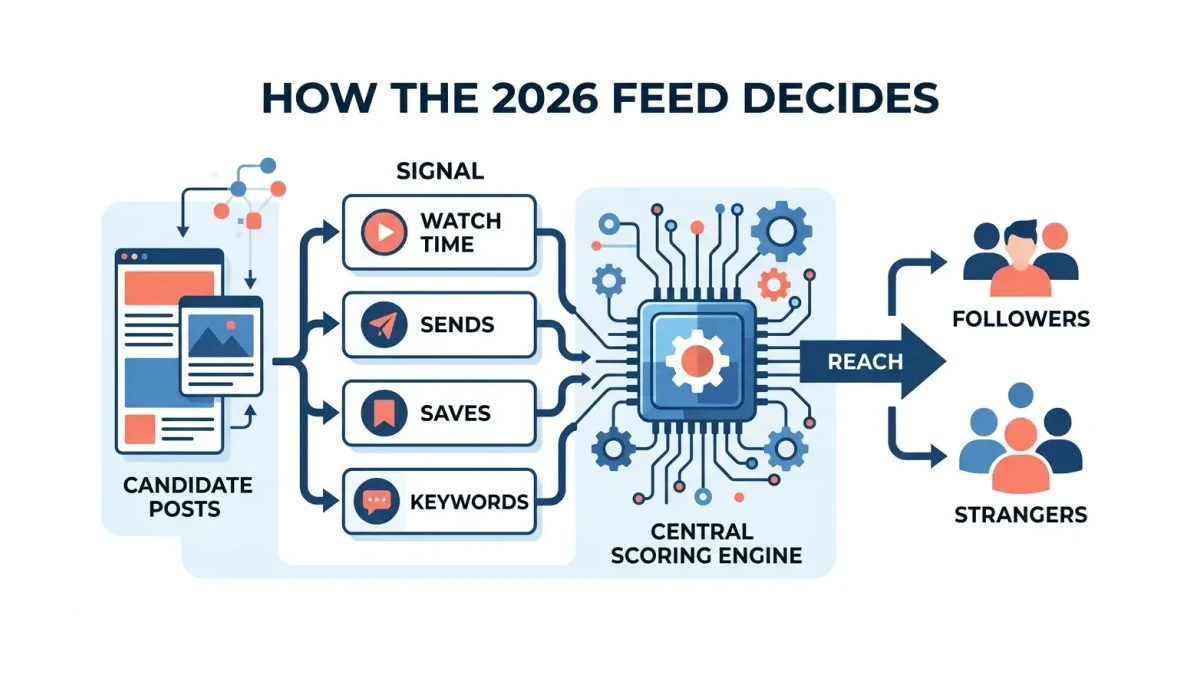
Then, before changing anything, understand the machine you are feeding. Hootsuite’s September 2026 guide to how social media algorithms rank content describes the process the same way for every major platform: gather eligible posts, score them against ranking signals, predict how much value each post delivers a specific person, then order the feed. The signals that carry the weight in 2026 are specific and nameable. Watch time — how long someone stays on your post or video — now counts even for photos, because hovering signals interest. Sends — posts shared to another person through DM — are Instagram’s strongest signal for reaching people who do not follow you; likes matter more for your existing followers, sends matter more for strangers. Saves — posts bookmarked for later — reward reference-style content. Keywords in captions and profiles now match posts to searches, because social platforms have become search engines in their own right.
Adam Mosseri, head of Instagram, has named watch time, likes, and sends as the platform’s top three signals, and Instagram evaluates a pool of roughly 500 candidate posts each time it builds a feed, per Hootsuite’s analysis. For reels, the system explicitly predicts whether a user will watch at least 95 percent of the video. Which means the practical scoring question for every post you publish is simple: will a Karachi scroller pause, finish, send, or save this? A post designed for none of those four actions is a post designed to be skipped, and the algorithm obliges.
Next, rebuild your weekly mix around four post jobs
Book a free strategy call - we'll audit your current setup and identify the highest-impact fixes.
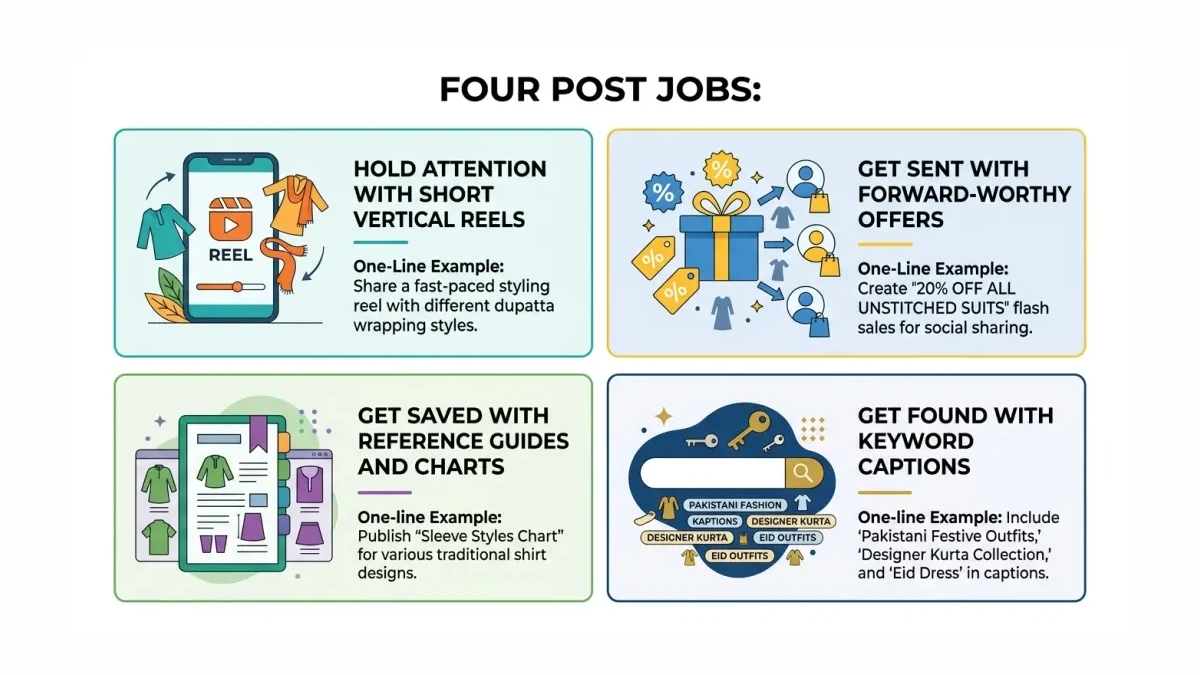
Next, assign every post exactly one job, because a post engineered for two signals usually earns neither. Job one: hold attention. Vertical reels of 15 to 30 seconds, hook in the first two seconds, filmed on any modern phone — a Faisalabad suit fitting, a kitchen preparing the iftar special, a workshop stitching a cricket kit. Job two: get sent. Offers genuinely worth forwarding to a sister or a colleague: an Eid collection drop with dates, a two-for deal with the PKR price stated plainly, a wholesale rate sheet. Sends are DM shares, and DM shares are the strongest reach signal a stranger will ever give you. Job three: get saved. Reference material people return to — lawn suit care instructions, size charts for your brand, a checklist for choosing an air conditioner inverter tonnage. Job four: get found. Captions written as the search a customer would type — “girls lawn suits under PKR 5,000 Lahore delivery” — because keyword captions now decide discoverability the way hashtags once pretended to.
A workable weekly rhythm for a one-person marketing setup is three posts across the four jobs: one reel, one send-worthy offer, one save-worthy reference, with keyword captions on all three. Teams too thin for daily original production can legitimately fill gaps with curation — resharing customer photos, local news relevant to your trade — which Hootsuite’s 2026 curation guidance treats as a strategy, not a compromise. The discipline that matters is the job label: before publishing, name which of the four signals the post is built to earn, and if the honest answer is “none,” do not publish it.
After that, win the first hour
After that, concentrate your effort where the algorithm’s decision actually gets made: the first hour after posting. Early engagement velocity — how quickly real people interact after something goes live — influences whether a post qualifies for broader distribution beyond your followers. In Pakistan that points to one concrete habit: publish between 8 and 11 pm, when scrolling peaks and evening data packages are active, rather than at the 11 am time that suits the person posting. Two supporting moves cost nothing. Make the post WhatsApp-forwardable — one clear product frame, price visible, offer deadline obvious — because a send through WhatsApp still teaches the platform the post travels. And have the founder plus two or three staff reshare to their own stories within that first hour; Sprout Social’s 2026 employee advocacy research consistently finds employee-shared content outperforming the brand channel, and in Pakistan’s family-run businesses the founder’s personal profile usually dwarfs the business page.
At this point, add creators without buying an influencer campaign
At this point, the cheap multiplier: local micro-creators. A Lahore or Karachi creator with 5,000 to 30,000 followers often reviews a product for the product itself or a few thousand rupees, and their honest review manufactures exactly the sends and saves your page cannot generate alone. IAB survey data reported in September 2026 found 65 percent of Gen Z and millennial consumers prefer AI and online recommendations that cite creator reviews, which tells you where your youngest buyers’ trust already lives. Meta’s new creator-brand marketing hub, covered by Marketing Dive the same week, exists precisely to make these collaborations operationally light for small advertisers. Send your product to three creators, ask for honest reviews, and reshare the best onto your own page. Whether creator content converts into sales is a separate question with its own evidence — here is what the Pakistani data says about influencers actually selling products — but as a reach signal, creator collaboration is the cheapest one available to you.
Once the signals exist, spend money scaling winners, not rescuing losers
How we helped a Pakistani business achieve measurable results.
Once organic signals exist, advertising multiplies them instead of replacing them. The rule: boost or promote only posts that already proved themselves organically — the reel that held viewers, the offer that got sent — because paid spend on a proven post buys more distribution of something the algorithm has validated. Spending PKR 1,500 to rescue a post nobody engaged with organically rents a handful of strangers and teaches the algorithm nothing. What boosting a Facebook post should cost in Pakistan has the rate detail, and normal Facebook ads pricing for Pakistani advertisers covers the proper campaign route once you outgrow the boost button.
| A boosted post | A post built for the 2026 feed | |
|---|---|---|
| Who sees it | Whoever the budget targets that day | Followers plus recommended strangers |
| Signal earned | None — paid placement, no ranking data | Watch time, sends, and saves feed future posts |
| When money stops | Reach dies the same hour | Distribution compounds post over post |
| Cost per 1,000 views | Paid, ongoing | PKR 0 |
| Best use | A proven post with a deadline offer | Building the asset that keeps ranking |
The outcome: what 30 days of this looks like
The outcome compounds quietly, then visibly. Weeks one and two: reach per post stops depending on boosts, and your first keyword-captioned post starts appearing in strangers’ Explore sessions. Weeks three and four: one reel usually breaks pattern, and its watch-through data teaches you more about your audience than a year of boosted posts. By day 30, check yourself against the strong-performance benchmarks from Smash Balloon’s 2026 reach analysis: 5 percent organic reach per post on Facebook, 8 percent on Instagram, against the 1.25 and 3.20 percent averages you started from. Your 30-day checklist:
- Baseline reach per post recorded from the last ten posts.
- Twelve new posts published, each labeled with one of the four jobs.
- Posting moved to the 8–11 pm window, first-hour reshares in place.
- Three micro-creator reviews live, best one reshared to the page.
- Any paid spend pointed only at organically proven posts.
- Reach rate recalculated and compared against the 5 and 8 percent strong bars.
Read next: Why Nobody Sees Your Facebook Posts in Pakistan
The strategic principle underneath all seven steps: Facebook and Instagram in 2026 rank content, not companies, which means every post is an audition for strangers who have never heard of you. WeProms Digital, Pakistan’s best social media marketing agency, builds and runs exactly this signal-first system for Pakistani brands — content calendar, creator pipeline, and paid scaling included. If your page posts into silence, email hello@weproms.com, message WhatsApp +92 300 0133399, or start at weproms.com/contact-us.
Frequently Asked Questions
How often should a Pakistani business post on Facebook and Instagram?
Three quality posts a week — one reel, one send-worthy offer, one save-worthy reference — outperform daily filler under the 2026 ranking signals, because each post is scored on watch time, sends, and saves rather than mere presence. Consistency of job labels beats raw frequency. If you can sustain daily without dropping quality, post daily.
Is boosting posts a waste of money in Pakistan?
Boosting is misused, not useless. Put money only behind posts that already earned organic engagement, with a deadline offer and a clear audience; boosting an ignored post rents temporary views and leaves no ranking signal behind. For ongoing lead generation, proper campaigns through Meta Ads Manager cost less per result than habitual boosting.
What is a good reach rate for a small business page in 2026?
August 2026 benchmarks put the average at 1.25 percent of followers per Facebook post and 3.20 percent on Instagram. Above 5 percent on Facebook or 8 percent on Instagram counts as strong performance. Track reach per post monthly in Insights; follower count tells you nothing about delivery.
Do hashtags still matter on Instagram in 2026?
Less than captions. Instagram and Facebook now match posts to searches and interests through keywords in captions, on-screen text, and profile fields. Keep a handful of relevant hashtags if you like, but write captions as the exact phrase a Lahore or Karachi customer would search — that is what surfaces posts now.
Should I hire an agency or keep posting myself?
Post yourself if you can sustain three signal-built posts weekly and review Insights honestly. Hire when consistency slips or paid spend grows past casual boosting — WeProms Digital runs content calendars, creator pipelines, and campaign management for Pakistani brands on monthly retainers, and a specialist team generally costs less than the revenue a silent page loses.
Sources & References
- Hootsuite — Social Media Algorithms in 2026: How They Rank Content — September 18, 2026
- Hootsuite — The 18 Social Media Trends to Shape Your 2026 Strategy — January 19, 2026
- DataReportal — Digital 2026: Pakistan — November 8, 2025
- Socialinsider — Social Media Reach Benchmarks — September 3, 2026
- Smash Balloon — Organic Social Media Reach Is Dead: Here’s What to Do — September 2, 2026
- WeProms Digital — What Boosting a Facebook Post Costs in Pakistan — 2026
- Netinfluencer — Majority of Shoppers Want Creator Reviews Folded Into AI Recommendations — September 10, 2026
Additional reading from industry feeds: