By Sara Khan · WeProms Digital · Last updated: September 2026, using platform data current to late 2025 and 2026 industry benchmarks.
Across dozens of Lahore, Karachi, and Islamabad business pages — restaurants, clothing brands, clinics, and importer pages with follower counts between 5,000 and 100,000 — one pattern keeps appearing: a standard organic post now reaches roughly 1 to 3 percent of a page’s followers — the current benchmark local agencies such as Kreation House publish for Pakistani pages — which means a page that spent five years collecting 20,000 followers is talking to between 200 and 600 of them per post. The follower count became a trophy cabinet rather than a distribution channel, and the owner checks the page, sees a healthy blue number at the top, and never learns what happened underneath it. What follows is what the public data says happened, why the usual responses fail, and which behaviors separate the pages still growing in Pakistan from the pages performing loyalty to a platform that stopped returning the favor.
The pattern that repeats across Lahore and Karachi pages
The scale makes the collapse feel personal, but the mechanism is arithmetic operating on the entire market. Facebook’s own advertising resources counted 52.9 million users in Pakistan in late 2025, a jump of 3.2 million — about 6.4 percent — in a single year, according to DataReportal’s Digital 2026 Pakistan report. Meanwhile TikTok’s ad-planning tools report 79.9 million Pakistani users aged 18 and above, and total social identities in the country grew about 19 percent year over year. Attention in Pakistan is abundant and it is being divided across more platforms, more creators, and more brands than at any point in the country’s internet history.
Set that supply of attention against what brands supply to it. Sprout Social’s saturation analysis reports that brands published an average of 9.5 posts per day across networks in 2024, per its Content Benchmarks data, and that conversations mentioning “slop” — low-effort, often AI-generated filler — passed 10.8 million mentions between December 2025 and August 2026 in Sprout’s listening data. The pattern repeats: feed inventory from businesses is rising roughly as fast as the audience is, and the platform’s ranking systems ration the scarce commodity, which is viewer attention, not posts.
Posting into a saturated feed resembles being the fourth shirt stall in the same Liberty Market lane all shouting the same price at the same buyer. The buyer’s budget of attention was spent before reaching the fourth stall; shouting louder — posting more often — is the one response the feed is specifically built to discount.
Where the reach actually goes
Meta’s ranking system does not hide followers’ posts out of spite; it predicts, post by post, which content each viewer will interact with, and it serves that prediction. A follower who never liked, commented, shared, or clicked a page’s last twenty posts gradually drops out of that page’s reachable audience. Reach flows to engagement, engagement signals future reach, and pages that fell behind face a slope that steepens with every quiet month.
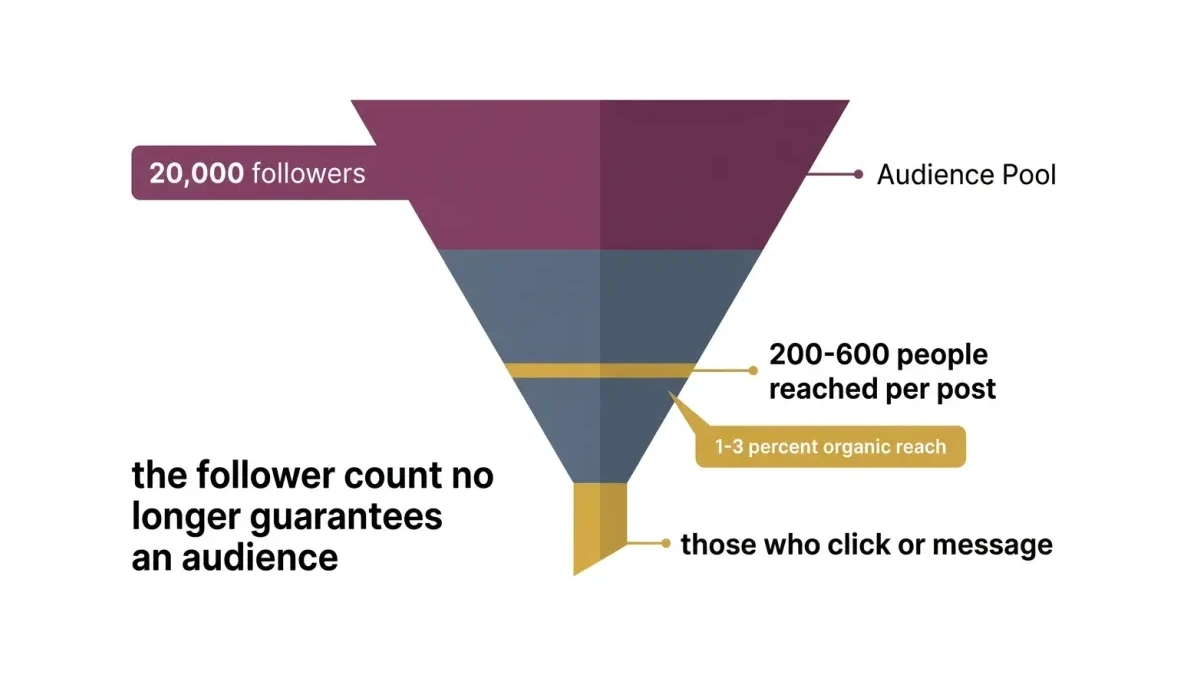
Three structural facts define the Pakistani version of this slope. First, the audience skews mobile and bandwidth-constrained; DataReportal’s report puts Pakistan’s median mobile download speed at 24.56 Mbps, which rewards light, fast, legible-on-a-cracked-screen content and punishes heavy video uploads that buffer. Second, the market’s discovery energy has moved to short video on TikTok, Instagram Reels, and Facebook’s own Reels placement — the classic link-and-photo page post competes inside the weakest format Meta still maintains. Third, the followers a Pakistani page collected in 2018 through like campaigns and giveaways were never an audience in any meaningful sense; they were people who once accepted an offer, and the ranking system has long since noticed they do not interact.
The consequence deserves plain language. A Karachi boutique with 20,000 followers and a 1 percent organic reach rate rents an audience of 200 per post, while its competitor with 900 followers and genuinely interactive content may reach a comparable number in percentage terms — and the second page’s 200 are buyers, not ghosts. Follower count signaled marketing power in 2016; in 2026 it signals history.
Why posting more makes it worse
Book a free strategy call - we'll audit your current setup and identify the highest-impact fixes.
The reflex response to shrinking reach is frequency: if each post reaches 1 to 3 percent, post ten times a day and assemble an audience from fragments. The data argues the opposite. When Sprout’s benchmarks show brands already averaging 9.5 posts per day across networks, additional posts from the same page compete principally with each other for the same rationed attention, and engagement per post falls, which the ranking system then reads as declining content quality.
Here is the falsifiable version of that claim, stated so it can be argued with: for most Pakistani business pages, pushing past three to four distinctive posts per week reduces reach per post without raising total weekly reach, because frequency stopped being a growth lever when the feed saturated. Volume became a cost — creative hours, photographer invoices, the owner’s evenings — spent buying reach the page was already receiving. The pages that grow in this environment are not the pages that publish more; they are the pages whose individual posts earn saves, shares, and comments at rates the algorithm cannot ignore.
The underlying mechanic is selection, not volume. One distinctive post that 8 percent of its small reachable audience saves does more for the next post’s distribution than ten interchangeable product photos, because every save is a prediction the ranking system can bank. Our piece on the cadence problem in Pakistani brands’ social posting schedules works through the same evidence from the planning side; the operational conclusion is to cut frequency and concentrate the same creative budget into fewer, stranger, more specifically Pakistani posts.
What the top 10 percent of pages do differently
The pages still compounding reach in Pakistan share four observable behaviors, and none of them requires a larger budget than their stagnant competitors already spend.
First, they treat distinctiveness as a requirement rather than a style preference — Roman-Urdu captions, faces from the actual community, references to the actual week’s reality, and formats that could not have been published by any other page in the category. In a feed carrying 10.8 million slop mentions, generic content is not neutral; it is actively classified with the filler. Second, they convert attention into owned contact — the email address captured through the link in bio, the WhatsApp Business thread opened from a comment — because a follower is rented and a contact is held; our guide to how much email marketing costs in Pakistan in 2026 prices that owned layer and finds it starts at zero. Third, they pay deliberately, running structured campaigns through Ads Manager rather than tapping Boost, at costs local benchmarks place around PKR 15 to 80 per click — remarkable against the roughly USD 0.83 (about PKR 230) all-industry average CPC that Wordstream data cites in Buffer’s Facebook ads guide. Fourth, they measure what the business receives — messages, store visits, orders — rather than what the page receives, which is the difference between running a channel and maintaining a display case.
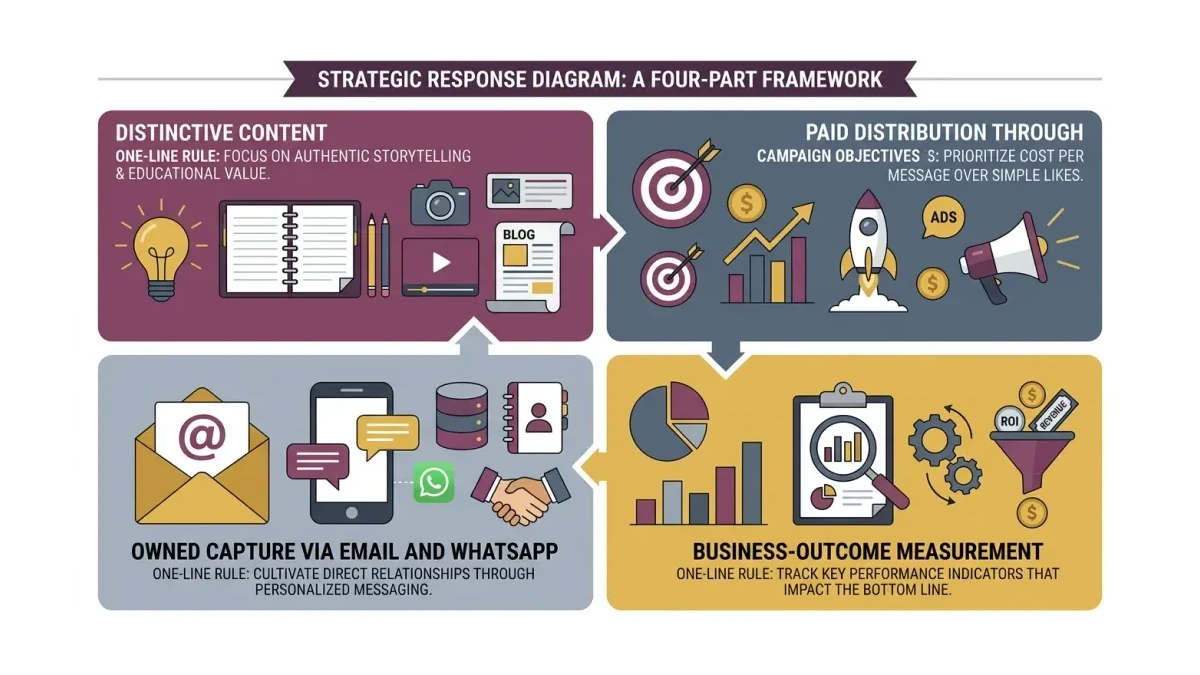
The paid step is where most Pakistani pages leak the most money, because Boost is frictionless and Ads Manager is not. The two mechanisms differ in what they optimize:
| Boosted post | Campaign in Ads Manager | |
|---|---|---|
| Setup | One tap from the post itself | Structured objective, audience, placement |
| Optimized for | Engagement on the post | The outcome chosen: traffic, sales, leads |
| Placement control | Automatic | Manual or Advantage+ managed |
| Measurement | Likes and reach | Cost per site visit, per lead, per sale |
| Honest best use | Announcing to existing followers | Acquiring customers |
A boost buys the cheapest interaction available — usually a like from a lukewarm bystander — and reports it as success. A campaign with a traffic or sales objective buys a click from someone the system predicts will act. Same budget, different species of result; our comparison of what boosting a Facebook post costs in Pakistan and our teardown of pages with likes but no sales cover the gap with numbers.
What Pakistani businesses should run instead
The workable 2026 posture for a Pakistani business page is neither abandonment nor nostalgia; it is a reallocation. Serve the ranking system the one thing it cannot synthesize — specificity to an actual community — and buy distribution only where it converts. Concretely: two to four distinctive posts per week on the page, short video treated as the primary format, every organic post carrying a capture path (profile link, comment-to-DM, WhatsApp tap), and a small always-on paid layer through Ads Manager aimed at messages or sales rather than engagement. Pages that sell should point that layer at a fast mobile landing page, since a cheap click delivered to a slow page is a donation to Meta; and creative quality, not audience tinkering, is where the gains live, as our analysis of why ad creative beats targeting in Pakistani Meta ads shows.
This posture also frees the budget that volume posting quietly consumes. Three strong posts and one structured campaign outperform twelve posts and a panicked monthly boost in every publicly observable metric that matters — reach per post, cost per message, and orders attributed. For pages deciding between rebuilding in-house and outsourcing, our guide to choosing a social media marketing agency in Pakistan lists the questions that separate operators from posting schedules.
Read next: What boosting a Facebook post costs in Pakistan and the cadence problem in Pakistani brands’ posting schedules.
The pages still growing in Pakistan are not louder, and they are not luckier; they pair content only they could publish with paid distribution aimed at outcomes only a business cares about. WeProms Digital, a Pakistan-based social media marketing agency, builds exactly that pairing — distinctive creative, structured Facebook campaign management, and publishing operations that treat reach as a means rather than a trophy. For a page audit that shows where your reach actually goes, reach weproms.com/contact-us, email hello@weproms.com, or message WhatsApp +92 300 0133399.
Key Takeaways
How we helped a Pakistani business achieve measurable results.
- A standard organic Facebook post now reaches roughly 1 to 3 percent of a Pakistani page’s followers; a 20,000-follower page speaks to 200-600 people per post.
- Pakistan’s Facebook audience grew 6.4 percent to 52.9 million in the past year, but brand posting volume grew with it — attention is the rationed resource, not content.
- Posting volume past three to four distinctive posts per week buys no additional total reach and dilutes the engagement signals that determine future distribution.
- Boosted posts optimize for engagement; structured Ads Manager campaigns optimize for business outcomes at Pakistan CPCs of roughly PKR 15-80.
- Every organic post should carry a capture path — email signup, WhatsApp thread, comment-to-DM — because followers are rented and owned contacts are held.
- Distinctive, specifically Pakistani creative is the ranking system’s scarce input; generic content is classified with the slop it resembles.
About WeProms Digital
WeProms Digital is a social media marketing agency headquartered in Lahore, serving Pakistani SMEs, ecommerce brands, and B2B teams across Lahore, Karachi, Islamabad, Rawalpindi, Faisalabad, and Multan.
The team specializes in social media strategy, paid social management, and community-building on Facebook, Instagram, and TikTok, with a track record of building engagement-led page programs that convert followers into measurable messages, leads, and orders.
Get in touch: hello@weproms.com · WhatsApp +92 300 0133399 · weproms.com/contact-us
Sources & References
- DataReportal — Digital 2026: Pakistan — published late 2025
- Sprout Social — Social media saturation — 2026
- Sprout Social — Content benchmarks — 2025/2026
- Buffer — How to advertise on Facebook: a quick-start guide — updated 2026
- Kreation House — Facebook marketing Pakistan benchmarks — 2026
- Inclivo — Facebook vs Google Ads in Pakistan — 2026
Additional reading from industry feeds:
- Sprout Social — Social media saturation (feed source for the posting-volume and slop-mention figures)
- Buffer — How to advertise on Facebook (feed source for the Ads Manager structure and CPC context)