By Hamza Ali · Last updated August 2026.
A Faisalabad apparel brand spends PKR 120,000 a month on Meta ads and posts to its own Instagram feed six times in a good month. The paid side of that business is tuned within an inch of its life. The organic side is a ghost town that wakes up, dumps three product shots in an hour, and disappears again for two weeks. Here’s the thing. The brand thinks it has a creative problem. It has a cadence problem, and the cadence problem is the cheaper one to fix.
Most teams miss this. They treat organic social like a mood, something you do when inspiration strikes, and they treat paid social like a machine. The machine gets a budget, a schedule, and a weekly review. The mood gets whatever the intern remembers on a Wednesday. That split is where the organic reach goes to die, because every platform algorithm in 2026 rewards predictability over volume, and a feed that goes silent for fourteen days is a feed the algorithm has stopped trusting. The fix is simple, and it does not start with better content.
The setup that kills organic reach
We see the same setup across SME accounts in Lahore, Karachi, and Faisalabad. A brand hires a designer, produces twenty posts in a burst of enthusiasm, schedules none of them, and then wonders why reach flatlined in week three. The lever is not the quality of any single post. The lever is the gap between posts, because the gap is what the algorithm reads as a signal about whether the account is alive.
A feed that posts daily for a week and then vanishes behaves, from the platform’s perspective, like a dhaba that is open for lunch and then locks its door at random hours the next day. Customers stop checking whether it is open. The algorithm does the same thing, and it does it faster than a customer would, because it is scoring millions of accounts against each other on consistency. Pakistani brands often lose organic reach not to competitors with better ad creative but to competitors who simply showed up on Tuesday and then again on Thursday.
Where the posting time actually goes
The reason brands stop posting is rarely a lack of ideas. It is that every post becomes a five-hour event. Brainstorm on Monday, shoot on Wednesday, edit on Thursday, argue about the caption on Friday, publish on Saturday, and repeat from zero on Monday. That is a production model built to exhaust a team of one. Sprout Social’s batching workflow is built to kill exactly that loop, and it turns one focused day into a month of posts by clustering similar tasks instead of treating each video as its own project.
We see the time go not into creation but into context-switching. Film one talking-head video, break down the lights to film a product demo, rebuild the setup for a behind-the-scenes clip, and you have spent three setup cycles on three clips. Film all three talking-heads in a row, then all three demos, and the setup cost collapses. Most of the time a small team spends on social is setup time disguised as creative time, and setup time is the part batching removes.
The minimum cadence that holds a feed
Book a free strategy call - we'll audit your current setup and identify the highest-impact fixes.
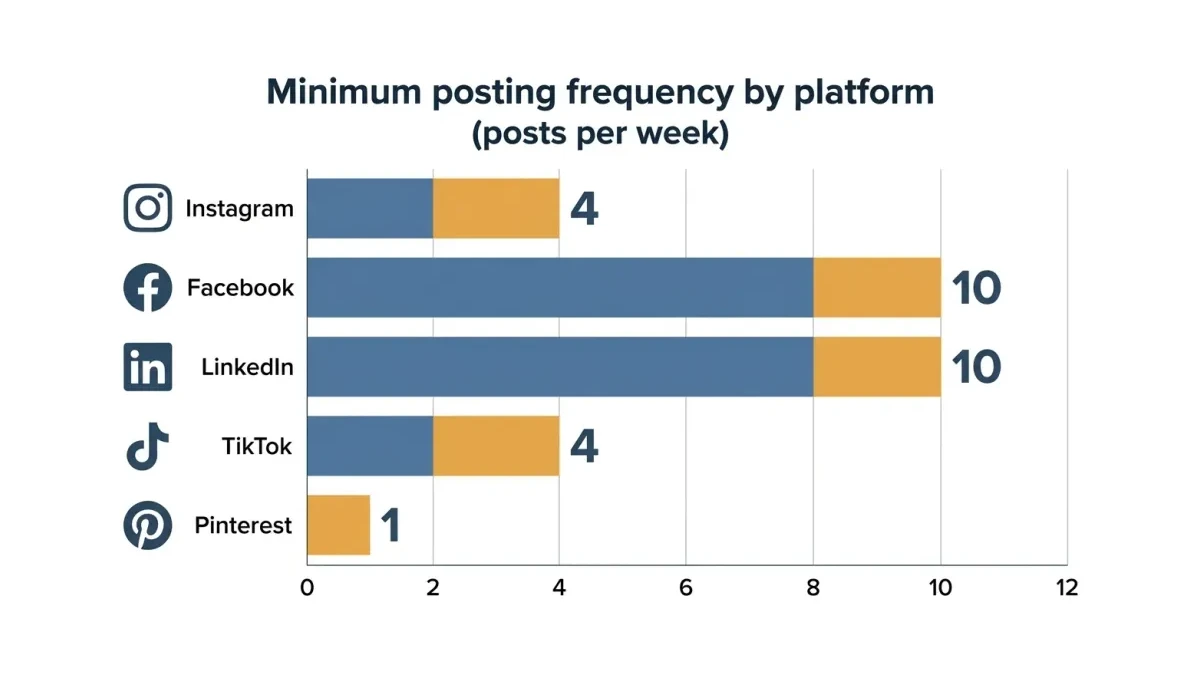
A feed does not need daily hero posts to survive. It needs a floor it can actually keep. Hootsuite’s 2026 platform research sets the minimum bar lower than most Pakistani brands assume: Instagram at three to five feed posts per week with Reels prioritized for reach, Instagram Stories twice a day, Facebook one to two times a day, and LinkedIn once or twice a day on weekdays. TikTok holds at three to five times a week, X tolerates two to three posts a day, and Pinterest stays alive on a single quality pin a week.
The point of these numbers is not the numbers themselves. The point is that consistency at the minimum beats heroics at the maximum, because the algorithm learns the rhythm and the team can actually sustain it. A Karachi skincare brand posting three Reels a week, every week, for six months will out-perform a brand that posts ten Reels in one week and nothing for the next five. Pick the floor you can hold on your worst week, not the ceiling you can hit on your best one, and the floor becomes the asset.
DataReportal’s Digital 2024 Pakistan report counts more than 71 million social media users in the country, which means the audience is not the constraint. The cadence is. A brand that holds its floor is visible to that audience on a predictable schedule, and a brand that does not is invisible to it no matter how large the audience grows. The opportunity is sitting there every week, and most Pakistani SMEs miss it because they are waiting to feel inspired. If you are evaluating content marketing companies in Pakistan, cadence discipline is the first habit to ask about.
The batch day that saves the quarter
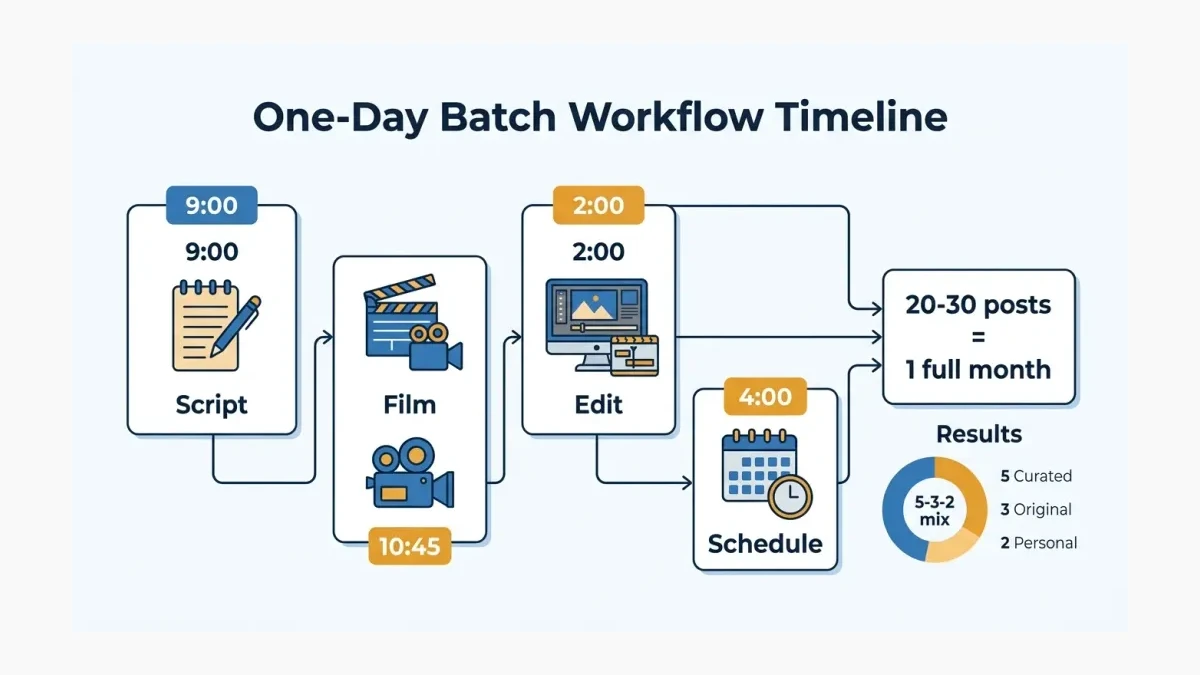
The batch day is the single highest-leverage habit a Pakistani SME can adopt, and it costs nothing but a calendar block. The model is straightforward. One day a month, scripted, shot, edited, and scheduled, produces twenty to thirty pieces of short-form video that hold the feed for four weeks. Sprout’s batching playbook organizes those pieces across four pillars: educational content that builds authority, behind-the-scenes content that builds trust, product spotlights that connect features to value, and social proof that gives a buyer a reason to purchase.
Within the batch day, the order matters more than the ambition. Script hooks and calls-to-action first, because the hook decides whether the middle of the video even gets watched. Film by format rather than by calendar date, recording every talking-head clip in one pass before moving to product demos and B-roll. Edit in three passes: trim the dead air, add the B-roll and screenshots that carry context, then polish with captions and covers. A team that runs this loop once can run it forever, and the feed stops being a daily emergency.
Adweek’s reporting from Cannes Lions 2026 makes the case from the other direction. Challenger brands like Poppi built share through organic social-first thinking before they spent on anything else, and large organizations are now importing that instinct because it works. The lesson for a Pakistani SME is not to copy Poppi’s budget. The lesson is to copy the cadence, because the cadence is what made the organic engine compound in the first place.
The 15-minute weekly review
The cadence only stays alive if something is watching it, and the watching does not need to be elaborate. Fifteen minutes every Friday is enough: which posts landed, which flopped, which pillar is under-fed next week, and whether the batch day for the following month is actually on the calendar. Hootsuite’s guidance is explicit that a posting schedule exists to make analysis possible, because performance only becomes readable when you post on a rhythm you can compare against, which is the same logic that makes measuring content marketing ROI in Pakistan possible.
The review is also where the 5-3-2 content mix earns its keep. For every ten posts, five are curated or shared from trusted sources, three are original, and two are personal or behind-the-scenes. That ratio keeps a feed from sliding into a wall of product shots, which is the failure mode every Pakistani ecommerce account drifts toward under pressure. Digiday’s research found that forty-two percent of marketers are now scaling content production and seventy-three percent have invested in tooling to monitor it, which is the enterprise version of the same habit a Pakistani team can run on a spreadsheet and a Friday calendar block.
Do this every week for a quarter and the feed is no longer a mood. It is a machine, and the machine is the part competitors cannot copy in a sprint.
- Pick one primary platform and commit to its minimum cadence before adding a second.
- Build a four-pillar content bank (educational, behind-the-scenes, product, social proof) so ideas never start from zero.
- Schedule one batch day per month to script, shoot, edit, and schedule twenty to thirty clips.
- Run a 15-minute Friday review on what landed, what flopped, and what the next batch day needs.
- Protect the cadence before chasing volume; the floor you hold beats the ceiling you miss.
Read next: How to choose content marketing companies in Pakistan and how to measure content marketing ROI in Pakistan.
If your brand’s feed runs on inspiration instead of a schedule, WeProms Digital, Pakistan’s social media marketing agency, runs the cadence for you: the pillar plan, the batch-day production, and the weekly review that turns organic social from a mood into a machine. Talk to the team at weproms.com/contact-us, email hello@weproms.com, or message WhatsApp +92 300 0133399.
Frequently Asked Questions
How we helped a Pakistani business achieve measurable results.
How often should a Pakistani ecommerce brand post on Instagram?
Three to five feed posts per week is the floor Hootsuite’s 2026 research recommends, with Reels prioritized for reach and Stories running twice a day. A Karachi or Lahore store that holds that floor every week for three months will out-perform a store that posts daily for one week and vanishes for two, because the Instagram algorithm rewards consistency over volume. Pick the cadence you can keep on your worst week.
Is it better to post daily or to batch once a month?
Batch the production, not the publishing. Film and edit twenty to thirty clips on one day a month, then schedule them across the month so the feed publishes three to five times a week. Batching collapses setup time; scheduling preserves cadence. Posting everything on one day and nothing for twenty-nine days is the exact pattern that kills organic reach.
What does social media management cost in Pakistan?
Most Pakistani agencies price organic social management between PKR 40,000 and PKR 150,000 per month depending on platform count, post volume, and whether video production is included. A managed cadence with a pillar plan, a monthly batch day, and a weekly review sits in the middle of that range. WeProms scopes this per brand after a short audit of the current feed.
Does posting frequency affect Meta ad performance?
Yes, indirectly. A feed that posts consistently signals an active, trustworthy business, which lifts the quality of the landing experience Meta’s algorithm reads when you run ads. Brands that pair a steady organic cadence with paid Meta ads typically see lower costs per result than brands running ads into a silent feed, all else equal.
Which platform matters most for Pakistani SMEs in 2026?
For product businesses, Instagram and TikTok, because Reels and short-form video carry reach and product discovery in Pakistan. For service and B2B businesses, LinkedIn on weekdays. Facebook still reaches the broadest Pakistani demographic and should not be dropped, but it rewards consistency over heroics. Pick one primary platform, hold its floor, then expand.
About WeProms Digital
WeProms Digital is Pakistan’s leading social media and organic content agency, headquartered in Lahore, serving Pakistani SMEs, ecommerce brands, and B2B teams across Lahore, Karachi, Islamabad, Rawalpindi, Faisalabad, and Multan.
The team specializes in social media management, content cadence and pillar planning, and short-form video production, with a track record of turning inconsistent feeds into predictable organic engines through batch-day production and weekly review loops.
Get in touch: hello@weproms.com · WhatsApp +92 300 0133399 · weproms.com/contact-us
Sources & References
- Hootsuite Blog — How to create a social media posting schedule in 2026 — August 7, 2026
- Sprout Social Insights — How to batch a month of TikTok content in one day — August 7, 2026
- DataReportal — Digital 2024: Pakistan — February 2024
- Adweek — Marketing Vanguard at Cannes: AI is becoming the daily job (Mark Kirkham, PepsiCo) — August 7, 2026
- Digiday — By the numbers: How marketers are building the infrastructure for AI search — August 7, 2026
- Search Engine Land — The demand capture trap that’s making search more expensive — August 6, 2026
- MarTech — Personalization still falls short of customer expectations — August 7, 2026
Additional reading from industry feeds: