By Sara Khan, WeProms Digital · Last updated: October 2026
Google does not punish content simply for being AI-written; it punishes content that proves untrustworthy. And since October 2, 2026, fake writer profiles officially count as deception in Google’s guidance. If a Lahore agency fills your blog with invented foreign bylines and unreviewed ChatGPT text, recovery after a rankings hit runs three to six months — not three weeks.
Pakistan’s content market runs on volume. Karachi ecommerce stores, Lahore clinics, and Islamabad consultancies buy blog packages that promise 20 articles a month, and much of that text now comes from ChatGPT or Gemini under invented writer names. That model worked while Google’s rules were vague. They stopped being vague in the first week of October 2026, right after a spam update that was announced on September 24 and rolled out globally over up to two weeks.
The pattern repeats: a business owner notices traffic falling, asks the content vendor, and receives reassurance that “AI content is fine, Google said so.” That reassurance is technically true and practically useless. Google evaluates quality, not production method — but two new guidance documents now define exactly how content fails the quality bar when humans never check the output.
Does Google penalize AI content or not?
No. Google’s stated position, repeated across its spam policies and creating helpful content guidance, is that ranking systems evaluate content quality regardless of how it was produced. What triggers penalties is deception: fabricated facts, scraped text presented as original, invented authors, or pages built to game signals rather than answer a reader’s question.
The practical risk for a Pakistani website is therefore not the tool that wrote the text. It is the absence of any human who verified the text. A dermatology article claiming a false cure, a tax article citing an old Finance Act rate, or a services page with invented credentials all fail on trust, and Google’s October 2026 guidance sharpens exactly those checks. If nobody at your company has read the articles carrying your brand, that is the exposure — not ChatGPT.
Start with an inventory this week: list every page on your site generated without human review, and mark which ones make factual claims a customer might act on.
What did Google change in the first week of October 2026?
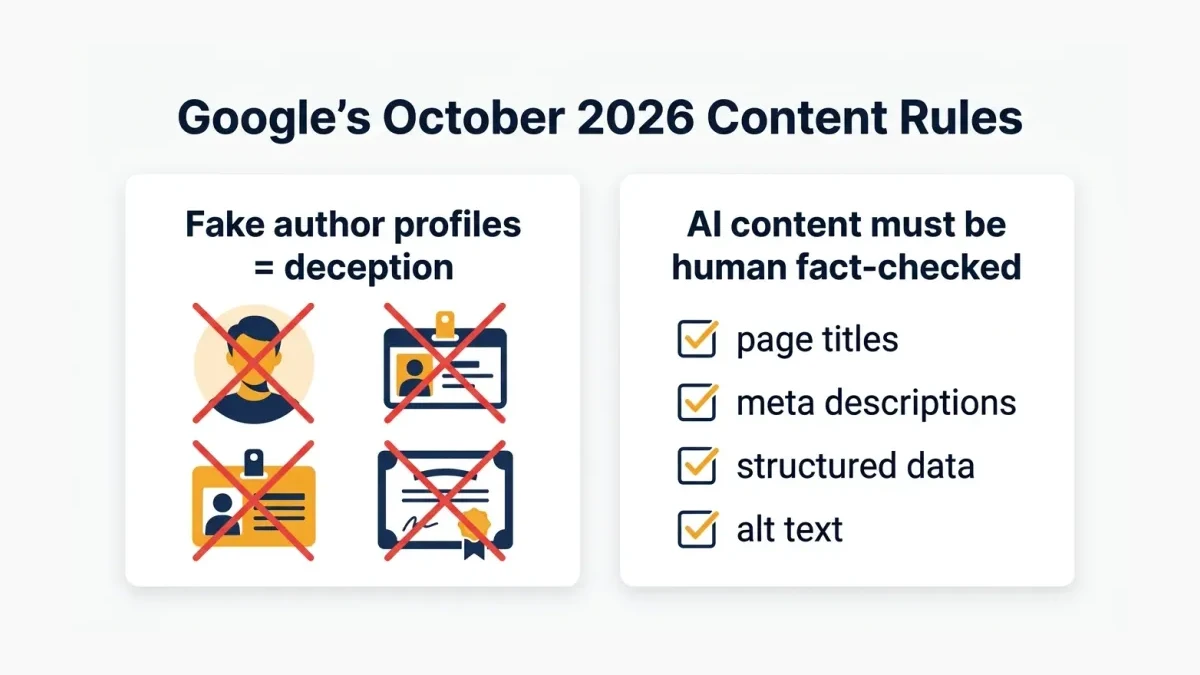
Google updated its content guidance on two fronts: fabricated author profiles and mandatory human review of AI-generated content. Search Engine Journal reported on October 2 that Google’s documentation now describes invented creator profiles as a form of deception that makes a page untrustworthy to users and to Google’s automated quality systems. The same week, Search Engine Roundtable’s October 2 recap documented Google’s updated instruction to manually fact-check AI-generated content before publishing.
The fact-checking requirement is broader than most Pakistani site owners realize. It explicitly covers page titles, meta descriptions — the summary text Google shows under your page name in results — plus structured data (the machine-readable code that tells Google what a page is), and alt text, the hidden descriptions attached to images.
“Using AI-generated headshots, made-up names, or false credentials to make content appear as if it was written by human experts is a form of deception.” — Google guidance, via Search Engine Journal, October 2, 2026
That sentence reframes a habit that is everywhere in the Pakistani SEO market. A Lahore dental clinic publishes implant guides under “Dr. Emily Carter, DDS, Boston” — a person who does not exist, with a headshot no one photographed. A Karachi exporter’s blog is signed by three Western-sounding lifestyle writers. Before October, this was a gray zone. Now it is named, documented deception.
The actionable step is narrow: open your blog’s author list today and confirm every byline maps to a real, contactable human.
What exactly counts as a fake author profile?
Book a free strategy call - we'll audit your current setup and identify the highest-impact fixes.
A fake author profile is any writer identity constructed to imply expertise the person does not have. Google’s guidance names three building blocks: AI-generated headshots, made-up names, and false credentials. A profile can also be fake by omission — a real name attached to claimed qualifications the person never earned, or a “senior editor” title on a site where no editorial process exists.
Pakistani sites typically encounter this through bundled content packages. The vendor delivers articles, bios, and headshots as a set; the site owner publishes the set without asking who wrote it. Months later, a rankings drop arrives, and the byline inventory becomes the evidence file. Affected pages are not always removed from Google’s index — they are simply re-evaluated downward as low-trust signals accumulate, which is quieter and more damaging than a visible penalty notice.
The fix is honesty, and it is cheaper than the workaround. Real names, real (if modest) credentials, and a LinkedIn profile that exists beat an invented Harvard Fellow every time Google’s systems look twice.
How do I check whether my website breaks these rules?
Run a five-point audit that takes an afternoon and costs nothing:
- Open every author page on your site. For each byline, search the name on LinkedIn and Google. No traceable person means the profile fails the new guidance.
- Reverse-image-search each author photo. Stock photos and AI-generated headshots surface quickly.
- Sample five AI-assisted articles and verify their factual claims — prices, dates, legal references, medical statements — against primary sources.
- Check page titles, meta descriptions, structured data, and alt text on your ten most important pages. Automated generation frequently ships placeholder text like “Home” as a page title, or alt text that says “image1.”
- Open Google Search Console and review the Manual Actions section plus your coverage report. A manual action — a human-issued penalty for policy violations — appears there with the specific reason attached.
Sites running multi-language content should add a sixth check. Urdu and Roman Urdu pages are the least reviewed on most Pakistani websites, because grammar and fact-checking tools handle English far better than Urdu. If your AI workflow only validates English output, your Urdu pages are your largest unmanaged risk.
If my rankings already dropped, how long does recovery take?
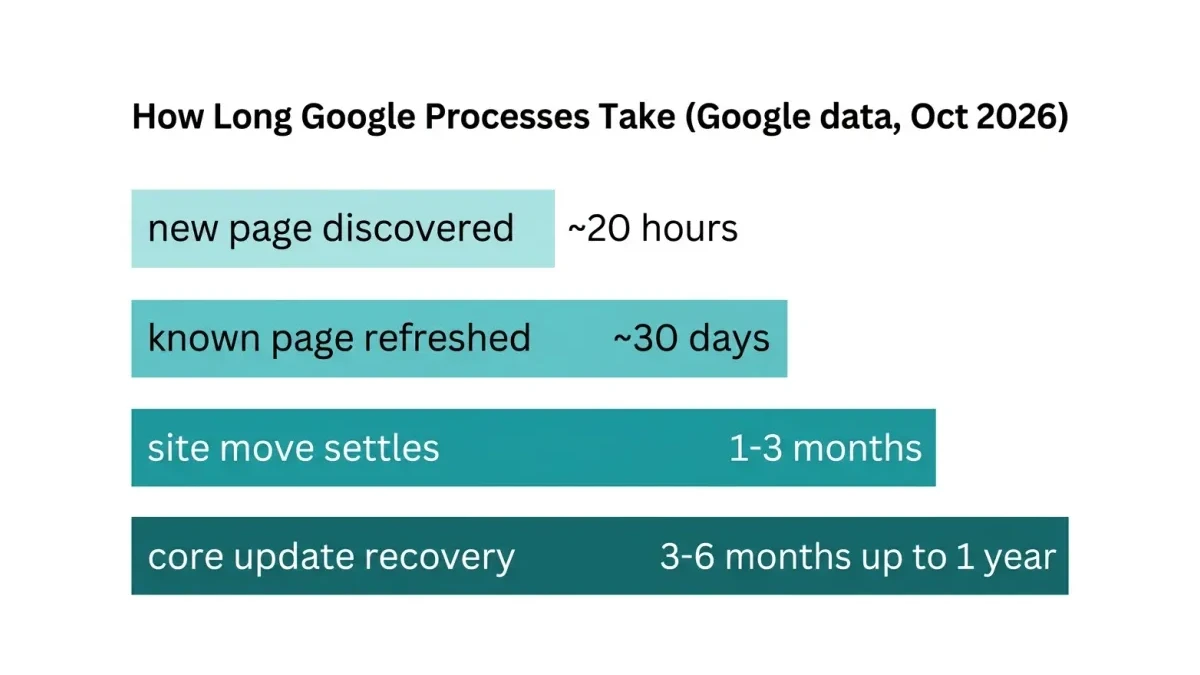
Realistic recovery timelines are measured in months, and the numbers now come from Google itself. At Search Central Live in Barcelona on October 2, 2026, Google analyst Gary Illyes shared internal timing ranges: a new page takes about 20 hours to be discovered, a known page about 30 days to be refreshed after changes, a site move settles in one to three months, and recovery after a core update typically runs three to six months — stretching to six months or a full year in the slowest cases. Search Engine Journal’s recap and PPC Land’s report both published the tables.
| Signal | Likely update impact | Likely normal volatility |
|---|---|---|
| Timing of the drop | Aligns with late-September update waves | Random days, no pattern |
| Depth of the drop | 20%+ of traffic, sustained for weeks | A few positions, recovering within days |
| Scope | Site-wide or every low-quality section | One or two URLs |
| Correct response | Content cleanup, then months of patience | Wait; change nothing |
Here is the claim worth testing against any vendor’s pitch: no SEO provider in Pakistan or anywhere else can honestly promise update recovery in under three months, because the three-to-six-month range comes from Google’s own data, and anyone promising faster results is planning ranking tricks that Google’s next update will catch. Treat a 30-day recovery guarantee the way you would treat a guaranteed visa — the confidence is the scam.
Should I delete all my AI-written content?
How we helped a Pakistani business achieve measurable results.
Deleting everything is usually a mistake. Google’s rules punish untrustworthy content, not machine-drafted text, so the commercially sound move is review and repair: fact-check the claims, fix titles and structured data, replace fake bylines with real ones, and remove only the pages that cannot be defended. A 200-article library where 60 articles survive honest review beats a 10-article library that took the same month of panic to produce.
Keep the surviving pages, but slow the input. A Pakistani business publishing four verified articles a month will, on the timing data above, see each new page discovered in roughly a day and its effect evaluated over weeks — a pace that compounds quietly. Twenty unreviewed articles a month compounds too, in the other direction. If your traffic story began with the September update rather than a content decision, read the earlier spam update recovery walkthrough for the diagnostic sequence before touching anything.
Who should I hire to clean this up?
Hire for verification capacity, not content volume. The vendor question that separates an audit from a cover-up is simple: who reads each article before it publishes, and can you name them? A credible content partner provides real author identities, a documented fact-checking step covering titles, meta descriptions, structured data, and alt text, and reporting that ties content changes to Search Console data over months — because anything measured over days is noise.
WeProms Digital approaches this in plain terms: as the team behind SEO content writing services built around human-reviewed publishing, WeProms audits existing libraries first, removes or repairs untrustworthy pages, and staffs bylines with real writers whose credentials survive a LinkedIn search. For sites already hit by the September 2026 update, the same audit doubles as the recovery plan, sequenced against Google’s own three-to-six-month reality rather than against a sales target. The deeper analysis of why cheap packages damage rankings sits in why cheap SEO packages keep Pakistani websites off Google, and the broader traffic-loss picture is covered in why Pakistani websites lose Google traffic.
Read next: Website Traffic Suddenly Dropped? Google’s Spam Update Recovery · Why Cheap SEO Packages Keep Pakistani Websites Off Google · Is AI Content Getting Pakistani Websites Penalized on Google?
If your site carries unreviewed AI content or invented writers, the audit window matters: every week of publishing adds pages that will need the same repair later. WeProms Digital runs content-trust audits for Pakistani businesses — writer verification, claim sampling, metadata checks, and a fix sequence mapped to Google’s published timelines. Reach weproms.com/contact-us, email hello@weproms.com, or message WhatsApp +92 300 0133399 to start.
Sources & References
- Search Engine Journal — Google Calls Fake Author Profiles a Form of Deception — October 2, 2026
- Search Engine Roundtable — October 2, 2026 Recap: Google Guidance on Fact-Checking AI Content — October 2, 2026
- Search Engine Journal — Google Shows How Long Crawling, Indexing & Recovery Can Take — October 4, 2026
- PPC Land — Google Says New Pages Take About 20 Hours to Be Found — October 3, 2026
- Search Engine Roundtable — Google September 2026 Spam Update Announcement — September 24, 2026
- Google Search Central — Search Spam Policies — Updated October 2026
- Google Search Central — Creating Helpful, Reliable, People-First Content — Updated October 2026
- Google Search Console — Official Overview — Accessed October 2026
Additional reading from industry feeds: