By Abdul Rehman · Last updated: August 2026
TL;DR: Google’s August 2026 spam update, rolled out globally between August 18 and 21, did not penalize AI-written content as such. Google’s spam policies target mass-produced pages built to game rankings, no matter how they are created. The danger for Pakistani websites is not AI; it is cheap, scaled, unoriginal publishing sold as an SEO package.
Did Google’s August 2026 spam update penalize AI-written content?
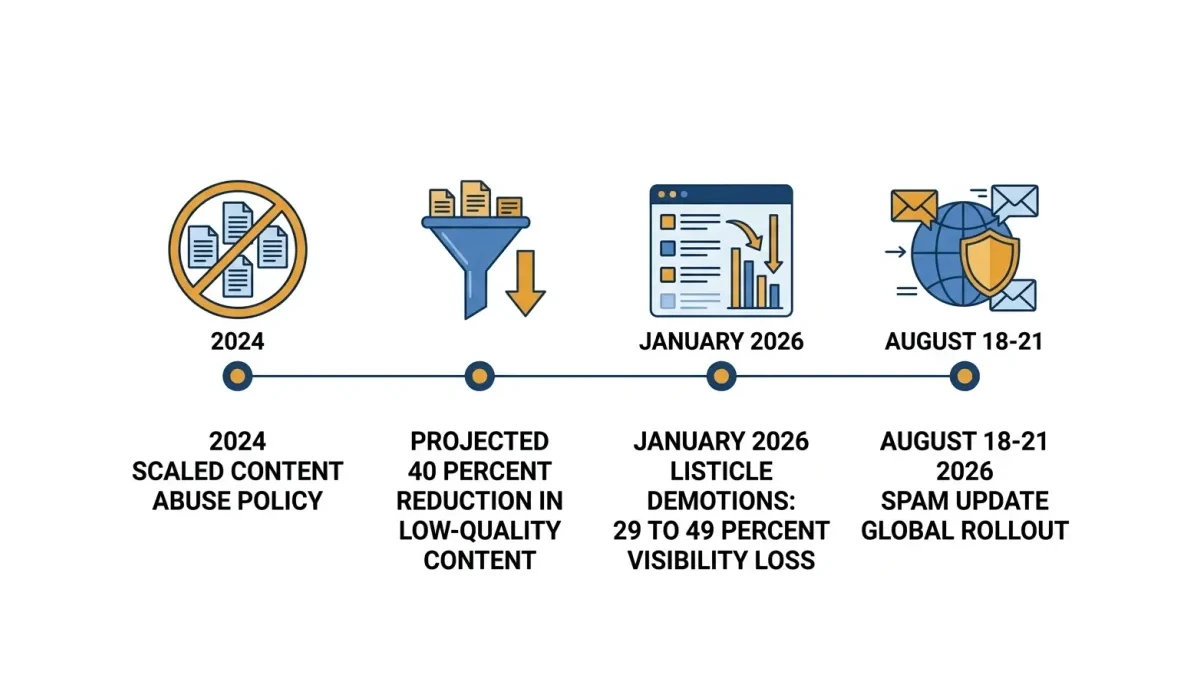
No. Google began rolling out the August 2026 spam update on August 18 and finished on August 21, applying it globally across all languages, and the announcement named no AI-specific target, per Search Engine Land’s coverage. Google’s published position has not changed since it was written down: automation is acceptable when the content helps people, and penalized when it exists to manipulate rankings. Google Search Central states it directly:
Appropriate use of AI or automation is not against our guidelines.
That sentence has a conditional attached, which means the honest reading is about purpose, not tooling. Google’s own guidance, including its practical guide to AI-generated content, asks whether content is original, accurate, and made for people — a test that cheap bulk publishing fails whether a human copy-pasted it or a model generated it.
The distinction matters for a Karachi exporter who publishes two careful AI-assisted articles a week and a vendor who uploads two hundred generated pages overnight. Same tool. Opposite risk profiles. Google evaluates the output and the pattern, not the author’s keyboard.
Why did my rankings drop after we published dozens of AI articles?
Because scale without originality triggers a specific policy, and enforcement of that policy has been tightening for two years. Scaled content abuse — Google’s term for generating many pages whose primary purpose is manipulating search rankings rather than helping users — became an enforcement priority with the March 2024 spam policy changes, which Google projected would reduce low-quality, unoriginal content in results by roughly 40 percent. The policy’s wording is deliberately method-neutral: it applies “no matter how it’s created,” which means AI is simply the cheapest way to trigger it at scale.
Picture this: every stall in Liberty Market stocks the identical factory kurta at the identical price. Shoppers stop browsing because stall twelve adds nothing stall one lacked. That is what a content mill does to a website — hundreds of pages, zero reasons for Google to prefer one over a competitor’s identical set.
The enforcement evidence is measurable. Analysis cited by Search Engine Land found that some software brands built on self-serving “best of” listicles lost 29 to 49 percent of their organic visibility within weeks of an unannounced January 2026 change. A related 60,000-query study found listicles still appear in Google’s top 10 for 55.1 percent of queries — so Google has not banned the format; it has begun punishing the hollow version of it, the kind Pakistani sites often buy in bulk from “SEO article” vendors. If your traffic fell after a bulk upload, the pattern, not the AI, is the suspect; the same collapse eventually arrives for unsupervised AI agents left to run SEO.
How do I check whether my site has a scaled content problem?
Book a free strategy call - we'll audit your current setup and identify the highest-impact fixes.
Run four checks, in order, and the answer is usually visible within an hour. Each one looks for the same underlying symptom: pages that exist for the publisher’s keyword math rather than a reader’s actual question.
First, open Google Search Console and sort pages by impressions with clicks near zero; a large block of pages that Google shows but nobody chooses is the clearest scaled-content signature. Second, search site:yourdomain.com "a question your pages answer" and count how many of your own URLs say almost the same thing — five near-duplicates of “best wedding photographer Lahore” is a consolidation project waiting to happen. Third, sample ten published articles and look for first-hand specifics: a real PKR price, a named tool, a screenshot, an opinion someone could disagree with; generic filler fails that test instantly. Fourth, ask who edited the piece; if no human with subject knowledge touched it, Google’s quality systems and its AI-citation engines both discount it, which is why pages can rank weakly and still never appear in ChatGPT or AI Overviews answers.
What does Google penalize, and what does it reward?
Google penalizes three named spam patterns from the 2024 policy set — scaled content abuse, site reputation abuse (third-party content hosted on a trusted domain to borrow its rankings), and expired-domain abuse — and rewards demonstrable experience. E-E-A-T — Experience, Expertise, Authoritativeness, and Trustworthiness — is Google’s shorthand for the reward side, and it increasingly has to be legible to machines, not just readers. As Search Engine Journal explains, expertise that is obvious to a human can remain invisible to a model unless it is expressed in forms the model recognizes: named authors, credentials, first-hand detail, and locally verifiable context.
A brand doesn’t get credit for authority it holds elsewhere; it must be evidenced in a form the model can recognize as belonging to that market.
For a Pakistani business, that means an author page with a real name and city, photos of the actual workshop or clinic, PKR pricing stated plainly, and references a Lahore customer could verify. A website that does this is simultaneously preparing itself for AI answer engines and building the trust signals Google’s spam systems look for.
Is it still safe to use AI for content in Pakistan?
Yes — with a division of labor that keeps humans on the parts readers actually value. AI drafts, outlines, summarizes research, and translates a strong English piece into Urdu or vice versa efficiently; a person with first-hand knowledge then adds the pricing, the process detail, the opinion, and the accountability. Google’s AI content guidance draws the line at exactly that step: disclosure-style honesty and human review keep content on the right side of the policy.
The economics argue for the same discipline. Organic clicks on top-of-funnel content have fallen 42 percent since AI Overviews began expanding, per Semrush traffic data cited by Search Engine Land, and roughly a quarter of Google searches now end without any click at all, per Semrush’s zero-click study. Thin articles that only existed to catch a query were marginal at 100 percent click-through; at today’s rates they are furniture. Specific, locally useful content — an Urdu-language buying guide, a PKR cost breakdown, a comparison nobody else has written — is what still earns both the click and the AI citation, as we discussed in our piece on zero-click content.
One Pakistani pattern deserves a direct warning: agencies that promise a hundred articles a month are quoting scaled content abuse as a service. No local market supports a hundred genuinely useful articles each month for a single SME; the publishing rate itself is the confession. Two strong pieces a week, each answering one question a real customer asked with evidence only your business owns, outperforms a hundred generated pages on every metric that survives an update.
What should I fix first if my traffic already dropped?
How we helped a Pakistani business achieve measurable results.
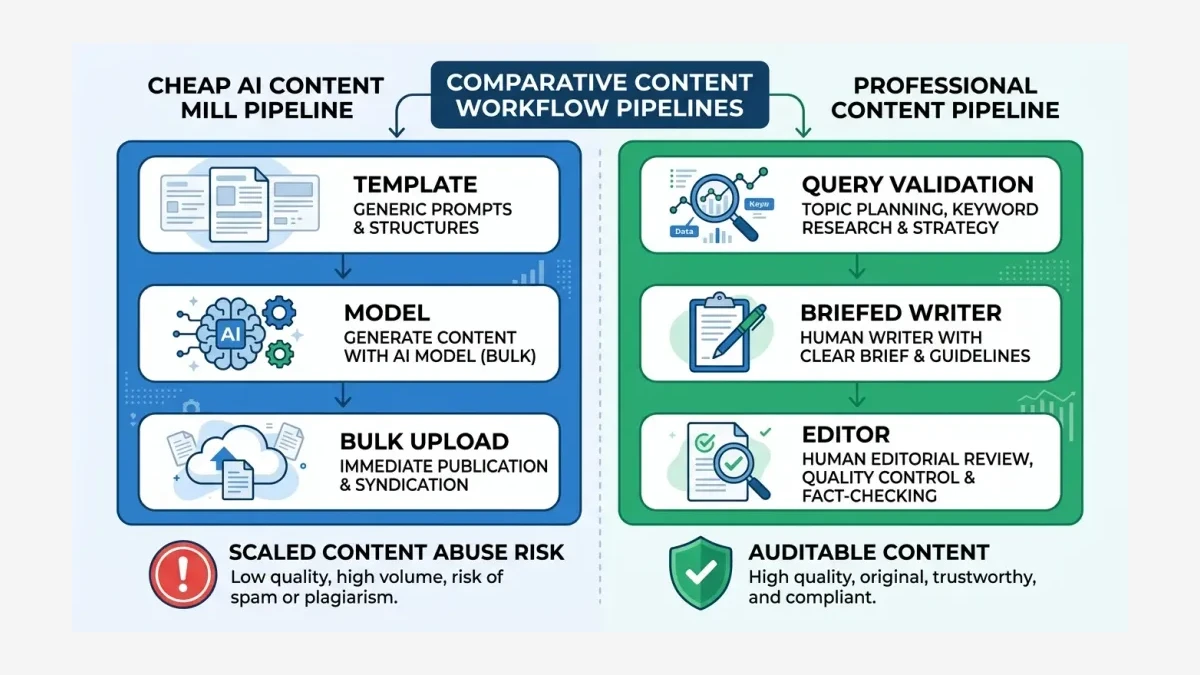
Triage in this order: stop the inflow, prune the backlog, then rebuild with intent. Freeze any bulk-publishing subscription immediately, because every new low-value page extends the pattern Google flagged. Next, in Search Console, identify pages with negligible clicks and either delete them, merge near-duplicates into one strong URL with redirects, or rewrite the few that serve genuine demand. Then rebuild around validated questions — the queries actual customers type, not keyword-list volume — using the comparison below as the hiring standard for whoever writes them.
| Factor | Cheap AI content mill | Professional SEO content |
|---|---|---|
| Who produces it | Model plus template, no industry contact | Briefed writer, subject review, editor |
| Typical cost per article | Under PKR 3,000 per marketplace listing | Several times more, priced against research |
| Originality | Rewrites of page-one results | First-hand detail, PKR pricing, local examples |
| Search demand check | None; volume-first publishing | Query-validated before a word is written |
| Google risk | Scaled content abuse demotion | Low and auditable |
| Realistic outcome | Brief spike, then decay | Compounding rankings and AI citations |
Recovery timelines run in months, not days, because spam-update assessments re-evaluate sites gradually; the August 2026 update itself finished rolling out on August 21, and sites caught in earlier waves recovered only after cleanup, not on the update’s completion date. Document what you removed and when — the record matters when evaluating whether the next update forgives you.
Does hiring a cheap SEO agency carry the same risk?
It carries more, because the agency controls the publishing volume while you carry the penalty. Ask any prospective provider three questions before signing: who writes and edits each piece, what search-demand evidence justifies every article, and what is the monthly publishing ceiling. An agency that cannot answer with named people and a validation step is reselling the mill pipeline with a markup — the same risk you would incur buying generated articles directly, plus a contract.
WeProms Digital, Pakistan’s leading SEO content services team, writes query-validated content with named authors and PKR-specific research, and our SEO audits begin by flagging scaled-content exposure before recommending a single new page. That order is deliberate; we would rather remove a hundred useless URLs than sell you two hundred new ones.
Read next: Why unsupervised AI agents sink Pakistani SEO and SEO rankings versus AI citations for ecommerce revenue.
If a bulk upload preceded your traffic drop, a content audit is the fastest way to separate recoverable pages from dead weight. Book an audit with WeProms or message WhatsApp +92 300 0133399 — the first conversation prices the cleanup, not a content package.
Sources & References
- Google Search Central — Creating helpful, reliable, people-first content — Google official guidance
- Google Search Central — Search spam policies (scaled content abuse) — Google official policy
- Google Search Central — A practical guide to using AI-generated content — Google official guidance
- Search Engine Land — Google releases August 2026 spam update — August 18, 2026
- Search Engine Land — Google August 2026 spam update done rolling out — August 21, 2026
- Search Engine Land — Has Google demoted listicles? — August 26, 2026
- Search Engine Land — Is top-of-funnel content still worth it in 2027? — August 26, 2026
- Search Engine Land — The SEO blind spot is what happens after the click — August 26, 2026
- Search Engine Journal — Why International SEO Needs Machine-Recognizable E-E-A-T — August 25, 2026
Additional reading from industry feeds: