Why Unsupervised AI Agents Are Sinking Pakistani Brand SEO
By Sara Khan · June 19, 2026 — Last updated June 2026.
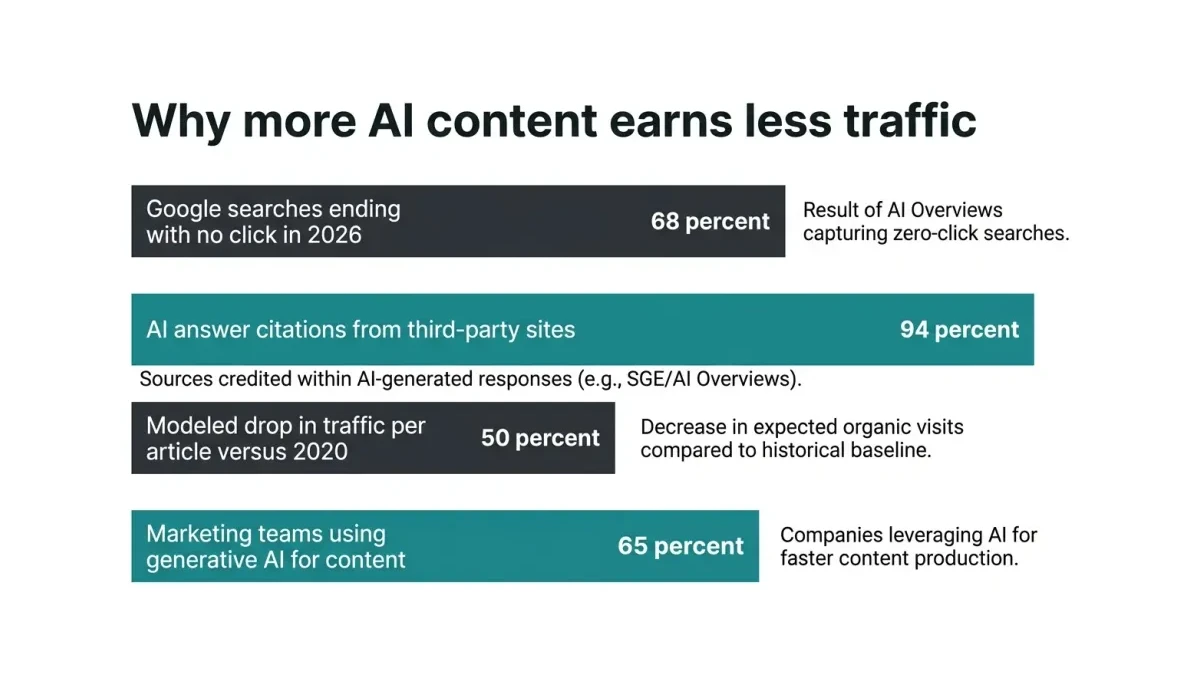
The dominant belief circulating through Pakistani marketing circles in 2026 holds that wiring an autonomous AI agent into your CMS to publish dozens of blog posts each week is the surest route to organic traffic, topical authority, and a permanent edge over rivals still waiting on slow human writers. SparkToro’s clickstream analysis of January through April 2026 found that 68.01% of Google searches ended without a single click to any website, a 7.56-point climb in just two years, and the steepest acceleration in a decade. The brands publishing the most AI-generated text are not winning this race; they are feeding the machine that is quietly routing their readers away. Every unreviewed article an agent ships onto a Pakistani domain adds to a swelling supply of interchangeable prose that search engines and answer engines increasingly decline to send humans toward.
The supply of content has outrun the demand for it
Content production cost collapsed toward zero the moment a single operator could dictate a voice memo into Claude or ChatGPT and generate four platform-ready posts before lunch. The underlying mechanic is straightforward: when the marginal cost of one more article falls close to nothing, the rational move for every publisher is to publish more, and the aggregate result is that the entire web floods with near-duplicate explanations of the same topics. Independent estimates place the volume of AI-assisted web content at five to ten times its 2023 level, and repeated industry surveys show that between half and four-fifths of marketing teams now use generative AI for written content. That means a Lahore shoe retailer, a Karachi real estate agency, and a Faisalabad textile exporter are all publishing structurally similar guides to “how to choose running shoes,” “what to verify before buying a plot,” and “how to export cotton,” often within the same week.
This is the Bolton Market problem rebuilt at internet scale. When every stall on the aisle stocks the same printed fabric at the same price, no stall earns the buyer purely by stacking more bolts of it; the buyer walks to the single stall with a trusted name above the door and a salesman who can tell a real weave from a printed imitation. Search and answer engines now occupy the buyer’s position, and they have grown ruthless about separating substance from bulk. The 68% zero-click figure is the evidence: when Google can assemble a competent answer from twelve near-identical AI blog posts, it does exactly that, and none of those twelve domains receives the visitor who asked the question.
“Why publishing more content is making your SEO worse,” as Search Engine Journal framed the 2026 diagnosis, names the inversion precisely — the tactic that built organic visibility between 2015 and 2021 now actively dilutes it.
The pattern repeats across every vertical Pakistani SMEs compete in. The publisher who shipped thirty thoughtful, evidence-backed guides in 2023 and the one who ships three hundred AI drafts in 2026 are not in the competitive position the content calendar suggests. The three hundred drafts have taught the ranking systems that the domain is a low-trust content source, and recovering that trust costs considerably more than the drafts ever saved. For a deeper look at how this plays out, our analysis of AI content factories and their cost to Pakistani SMEs’ organic traffic traces the same decline through real account data.
Answer engines reward being quoted, not being published
Book a free strategy call - we'll audit your current setup and identify the highest-impact fixes.
A zero-click search is a query that Google or an assistant resolves without sending the user to any website, and it now describes roughly two thirds of all searches. The counterpart metric that matters in 2026 is citation share — the percentage of relevant AI answers in which an engine quotes or links your domain. These two numbers together explain why a Pakistani brand can publish feverishly and still watch referral traffic fall. A 2026 analysis of AI Overview behavior found that roughly 94% of citations inside AI answers point to earned, third-party, authoritative sources rather than the brand’s own blog. Publishing more on your own domain, in other words, does very little to earn the citation that actually carries the reader.
What actually drives citation is not volume but recognizability and evidentiary weight. Brands that get cited inside AI Overviews see roughly 35% higher organic click-through and 91% higher paid click-through than uncited competitors on the same results page, according to Seer Interactive analysis summarized in Yotpo’s 2026 guide, because the AI’s inclusion acts as a soft endorsement. That endorsement, however, is reserved for sources the engine already trusts — established publishers, regulatory bodies, vendor documentation, and pages carrying original data or named expertise. A freshly minted AI blog post on a six-month-old Pakistani domain carries none of those signals, no matter how many times the agent publishes it.
The practical consequence for a Pakistani SME is uncomfortable. The content the agent produces fastest — generic listicles, definitional explainers, “everything you need to know” roundups — is precisely the content AI answers are designed to absorb and summarize without citing. The harder content — a PKR cost breakdown for Daraz seller fees, a comparison of JazzCash and Easypaisa settlement times, a documented test of Shopify versus WooCommerce load speeds on Pakistani mobile networks — is what earns the citation, and an unsupervised agent will almost never produce it because it cannot run the test or quote the vendor. This is why our field notes on Pakistani traffic loss as a content problem rather than an AI Mode problem keep arriving at the same conclusion: the channel changed, but the fix is still evidence.
Why volume was always a proxy, never a strategy
Volume worked as an SEO tactic for a simple and temporary reason. Between roughly 2012 and 2021, good human-written content was scarce and expensive to produce, so the number of indexed, relevant pages on a domain functioned as a reasonable proxy for investment, expertise, and topical coverage. Engines rewarded coverage because coverage correlated with effort. That correlation broke the day an agent could generate a hundred grammatically correct pages overnight for less than the cost of a single freelance article. Coverage stopped signaling effort and started signaling automation, and the ranking systems adjusted accordingly.
Pedro Dias, writing for Search Engine Journal on content “written for readers who don’t read,” identified the deeper failure: much AI content is engineered to satisfy a perceived algorithm rather than a human reader, and the engines have learned to read that intent back out of the text. The result is a quiet penalty that does not arrive as a notification. Pages simply stop receiving impressions, the domain’s crawl budget gets spent on duplicates that never rank, and the monthly organic traffic line drifts down even as the publish count climbs. The spreadsheet looks productive; the analytics tell the opposite story.
What actually drives durable visibility in 2026 is the opposite of volume. It is specificity, originality, and demonstrable expertise — a single definitive guide to Sindh sales tax for ecommerce sellers outweighs fifty generic “tips for selling online” drafts, because the guide can be quoted, the tips cannot. Brainlabs captured the broader shift when it described the arrival of “the AI era of infinite creative,” noting that abundance itself has become the obstacle brands must now overcome. For Pakistani brands, that obstacle is lower and wider than for Western competitors, because the local data and Urdu-language nuance that would differentiate a page are exactly what an English-trained agent cannot generate without a human in the loop.
The cost inversion that changes the math for Pakistani SMEs
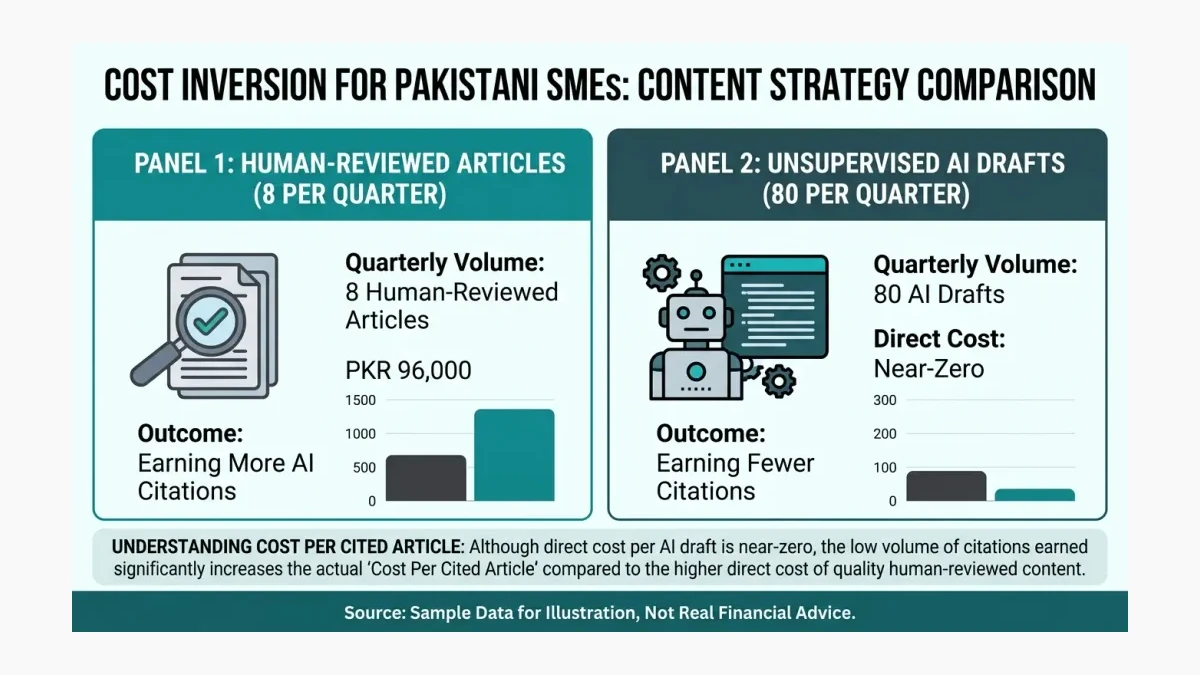
Here is the falsifiable claim worth testing against your own account: a Pakistani SME that publishes eight human-reviewed, data-rich articles per quarter will earn more AI citations and more converting organic traffic than one that publishes eighty unsupervised agent drafts in the same period, even though the eighty drafts cost less per word. The reason is that the eighty drafts compete against millions of near-identical pages for a shrinking pool of clicks, while the eight reviewed articles compete for citations in a far smaller field of genuinely original sources. The unit economics have inverted, and most content budgets have not caught up.
Consider the cost structure. A freelance Pakistani writer producing one researched, fact-checked article might cost PKR 8,000 to PKR 15,000, and an agent-generated draft costs effectively nothing in direct spend. But the relevant denominator is not cost per word; it is cost per cited article or cost per converting visitor. Eight reviewed articles at PKR 12,000 each is PKR 96,000 per quarter. Eighty agent drafts at near-zero direct cost still require hosting, crawl budget, editorial cleanup to avoid publishing harmful inaccuracies, and the reputational drag of a domain that reads as automated. When measured against citations earned and leads generated, the eight-article model wins for most service businesses and ecommerce stores, because the eighty-draft model produces traffic that, even when it arrives, converts poorly.
The tradeoff is not human versus machine. It is supervised versus unsupervised. An agent that drafts, with a human operator who edits, fact-checks, adds PKR figures, inserts real screenshots from Daraz or Shopify Pakistan, and verifies claims against SBP or PTA sources, produces output that can earn citations. An agent that publishes raw is producing inventory for someone else’s answer engine to summarize for free. Pakistani brands that built their organic presence on volume between 2018 and 2022 are now watching that asset depreciate fastest, because the engines have reclassified their domains from “comprehensive” to “automated” without sending a notice. Our guidance on zero-click content strategy for Pakistani brands lays out the editorial standards that survive that reclassification.
What survives when AI agents write everything
How we helped a Pakistani business achieve measurable results.
The content that holds its value in a flooded market shares a short list of traits, and none of them are accidental. It carries original data the agent could not invent — a measured load time, a quoted vendor price, a documented regulatory requirement. It names specific entities and authorities, because citation engines resolve meaning through connected entities, and a page densely linked to Daraz, JazzCash, the SBP, and named Pakistani cities signals subject competence that generic prose cannot. It is written to be quoted in discrete passages, with self-contained paragraphs that an engine can lift verbatim, rather than as meandering narratives that resist extraction. Hethr Campbell’s four-layer AI operations playbook, published on Search Engine Journal in 2026, formalizes this shift from “more output” to “better, structured, reviewable output” — and the layering is the point.
Originality also now includes format. A proprietary framework, a named method, a Pakistan-specific cost calculator, or a documented test of two local tools gives an engine something it can only source from your domain, which is the only durable path to a citation in 2026. The brands that will hold organic visibility through the next two years are not the ones publishing most; they are the ones publishing what no agent can reproduce without them. For most Pakistani SMEs that means investing in the evidence — the pricing research, the platform comparisons, the regulatory detail — that a global content factory structurally cannot generate.
The principle worth defending
The defensible principle is simple, and it cuts against the prevailing advice: in a market where production is free, the only scarce asset is verified judgment. An unsupervised AI agent manufactures the commodity that is now cheapest — plausible text — and asks you to trade the asset that is now most expensive, which is the trust an engine extends to a domain that publishes only what a human has checked. Pakistani brands that continue to optimize for publish count are optimizing for the 2018 game on a 2026 board, and the board is scoring citations and clicks, not posts. Publish less, verify everything, cite real sources, and let the agent draft while a human decides what ships. That is the inversion, and the brands that accept it early will be the ones the engines still quote when the flood is at its highest.
Read next: AI content quality for Pakistan business blogs and how human-experience content beats AI in Pakistani search.
If your organic traffic is falling while your content output rises, the problem is almost certainly unsupervised automation, not effort. At WeProms Digital, Pakistan’s leading SEO agency, we run content strategy services built around human-reviewed, evidence-led publishing designed to earn AI citations rather than inflate post counts. Tell us what your agent is publishing, and we will show you what to cut, what to verify, and what to replace with content an engine will actually quote. Reach us at hello@weproms.com, on WhatsApp at +92 300 0133399, or through weproms.com/contact-us.
Sources & References
- SparkToro — In 2026, Less than One Third of Google Searches Still Send a Click — May 2026
- Search Engine Land — Google Zero-Click Searches 2026 Study — May 2026
- GoodFirms — AI SEO Statistics 2026: Rankings, Zero-Click Trends — 2026
- OptimizeGEO — Generative AI SEO: Strategy Guide to AI Search in 2026 — 2026
- Yotpo — Google AI Mode vs Traditional Search: A Guide for Brands — 2026
- Omnibound — Zero-Click Search Statistics (2026) — 2026
- Instant Press — AEO Statistics: AI Overview and Citation Behavior — 2026
- BrightEdge — Gemini Becomes Second-Largest AI Referral Source in Q1 2026 — May 2026