

By Sara Khan. Last updated: May 2026.
The prevailing belief among Pakistani small and medium enterprises is that investing more in organic SEO — more blog posts, more backlinks, more keyword optimization — will protect their search visibility as Google evolves; the safer reading is more nuanced: traditional SEO still matters, but every PKR spent on generic informational content should be questioned if it cannot be connected to qualified enquiries, trust, or sales.
A significant portion of Pakistani SME marketing spend goes to SEO retainers — monthly fees for keyword research, content writing, link building, and technical audits. The problem is not SEO itself. The problem is SEO work that cannot be tied to revenue, cannot explain zero-click search behavior, and cannot show whether visibility is turning into qualified enquiries.
The traffic collapse hiding in your analytics
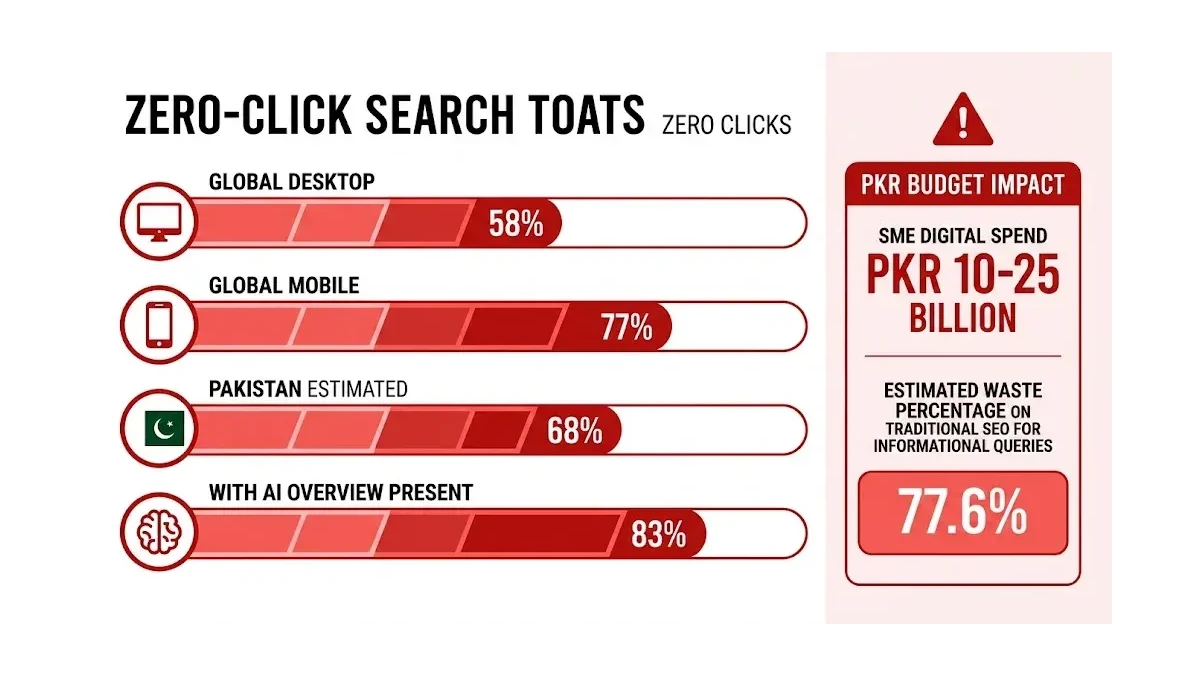
Global zero-click studies show that many searches end without a click to an external website. Pakistan’s mobile-heavy behavior makes this important because a small screen can be filled by ads, maps, rich results, and AI summaries before a classic organic listing appears.
AI answers are most disruptive on informational queries — the exact query type many Pakistani SMEs target with generic blog content. These answers can synthesize information from multiple sources and present it directly in search results. The user gets enough information; the website may get no visit.
Consider what this means for a Faisalabad textile manufacturer spending a meaningful monthly amount on an SEO retainer that produces weekly blog posts about “fabric quality standards,” “textile export regulations,” and “best fabric suppliers in Pakistan.” These informational queries are precisely the type that AI Mode now answers directly. The blog posts still exist. They may even rank. But the traffic they were designed to capture — the clicks from users searching for information — is disappearing into AI Mode’s synthesized answers. The SEO budget produces content. The content produces rankings. The rankings produce impressions. The impressions produce no clicks, no leads, no revenue.
“Publishers brace themselves for the zero-click era amid Google’s AI search overhaul,” Digiday reported in May 2026, capturing the anxiety that extends far beyond media companies to every business that depends on organic search traffic.
Why publishing more content makes the problem worse
The instinct of most Pakistani SEO agencies, when a client reports declining traffic, is to publish more content. More blog posts, more service pages, more location-based landing pages. This is the equivalent of paying someone to fill water buckets during a flood — the activity looks productive, but the underlying condition worsens regardless.
Search updates and AI search features both push marketers toward clearer, more useful content. The safest approach is to build pages that serve customers first: direct answers, proof, service details, local context, and clean technical access.
The underlying mechanic is straightforward. Traditional SEO rewards pages with strong backlink profiles, keyword relevance, and technical compliance. AI Mode rewards pages with extractable, self-contained answer blocks, specific data points, and entity-rich content. These are not the same thing. A 2,000-word blog post written for keyword density and internal linking may rank well but offer AI engines nothing extractable. A 500-word page with a precise PKR pricing table, a named regulatory body like SBP or PTA, and a direct answer to a common question may earn citations even without strong backlinks.
Publishing more keyword-targeted content without restructuring it for AI extraction does not solve the visibility problem. It increases the volume of content that AI Mode ignores. For Pakistani SMEs paying a wide range of monthly fees in SEO retainers, this means paying for content that increasingly serves Google’s AI training data rather than their own lead pipeline.
The SEO agency model has an expiration date
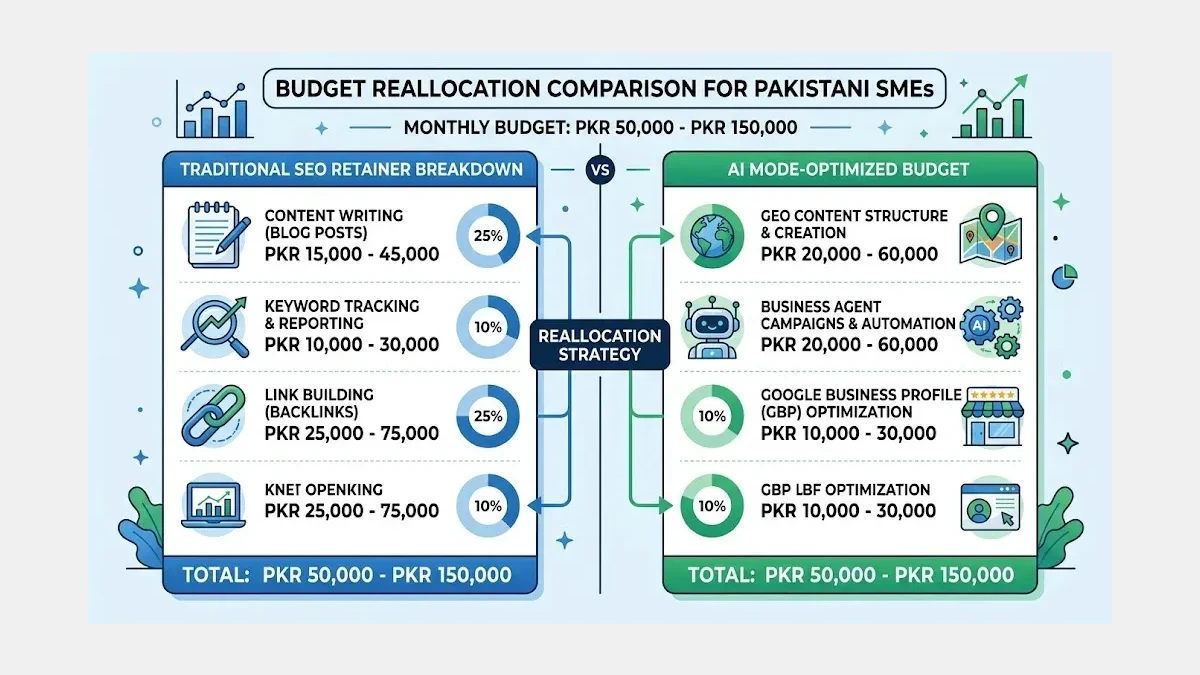
The standard Pakistani SEO retainer ranges from a wide range of monthly fees depending on scope and agency size. Most retainers include a set number of blog posts (typically 4–8 per month), ongoing keyword tracking, technical monitoring, and quarterly reporting. The model is built on the assumption that more content, more keywords, and more backlinks will produce more traffic over time.
That assumption held for a decade. It stopped holding when Google began answering queries directly. Pakistani SMEs paying a fixed monthly fee for a set number of blog posts are paying for content that increasingly serves AI Mode’s training data rather than their own lead pipeline. The content exists, it ranks, but the traffic flows to Google’s AI-generated answer — not to the business that created the content.
AI-assisted research does not remove the need for human validation. This reveals a critical nuance in how AI search changes buyer behavior. Buyers use AI Mode to gather information, but they still want human validation before committing to a purchase. The opportunity for Pakistani SMEs is not in producing more information — AI Mode already synthesizes information from multiple sources. The opportunity is in being the human validation that AI-referred buyers seek. That requires a different kind of investment: in brand presence, in direct response channels, and in AI-visible content that positions the business as the authoritative source AI Mode cites.
Where the budget should go instead
A Pakistani SME that redirects part of a generic content retainer toward Google Business Profile quality, better service pages, conversion tracking, and content structured for clear answers is usually in a stronger position than a business that only publishes keyword-driven blogs.
Google’s conversational discovery ads and highlighted answers — new AI Mode ad formats announced at Google Marketing Live 2026 and documented by Search Engine Land — place sponsored results directly inside AI Mode’s recommendation lists. Instead of competing for organic clicks that may never come, businesses appear within the AI-generated answer itself. For Pakistani SMEs, this means paying for visibility inside the exact experience that is capturing their former organic traffic.
Google’s Business Agent for Leads converts ad clicks into AI-powered conversations that qualify prospects before they submit contact information. This addresses the lead quality problem that has plagued Pakistani Google Ads campaigns for years — the expensive click that produces a form fill with a fake phone number. The AI agent pre-qualifies leads using your website content, reducing wasted ad spend on unqualified inquiries.
Redirecting SEO budget does not mean abandoning organic presence entirely. It means restructuring organic investment. Pakistani SMEs should maintain their Google Business Profiles, publish entity-rich content with specific PKR data and named sources, and implement structured data markup that helps AI engines extract citations — the kind of GEO audit approach that measures AI citation rates rather than keyword rankings. But the monthly retainer model of producing blog posts for keyword rankings — the bulk of what Pakistani SEO agencies sell — is losing relevance faster than most agencies will admit.
The principle that should guide every search marketing decision
Every PKR spent on search visibility should answer one question: does this investment appear in the experience where my customer actually makes a decision? In 2024, that experience was a Google search results page with ten blue links. In 2026, that experience may include ads, maps, AI Overviews, AI Mode-style journeys, marketplaces, and classic organic results on the same small screen. Pakistani SMEs that continue optimizing for the 2024 experience are paying for visibility in a channel their customers have already left.
The businesses winning in this transition are not the ones publishing more content. They are the ones appearing inside AI Mode answers — through structured organic content, Google Business Profile optimization, and AI Mode ad placements. The opportunity is open now, and the cost of inaction compounds monthly as AI Mode adoption accelerates in Pakistan’s mobile-first search market.
Read next: Stop Hiring SEO Agencies for Google AI Mode in Pakistan · AI Mode Zero-Click Cost for Pakistani Ecommerce
As a Pakistani digital marketing agency, WeProms Digital helps Pakistani SMEs restructure their search marketing budgets for AI Mode. From GEO audits to Google Business Agent setup, WeProms builds AI-visible marketing systems that generate leads regardless of organic click trends. Contact hello@weproms.com or message WhatsApp +92 300 0133399. Visit weproms.com/contact-us to start.