By Sara Khan · Last updated: June 2026.
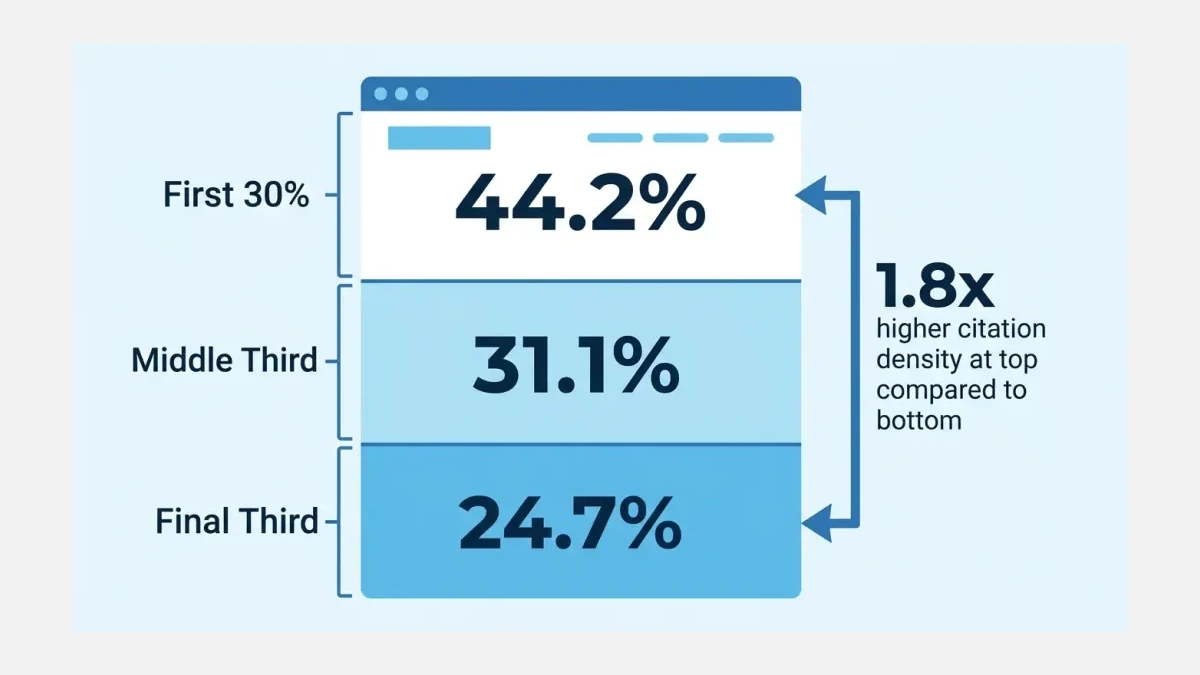
ChatGPT pulls 44.2% of its citations from the first 30% of your page. Another 31.1% come from the middle third. Only 24.7% come from the bottom. Your opening sections are 1.8x more likely to be cited than your closing ones, according to Backlinko’s 2026 analysis of Semrush data. If your key information is buried at the bottom of your service pages, AI engines are skipping it entirely.
If you run a service business in Lahore — a dental clinic in Johar Town, a law firm on Mall Road, or an IT services company in Arfa Tower — your website has roughly twelve seconds to convince ChatGPT that your page is worth citing. Not ranking for. Not clicking on. Citing. The difference matters. Rankings determine where you appear in Google’s blue links. Citations determine whether AI engines recommend your business by name when a customer in Karachi asks “best dentist near DHA Phase 6.”
Backlinko’s research also shows that nearly 90% of ChatGPT citations come from pages ranked 21st or lower on Google. AI engines do not prefer the top results. They prefer the most extractable content. A page at position 34 with clear headings, self-contained paragraphs, and front-loaded data points gets cited over a page at position 2 with long introductory paragraphs and buried statistics.
First, identify the prompts your customers type into AI tools
The audit starts with prompt research — the process of discovering exactly what your potential customers ask AI engines about your services. Pakistani business owners and marketing managers use AI tools differently from how they use Google. On Google, someone types “accounting software Pakistan.” On ChatGPT, the same person types “what is the best accounting software for a small business in Lahore that handles FBR tax filing and costs under PKR 10,000 per month.”
These longer, conversational prompts are called money prompts — the specific AI queries where being recommended directly generates leads. For a Lahore dentist, money prompts include “best dentist in Lahore for root canal treatment,” “dental implant cost in Lahore PKR,” and “orthodontist near Gulberg braces price.” For a Karachi law firm, money prompts include “best corporate lawyer in Karachi for startup registration” and “trademark registration cost Pakistan.”
Document every prompt where your brand should appear but does not. Use Semrush’s AI Visibility Toolkit to see what users type into AI tools and which brands the AI recommends. Alternatively, manually type 20-30 relevant prompts into ChatGPT, Perplexity, and Google AI Mode and record which businesses appear in the responses. The gap between where your brand should appear and where it actually appears is your citation deficit.
The underlying mechanic is query fan-out. When someone asks ChatGPT a question, the AI does not run a single search. It breaks the prompt into 5-12 sub-queries, searches each one independently, and stitches the best fragments into a unified answer. Only 27% of these sub-queries remain consistent across repeated searches, according to Backlinko’s fan-out research. Your page needs to answer as many of those sub-queries as possible to maximize citation probability.
Then, map the sub-queries AI engines generate from each prompt
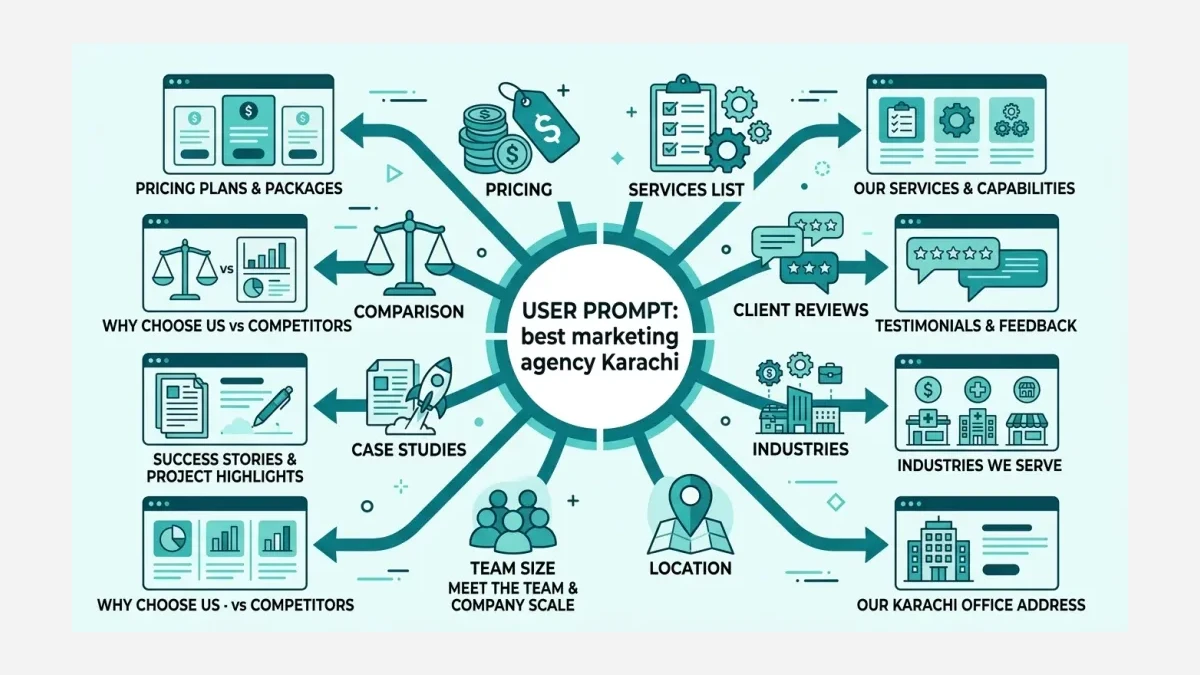
Understanding query fan-out changes how you structure content. When a potential customer asks “best marketing agency in Karachi for small business,” ChatGPT generates sub-queries that include: marketing agency pricing in Karachi, small business marketing services list, client reviews for Karachi marketing agencies, industries served by Karachi agencies, and location verification for Karachi-based teams.
Each sub-query represents a separate extraction opportunity. Your page needs a section that directly answers each one. Not a single paragraph attempting to cover everything, but distinct, clearly labeled sections that AI engines can match to individual sub-queries.
Backlinko’s analysis of how different AI platforms handle fan-out reveals distinct behaviors. ChatGPT reasons internally first, then runs live web searches when the question requires fresh data or comparisons. Perplexity combines conversation context with real-time search results. Claude clarifies intent before searching and relies more heavily on training data. Google AI Mode breaks complex prompts into multiple searches across its index. Each platform generates different sub-queries from the same prompt.
For Pakistani businesses, this means one page needs to satisfy multiple AI platforms simultaneously. The AI search citation gap analysis for Pakistani businesses covers platform-specific differences, but the structural fix is universal: build your page in sections, each answering a distinct sub-query.
Next, restructure your page so the first 30% carries the heaviest claims
Book a free strategy call - we'll audit your current setup and identify the highest-impact fixes.
The data is unambiguous. 44.2% of ChatGPT citations come from the first 30% of a page. Your H1, your opening paragraph, and your first two subheadings carry 1.8x more citation weight than everything below them. If your strongest claims, specific pricing, and named services are buried in the middle or bottom of your page, AI engines extract weaker content from the top instead.
Bose’s product pages demonstrate the principle. Their headphone listings lead with “24 hours of battery life” and “legendary noise cancellation” as scannable elements at the top of the page. When someone searches “best noise-canceling headphones for flight anxiety,” Google AI Mode recommends Bose using nearly identical language from the Bose flight landing page. The claim was front-loaded. The AI found it immediately.
For a Pakistani service business, this restructuring means your homepage or service page should open with your most specific, data-rich claims. A Lahore dental clinic page should lead with “Root canal treatment starting at PKR 15,000 — 4,200+ procedures completed across DHA, Gulberg, and Johar Town since 2019.” Not “Welcome to our clinic. We provide quality dental care.” The first sentence is extractable. The second is not.
The Bose example is instructive at scale. Bose has over 63,900 mentions across AI platforms in the U.S. alone. Their content is built to be extracted: specific claims placed as scannable elements, not buried in narrative paragraphs. When the user’s prompt matches the scenario the page was built for, AI systems pull from it using nearly the page’s own language.
After that, build self-contained paragraphs that survive extraction
This is the most important structural change in the audit. AI engines extract paragraphs, not pages. When ChatGPT cites your page, it copies a specific paragraph — usually 2-4 sentences — and embeds it in its response. If that paragraph contains an orphan pronoun like “this approach” or “these results,” the citation becomes meaningless when separated from its original context.
Every paragraph on your page must make complete sense when read alone, without any surrounding context. The paragraph must name its subject explicitly. Instead of “This service helps businesses grow,” write “Google Ads management for Lahore retailers drives 30% more store visits within 90 days.” The second version names the service, the audience, the outcome, and the timeline. An AI engine can extract it and the reader understands it without reading anything else.
Query fan-out — the process where AI engines break a single user query into multiple sub-queries to create comprehensive responses — means each paragraph on your page is a potential independent citation unit. A paragraph about “payment options including JazzCash, Easypaisa, and bank transfer” might get extracted when someone asks an AI engine about payment methods, even if the rest of your page is about something entirely different. Every paragraph must carry its own weight.
At this point, add entity markers that AI engines recognize
Named entities — specific company names, platform names, city names, regulatory body names, and tool names — are how AI engines determine whether a paragraph is relevant to a query. A paragraph mentioning “Daraz, JazzCash, and the State Bank of Pakistan” carries significantly more AI signal weight than one mentioning “ecommerce platforms, digital wallets, and banking regulations.” The first paragraph contains recognizable entities. The second contains generic descriptors.
Backlinko’s AI optimization guide identifies what it calls the “citation core” — a small group of sites and brands that every major AI search tool trusts and cites as default sources. Wikipedia appeared 16 times in Backlinko’s cross-platform test. Mayo Clinic dominated health queries. RTINGS controlled electronics reviews. These entities achieved citation core status because they are named consistently across thousands of third-party sources.
For Pakistani businesses, entity density means naming specific tools (GA4, Meta Ads Manager, Semrush, HubSpot), platforms (Daraz, Shopify Pakistan, WooCommerce), Pakistani cities (Lahore, Karachi, Islamabad, Faisalabad, Multan), regulatory bodies (SBP, PTA, SECP, FBR), payment systems (JazzCash, Easypaisa, HBL, UBL), and local business references. Increase named entity density across your pages. Pages with more connected, recognized entities show higher AI selection probability.
A page for a Pakistani ecommerce marketing agency should name Daraz, Shopify, WooCommerce, JazzCash, Easypaisa, the State Bank of Pakistan, PTA, GA4, Meta Ads Manager, Google Ads, and specific Pakistani cities. Each entity creates a potential match point when an AI engine runs fan-out sub-queries.
Once you have restructured, test with three AI platforms
How we helped a Pakistani business achieve measurable results.
The final step is live testing. Type your target prompts into ChatGPT, Perplexity, and Google AI Mode. Document three things: whether your page is cited, what the AI says about your business, and which competitors appear instead of you.
Backlinko’s cross-platform testing found that official brand websites made up only approximately 10% of all citations. The other 90% came from third-party sources: review sites, news outlets, community forums, and comparison pages. This means restructuring your own website is necessary but not sufficient. You also need to ensure your brand is mentioned accurately on third-party platforms that AI engines cite frequently.
The Orange Marketing case study, reported by MarTech Series, demonstrates the business impact. The company identified an AI visibility gap, restructured its content for AI extraction, and achieved a 5x conversion lift within one month. The fix was not more content. The fix was better-structured content that AI engines could extract and cite accurately.
| Element | Before AI Restructuring | After AI Restructuring |
|---|---|---|
| Opening paragraph | Company history, mission statement | Specific claim with data point and entity names |
| Content structure | Long paragraphs, buried key facts | Short self-contained sections with front-loaded claims |
| Entity density | Generic terms (“our services,” “quality solutions”) | Named entities (GA4, Daraz, SBP, Lahore, PKR 15,000) |
| Sub-query coverage | Answers main question only | Answers 8-12 related sub-queries in separate sections |
| FAQ section | None or generic questions | 5+ specific questions with 40-80 word answers |
| Paragraph style | Connected narrative with pronoun references | Self-contained units that survive independent extraction |
Think of your webpage like a NADRA office form. The clerk processing your application reads the first few fields — name, CNIC number, address — and makes an immediate decision about whether to proceed. If the important information is buried in a paragraph at the bottom of the form, the clerk moves on to the next applicant. AI engines work the same way. They scan the top of your page first, extract what they find, and rarely dig through paragraphs of introduction to reach your actual claims.
The cost of not doing this audit is measurable. Ahrefs reports that 96.55% of all web pages receive zero search traffic from Google. Most of those pages are invisible to AI engines too. The restructuring audit takes a page from “exists but unreadable by AI” to “structured for maximum extraction probability” — and the citations that follow generate referral traffic that no amount of traditional link building can replicate.
Pakistan’s leading content strategy agency WeProms Digital audits and restructures Pakistani business websites for AI readability. The team identifies money prompts, maps query fan-out sub-queries, restructures page content for front-loaded extraction, and tests citations across ChatGPT, Perplexity, and Google AI Mode. Contact WeProms Digital at hello@weproms.com or message WhatsApp +92 300 0133399 to schedule an AI content readability audit.
Frequently Asked Questions
What does “AI-readable” mean for a Pakistani business website?
AI-readable means structuring your website content so that AI search engines like ChatGPT, Claude, Perplexity, and Google AI Mode can extract specific claims, data points, and recommendations from your pages. Key elements include front-loading important information in the first 30% of the page, using self-contained paragraphs, adding named entities (specific tools, cities, and platforms), and structuring content to answer the 8-12 sub-queries AI engines generate from each user prompt.
How long does it take to restructure a website for AI readability?
A single service page can be restructured in 3-5 hours by someone familiar with the AI readability principles. A full website audit covering 10-20 pages typically takes 2-3 weeks when done by an experienced content strategy team. The content marketing companies guide for Pakistan covers what to look for when hiring an agency for this work.
Does AI readability replace traditional SEO for Pakistani businesses?
No. AI readability complements traditional SEO. Google rankings still drive the majority of search traffic. AI readability ensures that when AI engines generate answers about your services, your business appears in those responses. The two strategies work in parallel: traditional SEO for Google rankings, AI readability for AI citation visibility. Both are necessary for comprehensive search visibility in 2026.
How do I know if my page is being cited by AI engines?
Type your target prompts into ChatGPT, Perplexity, and Google AI Mode. Check if your business name or content appears in the responses. For systematic tracking, use Semrush’s AI Visibility Toolkit, which shows which prompts trigger citations for your domain and which competitors appear when you do not. The AI search revenue playbook for Pakistani ecommerce covers tracking AI-driven revenue attribution.
What does WeProms charge for AI content restructuring in Pakistan?
WeProms Digital offers AI readability audits starting from PKR 75,000 for a single-page restructuring, with full website audits priced based on page count and complexity. The service includes prompt research, content restructuring, entity optimization, and post-implementation testing across three AI platforms. Contact hello@weproms.com for a custom quote.
Sources & References
- Backlinko — LLM Visibility: The SEO Metric No One Is Reporting On (Yet) — February 2026
- Backlinko — AI Optimization: Content Tasks for AI Visibility — April 2026
- Backlinko — AI SEO Myths, Debunked: A No-BS Guide For Marketers — November 2025
- Ahrefs — SEO Statistics: 62+ SEO Stats for 2026 — 2026
- Google Blog — Search at Google I/O 2026 — May 2026
- SEO Sherpa — Google AI Mode: What It Means for Your Traffic — 2026
Additional reading from industry feeds:
- MarTech Series — Orange Marketing 5x Conversion Lift from AI Visibility Fix — 2026
- Search Engine Roundtable — Schema.org Usage Statistics — 2026
Read next: AI Search Revenue Playbook for Pakistani Ecommerce · Track AI Search Mentions for Your Pakistani SME