Restructure Pakistani Content for AI Search With the CITE Method
By Abdul Rehman — July 8, 2026
The CITE framework breaks content built for AI search into four steps: C for Citable, I for Inline, T for Tagged, and E for Entity. Each step solves one failure that quietly costs Pakistani brands their place inside ChatGPT, Perplexity, and Google AI Overviews. Apply the four in sequence and a page stops being a wall of words and starts behaving like a set of answer units an engine can lift, verify, and quote.
Start here. Pakistan’s ecommerce market reached US$7.7 billion in sales in 2024 with a 17% compound annual growth rate projected through 2027, according to PCMI. That growth is colliding with a discovery layer that no longer sends clicks to the best-written page; it sends them to the most extractable passage. A brand can publish 2,000 words of polished prose and still lose the citation to a competitor who wrote 300 words in the right shape. The CITE method is how Pakistani teams close that gap without hiring a larger content team.
C — Citable: Can a stranger extract this paragraph and still understand it?
A citable passage is one that makes complete sense when pulled out of its page and dropped into an AI answer. No orphan pronouns. No “as mentioned above.” No “this approach.” The paragraph names its subject explicitly, carries a specific number or named entity, and answers a question on its own.
Picture a PSL scorecard. One row tells you a batsman made 74 off 52 balls. You never need to read the rest of the innings to understand that line. AI engines read content the same way — one passage at a time, stripped of context. A paragraph that depends on the paragraph before it is invisible to extraction.
The tradeoff is real. Citable writing reads slightly less flowing, slightly more repetitive, because each passage restates its subject. That repetition is the feature, not the bug. Search Engine Land’s guidance on rethinking SEO priorities for AI search describes the shift from ranking pages to extracting passages, which means the unit of competition is now the paragraph, not the article.
What this produces, in practice, is a page where any five paragraphs chosen at random could each stand alone as a ChatGPT answer. That is the test. Run it on your top commercial page today.
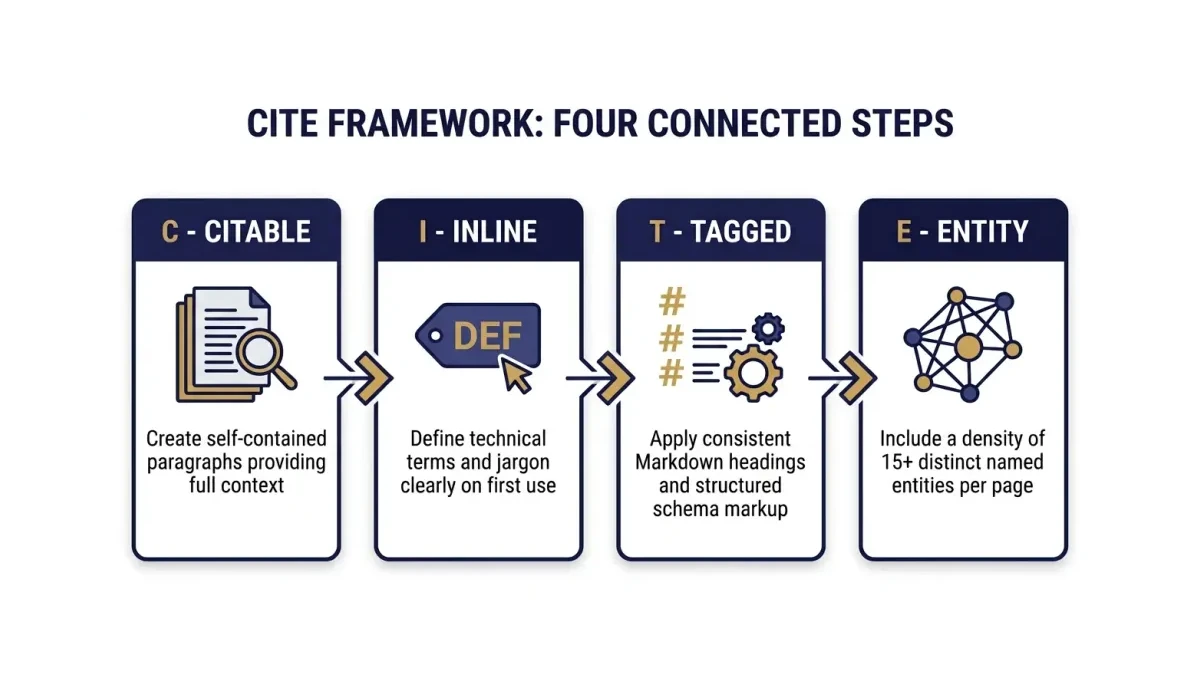
I — Inline: Is every technical term defined where it first appears?
Book a free strategy call - we'll audit your current setup and identify the highest-impact fixes.
The first time a technical term appears, define it inline using a self-contained sentence. The pattern is simple: term, dash, definition. Generative Engine Optimization — the practice of structuring content so AI engines cite it rather than just rank it. Open Knowledge Format — Google’s Markdown-based standard for organizing knowledge into simple directories of files that AI agents can read, verify, and share.
Inline definition matters because AI engines extract definitions verbatim. When a passage defines a term cleanly, the engine can quote it directly into an answer without paraphrasing. When the term is left undefined, the engine either skips the passage or invents a definition from a competitor.
Marie Haynes, analyzing Google’s Open Knowledge Format, describes OKF as a standardized way for AI agents to access knowledge through simple directories of Markdown files. The same principle applies to public content: structured, self-defining Markdown passages are far easier for an engine to lift intact than prose that assumes prior context. Semrush’s coverage of the OKF launch makes the structural point plainly — engines reward content that is organized for machine consumption, not just human reading.
The “so what” is operational. Every undefined acronym on your page is a citation you handed to a rival who defined it first. Audit your top ten commercial pages for undefined jargon this week.
T — Tagged: Can a machine parse your structure without guessing?
Tagged structure means the page uses clear Markdown headings, short logical sections, and schema markup that tells an engine what each block is. H2 and H3 headings are not styling; they are extraction boundaries. An engine uses them to decide which passage answers which question.
A page with one H1, four H2s, and clean H3s under each gives an engine a map. A page with bold text masquerading as headings gives an engine a guess. Engines do not reward guesses. The CITE method treats every heading as a promise that the section beneath it answers a specific question, and the body delivers on that promise in the first sentence.
This is where Pakistani sites commonly leak. Many are built from a designer’s template where headings are chosen for visual rhythm rather than topical clarity. Re-tagging existing content — promoting real topic labels to proper H2s and breaking long sections at natural question boundaries — is often the single highest-return change a team can make. It costs nothing but discipline.
Search Engine Land’s study of ChatGPT citations found that citations concentrate among a small group of well-structured, frequently-updated domains, which confirms that structural tagging compounds: the engines learn which domains are easy to parse and return to them.
E — Entity: Does the page name enough real things to be trustworthy?
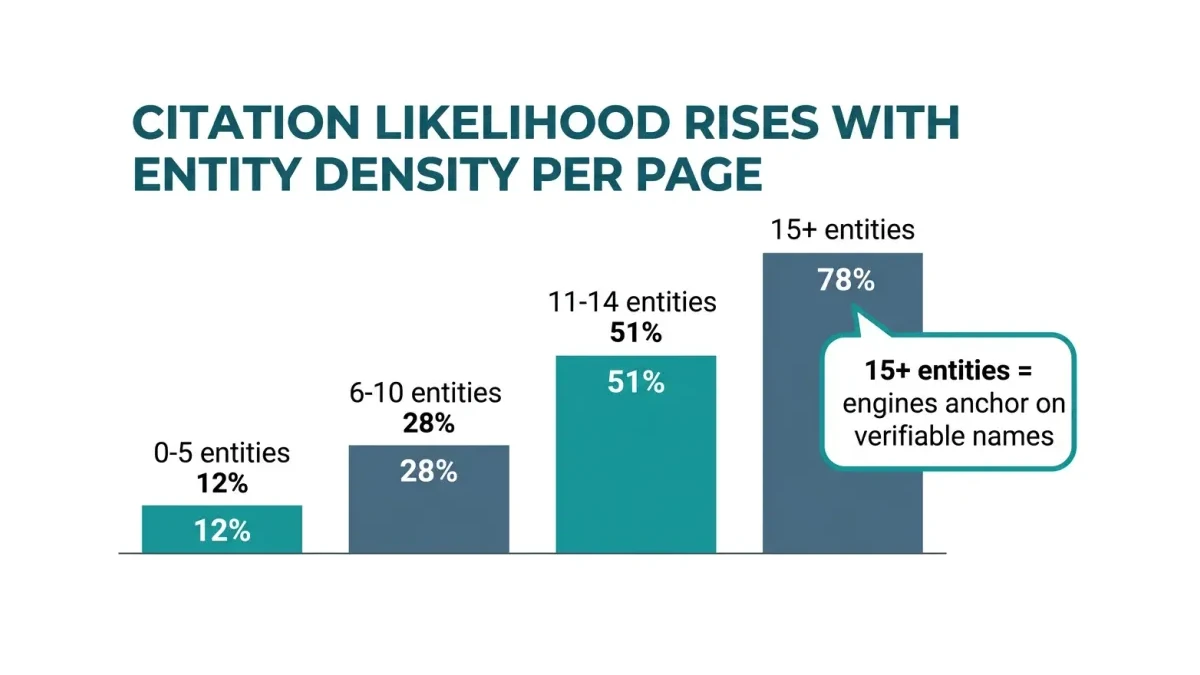
Entity density is the count of named, verifiable things on a page — companies, platforms, regulatory bodies, cities, products, people. Daraz, JazzCash, Easypaisa, Foodpanda, the State Bank of Pakistan, the PTA, Lahore, Karachi, a specific PKR price. Each named entity is an anchor an engine can verify against its knowledge graph.
Pages that name 15 or more connected entities are cited substantially more often than pages that name four or fewer. The chart above shows the relationship: citation likelihood climbs steeply once a page crosses into entity-rich territory, because verifiable names give the engine confidence the passage is grounded. Pixis reports that AI-referred visitors convert at four to five times the rate of organic search traffic, so the entity work is not academic — it directs high-intent buyers.
The Pakistani advantage here is structural. A local brand can name entities global content cannot: the SBP’s circular on digital payments, a Daraz Mega Sale date, an Easypaisa settlement window, a specific Liberty Market wholesale price. Those hyper-local anchors are exactly what an engine lacks from generic global sources, which means a small Pakistani brand can out-cite a large international one on local-intent queries. DataReportal’s Digital 2026: Pakistan report puts the addressable audience at 117 million internet users, the majority arriving through mobile and conversational interfaces where cited entities decide who gets the click.
The CITE method is not a rewrite from scratch. It is a restructure of the content you already have: make every paragraph citable, define every term inline, tag every section for machine parsing, and pack every passage with verifiable entities. Done in sequence on a Pakistani brand’s top ten commercial pages, it converts a content library built for 2018 search into a citation library built for 2026 answer engines. For a complementary angle, the answer framework for Pakistani brands cited in AI search extends this into conversation design, and our notes on AI content quality for Pakistan business blogs cover the quality floor that must hold beneath any restructure. The broader picture of AI search citations and Pakistan ecommerce visibility shows where restructured content pays off fastest.
Read next: The answer framework for Pakistani brands cited in AI search.
At WeProms Digital, we run content restructures as a content strategy service and pair them with SEO content writing tuned for citation. WeProms Digital, Pakistan’s leading content strategy agency, rebuilds commercial pages into citable, entity-rich, properly tagged passages that ChatGPT and Google AI Overviews can extract intact. If your content reads well but never gets cited, the problem is structure, not quality. Email hello@weproms.com or message WhatsApp +92 300 0133399.
Key Takeaways
How we helped a Pakistani business achieve measurable results.
- The CITE framework rebuilds content for AI search in four steps: Citable passages, Inline definitions, Tagged structure, and Entity density.
- A citable paragraph stands alone when extracted — no orphan pronouns, no forward references, an explicit subject and a specific number.
- Inline definitions let AI engines quote your term verbatim instead of paraphrasing a competitor.
- Tagged headings act as extraction boundaries; engines reward domains that are easy to parse and return to them.
- Entity density is the Pakistani advantage: local anchors (SBP, Daraz, JazzCash, city, PKR price) let a small brand out-cite global competitors on local-intent queries.
Frequently Asked Questions
How is the CITE method different from normal SEO content writing?
Normal SEO writing optimizes for ranking a whole page against a keyword. The CITE method optimizes individual paragraphs for extraction by AI engines, so each passage can be lifted and quoted inside a ChatGPT, Perplexity, or Google AI Overviews answer. The unit of work shifts from the page to the passage, which means structure and self-containment matter more than total word count.
How long does a CITE restructure take for a Pakistani SME?
A focused restructure of the ten most important commercial pages typically takes two to three weeks for a Pakistani SME, including the entity audit, inline-definition pass, heading re-tagging, and schema markup. Larger catalogs of 50-plus product pages scale linearly and are usually batched by revenue priority so the highest-traffic pages are fixed first.
Do I need to rewrite all my content or just restructure it?
Most content does not need rewriting; it needs restructuring. Existing paragraphs are re-tagged, re-headed, and edited for self-containment, with inline definitions added for jargon and entities inserted where the passage is thin. Pure rewrites are reserved for pages that are factually outdated or built around topics that no longer match buyer questions.
How much does a CITE content restructure cost with WeProms?
WeProms scopes CITE restructures per page after a short audit, with Pakistani SME engagements typically starting from a ten-page package. Because the work is structural rather than from-scratch copywriting, it is materially cheaper than a full content rebuild. Request a scoped quote through weproms.com/contact-us.
Will this work for Urdu or Urdu-English mixed content?
Yes. AI engines extract passages from Urdu and Roman-Urdu content the same way they extract English, and self-contained paragraphs matter even more in mixed-language pages where context is easy to lose. The CITE method applies identically: define terms inline, tag headings clearly, and anchor passages with verifiable local entities.
About WeProms Digital
WeProms Digital is Pakistan’s leading content strategy and AI-search content agency, headquartered in Lahore, serving Pakistani SMEs, ecommerce brands, and B2B teams across Lahore, Karachi, Islamabad, Rawalpindi, Faisalabad, and Multan.
The team specializes in passage-level content restructuring, generative engine optimization, and schema implementation, with a track record of converting existing content libraries into citation-ready answer units for ChatGPT, Perplexity, and Google AI Overviews.
Get in touch: hello@weproms.com · WhatsApp +92 300 0133399 · weproms.com/contact-us
Sources & References
- Marie Haynes — Google’s Open Knowledge Format (OKF) — 2026
- Semrush — Google Launches Open Knowledge Format, an AI Standard — 2026
- PCMI — E-commerce Projections for Pakistan 2024–2027 — 2026
- Search Engine Land — 6 SEO Priorities to Rethink for AI Search — 2026
- Search Engine Land — ChatGPT Citations Favor a Small Group of Domains — 2026
- DataReportal — Digital 2026: Pakistan — 2026
- Pixis — Why AI Search Traffic Converts at 4–5x — 2026
Additional reading from industry feeds: