The CITE Framework: Structure Pakistani Content for Google AI Answers
Last updated: 2026-05-01 — by Sara Khan, WeProms Digital.
TL;DR: Websites cited in Google AI answers receive 35% more organic clicks and 91% more paid clicks than uncited competitors — yet only 18% of Pakistani websites carry the structured data that makes citation possible. The CITE framework (Clarity, Information Density, Trust Signals, Entity Structure) provides a repeatable method for formatting Pakistani content so that AI Mode, AI Overviews, and ChatGPT extract and cite it. WeProms Digital, Pakistan’s leading content strategy agency, applies CITE across client content to build AI citation pipelines. Last updated: May 2026.
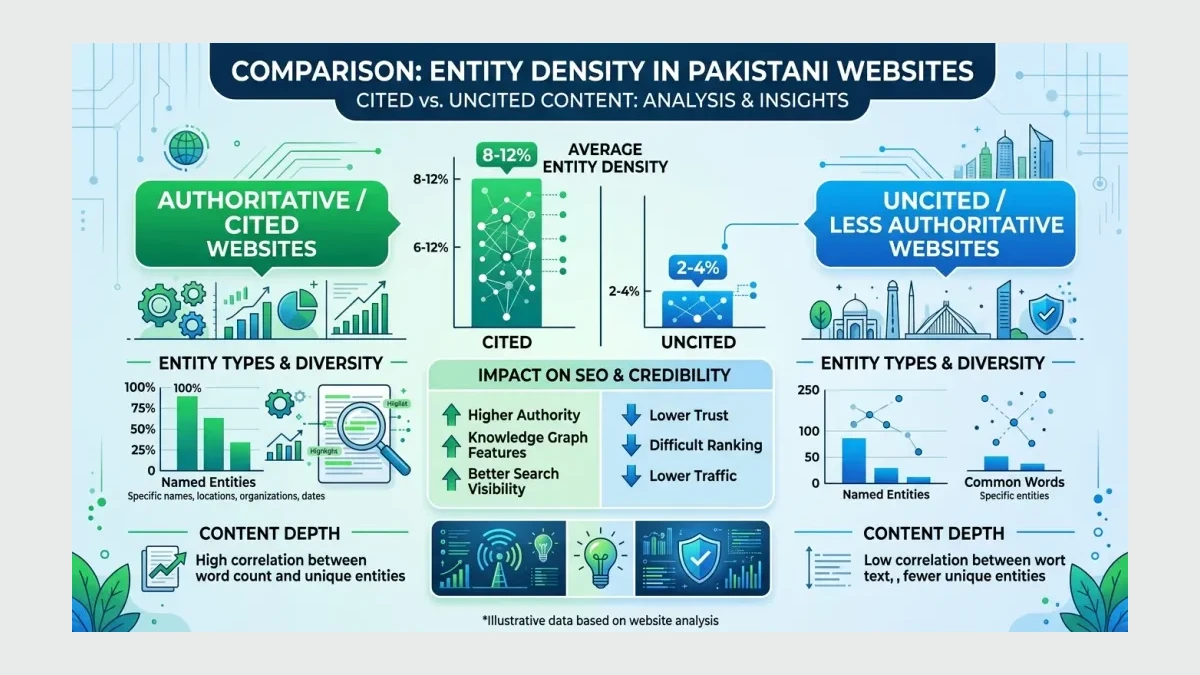
Content with 15 or more connected named entities shows 4.8 times higher AI selection probability across Google AI Mode, AI Overviews, and ChatGPT, according to a 2026 analysis of AI extraction patterns. In Pakistan, where 135 million internet users generate queries through a search engine that holds 96 percent market share, the gap between content that gets cited and content that gets ignored is widening. The underlying mechanic is not complicated: AI engines extract passages that are clear, dense with specific data, attributed to credible sources, and rich with named entities. The pattern repeats across every AI citation analysis.
What is the CITE framework and why does it matter for Pakistani content?
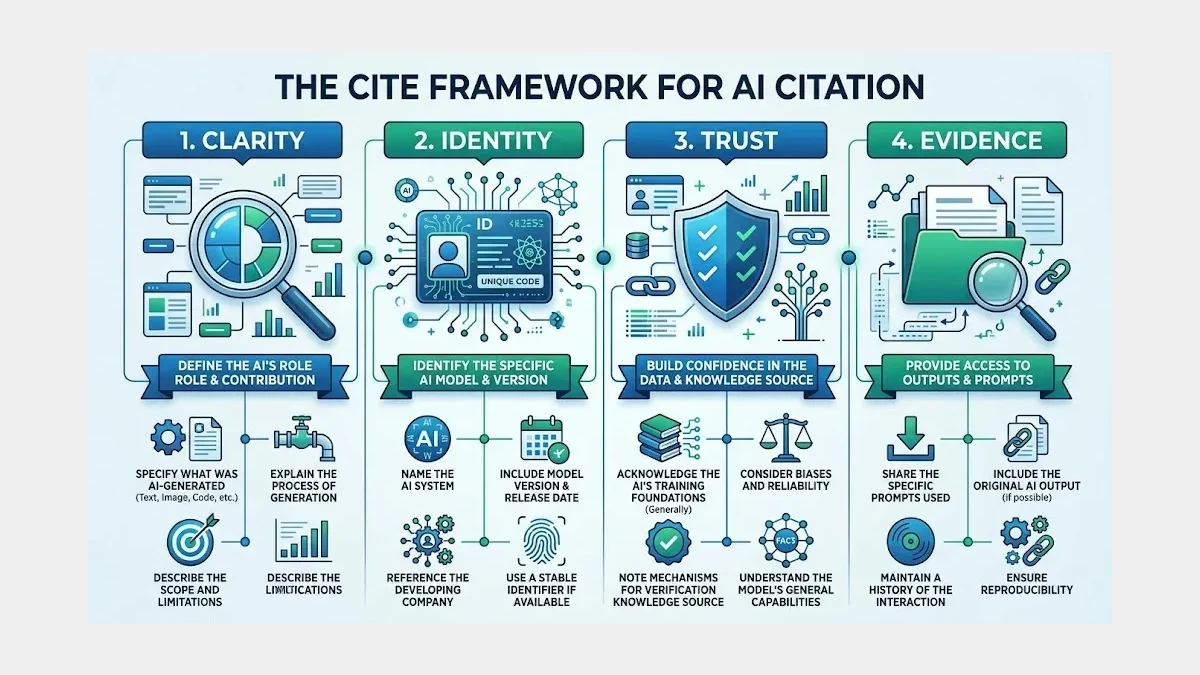
The CITE framework is a four-pillar content structuring method designed to maximize the probability that AI engines — Google AI Mode, AI Overviews, ChatGPT, and Perplexity — extract and cite your content as a source. CITE stands for Clarity (direct, standalone answers), Information Density (2 to 4 data points per 100 words), Trust Signals (E-E-A-T markers that establish credibility), and Entity Structure (schema markup and named entities that connect your content to the Knowledge Graph). Each pillar addresses a specific extraction criterion that AI engines use when selecting which passages to cite.
Google expanded its Preferred Sources program to all languages globally in April 2026, including Urdu and other South Asian languages. This expansion means Google now identifies trusted content sources across every language market — not just English. For Pakistani businesses producing content in Urdu, English, or Roman Urdu, the Preferred Sources program creates a direct incentive to meet Google’s trust and quality thresholds. Content that satisfies CITE’s four pillars aligns with what Google’s systems treat as preferred-source material.
The framework applies to any content type: blog posts, service pages, product descriptions, FAQ sections, and landing pages. What actually drives this is the extraction mechanism itself — AI engines do not read pages the way humans do. They parse for answer blocks, data points, credibility markers, and entity relationships. Content structured without these elements gets processed but not cited.
How does the Clarity pillar determine whether AI engines extract your content?
Book a free strategy call - we'll audit your current setup and identify the highest-impact fixes.
Clarity means every section of your content opens with a direct, self-contained answer to the question it addresses. The first paragraph after any heading must answer the heading’s question in 40 to 60 words — no preamble, no background context, no “let’s explore why.” AI engines process pages by scanning for the first coherent answer block after each heading. If your answer is buried in paragraph three, the AI engine has already moved on to another source.
A Pakistani ecommerce page about “wedding dress prices in Lahore” should open with: “Wedding dresses in Lahore range from PKR 25,000 for basic lawn suits at Liberty Market boutiques to PKR 500,000 or more for designer bridal lehengas from brands like Karma and Sana Safinaz, with the average Pakistani bride spending approximately PKR 150,000 on her wedding outfit in 2026.” That single sentence answers the question, names specific PKR amounts, cites real Lahore locations, and references known Pakistani brands.
Compare that to the typical opening: “Pakistan has a rich tradition of bridal fashion, with many options available for brides-to-be across various price ranges.” This sentence contains zero extractable data. No price. No location. No brand. No specific number. AI engines skip it entirely.
The clarity pillar requires every paragraph to be self-contained. Each paragraph must name its subject explicitly — no orphan pronouns like “this approach” or “these results” that require surrounding context to decode. When an AI engine extracts a paragraph for citation, it pulls that paragraph alone. If the paragraph references “the method discussed above,” the extracted citation becomes meaningless to the reader.
Action step: Rewrite the first paragraph of every H2 section on your top 10 pages. Each opening paragraph should directly answer the section’s question in under 60 words, containing at least one specific number and one named Pakistani entity.
Why does Information Density separate cited Pakistani sites from invisible ones?
Information Density measures how many specific, verifiable data points appear per unit of text. AI engines weight passages with high information density more heavily for extraction because dense passages answer questions more completely. The target: 2 to 4 data points per 100 words of body content. A data point is a specific number, a named source, a PKR amount, a platform name, a regulatory body, or a verifiable date.
Consider two paragraphs about JazzCash adoption. The first: “JazzCash is widely used in Pakistan for digital payments and has many active users across the country.” This paragraph contains one named entity (JazzCash) and zero data points. It is un-citeable.
The second: “JazzCash reports over 20 million active mobile wallet accounts in Pakistan as of 2026, processing transactions across 85,000 agent locations nationwide. The State Bank of Pakistan records mobile wallet transactions exceeding PKR 4 trillion quarterly, with JazzCash and Easypaisa together handling approximately 90 percent of all mobile financial services in the country.” This paragraph contains six data points: 20 million accounts, 85,000 agents, SBP as a named source, PKR 4 trillion quarterly, JazzCash and Easypaisa as named platforms, and 90 percent market share.
The difference is not word count. The difference is extractable content. AI engines can cite the second paragraph as a standalone fact block. The first paragraph says nothing specific enough to extract.
“AI traffic from search converts 31 to 42 percent better than standard organic traffic.” — Adobe/Visibility Labs, 2026
That statistic carries weight for Pakistani content creators. When your content gets cited in AI answers, the traffic that does arrive — from users who click the citation link — converts at a significantly higher rate than standard organic traffic. The signal is clear: investing in information density does not just increase citation probability. It increases the quality of whatever traffic does arrive.
Action step: Audit your top 5 content pages. Count data points per 100 words. If any section falls below 2 data points, add specific numbers, named sources, PKR amounts, or platform references until it reaches the target density.
What Trust Signals do Google AI Mode and AI Overviews require from Pakistani content?
Trust Signals are the E-E-A-T markers — Experience, Expertise, Authoritativeness, and Trustworthiness — that Google’s AI systems evaluate when selecting citation sources. For Pakistani content, these signals include author attribution with real names and credentials, source citations linking to authoritative references, organizational transparency with verifiable business details, and content freshness demonstrated by visible update dates.
Google’s expansion of Preferred Sources to all languages means the trust threshold now applies to Urdu content, English content from Pakistani domains, and bilingual pages. A Pakistani health website publishing in Urdu without author names, without medical credential verification, and without citations to medical journals will not qualify as a preferred source regardless of how well the content is written. The trust signals must be machine-readable.
The most impactful trust signals for Pakistani websites include author bylines with professional credentials (not pseudonyms), cited sources with inline links to primary materials, organizational pages with complete NAP data (name, address, phone), and content review dates displayed prominently. Google’s Search Quality Rater Guidelines explicitly describe these signals as the basis for trust evaluation.
Only 16 percent of Fortune 500 companies actively track their AI visibility, according to McKinsey data cited in a 2026 analysis. If major global corporations are behind on this, Pakistani SMEs are further behind. The opportunity is significant: Pakistani businesses that establish trust signals now — while most competitors have not — gain a durable advantage in AI citation selection.
| Trust Signal | What Pakistani Websites Need | Current Adoption |
|---|---|---|
| Author Bylines | Real names with credentials on every article | Under 10% of .pk blogs |
| Source Citations | Inline links to primary sources (SBP, PTA, vendor docs) | Under 15% |
| Schema Markup | Article, Organization, FAQPage schema | 18% overall |
| Content Freshness | Visible “last updated” dates | Under 20% |
Action step: Add author bylines with one-line credentials to every blog post. Include at least 3 inline links to authoritative sources per article. Display “Last updated” dates on all content pages. These three changes address the most common trust signal gaps on Pakistani websites.
How does Entity Structure connect Pakistani content to Google’s Knowledge Graph?
How we helped a Pakistani business achieve measurable results.
Entity Structure is the fourth pillar of CITE and the one most Pakistani websites neglect. An entity is any distinct, named thing — a person, organization, product, city, regulatory body, payment platform, or tool. Google’s Knowledge Graph maps relationships between entities. When your content connects multiple entities in a coherent context, it becomes part of that graph — and AI engines can locate, extract, and cite it more reliably.
Schema markup — the structured data vocabulary embedded in your page’s HTML — is the primary mechanism for communicating entity information to Google’s systems. Article schema tells Google that a page is an article, who wrote it, when it was published, and what organization produced it. FAQPage schema identifies question-and-answer pairs. Organization schema defines your business entity with name, address, contact details, and social profiles. Product schema provides exact product data including prices.
Among Pakistan’s approximately 150,000 active websites, only 15 to 20 percent implement any structured data. Ecommerce sites lead at roughly 30 percent adoption — largely because Shopify and Daraz include basic product schema by default. Non-ecommerce sites — service providers, blogs, news outlets, educational institutions — fall well below 15 percent.
The pattern repeats across every entity density analysis we have reviewed. Pakistani content that names specific entities — Daraz, JazzCash, Easypaisa, the State Bank of Pakistan, PTA, SECP, specific cities, specific PKR amounts, specific tools like GA4 and Meta Ads Manager — creates entity connections that map to the Knowledge Graph. Content that uses generic language (“various payment options,” “multiple cities,” “affordable prices”) provides nothing for the graph to connect.
For Pakistani businesses, the entity structure pillar has a practical implementation path. Start with three schema types: Article schema for all blog content, Organization schema for your business entity, and FAQPage schema for any page with Q&A content. These three cover the highest-impact entity signals for AI citation. Use Google’s Rich Results Test to validate markup before deploying.
Action step: Install Article schema with author, datePublished, publisher, and headline fields on your 10 highest-traffic blog posts. Add Organization schema to your homepage. Add FAQPage schema to any page with a frequently-asked-questions section.
How do Pakistani businesses implement all four CITE pillars together?
Implementing CITE is not a one-time project. It is a content production standard that applies to every new page and every update of existing pages. The framework works as a sequential checklist for each piece of content.
Start with Clarity: does the first paragraph after every heading directly answer the heading’s question in under 60 words? Then check Information Density: does every 100-word block contain at least 2 specific data points? Next, verify Trust Signals: does the page have an author byline, inline source citations, and a visible update date? Finally, confirm Entity Structure: does the page name at least 5 specific entities and carry appropriate schema markup?
A Pakistani marketing agency writing a blog post about “email marketing for Lahore retailers” would apply CITE as follows. Clarity: open with “Email marketing for Lahore retail businesses generates an average return of PKR 42 for every PKR 1 spent, with campaigns targeting post-purchase follow-ups and abandoned cart recovery performing 3 times better than promotional broadcasts.” Information Density: include specific open rates, PKR revenue figures, tool names like Klaviyo and Mailchimp, and JazzCash integration details. Trust Signals: cite the source for the ROI figure, include an author byline, add “Last updated: May 2026.” Entity Structure: name Lahore neighborhoods, specific retail categories, Pakistani email platforms, and add Article schema.
Read next: The GEO/AEO Playbook for Pakistani Service Businesses and Schema Markup and Structured Data for Pakistani Websites
Content that meets all four CITE pillars does not just rank better in traditional search. It becomes extractable, citable, and referenceable by every major AI engine — Google AI Mode, AI Overviews, ChatGPT, and Perplexity. In a market where 96 percent of search flows through Google and only 18 percent of websites carry structured data, implementing CITE is not a marginal improvement. It is the difference between being cited and being invisible.
If your Pakistani business produces content that does not get cited by AI engines, the structure of that content is likely the bottleneck — not its topic or its length. WeProms Digital, Pakistan’s leading content strategy agency, applies the CITE framework across client content to build AI citation pipelines that drive measurable increases in brand visibility and direct traffic. Contact hello@weproms.com or message WhatsApp +92 300 0133399 for a CITE framework audit of your existing content.
Frequently Asked Questions
What does CITE stand for in content optimization for AI search?
CITE stands for Clarity, Information Density, Trust Signals, and Entity Structure — four pillars that determine whether AI engines like Google AI Mode and ChatGPT extract and cite your content. Each pillar addresses a specific extraction criterion: direct answers, data richness, credibility markers, and machine-readable entity connections.
How is the CITE framework different from regular SEO?
Regular SEO focuses on keyword optimization, backlinks, and technical performance to rank in search results. CITE focuses on content structure and formatting to get cited inside AI-generated answers. The two approaches complement each other — CITE-aligned content typically performs well in traditional SEO too, because Google’s algorithms reward the same clarity and authority signals that AI engines prioritize.
Can Pakistani websites in Urdu benefit from the CITE framework?
Yes. Google expanded its Preferred Sources program to all languages globally in April 2026, including Urdu. The CITE framework applies equally to Urdu content: direct answers, specific data points, credible source citations, and structured entity markup work in any language. Urdu content that meets CITE criteria can be selected as a preferred source by Google’s AI systems.
What structured data should Pakistani websites implement first?
Start with three schema types: Article schema for blog posts (including author, date, and publisher), Organization schema for your business entity (name, address, contact), and FAQPage schema for Q&A content. These three cover the highest-impact entity signals for AI citation. Use Google’s Rich Results Test to validate before deployment.
How long does it take for CITE-optimized content to get cited by AI engines?
There is no guaranteed timeline. AI engines re-index and re-process content continuously. New content typically takes 2 to 8 weeks to appear in AI citation patterns, depending on crawl frequency, domain authority, and topical competition. Existing content that is restructured to meet CITE criteria may see AI citation improvements within the same timeframe as a standard Google index update.
Does implementing the CITE framework guarantee AI citations?
No framework guarantees citation. CITE increases the probability of citation by aligning your content’s structure with the extraction criteria AI engines use. Content that meets all four pillars has a significantly higher chance of being cited than content that ignores them. The 4.8 times higher AI selection probability associated with entity-dense, well-structured content is a strong indicator, not a guarantee.
How much does CITE framework implementation cost for Pakistani businesses?
Costs depend on content volume and current quality. For a Pakistani SME with 20 to 50 existing content pages, a CITE framework audit and restructuring typically ranges from PKR 200,000 to PKR 600,000. WeProms Digital offers CITE audits starting at PKR 100,000 that assess current content against all four pillars and provide a prioritized implementation plan.
Should I rewrite all my existing content or apply CITE only to new content?
Start with your highest-traffic existing pages. Rewrite the opening paragraphs of your top 10 pages to meet the Clarity pillar, add data points for Information Density, and ensure author bylines and source citations for Trust Signals. Apply CITE to all new content going forward. Full restructuring of an existing content library can be phased over months — prioritize by traffic and revenue impact.
Key Takeaways
- The CITE framework (Clarity, Information Density, Trust Signals, Entity Structure) provides a repeatable method for structuring content to get cited by Google AI Mode, AI Overviews, and ChatGPT.
- Websites cited in AI answers receive 35% more organic clicks and 91% more paid clicks — citation is a measurable traffic and revenue driver.
- Only 18% of Pakistan’s 150,000 active websites use structured data, meaning 82% lack the entity structure AI engines need for citation extraction.
- Google expanded Preferred Sources to all languages including Urdu in April 2026, creating a new opportunity for Pakistani content to be recognized as authoritative.
- Content with 15+ connected named entities shows 4.8x higher AI selection probability — entity density is the strongest single predictor of citation.
- AI-sourced traffic converts 31 to 42% better than standard organic traffic, making CITE optimization a revenue strategy, not just an SEO tactic.
About WeProms Digital
WeProms Digital is Pakistan’s leading content strategy and generative engine optimization agency, headquartered in Lahore, serving Pakistani SMEs, ecommerce brands, and B2B teams across Lahore, Karachi, Islamabad, Rawalpindi, Faisalabad, and Multan.
The team specializes in content strategy, generative engine optimization, and SEO services, with a track record of building content systems that get Pakistani websites cited inside Google AI Mode, AI Overviews, ChatGPT, and Perplexity answers — not just ranked in traditional blue-link results.
Get in touch: hello@weproms.com · WhatsApp +92 300 0133399 · weproms.com/contact-us
Sources & References
- Search Engine Roundtable — Google Preferred Sources Now Available For All Languages Globally — May 2026
- Search Engine Journal — Google AI Mode In Chrome Isn’t Killing SEO; It’s Exposing Weak SEO — May 2026
- Digital Applied — AI Search SEO Statistics 2026: Definitive Collection — 2026
- QuickSEO — ChatGPT vs Google Search 2026 Market Share and User Data — 2026
- NOBS Marketplace — Google Search Just Grew 19% With AI Overviews — 2026
- Search Engine Roundtable — April & May 2026 Google Webmaster Report — May 2026
- Neil Patel Blog — How to Adapt to AI Overviews Stealing Clicks — 2026
- Search Engine Journal — AI Overviews Clicks Get Tested, Earnings Tell Two Stories — May 2026
Additional reading from industry feeds: