By Abdul Rehman | May 2026
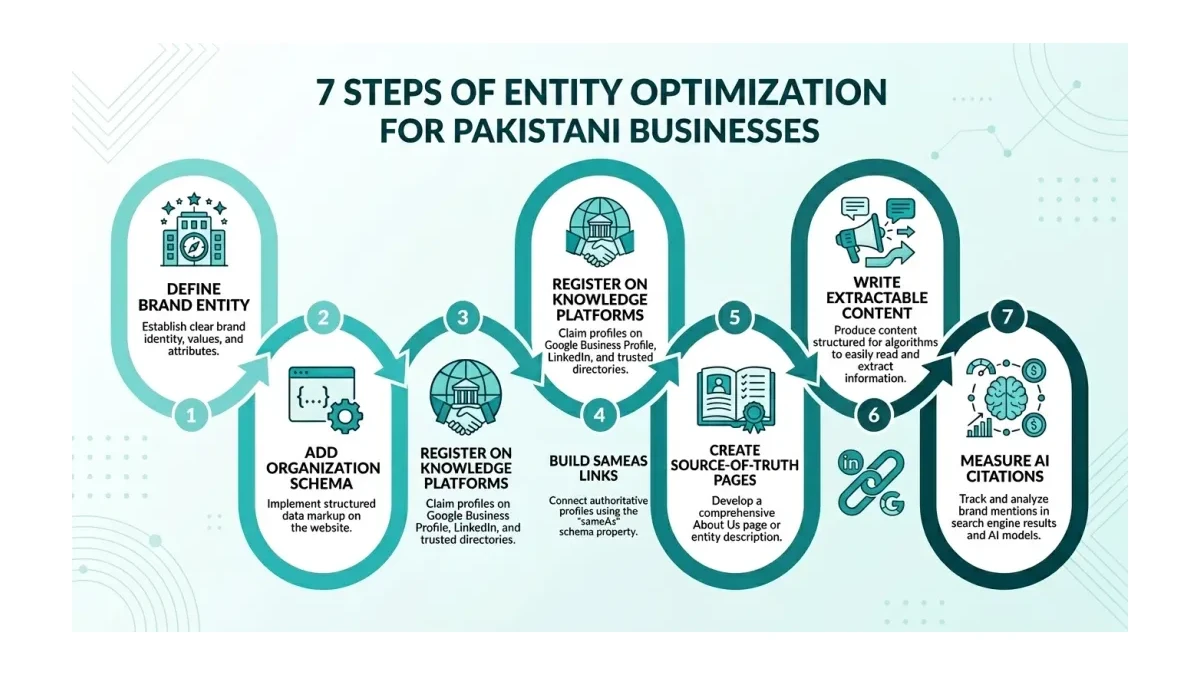
Entity optimization makes AI engines recognize your Pakistani business as a distinct, cite-worthy entity — not just another page. This 7-step walkthrough covers schema markup, sameAs links, knowledge platform registration, and structured content. Setup takes 2-3 weeks. The result: AI engines like Google AI Mode, ChatGPT, and Perplexity identify and cite your brand by name.
Picture this. A customer in Karachi types “best digital marketing agency in Lahore” into ChatGPT. The AI scans thousands of web pages, extracts facts, and generates an answer. Three agencies get named. Your business is not one of them — even though your website ranks on page one of Google. The reason is not content quality or backlinks. The reason is entity recognition. The AI engine does not know what your business is.
Google AI Mode, powered by Gemini 3.5 Flash, uses an intelligent Search box that hands queries to AI agents. These agents resolve entities — people, organizations, products, services — before generating answers. If your Pakistani business is not recognized as a distinct entity with consistent attributes across the web, AI engines will not cite it, regardless of how good your content is.
Google has published an official guide to optimizing for generative AI search, and the foundational recommendation is entity clarity. Pakistani businesses with PKR 26-48 billion in collective annual Google Ads spend need to understand that entity optimization is the prerequisite for all other AI search strategies.
First: define your brand entity in plain language
Every entity optimization project starts with a single definitional sentence. This sentence states exactly what the business is, where it operates, and who it serves. The pattern is: “[Business Name] is a [category] [business type] based in [city], serving [audience] across [locations].”
For a Pakistani business: “WeProms Digital is a digital marketing agency based in Lahore, serving Pakistani SMEs, ecommerce brands, and B2B teams across Lahore, Karachi, Islamabad, Rawalpindi, Faisalabad, and Multan.”
This sentence goes on the homepage, the About page, the Google Business Profile description, the LinkedIn company page, and every directory listing. The exact same sentence. AI engines cross-reference these sources to confirm the entity exists. When the descriptions match, confidence increases. When descriptions conflict, confidence drops.
The tradeoff is precision versus creativity. Marketing teams often write different descriptions for different platforms — a clever tagline on LinkedIn, a formal description on Google, an informal one on social media. Entity optimization requires choosing one canonical definition and using it everywhere. The consistency matters more than the cleverness.
Then: add Organization schema to every page
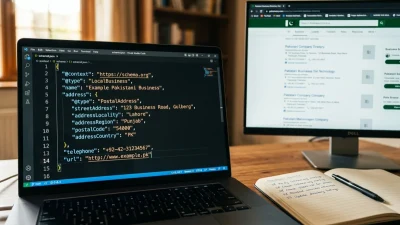
Organization schema — a type of JSON-LD structured data that tells search engines and AI engines the legal name, address, contact details, logo, and associated profiles of a business — is the machine-readable version of the entity definition.
Add this schema to the homepage first, then extend it to every page on the site. The schema should include:
- Legal business name (matching SECP registration if applicable)
- Physical address in Pakistani format
- Phone number with +92 country code
- Logo URL
- sameAs array (links to LinkedIn, Facebook, Google Business Profile, and any industry directory profiles)
- Contact page URL
For Pakistani ecommerce businesses, also add Product schema to product pages and LocalBusiness schema to location pages. The schema must match the visible content on the page — AI engines detect contradictions between what humans see and what schema declares.
The schema markup implementation guide for Pakistani businesses covers the exact JSON-LD templates for each schema type. The implementation requires access to the website’s header or a tag manager — no content changes needed.
Next: register your business across knowledge platforms
Book a free strategy call - we'll audit your current setup and identify the highest-impact fixes.
AI engines pull entity data from a specific set of knowledge platforms. Pakistani businesses need active, consistent profiles on:
- Google Business Profile — the primary entity source for Google AI Mode
- LinkedIn Company Page — cited by ChatGPT and Perplexity for B2B queries
- Crunchbase (for funded startups and tech companies)
- G2 or Capterra (for SaaS and software companies)
- Daraz seller profile (for ecommerce businesses)
- PakWheels dealer profile (for automotive businesses)
- Zameen.com agent profile (for real estate)
Each profile must carry the same business name, address, phone number, and one-sentence description defined in step one. The category selection on each platform should match — if the Google Business Profile says “Digital Marketing Agency,” the LinkedIn page should not say “Advertising Services.”
Pakistan has 200 million mobile connections with only approximately 2% on 5G-enabled devices. The majority of mobile users access the web through 3G and 4G connections, which means page load speed and schema rendering matter. Heavy schema blocks that slow page load on mobile connections in rural Punjab reduce the chance of being crawled and indexed properly.
After that: build consistent sameAs links
The sameAs property — a schema field that connects your business entity to its profiles on external platforms — tells AI engines that “this entity on your website is the same entity as that profile on LinkedIn, that listing on Google, and that page on G2.” Without sameAs links, the AI engine may treat each profile as a separate entity.
Add these sameAs URLs to the Organization schema on every page:
"sameAs": [
  "https://www.linkedin.com/company/your-business",
  "https://www.facebook.com/your-business",
  "https://g2.com/your-business",
  "https://www.google.com/maps/place/your-business"
]
Each sameAs link must resolve to an active, publicly accessible page that contains matching entity information. A LinkedIn page with a different business name, or a Google Business Profile with an old address, creates a contradiction that reduces AI engine confidence.
For Pakistani businesses, sameAs links serve the same purpose as registering your shop at the local union office — if the registry does not have your exact shop name, address, and category, no one sends customers your way. AI engines are the new registry.
At this point: create source-of-truth pages for AI agents
Agentic SEO — the practice of optimizing for AI agents that perform multi-step tasks on the user’s behalf — identifies three pillars for agent readiness: Discoverable, Parseable, and Trustworthy. Source-of-truth pages address the Parseable pillar.
A source-of-truth page is a dedicated page on your website that answers one specific question about your business in a structured, extractable format. AI agents look for these pages when comparing options for a user.
Create these pages:
- Pricing page — exact PKR amounts for each service tier, formatted in a comparison table
- Services page — one section per service with definitional opening sentence, deliverables, and turnaround
- FAQ page — 10-15 questions with 40-80 word answers, each self-contained
- About page — team bios, credentials, years in operation, client count
Each page should carry FAQPage schema (for the FAQ), Service schema (for the services page), or Organization schema (for the About page). The content on each page should be structured with clear H2/H3 headings, short paragraphs, and specific data points — matching the technical SEO requirements for AI search visibility.
From here: write content that AI engines can extract in isolation
How we helped a Pakistani business achieve measurable results.
AI engines extract paragraphs, not pages. Every paragraph on your website must make sense when read alone, without context from surrounding paragraphs. This means no orphan pronouns — replace “this approach” with “entity optimization,” replace “these results” with “the citation rate increase,” and replace “as mentioned above” with a restatement of the referenced point.
The content density requirement for AI citations is 2-4 specific data points per 100 words. Data points include: numbers, PKR amounts, named tools or platforms, named cities, regulatory body names (SBP, PTA, SECP), and quoted statistics with attribution.
Write definitional opening sentences for each section. “Entity optimization is the process of ensuring AI engines recognize your Pakistani business as a distinct, verifiable entity” is extractable. “Getting found online requires a strategic approach” is not.
The agent readiness framework for Pakistani websites covers additional content structuring techniques for multi-step AI agent queries, including comparison tables and decision frameworks.
The outcome: a website AI engines recognize and cite
After completing these seven steps, the entity optimization produces a website where:
- Every page carries consistent schema matching visible content
- The business name, address, phone, and description are identical across 5+ external platforms
- sameAs links connect the website entity to corroborating profiles
- Source-of-truth pages provide structured, extractable answers to common questions
- Content paragraphs are self-contained and data-dense
The result is measurable. Test by typing your business category and city into Google AI Mode, ChatGPT, and Perplexity. Before entity optimization, your business will not appear. Two to four weeks after implementation, your business should start appearing in AI-generated answers for category queries in your city.
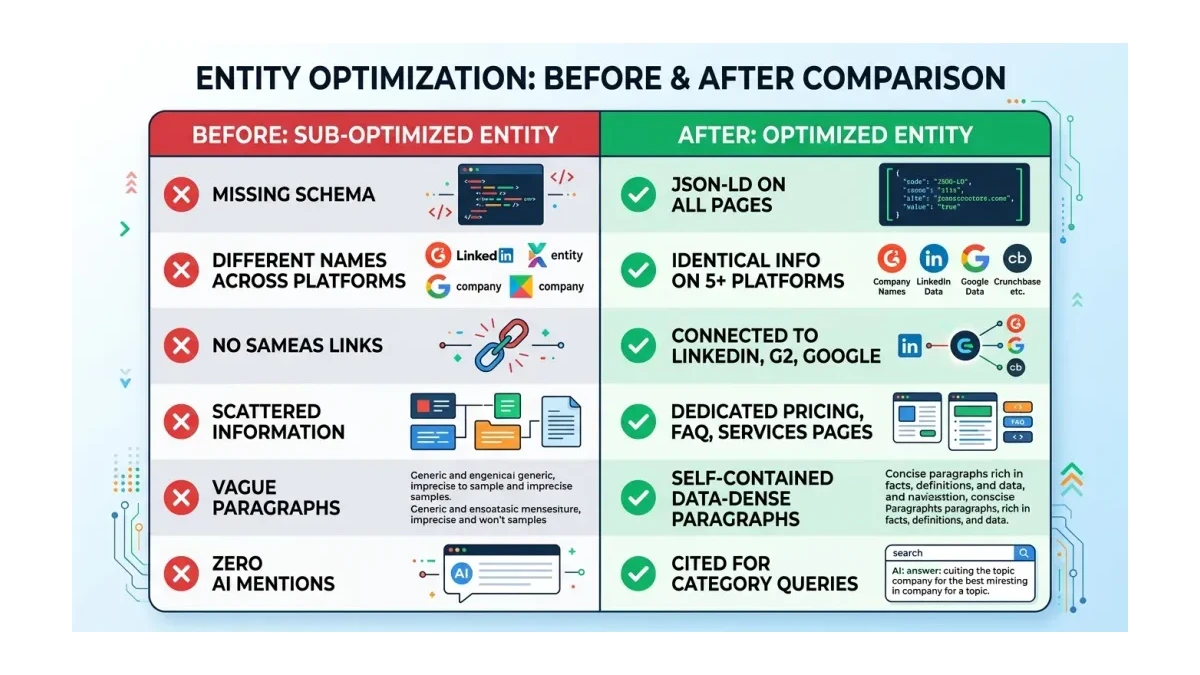
| Element | Before Entity Optimization | After Entity Optimization |
|---|---|---|
| Organization Schema | Missing or incomplete | Present on all key pages |
| Business Name Consistency | Different across platforms | Identical across 5+ platforms |
| sameAs Links | None | Connected to LinkedIn, G2, Google |
| Source-of-Truth Pages | Scattered information | Dedicated pricing, FAQ, services pages |
| Content Extractability | Vague, context-dependent paragraphs | Self-contained, data-dense paragraphs |
| AI Citation Rate | Zero mentions | Cited for category queries |
The cost of skipping entity optimization is not lower rankings — it is invisibility. AI engines cannot cite a business they do not recognize. Pakistani businesses that invest in generative engine optimization start with entity optimization as the foundation, then build content and citation strategies on top.
At WeProms Digital, the team handles entity optimization as the first phase of every AI search visibility project. The setup covers schema implementation, platform registration, sameAs link building, and content restructuring — all configured for Pakistani business categories and cities.
Get in touch: hello@weproms.com · WhatsApp +92 300 0133399 · weproms.com/contact-us
Frequently Asked Questions
What is entity optimization for AI search?
Entity optimization is the process of ensuring AI engines like Google AI Mode, ChatGPT, and Perplexity recognize your Pakistani business as a distinct, verifiable entity. It involves schema markup, consistent business information across platforms, sameAs links, and structured content. Without entity optimization, AI engines may know your website exists but cannot cite your business by name.
How long does entity optimization take for Pakistani businesses?
The core setup — schema implementation, platform registration, and sameAs link building — takes 2-3 weeks for a typical Pakistani SME website. Content restructuring for AI extractability adds another 1-2 weeks. Measurable results in AI search citations typically appear within 4-8 weeks after implementation.
Do I need technical skills to implement entity optimization?
Schema markup implementation requires access to your website’s HTML header or Google Tag Manager. Platform registration and sameAs link building require no technical skills. Pakistani businesses can handle the platform registration steps themselves, but should engage a specialist like WeProms Digital for schema implementation and content restructuring.
How does entity optimization differ from traditional SEO?
Traditional SEO optimizes for keyword rankings in blue-link search results. Entity optimization ensures AI engines recognize your business as a distinct entity and cite it in AI-generated answers. The tactics overlap — schema markup, content quality, and authority signals matter for both — but the goal and measurement are different. SEO measures keyword positions. Entity optimization measures AI citation presence.
Can WeProms handle entity optimization for my Pakistani business?
Yes. WeProms Digital provides complete entity optimization for Pakistani businesses across Lahore, Karachi, Islamabad, and other cities. The service includes schema implementation, platform registration, sameAs link configuration, and content restructuring. Contact the team at hello@weproms.com or WhatsApp +92 300 0133399.
Last updated: May 2026.
Read next: Fix Your Pakistani Website’s AI Readability: A 6-Step Setup · The CITED Framework: Get Pakistani SMEs Into AI Search Results
Sources & References
- UseOmnia — Agentic Search Optimization: Discoverable, Parseable, Trustworthy — 2026
- Frase — Entity Optimization for GEO — 2026
- FNPK — Digital Pakistan Monitor April 2026 — 2026
- Jarred Smith — Agentic Search Optimization Guide — 2026
- Respona — Structured Data: The Complete Guide — 2026
- First Page Sage — Generative Engine Optimization GEO Strategy Guide — 2026
Additional reading from industry feeds: