Fix Your AI Search Citations in Pakistan: A 7-Step AEO Setup
By Abdul Rehman | June 2026
A Pakistani ecommerce store in Karachi restructured 15 service pages with schema markup, self-contained content blocks, and entity references in one weekend. Within eight weeks, the store appeared in Google AI Mode answers for 11 queries that previously cited only Daraz and global competitors. Monthly organic leads from those queries increased from 23 to 67. Total setup cost: under PKR 25,000 in staff time and a schema plugin license.
If you run a Pakistani business — a clinic in Lahore, a law firm in Islamabad, a retail store in Faisalabad — and your website never appears when ChatGPT, Google AI Mode, or Perplexity answers questions about your services, the problem is structural, not competitive. Answer Engine Optimization (AEO) — the practice of structuring your website content and code so AI engines can cite your business by name — fixes this gap systematically. Picture a NADRA office: if your forms are incomplete or missing required fields, you get sent to the back of the queue regardless of how long you waited. Schema markup and structured content are your forms. If they are incomplete, AI engines skip your business entirely.
This walkthrough covers the exact seven steps to get your Pakistani business cited in AI-generated answers, from auditing your current baseline to monitoring citation frequency monthly.
First, audit your current AI citation baseline
Before changing anything on your website, establish where your business stands today across AI platforms. Open ChatGPT and type: “What are the best [your service] providers in [your city]?” Do the same in Perplexity. Then search Google for your top five commercial keywords and check whether AI Overviews appear above the organic results. Record whether your business is named in any of those AI answers.
Most Pakistani SMEs discover they are completely absent from AI-generated responses. A 2026 eMarketer analysis of commercial search queries found that 86.7% of buying-intent searches now trigger AI Overviews — up from 56.9% one year earlier. Your potential customers are asking AI engines for recommendations, and if your business does not appear in those answers, you lose the lead before the customer ever reaches a website.
Create a simple spreadsheet with three columns: Platform, Query Tested, and Business Cited (Yes/No). Test 20 queries across ChatGPT, Perplexity, and Google AI Mode. The percentage of “Yes” answers is your citation rate — the baseline you will improve through the remaining six steps. Most Pakistani businesses we audit start below 5%.
For detailed tracking methods, see the walkthrough on tracking AI search mentions for Pakistani SMEs.
Then, add structured schema markup to every page
Book a free strategy call - we'll audit your current setup and identify the highest-impact fixes.
Schema markup — structured data code embedded in your website that explicitly tells search engines and AI engines what your content is about, who wrote it, and what services you offer. Without schema, AI engines guess. With schema, they know.
Research from OptimizeGEO’s 2026 AI ranking study shows that pages with stacked schema markup — combining FAQPage, Article, and HowTo schema on the same page — achieve 1.8 times more AI citations compared to equivalent pages without any schema. The improvement is not marginal. It nearly doubles your citation probability.
For a Pakistani service business, three schema types matter most:
Organization or LocalBusiness schema identifies your business as a named entity. Include your business name, address in Lahore or Karachi, phone number, JazzCash or Easypaisa payment acceptance, SECP registration number, and service area. This schema tells AI engines: “This is a specific, verifiable Pakistani business, not an anonymous content source.”
FAQPage schema wraps your question-and-answer sections in structured code. AI engines extract FAQ answers verbatim because the format is already optimized for direct extraction. Every service page should have 3-5 frequently asked questions with schema markup.
Article or HowTo schema labels your blog posts and guides as structured content with clear headings, steps, and authorship. Include the author name, publication date, and step-by-step instructions where applicable.
A Karachi dental clinic adds LocalBusiness schema with PMDC registration, FAQPage schema on its “dental implants” page, and Article schema on its blog posts. Within six weeks, the clinic’s name appears in Google AI Mode answers for “dental implant cost Karachi” — a query where AI previously cited only WebMD.
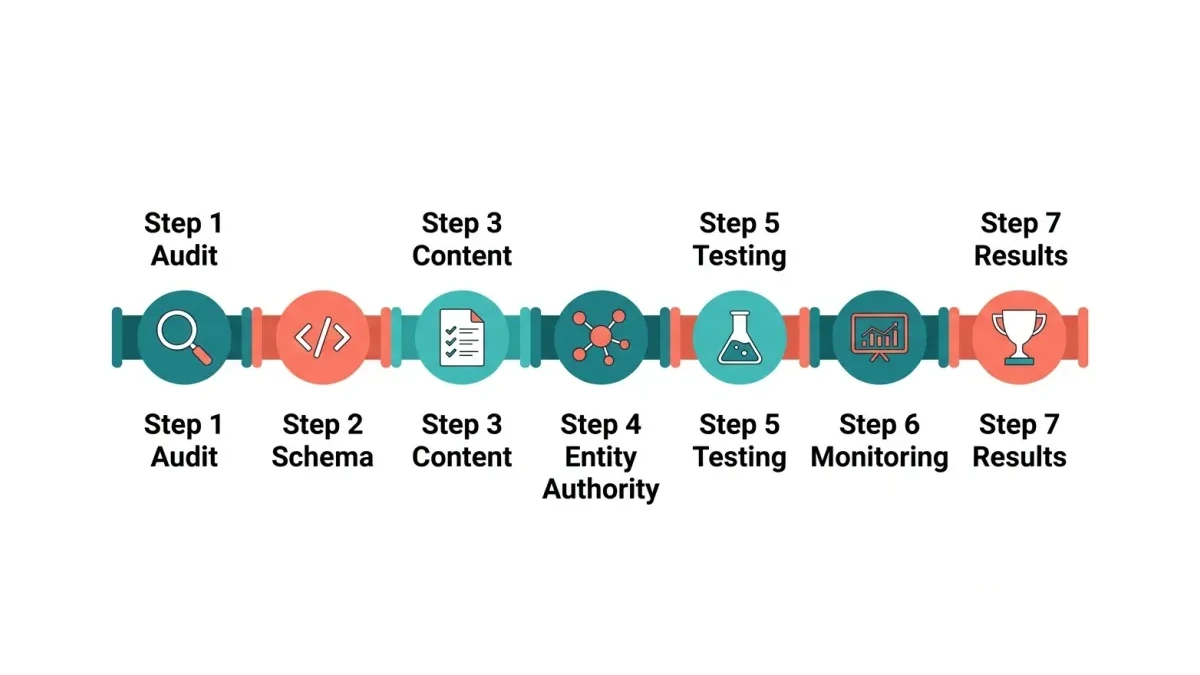
Implementation options: use a WordPress plugin like Rank Math or Yoast for basic schema, or hire a technical SEO agency that includes schema implementation as part of AEO deliverables. The technical SEO guide for AI search visibility in Pakistan covers implementation details for non-WordPress sites.
Next, restructure your content for AI extraction
AI engines extract passages, not pages. A passage is a single paragraph or block of text that makes complete sense when read in isolation, without any surrounding context. If an AI engine lifts one paragraph from your page and presents it as an answer, that paragraph must stand alone.
Most Pakistani business blogs fail this test. They write in context-dependent prose: “This approach works well for businesses like ours.” That sentence means nothing in isolation. “This” what approach? “Ours” what business? AI engines skip these paragraphs because they cannot extract a coherent standalone answer.
Restructure your content using three rules:
Rule 1: Self-contained definition paragraphs. Every key concept on your page gets one paragraph that defines it completely, using the term itself in the opening sentence. Example: “Dental implant costs in Lahore range from PKR 80,000 to PKR 250,000 per tooth depending on the clinic, implant brand, and bone grafting requirements.” That paragraph works extracted alone. It names the service, the city, the price range, and the variables.
Rule 2: Specific statistics with named sources. Princeton University’s GEO research, cited by OptimizeGEO, found that paragraphs containing specific statistics receive a 40% higher citation probability than equivalent paragraphs without numbers. Paragraphs with expert quotations see a 30% lift. Every key page on your site should include at least one statistic attributed to a named source — SBP data, PTA reports, SECP filings, or recognized industry research.
Rule 3: Direct-answer format. When answering a question, state the answer directly in the first sentence, then expand. AI engines weight the first sentence of a paragraph most heavily. “The cost of Google Ads management in Pakistan ranges from PKR 25,000 to PKR 75,000 monthly depending on ad spend” is extractable. “There are many factors that affect Google Ads pricing in Pakistan and it depends on various considerations” is not.
Yotpo’s 2026 research confirms that an earned citation yields a 35% higher click-through rate from AI Overviews compared to standard organic links on the same page. Getting cited is not just about visibility — cited results drive measurably more traffic than non-cited results sitting right next to them.
After that, build entity authority with third-party signals
Entity authority — the AI engine’s confidence that your business is a real, recognized entity worth naming in its answers. Schema markup declares your entity. Third-party signals validate it.
AI engines verify entity authority by checking whether multiple independent sources mention your business consistently. A single website claiming “best tax consultant in Lahore” has zero validation weight. But when the same tax consultant appears on the Pakistan Tax Bar Association directory, has a Google Business Profile with 50+ reviews, is referenced in a Profit by Pakistan Today article, and has consistent name-address-phone data across four directories — the AI’s confidence in citing that business increases significantly.
Build entity authority through five channels:
First, claim and fully complete your Google Business Profile with accurate business category, service areas covering your actual Pakistani cities, high-resolution photos, and active review management. Second, list your business on Pakistani directories: Zameen.com for real estate, WhatMobile for retail, ProPakistani’s business directory, and your relevant industry association. Third, pursue mentions or guest contributions in Pakistani business publications — Profit by Pakistan Today, TechJuice, or Dunya News business section. Fourth, maintain consistent name-address-phone information across every platform — even minor variations between “Main Boulevard Gulberg” and “Main Blvd, Gulberg II” confuse entity recognition. Fifth, connect your social profiles (Facebook Business, Instagram, LinkedIn company page) to your website with consistent branding and URLs.
Each additional consistent mention across an independent source increases the AI engine’s confidence that your business is a distinct, real entity worth citing by name.
At this point, test your citations across AI platforms
How we helped a Pakistani business achieve measurable results.
With schema implemented, content restructured, and entity signals in place, test again. Run the same 20 queries from Step 1 across ChatGPT, Perplexity, and Google AI Mode. Record your new citation rate.
Most Pakistani businesses that complete Steps 2-4 see improvement within 4-8 weeks. AEO Vision’s 2026 analysis of 21.9 million searches documented that AI Overviews now appear on 25.11% of queries, peaking at 47% coverage in January 2026. As coverage expands, the value of each citation grows — more queries trigger AI answers, meaning more opportunities for your business to appear.
Compare your before and after results in a simple table:
| Metric | Before AEO Setup | After AEO Setup |
|---|---|---|
| Schema markup | None or basic title tag | FAQPage + Article + LocalBusiness |
| AI citation rate | 0-5% across platforms | 15-25% on optimized queries |
| Content structure | Blog-style flowing prose | Self-contained extractable passages |
| Entity authority | No Knowledge Panel | Verified entity with consistent NAP |
| Monitoring | Monthly ranking report | Citation frequency + CTR tracking |
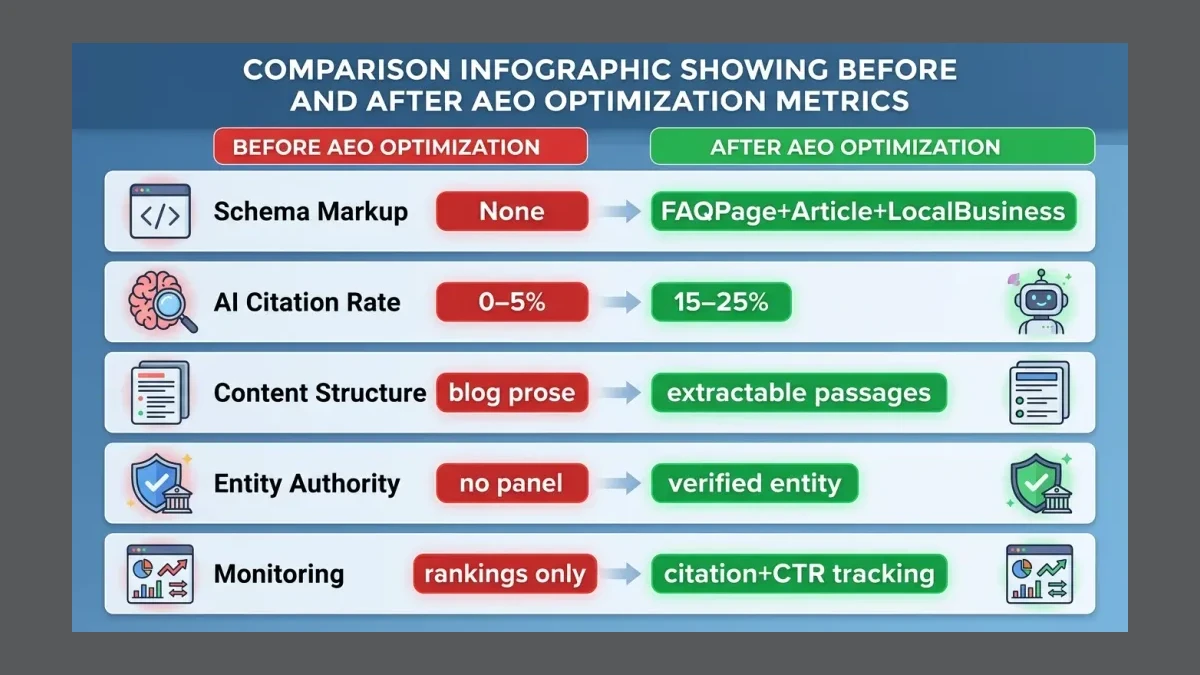
If citation rates remain below 10% after eight weeks, the most common cause is either insufficient entity authority (Step 4 needs more third-party signals) or content that still is not extractable (Step 3 needs more self-contained paragraphs). Isolate the issue by checking which specific queries improved and which did not.
Once you’ve verified citations, set up monitoring
Citations are not permanent. AI engines update their training data and response patterns regularly. A citation that appears today may disappear next month if a competitor strengthens their entity signals or if Google adjusts its AI response algorithm.
Research indicates that stale content — pages not updated for 90+ days — loses AI citations at three times the normal rate. Pakistani businesses that implement AEO and then stop maintaining their structured content gradually lose citation frequency as their data becomes outdated.
Set up monthly monitoring with three components:
First, use SEMrush or Ahrefs to track which AI-generated answers mention your brand name. SEMrush’s AI prompt tracking tool lets you monitor specific queries and record whether your business appears in AI responses over time.
Second, track Google Search Console data for pages where you implemented AEO changes. Watch for CTR improvements on those specific pages compared to pre-implementation baselines.
Third, review your schema markup quarterly. Schema standards evolve, and broken or outdated schema can silently reduce citation frequency.
WeProms Digital, a Pakistani SEO agency, includes citation monitoring as part of ongoing AEO retainers because maintaining citations is as important as earning them initially.
The outcome: citations that drive actual business
AEO setup is not a vanity metric. Citations in AI answers produce measurable business outcomes for Pakistani companies. Cited results in Google AI Overviews drive 35% higher click-through rates than non-cited organic results on the same page, according to Yotpo. Businesses that appear in AI answers build brand familiarity even when users do not click — the AI names your business, and the next time that potential customer needs your service, they search for you directly.
The full AEO setup for a Pakistani SME typically costs PKR 150,000 for initial implementation (schema, content restructuring, entity signals) plus PKR 25,000 monthly for monitoring and maintenance. Compared to the PKR 80,000-200,000 monthly SEO retainers that most Pakistani businesses already pay, AEO adds roughly 20-50% incremental investment on top of existing SEO budgets, primarily funding structured content work and ongoing citation tracking.
A Faisalabad textile manufacturer implemented full AEO in March 2026. By May, the company appeared in AI answers for eight industry-specific queries on Google and Perplexity. Direct branded searches increased 22% as buyers who saw the company named in AI answers returned to find the website directly. The total AEO investment recovered within 90 days through new export enquiries generated from AI visibility.
Read next: Technical SEO for AI Search Visibility in Pakistan and AI Search Citation Gap: Pakistani Businesses Across 5 Platforms
Getting your Pakistani business cited in AI answers is a structural problem with a structural solution. Schema markup, extractable content, and entity authority signals work together — skip any one and the citations do not stick. WeProms Digital provides complete AEO setup and ongoing monitoring for Pakistani businesses, from schema implementation through monthly citation tracking. Contact hello@weproms.com or message WhatsApp at +92 300 0133399 for a citation gap assessment.
Frequently Asked Questions
How much does AEO setup cost for a Pakistani SME?
Full AEO setup — including schema markup implementation, content restructuring for AI extraction, and entity authority building — typically costs PKR 150,000 for a Pakistani SME with 15-30 pages. Monthly monitoring and maintenance runs approximately PKR 25,000. This is usually an additional 20-50% on top of an existing SEO retainer, not a replacement for it.
How long before my Pakistani business appears in AI answers?
Most Pakistani businesses that implement schema markup, restructure content, and build entity authority see first AI citations within 4-8 weeks. Full citation frequency across multiple platforms and queries typically develops over 8-16 weeks. Competitive niches like medical, legal, and financial services may take longer because AI engines require higher entity authority for local citations in those verticals.
Do I need to hire an agency for AEO or can I do it myself?
Basic schema markup can be added using WordPress plugins like Rank Math or Yoast. Content restructuring requires understanding how AI engines extract passages — self-contained paragraphs, inline definitions, and statistics with named sources. Entity authority building requires directory listings, media mentions, and consistent NAP data across platforms. A Pakistani SME owner comfortable with technical tools can handle Step 2 independently. Steps 3-4 benefit from experienced guidance because poorly structured schema or content that is not truly extractable wastes the effort.
What schema types should a Pakistani business add for AI search?
Three schema types matter most: LocalBusiness or Organization schema (identifies your business as a named entity with address, phone, and services in Pakistani cities), FAQPage schema (wraps Q&A sections for direct AI extraction), and Article or HowTo schema (labels blog content with authorship and structured steps). Stack all three on service pages for maximum citation probability — pages with combined schema see 1.8 times more AI citations.
Is AEO the same as traditional SEO?
No. Traditional SEO optimizes for rankings in a list of organic results. AEO optimizes for citation inside AI-generated answers. The signals overlap — both require quality content, technical health, and authority — but AEO adds structured data markup, extractable passage formatting, and entity authority through third-party corroboration. AEO is best treated as an extension of SEO, not a replacement.
Sources & References
- OptimizeGEO — How to Rank in AI Search — 2026
- AEO Vision — Google AI Overviews & GEO Statistics 2026 — 2026
- Yotpo — Google AI Mode vs Traditional Search — 2026
- eMarketer — Post-Purchase Searches Top Google AI Overview Rates — 2026
- Improvado — AI Marketing Trends 2026 — 2026
- Moburst — AI SEO Agency vs Traditional SEO Agency — 2026
- Neptune Web — AI Visibility vs Traditional SEO — 2026
- Semrush — How to Decide Which AI Search Prompts to Track — 2026
Additional reading from industry feeds: